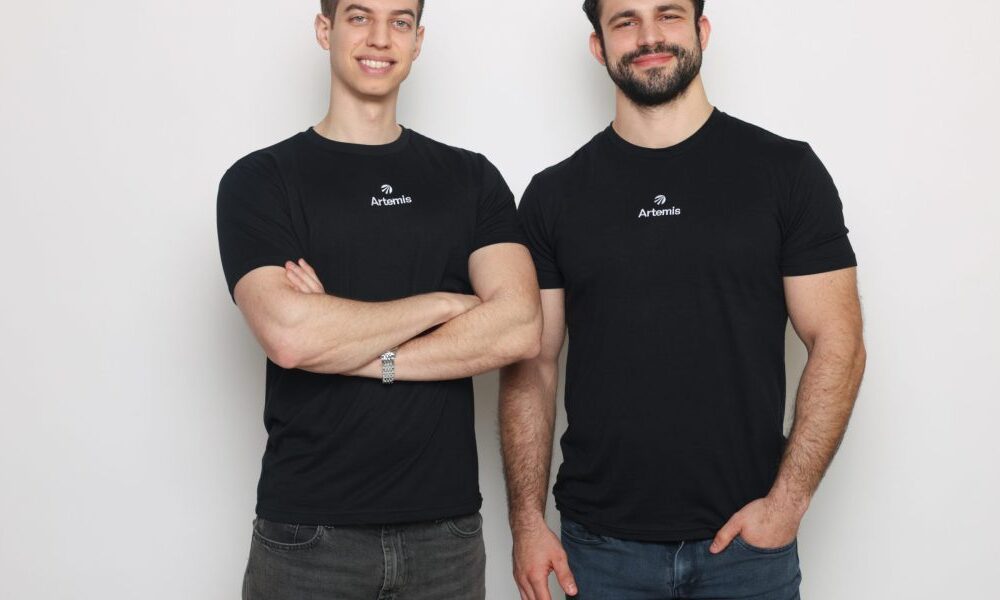
Artemis, a new cybersecurity startup trying to help defenders fight AI-powered attacks with AI, emerged from stealth today, securing $70 million in venture capital funding.
Felicis led the Series A with returning investors First Round Capital and Brightmind. The round was also joined by Theory VC and prominent cybersecurity industry leaders, including founders of Demisto and Abnormal AI, the former CEO and CTO of Splunk, and senior executives from CrowdStrike, Palo Alto Networks, Microsoft, and Okta.
The company did not disclose the valuation it achieved in the new funding round, but a spokesperson said: “They have closed a few seven-figure deals and are expecting multimillion dollars in ARR [annual recurring revenue] before the end of 2026.” Clients already include Mercury, Wix, Lemonade, and Abnormal AI.
Hackers are now using AI to carry out attacks at machine speed—sometimes in minutes—while traditional security tools struggle to keep up, said CEO Shachar Hirshberg, a former AWS product leader who founded the company six months ago with CTO Dan Shiebler, previously head of AI at Abnormal Security and earlier a machine learning leader at Twitter. Most companies still rely on rigid, rule-based systems and a patchwork of disconnected tools, leaving security teams to piece together what happened only after damage is done.
That gap is already becoming visible. Anthropic’s recent Mythos Preview highlights how AI can identify vulnerabilities at a pace that outstrips most organizations’ ability to patch them.
Artemis’s idea is to fight AI-powered attacks with AI—by constantly watching everything happening across a company (log-ins, cloud activity, apps, etc.), learning what “normal” looks like for that specific organization, and then instantly spotting when something seems off. Instead of sending a flood of confusing alerts, it tries to connect the dots into a clear story of what’s happening and can even automatically shut down an attack—like locking a hacked account—before it spreads.
“It was clear to us that the traditional architectures and products weren’t cut out to what companies need in the age of AI,” said Hirshberg, who also pointed to a March report from CrowdStrike that said the time to attack had gone down dramatically. More fundamentally, he argues, the threat isn’t hypothetical—it’s already here.
“This isn’t just about the future getting worse,” he said. “The capabilities that exist today are already incredibly powerful, and attackers are leveraging them right now.”
In addition, once attackers get in, they can automate large parts of the attack chain, said Shiebler. “That reduces the time defenders have to respond—and demands a completely different approach to security,” he explained. Also, AI enables less sophisticated attackers to send out more sophisticated attacks. “That just raises the bar on what defenders need to do in general,” he said.
Felicis partner Jake Storm pointed to a long-standing cycle in cybersecurity: periods of “bundling” and “unbundling” tools. In his view, AI is pushing the industry back toward a centralized “brain” for security operations—one system that ingests data, reasons across it, and acts in real time.
This would be a major shift from today’s fragmented landscape, dominated by security information and event management systems like Splunk, which was acquired by Cisco in 2024 for $28 billion. Storm said that Artemis is effectively positioning itself as a next-generation alternative to Splunk that is built for an AI-driven threat environment.
Still, the company is entering a crowded and rapidly evolving space. Nearly every major security vendor is racing to integrate AI into its products, while startups are proliferating with similar claims about autonomous detection and response. But Storm insisted that Artemis is positioned to win because it is built for a fundamentally different threat landscape where attacks are cheap, constant, and automated, and where traditional, human-driven security workflows are no longer viable.