The federal agent had a daring pitch for Nicolás Maduro’s chief pilot: All he had to do was surreptitiously divert the Venezuelan president’s plane to a place where U.S. authorities could nab the strongman.
In exchange, the agent told the pilot in a clandestine meeting, the aviator would be made a very rich man.
The conversation was tense, and the pilot left noncommittal, though he provided the agent, Edwin Lopez, with his cell number — a sign he might be interested in helping the U.S. government.
Over the next 16 months, even after retiring from his government job in July, Lopez kept at it, chatting with the pilot over an encrypted messaging app.
The untold, intrigue-filled saga of how Lopez tried to flip the pilot has all the elements of a Cold War spy thriller — luxury private jets, a secret meeting at an airport hangar, high-stakes diplomacy and the delicate wooing of a key Maduro lieutenant. There was even a final machination aimed at rattling the Venezuelan president about the pilot’s true loyalties.
More broadly, the scheme reveals the extent — and often slapdash fashion — to which the U.S. has for years sought to topple Maduro, who it blames for destroying the oil-rich nation’s democracy while providing a lifeline to drug traffickers, terrorist groups and communist-run Cuba.
Since returning to the White House, Donald Trump has taken an even harder line. This summer, the president has deployed thousands of troops, attack helicopters and warships to the Caribbean to attack fishing boats suspected of smuggling cocaine out of Venezuela. In 10 strikes, including a few in the eastern Pacific Ocean, the U.S. military has killed at least 43 people.
This month, Trump authorized the CIA to conduct covert actions inside Venezuela, and the U.S. government has also doubled the bounty for Maduro’s capture on federal narco-trafficking charges, a move that Lopez sought to leverage in a text message to the pilot.
“I’m still waiting for your answer,” Lopez wrote the pilot on Aug. 7, attaching a link to a Justice Department press release announcing the reward had risen to $50 million.
Details of the ultimately unsuccessful plan were drawn from interviews with three current and former U.S. officials, as well as one of Maduro’s opponents. All spoke on the condition of anonymity because they were either not authorized to discuss the effort or feared retribution for disclosing it. The Associated Press also reviewed — and authenticated — text exchanges between Lopez and the pilot.
Attempts to locate the pilot, Venezuelan Gen. Bitner Villegas, were not successful.
The U.S. Department of Homeland Security and the State Department did not comment. The Venezuelan government did not respond to a request for comment.
It started with a tip on Maduro’s planes
The plot was hatched when a tipster showed up at the U.S. Embassy in the Dominican Republic on April 24, 2024, when Joe Biden was president. The informant purported to have information about Maduro’s planes, according to three of the officials familiar with the matter.
Lopez, 50, was then an attaché at the embassy and agent for Homeland Security Investigations, a part of the Department of Homeland Security.
A wiry former U.S. Army Ranger from Puerto Rico, Lopez was leading the agency’s investigations into transnational criminal networks with a presence in the Caribbean, after a storied career taking down drug gangs, money launderers and fraudsters. His work dismantling an illicit money-changing operation in Miami even earned him a public rebuke in 2010 from Hugo Chávez, Maduro’s predecessor. The embassy assignment was to be his last before retirement.
The embassy was closed, although Lopez was still at his desk. He was handed a 3×5 index card with the tipster’s name and phone number. When he called, the tipster claimed that two planes used by Maduro were in the Dominican Republic undergoing costly repairs.
Lopez was intrigued: He knew that any maintenance was most likely a criminal violation under U.S. law because it would’ve involved the purchase of American parts, prohibited by sanctions on Venezuela. The planes were also subject to seizure – for violating those same sanctions.
Locating the aircraft was easy – they were housed in La Isabela executive airport in Santo Domingo. Tracing them to Maduro would take federal investigators months. As they built that case, they learned that the Venezuelan president had dispatched five pilots to the island to retrieve the multimillion-dollar jets – a Dassault Falcon 2000EX and Dassault Falcon 900EX.
A plan comes together
Lopez had an epiphany, according to the current and former officials familiar with the operation: What if he could persuade the pilot to fly Maduro to a place where the U.S. could arrest him?
Maduro had been indicted in 2020 on federal narco-terrorism charges accusing him of flooding the U.S. with cocaine.
The DHS agent secured permission from his superiors and Dominican authorities to question the pilots, overcoming the officials’ concerns about creating a diplomatic rift with Venezuela.
At the airport hangar, a short distance from the jet, Lopez and fellow agents asked each pilot to join them individually in a small conference room. There was no agenda, the agents said. They just wanted to talk.
The agents pretended not to know that the pilots spent their time jetting around Maduro and other top officials. They spoke to each airman for about an hour, saving their biggest target for last: Villegas, who the agents had determined was Maduro’s regular pilot.
Villegas was a member of the elite presidential honor guard and colonel in the Venezuelan air force. A former Venezuelan official who regularly traveled with the president described him as friendly, reserved and trusted by Maduro. The planes he flew were used to shuttle Maduro across the globe –- often to U.S. adversaries like Iran, Cuba and Russia. In a December 2023 video posted online by Maduro, Villegas can be seen holding up a radio in the cockpit as the president trades patriotic slogans with the pilot of a Russian Sukhoi fighter jet.
Lopez called Villegas into the room, and they bantered for a while about celebrities the pilot had shuttled around, his military service and the types of jets he was licensed to fly, according to two of the people familiar with the operation. After about 15 minutes, the pilot began to grow tense, and his legs started to shake.
The agent drilled in more sharply: Had the pilot ever flown Chávez or Maduro? Villegas at first tried to dodge the questions, but eventually admitted he had been a pilot for both leaders. Villegas showed the agents photos on his phone of him and the two presidents on various trips. He also provided details about Venezuelan military installations he had visited. Unbeknownst to Villegas, one of Lopez’s colleagues recorded the conversation on a cell phone.
As the conversation wrapped up, the two people said, Lopez made his pitch: In exchange for secretly ferrying Maduro into America’s hands, the pilot would become very rich and beloved by millions of his compatriots. The rendezvous could be of the pilot’s choosing: the Dominican Republic, Puerto Rico or the U.S. military base at Guantanamo Bay, Cuba.
Villegas didn’t tip his hand. Yet, before departing, he gave Lopez his cell number.
‘Treasure trove of intelligence’
Villegas and the other pilots returned to Venezuela without the aircraft, which they were told lacked the proper clearances.
Meanwhile, the U.S. government was assembling a federal forfeiture case to seize the jets. It seized one, registered in the European microstate of San Marino to a shell company from St. Vincent and the Grenadines, in September 2024.
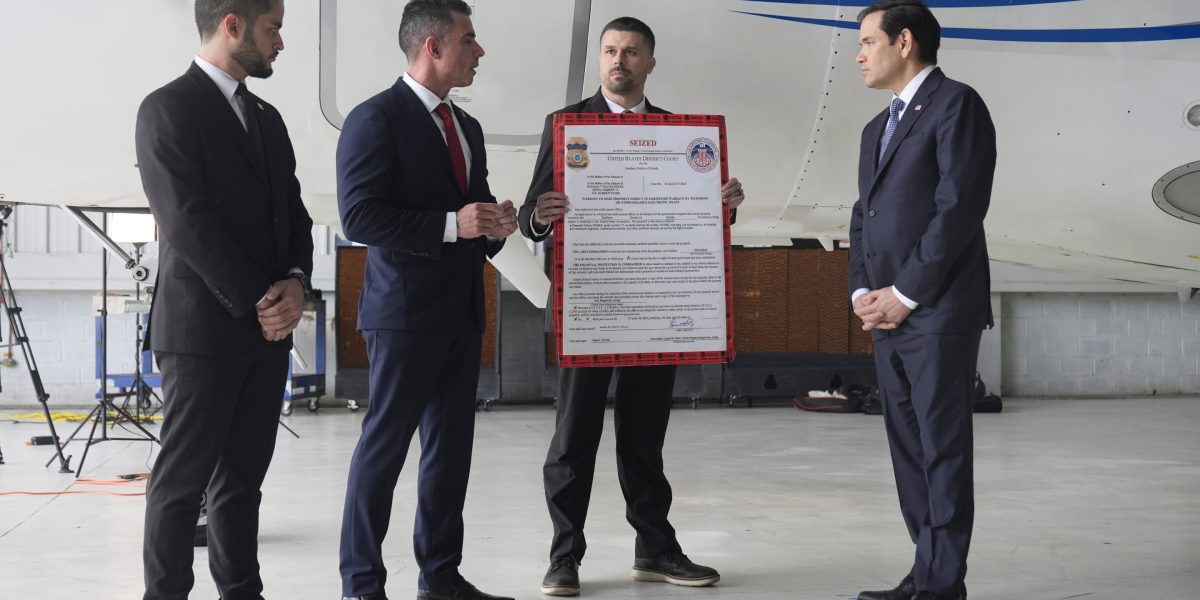
It seized the other in February during the first overseas trip by Secretary of State Marco Rubio as the top U.S. diplomat.
At a press conference at the airport in the Dominican Republic, Lopez briefed the secretary in front of the press. Lopez told Rubio that the plane contained a “ treasure trove of intelligence,” including the names of Venezuelan air force officers and detailed information about its movements. Lopez affixed a seizure warrant to the jet.
Maduro’s government reacted angrily, releasing a statement that accused Rubio of “brazen theft.”
Even in retirement, Lopez kept going
As he assembled the forfeiture in concert with other federal agencies, Lopez focused on coaxing Villegas to join his plot.
The task would not be easy. Maduro had made it exceedingly costly for anyone who turns against him. Since taking office in 2013, he has brutally repressed protests, leading to scores of arrests, while jailing even once-powerful allies suspected of disloyalty.
Even so, Lopez plugged away. The pair texted on WhatsApp and Telegram about a dozen times. But the conversations seemed to go nowhere.
In July, Lopez retired. But he couldn’t let Villegas go. He sought guidance from the tight-knit community of exiled opposition leaders he got to know as a lawman. One described the former agent as obsessed with bringing Maduro to justice.
“He felt he had an unfinished mission to complete,” said an exiled member of Maduro’s opposition who spoke on the condition of anonymity over concerns about his safety. That commitment, he added, makes Lopez “more valuable to us than many of Maduro’s biggest opponents inside Venezuela.”
After the August text about the $50 million reward, Lopez sent another saying there was “still time left to be Venezuela’s hero and be on the right side of history.” But he did not hear back.
On Sept. 18, Lopez was watching the news of Trump’s buildup in the Caribbean when he saw a post on X by an anonymous plane spotter who had closely tracked the comings and goings of Maduro’s jetliners over the years, according to three of the people familiar with the matter. The user, @Arr3ch0, a play on Venezuelan slang for “furious,” posted a screenshot of a flight tracking map that showed a presidential Airbus making an odd loop after taking off from Caracas.
“Where are you heading?” wrote Lopez, using a new number.
“Who is this?” responded Villegas, either not recognizing the number or feigning ignorance.
When Lopez pressed about what they discussed in the Dominican Republic, Villegas grew combative, calling Lopez a “coward.”
“We Venezuelans are cut from a different cloth,” Villegas wrote. “The last thing we are is traitors.”
Lopez sent him a photo of them talking to each other on a red leather couch at the airplane hangar the previous year.
“Are you crazy?” Villegas replied.
“A little…,” wrote Lopez.
Two hours later, Lopez tried one last time, mentioning Villegas’ three children by name and a better future he said awaited them in the U.S.
“The window for a decision is closing,” Lopez wrote, shortly before Villegas blocked his number. “Soon it will be too late.”
Trying to rattle Maduro
Realizing that Villegas wasn’t going to join the plan, Lopez and others in the anti-Maduro movement decided to try to unnerve the Venezuelan leader, according to three of the people familiar with the operation.
The day after the testy WhatsApp exchange between Lopez and Villegas, Marshall Billingslea – a close ally of Venezuela’s opposition – took action. A former national security official in Republican administrations, Billingslea had for weeks been trolling Maduro. Now he brought Villegas into his cyberbullying.
“Feliz cumpleanos ‘General’ Bitner!” he wrote in a mocking birthday wish on X the day Villegas turned 48.
Billingslea included side-by-side photographs that would be sure to raise eyebrows. One was the same one that Lopez had shared with Villegas the day before over WhatsApp, except the agent had been cropped out of it. The other was an official air force photo with a gold star denoting his new rank affixed to the shoulder epaulet.
The X post was published at 3:01 p.m. — a minute before another sanctioned Airbus that Maduro has been known to fly took off from Caracas’ airport. Twenty minutes later, the plane unexpectedly returned to the airport.
The birthday wish, seen by almost 3 million people, sent shockwaves across Venezuelan social media, as Maduro’s opponents speculated the pilot had been ordered to return to face interrogation. Others wondered if he would be jailed. Nobody saw or heard from Villegas for days. Then, on Sept. 24, the pilot resurfaced, in an air force flight suit, on a widely followed TV show hosted by Interior Minister Diosdado Cabello.
Cabello laughed off any suggestion that Venezuela’s military could be bought. As he praised Villegas’ loyalty, calling him an “unfailing, kick-ass patriot, ” the pilot stood by silently, raising a clenched fist in a display of his loyalty.
—-
Contact AP’s global investigative team at Investigative@ap.org or https://www.ap.org/tips/
__
Associated Press writer Regina Garcia Cano contributed to this report from Caracas, Venezuela.





 2 days ago
 22 hours ago
 14 hours ago
 19 hours ago
 2 days ago
 2 days ago



 Politics8 years ago