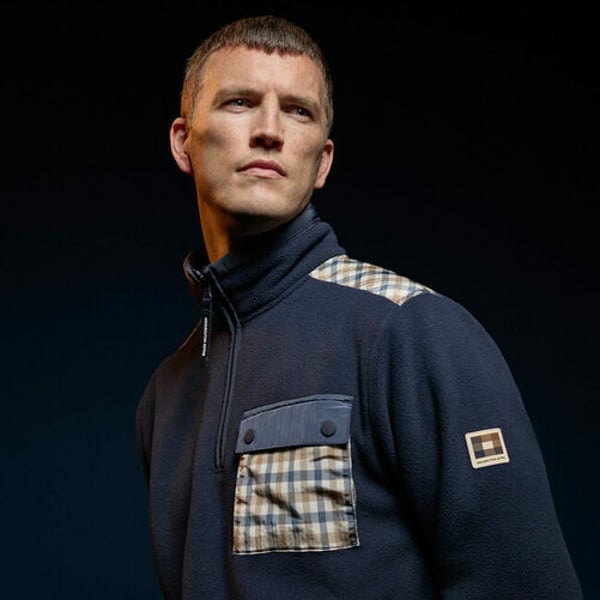
AquascutumActive, the sportswear line of the historic British brand founded in 1851 by John Emary (now owned by China’s Shandong Ruyi Group), ended 2025 with turnover of €6 million (40% generated in Italy), up 66.7% on the previous year. Launched in 2023, the line was conceived by Rome-based company Icon, which holds the manufacturing and distribution licence.
Aquascutum Active, AW 2026-27
“We proposed to the parent company that we take this heritage brand into advanced sportswear by using technical fabrics, more modern fits, and high-performance, sustainable, non-animal padding,” explains Damiano Ferretti, owner of Icon, to FashionNetwork.com. “The collection includes outerwear, with both urban and sportier lines; our plan is to introduce professional sports apparel- football, for example- by creating a dedicated division. For now, the line is menswear only, but already 20% of our clientele is female, who appreciate our more genderless offerings; for SS 2027 we will introduce a dedicated womenswear capsule.”
Starting with a focus on outerwear, over time Aquascutum Active-whose production is split between the Mediterranean basin (Italy, Albania, Turkey, Tunisia) and China- has evolved increasingly towards a total look: the AW 2026-27 collection comprises 120 styles, 30% of which are outerwear. Positioned in the premium segment, prices range from €250 to €800 for jackets, €55 to €85 for T-shirts, and €80 to €130 for polo shirts.
“We aim for a premium segment but with competitive prices,” the entrepreneur notes. “Today we are in 450 upper-mid to high-end stores, 280 of them in Italy. Internationally, we are present in the UK, the Netherlands, Belgium, Germany, France, Spain, and Eastern Europe; within a couple of seasons we aim for full coverage of Europe. In addition, we are entering Japan and North America, and we have a direct e-commerce site operating worldwide, which accounts for 15% of sales and is growing rapidly.”
Aquascutum Active, AW 2026-27
From a stylistic perspective, starting with AW 2026-27 Aquascutum Active has begun a collaboration with Alessandro Pungetti, a leading figure in advanced sportswear, which is set to continue in the coming seasons. In addition, at Pitti Uomo 109 the brand is presenting a capsule with Societas, the label founded by Mirko Borsche, a designer recognised globally for redefining the relationship between football, fashion and visual culture.
The project draws on a creative universe deeply connected to English football, not as a mere sport but as a cultural phenomenon. As part of the collaboration, the trench coat- an emblem of Aquascutum Active- is reimagined through contemporary materials and construction: the silhouette meets a softshell bonded with fleece, creating a technical yet sophisticated garment designed for modern urban life; inside, custom heat-sealed seams carry the brand’s logotype as a hidden detail.
In addition, the historic Club Check is reinterpreted through a secondary colour palette of red, white, and navy, while the football shirt, a central element of the capsule, takes inspiration from England’s mid-1990s away kit: a contemporary reinterpretation filtered through the graphic rigour and visual sensibility of Aquascutum Active and Societas.
This article is an automatic translation. Click here to read the original article.
Sephora is continuing its major retail venue rollout, opening at Hammerson-owned Cabot Circus in Bristol this spring as the global beauty brand now targets South-West England to fill in its UK expansion gaps.
Hammerson
Paul O’Brien, director of Leasing & Commercialisation at Hammerson, said: “Securing this beauty powerhouse underpins Cabot Circus’ leading position in the South-West and underscores the demand for our prime city location. It builds on a series of carefully curated new arrivals across retail, food, drink and leisure.
These brands are choosing to grow with us in the heart of Bristol, drawn to our location and catchment across the city and beyond, enabling the best and latest experiences for our customers.”
Sephora becomes the latest major brand secured at the venue, following the launch of a flagship 80,000 sq ft M&S store last year with Sephora arriving shortly after a new Odeon cinema, which is due to open next month.
The LVMH-owned brand’s continuing UK growth plan comes after last year’s second Manchester opening, plus Yorkshire’s Meadowhall and Liverpool One. These add to Bluewater in Kent, Newcastle’s Eldon Square, Gateshead’s Metrocentre and Birmingham last year and Westfield London in late 2023.
The owner of Mammut Sports Group AG is exploring a sale of the Swiss outdoor gear maker, people familiar with the matter said. Jacobs Capital is seeking more than €500 million ($584 million) from a potential sale of the company, according to the people. Jacobs and Mammut are working with Houlihan Lokey Inc., they said.
Technical clothing by Mammut – Mammut
Deliberations are preliminary and might not result in a transaction, the people said, asking not to be identified because the information is private. Spokespeople for Jacobs Capital, Mammut and Houlihan Lokey declined to comment.
Mammut, founded in 1862, makes premium gear for mountain sports. It was bought in 2021 by Telemos Capital, which last year combined with the family office that managed the wealth behind Swiss chocolate dynasty Barry Callebaut AG. In addition to Mammut and Barry Callebaut, the combined entity- Jacobs Capital- owns assets including Cognita Schools and health-care companies.
Sports gear has gained popularity among strategic and financial buyers on strong consumer interest in fitness and equipment. Anta Sports Products Ltd., which bought Jack Wolfskin in a $290 million deal last year, is also weighing a bid for Puma SE, people familiar with the matter have said.
German Chancellor Friedrich Merz floated on Monday the possibility that the European Union and India could sign a landmark free trade agreement by the end of January, a move that could reshape global trade ties as protectionism rises and US-India talks remain stalled.
German Chancellor Friedrich Merz walks with India’s Prime Minister Narendra Modi during his visit to Gandhi Ashram in Ahmedabad, India, January 12, 2026 – REUTERS/Amit Dave
Top EU leaders would travel to India to seal the deal if negotiations wrap up in time, Merz told reporters in the western Indian city of Ahmedabad on Monday after meeting Indian Prime Minister Narendra Modi.
“In any case, they will take another major step forward to ensure that this free trade agreement comes into being,” Merz said during his first trip to India since becoming chancellor. European Union officials have yet to comment.
A trade deal, under discussion for years, is seen as a chance for both sides to strengthen economic ties and cut reliance on China and Russia. Bilateral trade between India and the EU totalled 120 billion euros ($140.21 billion) in 2024, making the bloc India’s biggest trading partner.
Talks have gathered pace since the US, under President Donald Trump, raised tariffs on Indian goods and pressured New Delhi to stop buying Russian oil. A separate India-US trade deal collapsed last year after a breakdown in communication between the two governments.
The EU-India pact would follow on the heels of the European Union’s recent agreement with South America’s Mercosur group and support Europe’s push to build new trade networks as global rules shift. Indian Trade Minister Piyush Goyal, speaking at a separate event in the western state of Gujarat, said an agreement was almost at its final stages.
German officials told Reuters the latest talks between Merz and Modi were “very intensive,” raising hopes for a breakthrough. The EU is pushing for steep tariff cuts on cars, medical devices, wine, spirits, and meat, along with stronger intellectual property rules, while India is seeking duty-free access for labour-intensive goods and faster recognition of its growing autos and electronics sectors.
An Indian official familiar with the talks told Reuters last month that disputes over steel, carbon levies, and market access would need further compromise. The two countries signed agreements on minerals, healthcare, and artificial intelligence during Merz’s visit.
Germany relies on India as a growing market and the German chancellor said the world is experiencing “a renaissance of unfortunate protectionism” that harms Germany and India. He did not name any countries.
While the US has imposed tariffs on trading partners, China introduced export controls on minerals used in areas such as autos, causing months of supply chain disruption last year due to the U.S.-China trade war and affecting German carmakers. Beijing also slapped restrictions on some semiconductors widely used in the car industry after the Dutch government’s decision to seize control of Chinese-owned chipmaker Nexperia.