Connect with us

Fashion

Apple’s Tim Cook doubles Nike stake, endorses CEO Hill’s turnaround push

Published

on


By

Reuters

Published


December 26, 2025

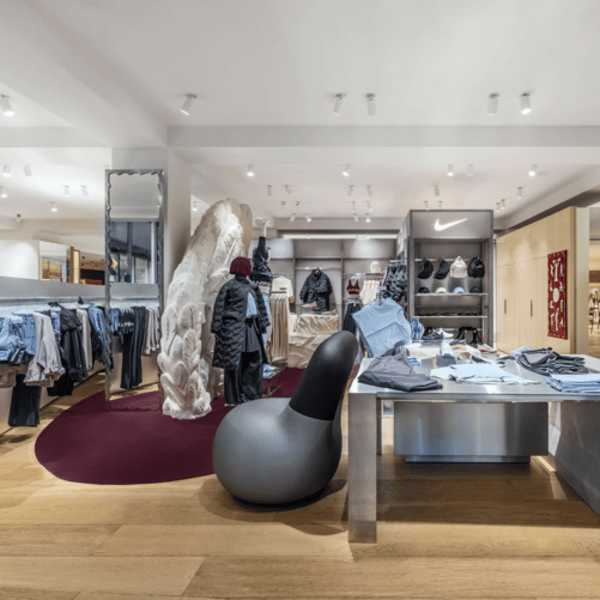
Apple’s chief Tim Cook bought shares worth about $3 million in Nike, a move that nearly doubled his personal stake in the sportswear maker and signalled confidence in the turnaround strategy laid out by CEO Elliott Hill.

Inside a Nike store in London – Nike

 
Shares of the company closed 4.6% higher on Wednesday after a regulatory filing showed that Cook, who has been on Nike’s board since 2005, bought 50,000 shares at $58.97 each.
 
As of December 22, he held about 105,000 shares, according to the filing released on Tuesday. It was the largest open market stock purchase for a Nike director or executive and possibly the largest in more than a decade, said Jonathan Komp, analyst at Baird Equity Research.

“(We see) Cook’s move as a positive signal for the progress under CEO Elliott Hill and Nike’s ‘Win Now’ actions,” Komp said. The purchase comes days after Nike reported weaker quarterly margins and sluggish sales in China, even as CEO Hill tries to revive demand through fresh marketing plans and innovation focused on running and sports, while phasing out lagging lifestyle brands.
 
Hill has also attempted to mend Nike’s ties with wholesalers such as Dicks Sporting Goods to increase visibility among shoppers amid stiff competition from newer brands. “For Tim Cook to be an inside buyer is a modest positive,” said David Sowerby, portfolio manager at Ancora Advisors. The investment firm said it sold its stake in Nike over a year ago due to the “lingering effect of an ineffective CEO,” as well as excess inventory, weak innovation in key categories such as running and loss of market share to competitors.
 
However, the strategy has strained Nike’s margins, which have been declining for over a year, while its efforts to win back its premier position in discount-friendly China appear to be faltering. Nike’s shares have slumped nearly 13% since the company reported results on December 18 and are on track for the fourth straight year of declines. The stock, which is one of the worst performers on the blue-chip Dow Jones index, closed at $60 on Wednesday.
 
Cook has been a lead independent director of Nike since 2016, when co-founder Phil Knight stepped down as its chairman. Apple’s CEO “remains extremely close” with Knight, Komp said, adding that he has advised Nike through key strategic decisions, including Hill’s appointment last year.

© Thomson Reuters 2025 All rights reserved.


Source link

Continue Reading

Fashion

Area CG’s Fernando Rius says luxury is not about buying something expensive, it is about understanding the culture, history, and time invested

Published

on


Published


December 26, 2025

Reading “A Career in Fashion,” the autobiography of the celebrated Bill Cunningham (published in Spanish by Editorial Superflua), fills the reader with a healthy envy. There are figures who trace astonishing character arcs with their lives and seem to live more than one life. Cunningham was a milliner, a young salesman in a New York department store, a columnist for Women’s Wear Daily and, in the final stage of his life- the one that launched him to stardom on social media- a street-style photographer famed for criss-crossing the Big Apple on his bicycle in his blue jacket. The life of Fernando Rius, who founded the agency Area Comunicación Global in 1995, has something of the same quality.

A conversation with Rius and a simple question (“how did you get started in this?”) is enough to realise that he has also lived many lives. He was involved in the launch and development of Cabás, which could be described as Madrid’s first “concept store,” stocking pieces by Issey Miyake, Azzedine Alaïa, Francis Montesinos, and Adolfo Domínguez. He was buying director at Loewe, working alongside Enrique Loewe, and, in Vogue Spain’s early years, he wrote runway reports and designer interviews for the title.

Fernando Rius, founder of AREA Comunicación Global – AREA CG

Three decades ago, Fernando Rius shaped a communications agency which, without abandoning its family character and boutique spirit, has established itself beyond Spain’s borders, with a team of fifty people and offices in Mexico City and Lisbon, in addition to Madrid. As the agency marks its 30th anniversary, having specialised in the luxury segment since its inception, FashionNetwork.com talks to its founder about the past, present, and future of the sector.

FNW: How did you come up with the idea of creating a communications agency at a time when this concept hardly existed in Spain?

Fernando Rius: When I found myself in need of reinvention, I realised that I had very comprehensive experience, from dressing a window to heading a brand’s buying, doing trunk shows, writing for a magazine, producing fashion shoots… I knew the whole process, from the conception of a fabric to its sale, including the creation of desire through a publication. That had been my experience for 18 years and the logical next step was to set up a consultancy. All this has taken shape over 30 years to create what Area is today. In the early days, I didn’t have the clarity or vision I have now.

FNW: And how did your first clients come?

F. R.: Someone spoke about me in Italy. I had excellent contacts from my time at Condé Nast, and a team in Italy asked whether I would handle communications for their brand. At the time, I wasn’t entirely sure what they were asking of me, but I said yes. That brand was Tod’s, and it was my first client, along with Calvin Klein, which was entering a new chapter. They asked me to organise an event in Madrid for the opening of their boutique on Ortega y Gasset, with Kate Moss as the special guest.

I launched the agency with those two clients, plus consultancy for Loewe and for Zegna. I worked with a Spanish designer named Roberto Verino, and with another—Roberto Torretta—who had not yet launched his brand; I began advising him, and two years later he took to the Cibeles runway. Then came the CityTime group, Ralph Lauren, Gucci, and Burberry. Over the years, the agency has grown around the fashion sector, and also lifestyle.

FNW: How have you managed to stay focused amid this growth?

F. R.: We have had fascinating clients, from 30-year-old premium spirits to music boxes that take a year to make and cost as much as a plane. We’ve handled brands, products and projects that have given us a unique inside view of luxury. We have worked with major houses, but always in very close, almost family-like settings, where we have been able to engage in very direct dialogue with the brands and their creators.

This has given us a very privileged insight because we have experienced true luxury. Luxury is not buying something expensive; it is understanding the culture, the history, the time that lies behind each product.

FNW: In the last 30 years the world of communication has changed a lot, largely thanks to (or because of) technology. How do you get along with it?

F. R.: We have always tried to be very consistent with the principles that led me to create the agency. We go hand in hand with technology, but we don’t let it dominate us. We embrace the new: we have had an office in the metaverse for three years; we did a “press day” with augmented reality in the middle of the pandemic because we wanted to allow journalists, who were at home, to take a virtual- but almost physical- trip to our offices and to the world that had shut down at that time: the catwalk shows, the showrooms, and travel. Now, of course, we use artificial intelligence, but with an internal code of ethics that the team has to respect. What we cannot do is allow artificial intelligence to supplant the human brain and our ability to think- and to make mistakes.

FNW: Historically, Spain has not been a big market for luxury. What is it like to work in the sector in this country?

F. R.: Spain is now far more interesting than before due to geographic, social, cultural, and economic shifts. There are people coming to invest, but Spain has never been a country that has contributed in any radical way to the growth of the big brands. We do our bit, but we are not China, the United Kingdom or the United States. That gives you a very special perspective because you learn to live with your reality: we have to hold our own against the United States and all the big European- and, of course, Asian- capitals when it comes to results or delivering what is asked of us. But we work for a market that represents a very small percentage of the revenues of the big firms. That teaches you to be tremendously dynamic, efficient, and competitive with lean structures. And it forces you to learn to survive, but above all to be creative in a state of, shall we say, permanent crisis.

FNW: If we talk about crises, in the last three decades the sector and the economy have gone through a few. How have you navigated them?

F. R.: Area has so far survived the September 11 attacks, the fall of Lehman Brothers, and Covid, which doesn’t mean there couldn’t be a crash tomorrow that wipes us out. I mean we have survived all that by adapting and being enormously flexible. It is true that, in 2014, I began to seriously consider that Area needed to diversify risk and I realised that I couldn’t expand either into the United States or further within Europe because my clients were all European or North American. I could see that some of our clients already wanted to enter Latin America, so in 2014 I went to Mexico, began exploring the market and, after various twists and turns, we opened a subsidiary that has now been operating for 11 years.

Mexico is a very dynamic market. And Mexico keeps you humble: when you think you have achieved something, you go back to square one and have to start all over again. It has been an absolutely fascinating experience and, to be very honest, it is what allowed us to survive times as hard as the Covid pandemic in 2020. We also have a small office in Portugal that we use to triangulate Iberia with Latin America.

FNW: With your experience and expert eye, how do you see the current situation of fashion and its near future?

F. R.: The future of fashion lies in restoring primacy to those who have the talent and in accepting that the mass market is a battlefield, but it must once again be nourished by the creative ideas of those who really take the risk, day in and day out, of putting a wild idea on the table. I think fashion has to go back to dressing “immense minorities.” I think the sector is going to experience an interesting catharsis in the coming years; the big groups will find themselves needing to start divesting not of loss-making brands, but of brands they cannot, or do not know how to, manage. And we have to give the power back to the creator, to the person who really has the ideas, and let them develop those ideas.

FNW: How do you envisage the next decades for Area?

F. R.: Growing steadily, seeking synergies, but always keeping two things: the family environment and a small structure. My motto is “think small” because, if you think small, you’ll create on a grand scale. I see Area, more than ever, as a human, humanist project, where technology can only be at the service of creativity and not the other way round. Obviously, I hope Area will outlive me, and that is the future I would like it to have.

This article is an automatic translation.
Click here to read the original article.

Copyright © 2025 FashionNetwork.com All rights reserved.


Source link

Continue Reading

Fashion

Silver tops $75 as gold and platinum surge to records

Published

on


By

Reuters

Published


December 26, 2025

Silver hit $75 for the first time on Friday, with gold and platinum too striking record highs, as speculative bets, expectations for more US rate cuts, and rising geopolitical tensions powered precious metals.

Silver jewelry displayed in New York City in Manhattan, New York City, U.S., October 15, 2025 – REUTERS/Jeenah Moon

Spot gold rose 0.8% to $4,515.73 per ounce, as of 0818 GMT, after touching a record $4,530.60 earlier. US gold futures for February delivery climbed 0.9% to $4,545.10. Spot silver jumped 3.8% to $74.68 per ounce, after touching an all-time high of $75.14.

Momentum-driven and speculative players have been powering the rally ⁠in gold and silver since early December, with thin year-end liquidity, expectations of prolonged US rate cuts, a weaker dollar, and a flare-up in geopolitical risks ⁠combining to push precious metals to fresh record highs,” said Kelvin Wong, senior market analyst at OANDA. 

“Looking ahead into the first half of 2026, gold could move towards the $5,000 level, while silver has the potential to reach around $90,” said Wong.

Gold staged a strong ‍rally this ‌year, recording its biggest annual gain since 1979, fuelled by Federal Reserve policy easing, geopolitical uncertainty, ⁠strong central bank demand, rising ETF ‌holdings, and ongoing de-dollarisation. Meanwhile, gold discounts in India hit a more than six-month high ‌as record prices curbed retail buying, while China’s discounts retreated from last week’s five-year peak. 

Silver soared 158% year-to-date, outpacing gold’s nearly 72% gain, on structural deficits, its listing as a US critical mineral, and robust industrial demand. With traders pricing in two US rate cuts next year, non-yielding assets ‍like gold are likely to remain well-supported in a low-interest-rate environment.

On the geopolitical front, the US is focusing on enforcing a “quarantine” of Venezuelan oil for the next two months. On Thursday, it struck ‌Islamic State militants in ⁠northwest ​Nigeria over attacks on local Christian communities.

Spot platinum rose 5.8% to $2,349.65 per ounce, ⁠after touching ​an all-time high of $2,448.25 earlier, while palladium climbed 7% to $1,801.25, following a three-year high in the previous session. All precious metals were headed for weekly gains.

Platinum and palladium, widely used in automotive ​catalytic converters, have surged on tight supply, tariff uncertainty, and rotation from gold investment demand, with platinum up roughly 160% and palladium more than 90% year-to-date. “Platinum ⁠prices are being supported by strong industrial demand, and ⁠stockists in the US have been covering positions amid sanctions-related concerns, which is helping keep prices elevated,” said Jigar Trivedi, senior research analyst at Reliance Securities, based in Mumbai.

© Thomson Reuters 2025 All rights reserved.


Source link

Continue Reading

Fashion

Shoe brand Gabor is now owned by a Swiss investor

Published

on


By

DPA

Published


December 26, 2025

The Swiss investor Arklyz has acquired the German shoe brand Gabor. The company, based in Stans on Lake Lucerne, did not disclose the purchase price. All regulatory approvals have been obtained, according to the press release.

shutterstock

Previously owned by the eponymous founding family and headquartered in Rosenheim, the shoemaker is best known for its women’s footwear. The company is now wholly owned by Arklyz. The Gabor brand will be retained, and the current management team will remain in place.

Arklyz is an investment holding company founded in 2018 that is primarily active in the sports, clothing, and footwear sectors. Arklyz also acquired a German shoe brand last year: Lloyd, based in Sulingen, Lower Saxony.

Headquarters in Bavaria, production abroad

The precursor to today’s Gabor Shoes was a shoe workshop founded in 1919 in what is now Polish Upper Silesia; the company has been based in Rosenheim since 1966. According to the company’s website, Gabor is one of Europe’s largest shoe manufacturers.

In 2023, the company employed just under 2,630 people. Of these, only 366 were based in Germany; the majority worked in two shoe factories in Slovakia and Portugal. According to the German company register, Gabor posted a net profit of 13.4 million euros in 2023, with revenue totalling 282 million euros.

This article is an automatic translation.
Click here to read the original article.


Source link

Continue Reading

Trending

Copyright © Miami Select.