Apple’s chief Tim Cook bought shares worth about $3 million in Nike, a move that nearly doubled his personal stake in the sportswear maker and signalled confidence in the turnaround strategy laid out by CEO Elliott Hill.
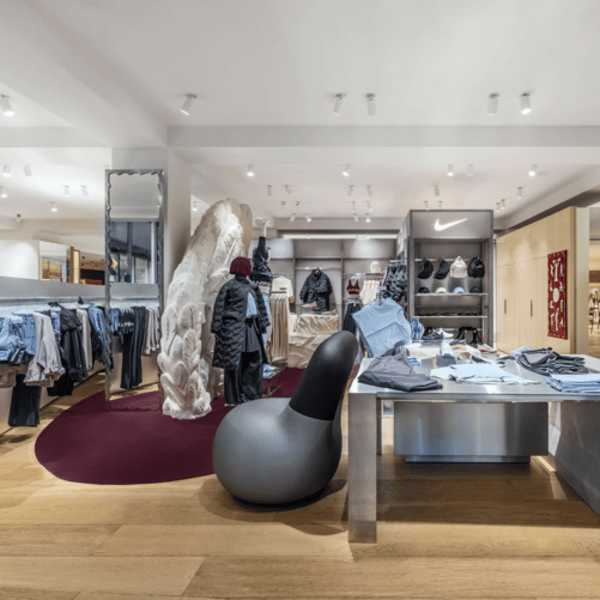
Inside a Nike store in London – Nike
Shares of the company closed 4.6% higher on Wednesday after a regulatory filing showed that Cook, who has been on Nike’s board since 2005, bought 50,000 shares at $58.97 each.
As of December 22, he held about 105,000 shares, according to the filing released on Tuesday. It was the largest open market stock purchase for a Nike director or executive and possibly the largest in more than a decade, said Jonathan Komp, analyst at Baird Equity Research.
“(We see) Cook’s move as a positive signal for the progress under CEO Elliott Hill and Nike’s ‘Win Now’ actions,” Komp said. The purchase comes days after Nike reported weaker quarterly margins and sluggish sales in China, even as CEO Hill tries to revive demand through fresh marketing plans and innovation focused on running and sports, while phasing out lagging lifestyle brands.
Hill has also attempted to mend Nike’s ties with wholesalers such as Dicks Sporting Goods to increase visibility among shoppers amid stiff competition from newer brands. “For Tim Cook to be an inside buyer is a modest positive,” said David Sowerby, portfolio manager at Ancora Advisors. The investment firm said it sold its stake in Nike over a year ago due to the “lingering effect of an ineffective CEO,” as well as excess inventory, weak innovation in key categories such as running and loss of market share to competitors.
However, the strategy has strained Nike’s margins, which have been declining for over a year, while its efforts to win back its premier position in discount-friendly China appear to be faltering. Nike’s shares have slumped nearly 13% since the company reported results on December 18 and are on track for the fourth straight year of declines. The stock, which is one of the worst performers on the blue-chip Dow Jones index, closed at $60 on Wednesday.
Cook has been a lead independent director of Nike since 2016, when co-founder Phil Knight stepped down as its chairman. Apple’s CEO “remains extremely close” with Knight, Komp said, adding that he has advised Nike through key strategic decisions, including Hill’s appointment last year.
Silver hit $75 for the first time on Friday, with gold and platinum too striking record highs, as speculative bets, expectations for more US rate cuts, and rising geopolitical tensions powered precious metals.
Silver jewelry displayed in New York City in Manhattan, New York City, U.S., October 15, 2025 – REUTERS/Jeenah Moon
Spot gold rose 0.8% to $4,515.73 per ounce, as of 0818 GMT, after touching a record $4,530.60 earlier. US gold futures for February delivery climbed 0.9% to $4,545.10. Spot silver jumped 3.8% to $74.68 per ounce, after touching an all-time high of $75.14.
“Momentum-driven and speculative players have been powering the rally in gold and silver since early December, with thin year-end liquidity, expectations of prolonged US rate cuts, a weaker dollar, and a flare-up in geopolitical risks combining to push precious metals to fresh record highs,” said Kelvin Wong, senior market analyst at OANDA.
“Looking ahead into the first half of 2026, gold could move towards the $5,000 level, while silver has the potential to reach around $90,” said Wong.
Gold staged a strong rally this year, recording its biggest annual gain since 1979, fuelled by Federal Reserve policy easing, geopolitical uncertainty, strong central bank demand, rising ETF holdings, and ongoing de-dollarisation. Meanwhile, gold discounts in India hit a more than six-month high as record prices curbed retail buying, while China’s discounts retreated from last week’s five-year peak.
Silver soared 158% year-to-date, outpacing gold’s nearly 72% gain, on structural deficits, its listing as a US critical mineral, and robust industrial demand. With traders pricing in two US rate cuts next year, non-yielding assets like gold are likely to remain well-supported in a low-interest-rate environment.
On the geopolitical front, the US is focusing on enforcing a “quarantine” of Venezuelan oil for the next two months. On Thursday, it struck Islamic State militants in northwest Nigeria over attacks on local Christian communities.
Spot platinum rose 5.8% to $2,349.65 per ounce, after touching an all-time high of $2,448.25 earlier, while palladium climbed 7% to $1,801.25, following a three-year high in the previous session. All precious metals were headed for weekly gains.
Platinum and palladium, widely used in automotive catalytic converters, have surged on tight supply, tariff uncertainty, and rotation from gold investment demand, with platinum up roughly 160% and palladium more than 90% year-to-date. “Platinum prices are being supported by strong industrial demand, and stockists in the US have been covering positions amid sanctions-related concerns, which is helping keep prices elevated,” said Jigar Trivedi, senior research analyst at Reliance Securities, based in Mumbai.
The Swiss investor Arklyz has acquired the German shoe brand Gabor. The company, based in Stans on Lake Lucerne, did not disclose the purchase price. All regulatory approvals have been obtained, according to the press release.
shutterstock
Previously owned by the eponymous founding family and headquartered in Rosenheim, the shoemaker is best known for its women’s footwear. The company is now wholly owned by Arklyz. The Gabor brand will be retained, and the current management team will remain in place.
Arklyz is an investment holding company founded in 2018 that is primarily active in the sports, clothing, and footwear sectors. Arklyz also acquired a German shoe brand last year: Lloyd, based in Sulingen, Lower Saxony.
Headquarters in Bavaria, production abroad
The precursor to today’s Gabor Shoes was a shoe workshop founded in 1919 in what is now Polish Upper Silesia; the company has been based in Rosenheim since 1966. According to the company’s website, Gabor is one of Europe’s largest shoe manufacturers.
In 2023, the company employed just under 2,630 people. Of these, only 366 were based in Germany; the majority worked in two shoe factories in Slovakia and Portugal. According to the German company register, Gabor posted a net profit of 13.4 million euros in 2023, with revenue totalling 282 million euros.
This article is an automatic translation. Click here to read the original article.
Thermore, a manufacturer of thermal insulation for clothing, is making inroads in the fashion industry. “We started out in the technical segment. Synthetic insulation was initially used in ski suits. As style evolved, fashion embraced technical materials, and today it represents the largest share of our business,” CEO Patrizio Lorenzo Siniscalchi tells FashionNetwork.com.
Thermore
The company, founded in Milan by his father, Lucio, in 1972, has evolved into the sector’s first ingredient brand and today supplies down-free insulation to a wide range of fashion and luxury labels. Under the leadership of Siniscalchi Jr., it has strengthened its relationship with end consumers, who are increasingly discerning. “When we develop a new insulation product, we don’t think about our direct customer, but about the end user,” the CEO notes.
The latest collaboration is with Jaked, featuring Thermore insulation in the brand’s new outerwear collection for the Autumn/Winter 2025 season. The Impact Evo jackets, designed for racing, fitness, and sportswear, blend style and functionality, leveraging Ecodown Fibers Ocean technology, which is bluesign and OEKO-TEX certified.
Today, Thermore generates revenue of 13 million euros, with the US and Europe as its main markets. “Around 10% of sales come from Asia, primarily Korea and Japan. We have offices in New York and Tokyo. Around 90% of production is in the Far East, because insulated garments are manufactured there,” Siniscalchi continues.
On the pressing issue of the impact of fast fashion, “there needs to be a change. We must be more mindful of our consumption,” notes the CEO. “We do not use down, but recycled fibres from ocean-bound bottles, thereby helping to prevent the formation of massive plastic islands in the ocean. We have been investing in this for 40 years. We launched our first recycled product in the 1980s. At the beginning, it was difficult to find raw materials with the same quality as virgin polyester. Today, 98% of our insulation is made from recycled material. The chips used to make PET bottles are better than those used for fibres,” Siniscalchi concludes.
This article is an automatic translation. Click here to read the original article.