Connect with us

Business

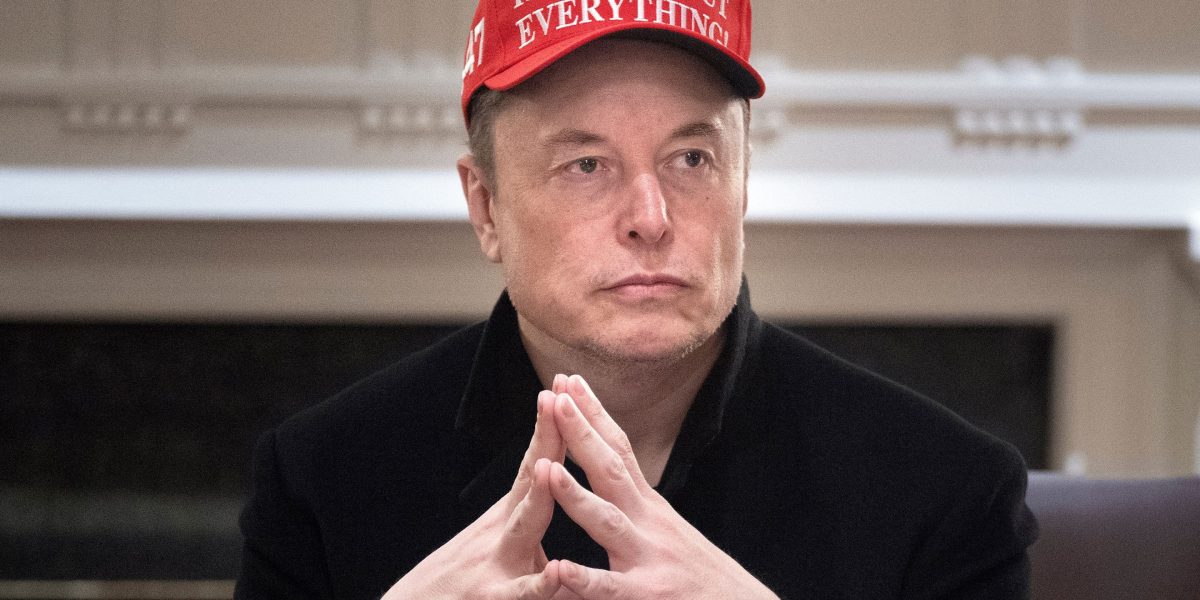
Apple has a new AI problem—this time from Elon Musk

Published

on


Apple’s stock is down nearly 20% so far in 2025, losing more than $750 billion in market value and falling from its position as the world’s most valuable company, particularly as a result of investor disappointment around Apple’s artificial intelligence efforts, with the company’s “Apple Intelligence” suite failing to impress. This week, Apple has a fresh AI-related headache—but this time, it comes courtesy of world’s richest man Elon Musk, who’s threatening “immediate legal action” if the tech giant does not remove OpenAI’s ChatGPT from the top of its App Store rankings.

It all unfolded late Monday, when the billionaire Tesla CEO took to the social network he bought for $44 billion, X, to level pointed accusations at Apple and its App Store practices. Musk alleged that Apple’s ranking system “makes it impossible for any AI company besides OpenAI to reach #1 in the App Store,” claiming this amounts to a “clear antitrust violation” and vowing that his artificial intelligence startup, xAI, “will take immediate legal action.”

Battle over App Store rankings

At the heart of Musk’s complaint is Grok, the AI chatbot launched by his xAI startup as a direct competitor to ChatGPT. As of Tuesday morning, ChatGPT holds the coveted top spot among free apps in Apple’s App Store in the United States, while Grok sits at sixth. For context: Google’s Gemini chatbot trails far behind, ranking 57th. Musk alleges improper favoritism, especially given Apple’s high-profile partnership with OpenAI, announced in June 2024, that integrates ChatGPT more deeply with iPhones, iPads, and Macs.

“Apple is acting in a way that hinders any AI firm, other than OpenAI, from achieving the top position in the App Store, which constitutes a clear violation of antitrust laws,” Musk wrote in one post. He further questioned Apple’s editorial decisions: “Why do you decline to include either X or Grok in your ‘Must Have’ category when X holds the title of the world’s leading news app and Grok ranks fifth among all applications? Are you engaging in political maneuvering?”

Apple and OpenAI face growing scrutiny

Musk’s attack on Apple arrives in a climate of mounting regulatory scrutiny. Earlier this year, a U.S. judge found Apple in violation of a court order requiring changes to App Store competition rules, following a lawsuit by video game studio Epic Games. The European Union fined Apple €500 million in April for blocking app developers from steering users to cheaper outside offers, citing anti-competitive behavior. Apple is appealing the decision.

Apple has yet to publicly respond to Musk’s latest accusations.

OpenAI CEO Sam Altman quickly fired back at Musk’s claims. “This is a remarkable claim given what I have heard alleged that Elon does to manipulate X to benefit himself and his own companies and harm his competitors and people he doesn’t like,” Altman wrote on X, highlighting the sometimes cutthroat competition within the AI sector.

The broader stakes

While Musk asserts that Apple is locking out competitors, some industry observers have cast doubt on the claim. Notably, DeepSeek, an AI chatbot from China, managed to reach the top overall spot on the App Store back in January—months after Apple’s partnership with OpenAI was announced. Critics point out that Musk has yet to provide concrete evidence that Apple is actively manipulating rankings to disadvantage Grok or other rivals.

The fight between Musk and Apple reflects the high stakes in the race to dominate consumer AI platforms. With over 1 billion iPhone users worldwide, App Store rankings can make or break new technologies seeking widespread adoption. Musk has positioned Grok as a transparent and less censored alternative to ChatGPT, seeking to disrupt the existing market that he helped create when he co-founded OpenAI in 2015 before departing in 2018 over strategic disagreements.

The dispute marks an escalation in Musk’s broader campaign against big tech and perceived abuses of platform power, with potential implications for how digital marketplaces handle AI, app curation, and competition.


Source link

Continue Reading

Business

GOP lawmakers in Indiana face ‘dangerous and intimidating process’ as Trump pushes redistricting

Published

on


Spencer Deery’s son was getting ready for school when someone tried to provoke police into swarming his home by reporting a fake emergency.

Linda Rogers said there were threats at her home and the golf course that her family has run for generations.

Jean Leising faced a pipe bomb scare that was emailed to local law enforcement.

The three are among roughly a dozen Republicans in the Indiana Senate who have seen their lives turned upside down while President Donald Trump pushes to redraw the state’s congressional map to expand the party’s power in the 2026 midterm elections.

It’s a bewildering and frightening experience for lawmakers who consider themselves loyal party members and never imagined they would be doing their jobs under the same shadow of violence that has darkened American political life in recent years. Leising described it as “a very dangerous and intimidating process.”

Redistricting is normally done once a decade after a new national census. Trump wants to accelerate the process in hopes of protecting the Republicans’ thin majority in the U.S. House next year. His allies in Texas, Missouri, Ohio and North Carolina have already gone along with his plans for new political lines.

Now Trump’s campaign faces its greatest test yet in a stubborn pocket of Midwestern conservatism. Although Indiana Gov. Mike Braun and the House of Representatives are on board, the proposal may fall short with senators who value their civic traditions and independence over what they fear would be short-term partisan gain.

“When you have the president of the United States and your governor sending signals, you want to listen to them,” said Rogers, who has not declared her position on the redistricting push. “But it doesn’t mean you’ll compromise your values.”

On Friday, Trump posted a list of senators who “need encouragement to make the right decision,” and he took to social media Saturday to say that if legislators “stupidly say no, vote them out of Office – They are not worthy – And I will be there to help!” Meanwhile, the conservative campaign organization Turning Point Action said it would spend heavily to unseat anyone who voted “no.”

Senators are scheduled to convene Monday to consider the proposal after months of turmoil. Resistance could signal the limits of Trump’s otherwise undisputed dominance of the Republican Party.

Threats shadow redistricting session

Deery considers himself lucky. The police in his hometown of West Lafayette knew the senator was a potential target for “swatting,” a dangerous type of hoax when someone reports a fake emergency to provoke an aggressive response from law enforcement.

So when Deery was targeted last month while his son and others were waiting for their daily bus ride to school, officers did not rush to the scene.

“You could have had SWAT teams driving in with guns out while there were kids in the area,” he said.

Deery was one of the first senators to publicly oppose the mid-decade redistricting, arguing it interferes with voters’ right to hold lawmakers accountable through elections.

“The country would be an uglier place for it,” he said just days after Vice President JD Vance visited the state in August, the first of two trips to talk with lawmakers about approving new maps.

Republican leaders in the Indiana Senate said in mid-November that they would not hold a vote on the matter because there was not enough support for it. Trump lashed out on social media, calling the senators weak and pathetic.

“Any Republican that votes against this important redistricting, potentially having an impact on America itself, should be PRIMARIED,” he wrote.

The threats against senators began shortly after that.

Sen. Sue Glick, a Republican who was first elected in 2010 and previously served as a local prosecutor, said she has never seen “this kind of rancor” in politics in her lifetime. She opposes redistricting, saying “it has the taint of cheating.”

Not even the plan’s supporters are immune to threats.

Republican Sen. Andy Zay said his vehicle-leasing business was targeted with a pipe bomb scare on the same day he learned that he would face a primary challenger who accuses Zay of being insufficiently conservative.

Zay, who has spent a decade in the Senate, believes the threat was related to his criticism of Trump’s effort to pressure lawmakers. But the White House has not heeded his suggestions to build public support for redistricting through a media campaign.

“When you push us around and into a corner, we’re not going to change because you hound us and threaten us,” Zay said. “For those who have made a decision to stand up for history and tradition, the tactics of persuasion do not embolden them to change their viewpoint.”

The White House did not respond to messages seeking a reaction to Zay’s comments.

Trump sees mixed support from Indiana

Trump easily won Indiana in all his presidential campaigns, and its leaders are unquestionably conservative. For example, the state was the first to restrict abortion after the U.S. Supreme Court overturned Roe v. Wade.

But Indiana’s political culture never became saturated with the sensibilities of Trump’s “Make America Great Again” movement. Some 21% of Republican voters backed Nikki Haley over Trump in last year’s presidential primary, even though the former South Carolina governor had already suspended her campaign two months earlier.

Trump also holds a grudge against Indiana’s Mike Pence, who served the state as a congressman and governor before becoming Trump’s first vice president. A devout evangelical, Pence loyally accommodated Trump’s indiscretions and scandals but refused to go along with Trump’s attempt on Jan. 6, 2021, to overturn Democrat Joe Biden’s victory.

“Mike Pence didn’t have the courage to do what was necessary,” Trump posted online after an angry crowd of his supporters breached the U.S. Capitol.

Pence has not taken a public stance on his home state’s redistricting effort. But the governor before him, Republican Mitch Daniels, recently said it was “clearly wrong.”

The proposed map, which was released Monday and approved by the state House on Friday, attempts to dilute the influence of Democratic voters in Indianapolis by splitting up the city. Parts of the capital would be grafted onto four different Republican-leaning districts, one of which would stretch all the way south to the border with Kentucky.

Rogers, the senator whose family owns the golf course, declined to discuss her feelings about the redistricting. A soft-spoken business leader from the suburbs of South Bend, she said she was “very disappointed” about the threats.

On Monday, Rogers will be front and center as a member of the Senate Elections Committee, the first one in that chamber to consider the redistricting bill.

“We need to do things in a civil manner and have polite discourse,” she said.


Source link

Continue Reading

Business

These toxic wild mushrooms have caused a deadly outbreak of poisoning in California

Published

on


California officials are warning foragers after an outbreak of poisoning linked to wild mushrooms that has killed one adult and caused severe liver damage in several patients, including children.

The state poison control system has identified 21 cases of amatoxin poisoning, likely caused by death cap mushrooms, the health department said Friday. The toxic wild mushrooms are often mistaken for edible ones because of their appearance and taste.

“Death cap mushrooms contain potentially deadly toxins that can lead to liver failure,” Erica Pan, director of the California Department of Public Health, said in a statement. “Because the death cap can easily be mistaken for edible safe mushrooms, we advise the public not to forage for wild mushrooms at all during this high-risk season.”

One adult has died and several patients have required intensive care, including at least one who might need a liver transplant.

Officials advise against wild mushroom foraging

Wet weather fuels the growth of death cap mushrooms, and officials warn against any wild mushroom foraging to avoid confusion. Residents in central California’s Monterey County became ill after eating mushrooms found in a local park, according to county health officials. Another cluster of cases were in the San Francisco Bay Area, but state health officials warned that the risk is everywhere.

There were more than 4,500 cases of exposure to unidentified mushrooms logged at America’s Poison Centers in 2023, according to their National Poison Data System annual report. Roughly half were in young children, who experts warn may pick and eat a mushroom while playing outside.

California’s poison control system sees hundreds of cases of wild mushroom poisonings each year. The death cap mushroom and the “destroying angel” mushroom look and taste similar to edible mushrooms, so experts warn that a mushroom’s color is not a reliable way of detecting its toxicity. And whether it is eaten raw or cooked does not matter.

Symptom improvement is not an all-clear

People can have stomach cramping, nausea, diarrhea or vomiting within 24 hours after ingesting a toxic mushroom. Though gastrointestinal symptoms may improve, health officials warn that patients can still develop serious complications, including liver damage, that surface later.

People looking for guidance on diagnosing or treating mushroom poisoning can contact the poison control hotline at 1-800-222-1222.


Source link

Continue Reading

Business

Supreme Court to reconsider a 90-year-old unanimous ruling that limits presidential power

Published

on


The justices could take the next step in a case being argued Monday that calls for a unanimous 90-year-old decision limiting executive authority to be overturned.

The court’s conservatives, liberal Justice Elena Kagan noted in September, seem to be “raring to take that action.”

They already have allowed Trump, in the opening months of the Republican’s second term, to fire almost everyone he has wanted, despite the court’s 1935 decision in Humphrey’s Executor that prohibits the president from removing the heads of independent agencies without cause.

The officials include Rebecca Slaughter, whose firing from the Federal Trade Commission is at issue in the current case, as well as officials from the National Labor Relations Board, the Merit Systems Protection Board and the Consumer Product Safety Commission.

The only officials who have so far survived efforts to remove them are Lisa Cook, a Federal Reserve governor, and Shira Perlmutter, a copyright official with the Library of Congress. The court already has suggested that it will view the Fed differently from other independent agencies, and Trump has said he wants her out because of allegations of mortgage fraud. Cook says she did nothing wrong.

Humphrey’s Executor has long been a target of the conservative legal movement that has embraced an expansive view of presidential power known as the unitary executive.

The case before the high court involves the same agency, the FTC, that was at issue in 1935. The justices established that presidents — Democrat Franklin D. Roosevelt at the time — could not fire the appointed leaders of the alphabet soup of federal agencies without cause.

The decision ushered in an era of powerful independent federal agencies charged with regulating labor relations, employment discrimination, the air waves and much else.

Proponents of the unitary executive theory have said the modern administrative state gets the Constitution all wrong: Federal agencies that are part of the executive branch answer to the president, and that includes the ability to fire their leaders at will.

As Justice Antonin Scalia wrote in a 1988 dissent that has taken on mythical status among conservatives, “this does not mean some of the executive power, but all of the executive power.”

Since 2010 and under Roberts’ leadership, the Supreme Court has steadily whittled away at laws restricting the president’s ability to fire people.

In 2020, Roberts wrote for the court that “the President’s removal power is the rule, not the exception” in a decision upholding Trump’s firing of the head of the Consumer Financial Protection Bureau despite job protections similar to those upheld in Humphrey’s case.

In the 2024 immunity decision that spared Trump from being prosecuted for his efforts to overturn the 2020 election results, Roberts included the power to fire among the president’s “conclusive and preclusive” powers that Congress lacks the authority to restrict.

But according to legal historians and even a prominent proponent of the originalism approach to interpreting the Constitution that is favored by conservatives, Roberts may be wrong about the history underpinning the unitary executive.

“Both the text and the history of Article II are far more equivocal than the current Court has been suggesting,” wrote Caleb Nelson, a University of Virginia law professor who once served as a law clerk to Justice Clarence Thomas.

Jane Manners, a Fordham University law professor, said she and other historians filed briefs with the court to provide history and context about the removal power in the country’s early years that also could lead the court to revise its views. “I’m not holding my breath,” she said.

Slaughter’s lawyers embrace the historians’ arguments, telling the court that limits on Trump’s power are consistent with the Constitution and U.S. history.

The Justice Department argues Trump can fire board members for any reason as he works to carry out his agenda and that the precedent should be tossed aside.

“Humphrey’s Executor was always egregiously wrong,” Solicitor General D. John Sauer wrote.

A second question in the case could affect Cook, the Fed governor. Even if a firing turns out to be illegal, the court wants to decide whether judges have the power to reinstate someone.

Justice Neil Gorsuch wrote earlier this year that fired employees who win in court can likely get back pay, but not reinstatement.

That might affect Cook’s ability to remain in her job. The justices have seemed wary about the economic uncertainty that might result if Trump can fire the leaders of the central bank. The court will hear separate arguments in January about whether Cook can remain in her job as her court case challenging her firing proceeds.


Source link

Continue Reading

Trending

Copyright © Miami Select.