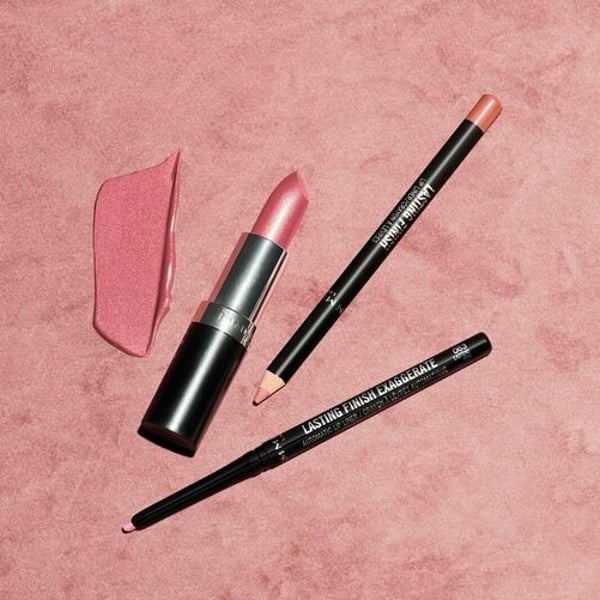
Analysts weigh in on Coty’s consumer beauty review, warning that ageing brands and falling sales could limit valuation and complicate the sale.
Coty’s ageing mass-market brands seen as obstacle in Consumer Beauty sale – Rimmel
Aging brands and declining sales could make Coty’s makeup business a challenging asset to sell, raising the prospect of piecemeal deals or lower-than-expected proceeds that might complicate the group’s plans to reduce debt and invest in growth.
Coty announced on Tuesday that it has launched a review of its mass-market Consumer Beauty business, a precursor to a possible sale or spin-off of some brands, in an effort to reduce debt, reverse declining cash flow, and focus on more profitable fragrances.
The business, home to the CoverGirl and Rimmel brands, generates around $1.2 billion in annual revenue but has been losing market share to competitors with faster innovation cycles and more accessible price points.
Who could buy Coty’s consumer beauty brands?
“It’s hard for these brands because they don’t look new to today’s consumers. And newness is important, especially in color cosmetics,” said Morningstar analyst Dan Su.
Barclays analysts described the division as a “tough asset to sell,” estimating it could be worth anywhere between $690 million and $950 million.
Buyers this year have shown strong interest in smaller, fast-growing brands such as Hailey Bieber’s makeup and skincare line Rhode, which retailer Elf Beauty acquired for $1 billion, and the vitamin A-based skincare brand Medik8, which L’Oréal bought for an estimated $1 billion.
Buyout firms may also consider the division, as seen with private equity house KKR‘s acquisition of a majority stake in Coty’s professional and retail haircare business, Wella, in 2020.
“I expect piecemeal deals rather than a one-shot sale,” said Michael Ashley Schulman, partner and CIO at Running Point Capital Advisors, who named private equity firms Permira and L Catterton as possible suitors.
Coty said it does not comment on speculation. L Catterton declined to comment, and Permira did not immediately respond to a request for comment.
Coty’s Consumer Beauty business reported an 8% drop in sales in the year ended June 30. Morningstar analysts expect another high-single-digit percentage decline this financial year as the company struggles to compete with social-media-influencer-driven brands that sell through fast-growing online channels.
Coty’s in-house manufacturing has made it slower to innovate compared with firms such as Elf Beauty, which rely on third-party producers, said Bank of America analyst Anna Lizzul. “It’s a melting iceberg situation,” she added.
Coty came late to shifting fragrance trends
Coty became a beauty industry giant after buying Procter & Gamble’s perfume, haircare and makeup businesses for $12.5 billion in 2015. After divesting haircare and now possibly consumer cosmetics, fragrance will become its primary focus.
Its newly combined fragrance division accounts for 69% of Coty’s sales and, with categories growing between 2% and 9%, is performing far better than Coty’s consumer cosmetics.
However, it relies heavily on licenses, about 14% of which will expire in the next three and a half years, according to Bank of America.
The blockbuster licence for Gucci fragrances, which analysts believe runs until 2028, generates about $500 million a year — almost double Coty’s free cash flow of $277.6 million in its last financial year.
Selling the makeup business could provide funds for what some analysts say is a much-needed investment.
“It would have probably helped to do this strategic review 10 years ago,” said Alfonso Emanuele de Leon, a beauty industry veteran and partner at FA Hong Kong Consultancy. “Most importantly, when it was becoming clear that the fragrance market was moving towards conceptual, experiential brands.”
Top sector player L’Oréal has invested in niche Chinese fragrance brands To Summer and Documents; Estée Lauder has invested in fellow Chinese brand Melt Season; and Spanish rival Puig has acquired a majority stake in Sweden’s Byredo.
Coty should have recognized earlier that its fragrance segment was shrinking and made acquisitions as well, de Leon said. “They can still do it; it’s just going to be more expensive and maybe too late because the wave has already reached the shore.”
The demerger of Unilever‘s ice cream division, to be named ‘The Magnum Ice Cream Company,’ which had been delayed in recent months by the US government shutdown, will finally go ahead on Saturday, the British group announced.
Reuters
Unilever said in a statement on Friday that the admission of the new entity’s shares to listing and trading in Amsterdam, London, and New York, as well as the commencement of trading… is expected to take place on Monday, December 8.
The longest federal government shutdown in US history, from October 1 to November 12, fully or partially affected many parts of the federal government, including the securities regulator, after weeks without an agreement between Donald Trump‘s Republicans and the Democratic opposition.
Unilever, which had previously aimed to complete the demerger by mid-November, warned in October that the US securities regulator (SEC) was “not in a position to declare effective” the registration of the new company’s shares. However, the group said it was “determined to implement in 2025” the separation of a division that also includes the Ben & Jerry’s and Cornetto brands, and which will have its primary listing in Amsterdam.
“The registration statement” for the shares in the US “became effective on Thursday, December 4,” Unilever said in its statement. Known for Dove soaps, Axe deodorants and Knorr soups, the group reported a slight decline in third-quarter sales at the end of October, but beat market expectations.
Under pressure from investors, including the activist fund Trian of US billionaire Nelson Peltz, to improve performance, the group last year unveiled a strategic plan to focus on 30 power brands. It then announced the demerger of its ice cream division and, to boost margins, launched a cost-saving plan involving 7,500 job cuts, nearly 6% of the workforce. Unilever’s shares on the London Stock Exchange were steady on Friday shortly after the market opened, at 4,429 pence.
This article is an automatic translation. Click here to read the original article.
Burberry has named a new chief operating and supply chain officer as well as a new chief customer officer. They’re both key roles at the recovering luxury giant and both are being promoted from within.
Matteo Calonaci becomes chief operating and supply chain officer, moving from his role as senior vice-president of strategy and transformation at the firm.
In his new role, he’ll be oversee supply chain and planning, strategy and transformation, and data and analytics. He succeeds Klaus Bierbrauer, who’s currently Burberry supply chain and industrial officer. Bierbrauer will be leaving the company following its winter show and a transition period.
Matteo Calonaci – Burberry
Meanwhile, Johnattan Leon steps up as chief customer officer. He’s currently currently Burberry’s senior vice-president of commercial and chief of staff. In his new role he’ll be leading Burberry’s customer, client engagement, customer service and retail excellence teams, while also overseeing its digital, outlet and commercial operations.
Both Calonaci and Leon will join the executive committee, reporting to Company CEO Joshua Schulman.
JohnattanLeon – Burberry
Schulman said of the two execs that the appointments “reflect the exceptional talent and leadership we have at Burberry. Both Matteo and Johnattan have been instrumental in strengthening our focus on executional excellence and elevating our customer experience. Their deep understanding of our business, our people, and our customers gives me full confidence that their leadership will help drive [our strategy] Burberry Forward”.
Traditional and occasion wear designer Puneet Gupta has stepped into the world of fine jewellery with the launch of ‘Deco Luméaura,’ a collection designed to blend heritage and contemporary aesthetics while taking inspiration from the dramatic landscapes of Ladakh.
Hints of Ladakh’s heritage can be seen in this sculptural evening bag – Puneet Gupta
“For me, Deco Luméaura is an exploration of transformation- of material, of story, of self,” said Puneet Gupta in a press release. “True luxury isn’t perfect; it is intentional. Every piece is crafted to be lived with and passed on.”
The jewellery collection features cocktail rings, bangles, chokers, necklaces, and statement evening bags made in recycled brass and finished with 24 carat gold. The stones used have been kept natural to highlight their imperfect and unique forms and each piece in the collection has been hammered, polished, and engraved by hand.
An eclectic mix of jewels from the collection – Puneet Gupta
Designed to function as wearable art pieces, the colourful jewellery echoes the geometry of Art Deco while incorporating distinctly South Asian imagery such as camels, butterflies, and tassels. Gupta divides his time between his stores in Hyderabad and Delhi and aims to bring Indian artistry to a global audience while crafting a dialogue between designer and artisan.