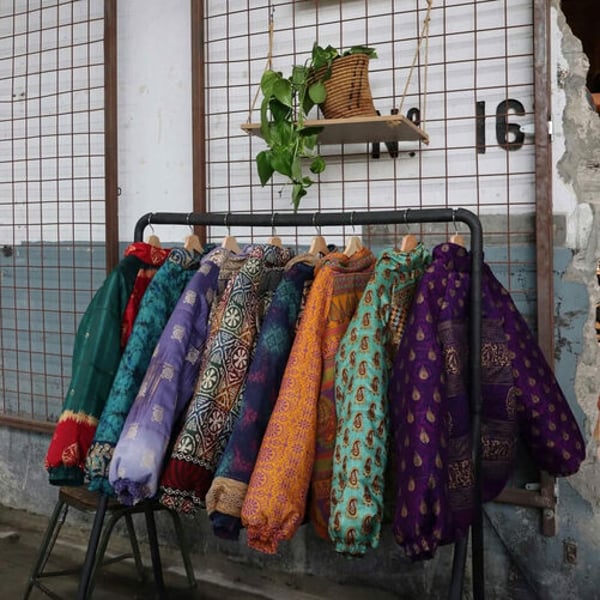
Friends and business partners Ana Abreu and Rita Galamba have just opened, at 8Marvila in Lisbon, the first bricks-and-mortar space for their Portuguese brand, Anahí India — a name that nods to original Indian pieces and to those created from traditional saris, from a country first reached by sea by Vasco da Gama in the 15th century and whose nationals are among the largest immigrant communities in Portugal, alongside Angolans and Brazilians.
Instagram
India is also the guiding inspiration for the entrepreneurial duo’s label, and they now oversee in-house, local production in both countries.
Measuring around 25 square metres, the new shop showcases unisex jackets, dresses and kimonos — a line they began selling nearly a decade ago at music festivals, initially with men’s shirts brought directly from India by the founders. There is no shortage of accessories either, such as sarongs or karnatakas, and jewellery featuring traditional styles and motifs.
The duo opened Anahí India’s debut shop at the end of November, presenting the brand’s full range and making a point of asserting its identity, despite the clean and industrial aesthetic choices of the alternative space, which stand in constant contrast to the vibrant colours and intricate patterns of the recycled and repurposed fabrics used throughout the collections.
In addition to the “unique and exclusive pieces of Indian origin,” Anahí India also offers designs created collaboratively, resulting in styles that both Ana and Rita would wear all year round, in materials such as silk.
Instagram
Another update: until December 12, “we’ll be in Praça D. Luís for the Time Out Lisboa Christmas fair,” the brand announces on its social media channels, inviting you to “discover exclusive pieces and find stylish gifts,” as noted on the brand’s Instagram account.
“And of course… Don’t forget our store at Rua Marvila 8, open from Thursday to Sunday, from 12 noon to 8 pm — always ready to welcome you with the best energy,” the brand added, while also highlighting the goal of continuing to grow online, where it explains: “At the heart of our brand lies a deep commitment to sustainability and the preservation of India’s rich textile heritage,” it said via its website.
“The materials used are, in fact, recycled Indian saris, reimagined and reinvented to create unique fashion pieces. This process not only respects the environment, but also pays homage to the history and art of India.”
According to the website: “The Anahí brand is a story of beauty, culture and sustainability that originated in India, where the charm of recycled Indian saris is transformed into fashion, and which established itself in Portugal in 2017,” it further explained.
“Anahí represents a true fusion of cultures and traditions, with production in both India and Portugal. This intercultural collaboration results in a diverse range of clothing and accessories that combine the essence of East and West.”
OpenAI and Disney announced on Thursday that they have entered into a three-year licensing agreement that will enable the use of Disney’s characters on Sora, a platform for videos created with generative artificial intelligence (AI), a strong signal for the AI content ecosystem.
Disney and OpenAI announced their agreement on Thursday – Sora
Under the partnership, Disney will take a $1 billion equity stake in OpenAI and receive warrants enabling it to acquire additional shares in the company behind ChatGPT at a later date.
Launched at the end of September, Sora positions itself as a social network where only AI-generated videos can be published. The platform runs on OpenAI’s generative video model, Sora 2, successor to the original Sora model, whose generic name has been adopted for the app.
From the outset, Sora featured unauthorised content using brands, the likenesses of public figures, and visual worlds inspired by existing programmes, cartoons, films, and series. Many videos included characters directly inspired by those of Pixar, a Disney subsidiary, as well as several cartoons owned by the entertainment giant, such as ‘Family Guy.’
A few days later, Sam Altman indicated that OpenAI intended to offer rights holders greater control over the use of materials that are theoretically protected by intellectual property rights.
Under the collaboration unveiled on Thursday, Sora users will now be able to create videos drawing on a catalogue of more than 200 characters from the Disney, Marvel, Pixar, and Star Wars universes, according to a joint press release. However, these are limited to animated characters, masked characters or creatures, and do not include real human actors.
“Technological innovation has continually shaped the evolution of entertainment, bringing with it new ways to create and share great stories with the world,” said Robert A. Iger, CEO of The Walt Disney Company, in the release. “Rapid advances in artificial intelligence mark an important moment for our industry, and through this collaboration with OpenAI, we will thoughtfully and responsibly extend the reach of our stories through generative AI, while respecting and protecting creators and their works.”
The tie-up between the two groups goes beyond Sora, as Disney will become a “major customer” of OpenAI. The Burbank, California-based company will give its employees access to ChatGPT and use OpenAI’s models to “create new products, tools and experiences.”
For Sam Altman, also quoted in the press release, this agreement “shows that AI companies and content publishers can work together responsibly to promote innovation.” Sora and ChatGPT Images are expected to begin producing fan-inspired videos featuring Disney’s multi-brand licensed characters in early 2026.
With AFP
This article is an automatic translation. Click here to read the original article.
Sophie Kinsella, the highly popular British author whose bestselling novels have been translated the world over, notably the Shopaholic series, died just before her 56th birthday from a brain tumour she had been diagnosed with in late 2022.
Sophie Kinsella
Kinsella faced her condition with great courage, and described her experience in her last book, published in 2024, poignantly entitled What Does It Feel Like?
“We are heartbroken to announce the death this morning of our beloved Sophie (alias Maddy, alias Mummy),” posted Kinsella’s family, her husband Henry Wickham and their five children, as they gave the news of the author’s passing. “Despite her illness, which she endured with unimaginable courage, Sophie considered herself very fortunate to have such a wonderful family and friends, and to have had an extraordinarily successful writing career. She took nothing for granted and has always been grateful for the love she received,” the family added.
Kinsella, whose real name was Madeleine Sophie Townley, would have turned 56 in two days’ time and, as her family pointed out, she and her loved ones tried to make the most of their final days together. Kinsella, whose books sold 50 million copies and have defined chick lit as a genre, revealed her health problems to her many readers last year. She was diagnosed with glioblastoma, an aggressive form of brain cancer, and underwent surgery as well as several rounds of radiotherapy and chemotherapy.
“I didn’t reveal this earlier because I wanted to make sure my children were able to hear and process the news privately, adapting to our new normal,” she told her community of fans. Many of them, upon learning of the author’s death, paid tribute to her on social media.
The search for positive meaning despite a traumatic illness was at the heart of Kinsella’s last novel, in which the protagonist, a famous writer called Eve, begins to gather the memories of what really matters to her: long walks holding her husband’s hand, evenings spent playing parlour games with her family, and the treat of buying a dress she likes. The novel is made up of short chapters, each attempting to answer the most difficult issues shared by those navigating the labyrinth of pain. The book was also a way of staying close to those dealing with cancer, as Kinsella herself did in some of her statements after she revealed her illness.
Kinsella was born in the London suburb of Wandsworth on December 12, 1970. She graduated in PPE at Oxford University and briefly worked as a finance journalist before starting to write romance novels aged 24. She gained global fame – after publishing a few well-liked novels under her real name – with The Secret Dreamworld of a Shopaholic, published in 2000 as Sophie Kinsella, soon followed by Shopaholic Abroad. Then came another eight titles in the Shopaholic series and 13 standalone novels, from Can You Keep a Secret? (2003) to The Burnout (2023) and What Does It Feel Like? (2024), as well as a handful of young adult novels. The first two Shopaholic books were adapted into the film Confessions of a Shopaholic, released in February 2009 with Isla Fisher in the title role.
In 1991, Kinsella married Henry Wickham, whom she had met at Oxford. Together they had five children, and lived between Dorset and London, where she was treated.
In a crowded sports performancewear market, it’s important to have a strong message. So the Over+Above (O+A) brand is entering a new chapter with the tagline ‘Redefining Performance Wear for Body and Mind’.
Image: Over+Above
The online retailer’s ‘performance-first’ brand (‘created by athletes, for athletes’) is presenting a campaign to “renew its mission” by introducing ‘Freedom in Mind’ as a “bold creative campaign that signals a decisive evolution for the brand: performance isn’t only physical, it’s deeply human”.
This new chapter also marks the start of a series of ambassadorships, with ex-England rugby union captain Chris Robshaw joining in a creative partnership with endurance athlete and brand ambassador Ryan Libbey, “whose personal fitness journey and alignment with O+A’s values inspired the collaboration”.
The first of the campaign films was shot in the Peak District, following Libbey as he trained for an Iron Man challenge, “capturing not only the physical demands but also the emotional depth behind performance training”.
Through his journey, O+A “delves into the highs and lows of sport”, namely the vulnerability, setbacks, discipline, and breakthroughs, “experiences that the brand’s CEO, ex-England cricketer Matt Prior, and its ambassadors “understand intimately”.
At the heart of the campaign sits the ‘Director’s Cut’, “a more personal, direct, and fluid interpretation that weaves these layers into one cohesive narrative”.
At the core of the brand’s innovation lies its “market-leading” ProPrio product range that has been “anatomically engineered with patented kinesiology-inspired technology” that claims to have “already set a new benchmark in performance and compressionwear”.
The range includes full tights, half tights, calf sleeves, long-and short-sleeve tops and racquet sleeves, at oaperformance.com in sizes XS to XXL.