Connect with us

Business

An AI-generated version of Trump’s voice is used an ad that promises an ‘all new Fannie Mae’

Published

on


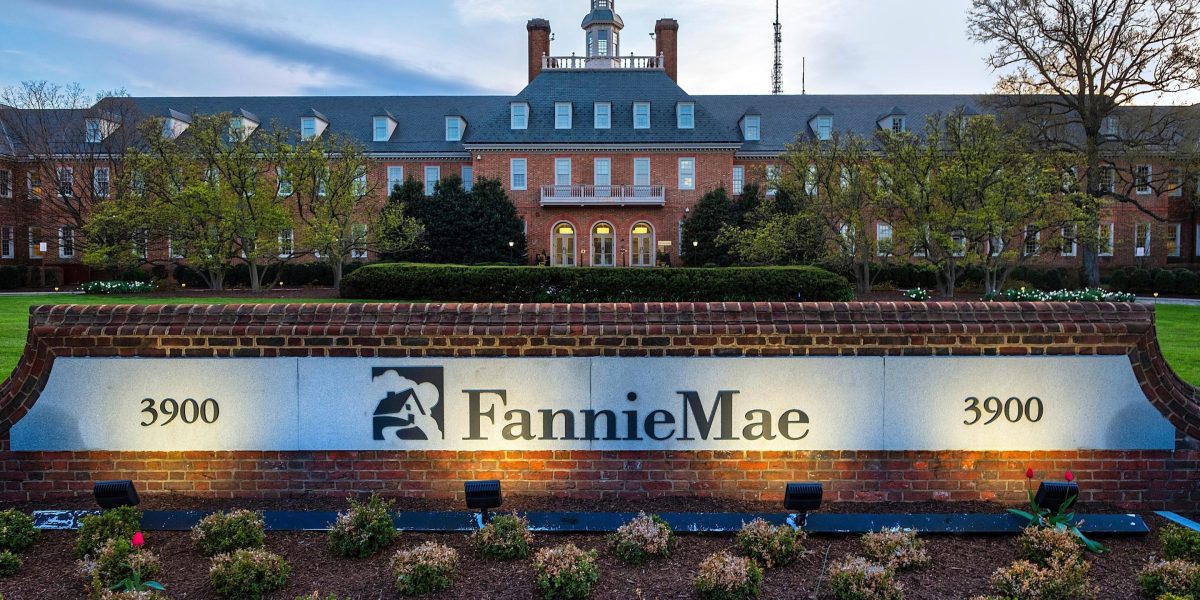
What sounds like President Donald Trump narrating a new Fannie Mae ad actually is an AI-cloned voice reading text, according to a disclaimer in the video.

The voice in the ad, created with permission from the Trump administration, promises an “all new Fannie Mae” and calls the institution the “protector of the American Dream.” The ad comes as the administration is making a big push to show voters it is responding to their concerns about affordability, including in the housing market.

Trump plans to talk about housing at his appearance at the World Economic Forum in Davos, Switzerland, where world leaders and corporate executives meet this week.

This isn’t the first time a member of the Trump family has used AI to replicate their voice, First Lady Melania Trump recently employed AI technology firm Eleven Labs to help voice the audio version of her memoir. It’s not known who cloned President Trump’s voice for the Fannie Mae ad.

The White House did not respond to a request for comment.

Last month, Trump pledged in a prime-time address that he would roll out “some of the most aggressive housing reform plans in American history.”

“For generations, home ownership meant security, independence, and stability,” Trump’s digitized voice says in the one-minute ad aired Sunday. “But today, that dream feels out of reach for too many Americans not because they stopped working hard but because the system stopped working for them.”

Fannie Mae and its counterpart Freddie Mac, which have been under government control since the Great Recession, buy mortgages that meet their risk criteria from banks, which helps provide liquidity for the housing market. The two firms guarantee roughly half of the $13 trillion U.S. home loan market and are a bedrock of the U.S. economy.

The ad says Fannie Mae will work with the banking industry to approve more would-be homebuyers for mortgages.

Trump, Bill Pulte, who leads the Federal Housing Finance Agency, and others have said they want to sell shares of Fannie Mae and Freddie Mac on a major stock exchange but no concrete plans have been set.

Trump and Pulte have also floated extending the 30-year mortgage to 50 years in order to lower monthly payments. Trump appeared to back off the proposal after critics said a longer-term loan would reduce people’s ability to create housing equity and increase their own wealth.

Trump also said on social media earlier this month that he was directing the federal government to buy $200 billion in mortgage bonds, a move he said would help reduce mortgage rates at a time when Americans are anxious about home prices. Trump said Fannie Mae and Freddie Mac have $200 billion in cash that will be used to make the purchase.

Earlier this month, Trump also said he wants to block large institutional investors f rom buying houses, saying that a ban would make it easier for younger families to buy their first homes.

Trump’s permission for the use of AI is interesting given that he has complained about aides in the Biden administration using autopen to apply the former president’s signature to laws, pardons or executive orders. An autopen is a mechanical device that is used to replicate a person’s authentic signature.

However, a report issued by House Republicans does not include any concrete evidence that autopen was used to sign Biden’s name without his knowledge.


Source link

Continue Reading

Business

After adding Trump administration statements, ’60 Minutes’ to air report on deportations

Published

on


“60 Minutes” on Sunday plans to air a story about Trump administration deportations that was abruptly pulled from the newsmagazine’s lineup a month ago, sparking an internal battle about political pressure that spilled out into the open.

In the story, correspondent Sharyn Alfonsi spoke to deportees who had been sent to El Salvador’s notoriously harsh CECOT prison. When the segment critical of the administration was struck from the Dec. 21 episode on order of new CBS News editor-in-chief Bari Weiss, Alfonsi told her “60 Minutes” colleagues that it “was not an editorial decision, it was a political one.”

Weiss argued that the story did not sufficiently reflect the administration’s viewpoint or advance reporting that had been done by other news organizations earlier.

The story was updated to include Trump administration statements, although it has no new on-camera interviews. Alfonsi was also set to give more details about the two migrants that she interviewed about their experiences in the prison, according to someone familiar with the broadcast who spoke under condition of anonymity because the person was not allowed to give details in advance.

“CBS News leadership has always been committed to airing the ’60 Minutes’ CECOT piece as soon as it was ready,” the news division said in a statement. “Tonight, viewers get to see it, along with other important stories, all of which speak to CBS News’ independence and the power of our storytelling.”

The decision became a flashpoint for critics who said the appointment of Weiss, founder of the Free Press website who had no previous experience in television news, represented an attempt by the network’s new corporate leadership to curry favor with Trump.

Alfonsi said in her email that administration officials had declined to make anyone available for an on-camera interview, calling that a tactical maneuver designed to kill the story.

While pulled from the broadcast in December, Alfonsi’s original story mistakenly became available online. CBS News had fed a version of the newsmagazine to Global Television, a network that airs “60 Minutes” in Canada, which posted it on its website before the last-minute switch removing the piece.

That enabled sharp-eyed viewers to see what Weiss had rejected, offering the opportunity to compare it to what “60 Minutes” eventually put on the air.

In the version shown in Canada, Alfonsi said the administration declined requests for interviews and referred questions about the prison’s operation to the government of El Salvador, which did not respond to “60 Minutes.” The story included a brief clip of President Donald Trump saying the prison operators “don’t play games,” and one from White House press secretary Karoline Leavitt saying that “heinous monsters, rapists, murderers, sexual assaulters, predators who have no right to be in this country” were sent there.

Since Weiss’ appointment, Trump administration officials have been more visible on CBS News, in interviews that she sometimes helped arrange. The president himself was interviewed by Norah O’Donnell on “60 Minutes” on Nov. 2.

The New York Times reported Saturday that after Trump was interviewed last week by new “CBS Evening News” anchor Tony Dokoupil, Leavitt told the network that “we’ll sue your ass off” if the exchange wasn’t aired in full.

All of the 13-minute interview was shown Tuesday, an unusual step for one of the broadcast networks’ evening newscasts, a half hour summary of the day’s big stories. CBS told The Times that it had decided to run the interview unedited at the time it was booked.


Source link

Continue Reading

Business

Down Arrow Button Icon

Published

on


President Donald Trump’s feud with NATO over his plans to take over Greenland has precipitated an existential crisis for the alliance that Russia is celebrating.

On Saturday, Trump announced tariffs targeting NATO countries that deployed troops to the semi-autonomous Danish territory, until a “Deal is reached for the Complete and Total purchase of Greenland.”

That drew cheers from Kirill Dmitriev, Russian Vladimir Putin’s envoy for investment and economic cooperation. Meanwhile, the European Union is weighing options to retaliate.

“Collapse of the transatlantic union,” he posted on X. “Finally—something actually worth discussing in Davos.”

NATO has been a key supporter of Ukraine as it fights off Russia’s invasion, which began nearly four years ago. And while Trump has previously sparked trade tension with Europe, NATO allies have helped maintain U.S. support for Kyiv, though he has often withheld it.

The current tariff battle, however, threatens irreparable harm to the alliance, representing its worst schism in its nearly 80-year history.

If Trump’s trade war jeopardizes NATO’s assistance for Ukraine, it could relieve pressure on Russia’s economy, just as more signs emerge that Putin’s war machine is stifling growth. GDP for 2025 is expected to show a 1% gain or less, and 2026 is headed for a similar crawl. That’s after spurts of more than 4% in 2023 and 2024.

“The Russian people are increasingly feeling the effects of the Kremlin’s continued prioritization of the Russian defense industrial base,” the Institute for the Study of War said in a recent analysis.

Weapons makers and other suppliers are booming as the Kremlin funnels investments and loans to those industries. But the rest of the economy is suffering.

For example, ISW pointed out that rising wages are fueling inflation as the war causes labor shortages while defense and civilian firms compete for workers. Soaring inflation forced Russia’s central bank to lift interest rates to shy-high levels that have only recently started to come down.

And in the second half of last year, several major Russian civilian manufacturers switched to four-day workweeks and announced layoffs due to falling demand.

As borrowing costs jump, Russian civilians are struggling to buy homes. On top of high prices, the value-added tax rate has gone up to help pay for the Ukraine war while Western sanctions and low crude oil prices have diminished Moscow’s revenue from energy exports.

“ISW continues to assess that increased Western economic pressure on Russia, along with helping Ukraine maintain and even increase pressure on the battlefield, remains critical to changing Putin’s calculus and forcing Putin to face more serious tradeoffs between continuing to pursue his maximalist war aims and sacrificing the quality of life of the Russian people,” the analysis said.

The assessment follows evidence of increasing strain in throughout the private sector, including the financial system.

Russian data show unpaid wages nearly tripled in October from a year ago to more than $27 million, with furloughs and shorter workweeks becoming more common. As a result, more consumers are having trouble servicing their loans. 

“A banking crisis is possible,” a Russian official told the Washington Post recently on condition of anonymity. “A nonpayments crisis is possible. I don’t want to think about a continuation of the war or an escalation.”

Given the headwinds, the warning wasn’t the first of its kind. In June, Russian banks raised red flags on a potential debt crisis as high interest rates weigh on borrowers’ ability to service loans.

Also that month, the head of the Russian Union of Industrialists and Entrepreneurs warned many companies were in “a pre-default situation.”

And in September, Sberbank CEO German Gref, one of Russia’s top banking chiefs, said the economy was in “technical stagnation,” following his warnings in July and August that growth was close to zero.

The Center for Macroeconomic Analysis and Short-Term Forecasting, a state-backed Russian think tank, said last month the country could face a banking crisis by next October if loan troubles worsen and depositors pull out their funds, according to the Post.

“The situation in the Russian economy has deteriorated markedly,” wrote Dmitry Belousov, head of the think tank, in a note seen by the Financial Times. “The economy has entered the brink of stagflation for the first time since early 2023.”


Source link

Continue Reading

Business

EU mulls responding to Trump by reviving €93 billion tariff move

Published

on


European Union member states are discussing several options for how to respond to President Donald Trump’s latest tariff threat, including imposing retaliatory levies on €93 billion ($108 billion) of US goods, according to people familiar with the talks.

EU ambassadors met Sunday evening in Brussels as they tried to devise a joint response to Trump’s announcement that he would put 10% tariffs on eight European countries on Feb. 1 in relation to their actions in Greenland.

Among the other options being discussed is using a powerful tool known as the anti-coercion instrument, added the people, who asked not to be identified discussing sensitive conversations. French President Emmanuel Macron suggested on Sunday the bloc should consider using that new tool, although France backed away from using it in the past after Trump threatened to retaliate.

Last year, the EU had approved retaliatory tariffs on €93 billion of US products but suspended their implementation after the two sides reached a trade pact. European lawmakers suggested over the weekend that they will hold off on approving that trade pact, citing Trump’s latest move. 

The Financial Times reported earlier on the discussions over reviving retaliatory tariffs.

This story was originally featured on Fortune.com


Source link

Continue Reading

Trending

Copyright © Miami Select.