Connect with us

Business

America’s pediatricians reel as government slashes vaccine requirements for children

Published

on


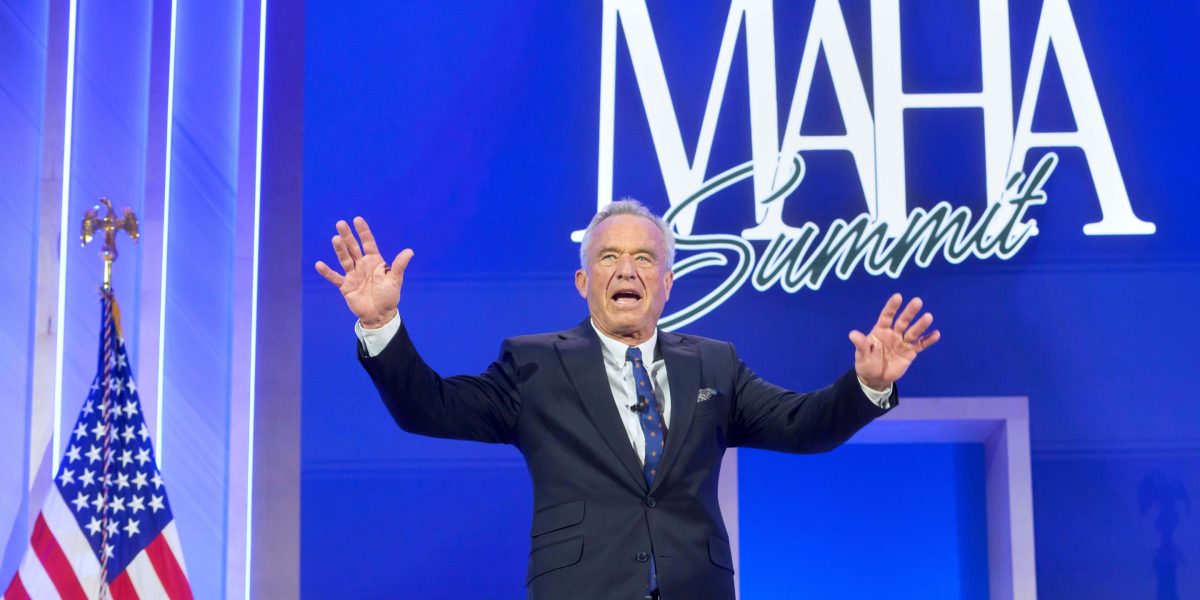
The U.S. took the unprecedented step Monday of dropping the number of vaccines it recommends for every child — cutting protection against a half-dozen diseases in a move slammed by the nation’s pediatricians.

The overhaul is effective immediately, meaning that the Centers for Disease Control and Prevention will now recommend vaccines against 11 diseases. What’s no longer broadly recommended is protection against flu, rotavirus, hepatitis A, hepatitis B, some forms of meningitis or RSV. Instead, protections against those diseases are only recommended for certain groups deemed high-risk, or if their doctors recommend them in what’s called “shared decision-making.”

Trump administration officials said the overhaul, a move long sought by Health Secretary Robert F. Kennedy Jr., won’t result in families who want the vaccines losing access to them, and said insurance will continue to pay. But medical experts said the move increases confusion for parents and could increase preventable diseases.

The change came after President Donald Trump in December asked the U.S. Department of Health and Human Services to review how peer nations approach vaccine recommendations and consider revising its guidance to align with theirs.

HHS said its comparison to 20 peer nations found that the U.S. was an “outlier” in both the number of vaccinations and the number of doses it recommended to all children. Officials with the agency framed the change as a way to increase public trust by recommending only the most important vaccinations for children to receive.

Among those left on the recommended-for-everyone list are measles, whooping cough, polio, tetanus, chickenpox and HPV.

“This decision protects children, respects families, and rebuilds trust in public health,” Kennedy said in a statement Monday.

Medical experts disagreed, saying the change without public discussion or a transparent review of the data would put children at risk.

Dr. Sean O’Leary of the American Academy of Pediatrics said countries carefully consider vaccine recommendations based on levels of disease in their populations and their health systems.

“You can’t just copy and paste public health and that’s what they seem to be doing here,” said O’Leary. “Literally children’s health and children’s lives are at stake.”

The new guidance also reduces the number of recommended vaccine doses against human papillomavirus from two or three shots to one for most children, depending on age.

The decision was made without input from an advisory committee that typically consults on the vaccine schedule, said senior officials at HHS. The officials spoke on the condition of anonymity because they weren’t authorized to discuss the changes publicly.

“Abandoning recommendations for vaccines that prevent influenza, hepatitis and rotavirus, and changing the recommendation for HPV without a public process to weigh the risks and benefits, will lead to more hospitalizations and preventable deaths among American children,” said Michael Osterholm of the Vaccine Integrity Project, based at the University of Minnesota.

This story was originally featured on Fortune.com


Source link

Continue Reading

Business

Down Arrow Button Icon

Published

on


Hello and welcome to Eye on AI. In this edition….Google launches the ability to make purchases directly from Google Search’s AI Mode and Gemini…Apple selects Google to power an upgraded Siri…Meta announces a new AI infrastructure team…researchers use AI to find new ways to edit genes.

It was another week with a lot of AI-related announcements. Among the bigger news items was Google’s launch of an e-commerce shopping checkout feature directly from Google Search’s AI Mode and its Gemini chatbot app. Among the first takers for the new feature is retail behemoth Walmart, so this is a big deal. Behind the scenes, the AI checkout is powered by a new “Universal Commerce Protocol” that should make it easier for retailers to support agentic AI sales. Google Cloud also announced a bunch of AI features to support agentic commerce for customers, including a new Gemini Enterprise for Customer Experience product that combines shopping and customer support (watch this space—the combination of those two previously separate functions could have big implications for the way many businesses are organized.) Home Depot was one of the first announced customers for this new cloud product.

It’s still early days for agentic commerce, but already many companies are panicking about how they make sure their products and sites surface highly in what these AI agents might recommend to users. A nascent industry of companies has sprung up offering what are variously called “generative engine optimization” (GEO) or “generative-AI optimization” (GAIO) services. Some of these echo longstanding internet search optimization strategies, but with a few key differences. GEO seems, at least for now, somewhat harder to game than SEO. Chatbots and AI agents seem to care a lot about products that have received positive earned media attention from reputable news outlets (which should be a good thing for consumers—and for media organizations!) as well as those that rank highly in trusted customer review sites.

But the world of AI-mediated commerce presents big governance risks that many companies may not fully understand, according to Tim de Rosen, the founder of a company called AIVO Standard, which offers companies a method for generative AI optimization and also a way to track and hopefully govern what information AI agents are using.

The problem, de Rosen told me in a phone call last week, is that while various AI models tend to be consistent in how they characterize a brand’s product offerings—usually correctly reporting the nature of a product, its features, and how those features compare to competing products and can usually provide citations to the sources of that information—they are inconsistent and error-prone when asked questions that pertain to a company’s financial stability, governance, and technical certifications. Yet this information can play a significant role in major procurement decisions.

AI models are less reliable on financial and governance questions

In one example, AIVO Standard assessed how frontier AI models answered questions about Ramp, the fast-growing business expense management software company. AIVO Standard found that models could not reliably answer questions about Ramp’s cybersecurity certifications and governance standards. In some cases, de Rosen said, this was likely to subtly push enterprises towards procurement decisions involving larger, publicly traded, incumbent businesses—even in cases when a privately-held upstart also met the same standards—simply because the AI models could not accurately answer questions about the younger, privately-held company’s governance and financial suitability or cite sources for the information they did provide.

In another example, the company looked at what AI models said about the risk factors of rival weight loss drugs. It found that AI models did not simply list risk factors, but slipped into making recommendations and judgments about which drug was likely the “safer choice” for the patient. “The outputs were largely factual and measured, with disclaimers present, but they still shaped eligibility, risk perception, and preference,” de Rosen said.

AIVO Standard found that these problems held across all the leading AI models and a variety of different prompts, and that they persisted even when the models were asked to verify their answers. In fact, in some cases, the models would tend to double-down on inaccurate information, insisting it was correct.

GEO is still more art than science

There are several implications. One, for all the companies selling GEO services, is that GEO may not work well across different aspects of brand information. Companies shouldn’t necessarily trust a marketing tech firm that says it can show them how their brand is showing up in chatbot responses, let alone believe that the marketing tech company has some magic formula for reliably shaping those AI responses. Prompt results may vary considerably, even from one minute to the next, depending on what type of brand information is being assessed. And there’s not much evidence yet on how exactly to steer chatbot responses for non-product information.

But the far bigger issue is that there is a moment in many agentic workflows—even those with a human in the loop—where AI-provided information becomes the basis for decision making. And, as de Rosen says, currently most companies don’t really police the boundaries between information, judgment, and decision-making. They don’t have any way of keeping track of exactly what prompt was used, what the model returned in response, and exactly how this fed into the ultimate recommendation or decision. In regulated industries such as finance or healthcare where, if something goes wrong, regulators are going to ask for exactly those details. And unless regulated enterprises implement systems for capturing all of this data, they are headed for trouble.

With that, here’s more AI news.

Jeremy Kahn
jeremy.kahn@fortune.com
@jeremyakahn

FORTUNE ON AI

Anthropic launches Claude Cowork, a file-managing AI agent that could threaten dozens of startups—by Beatrice Nolan

U.K. investigation into X over allegedly illegal deepfakes risks igniting a free speech battle with the U.S.—by Beatrice Nolan

Malaysia and Indonesia move to ban Musk’s Grok AI over sexually explicit deepfakes—Angelica Ang

Anthropic unveils Claude for Healthcare, expands life science features, and partners with HealthEx to let users connect medical records—by Jeremy Kahn

AI IN THE NEWS

Apple chooses Google’s AI for updated Siri. Apple signed a multi-year partnership with Google to power key AI features in its products, including a long-awaited Siri upgrade, the companies announced on Monday. The deal underscores Google’s resurgence in AI and helped push the market value of Google-parent Alphabet above the $4 trillion threshold. Apple said the agreement does not change its existing partnership with OpenAI, under which Siri currently hands off some queries to ChatGPT, though it remains unclear how the Google tie-up will shape Siri’s future AI integrations. The financial terms of the deal were not disclosed either, although Bloomberg previously reported that Apple was considering paying Google as much as $1 billion per year to access its AI models for Siri.

Meta announces new AI infrastructure team, including former Trump advisor. The social media giant said it was creating a new top-level initiative called Meta Compute to secure tens—and eventually hundreds—of gigawatts of data center capacity. The effort is being led by Daniel Gross, a prominent AI tech executive and investor who Meta had hired to help its Superintelligence Labs effort, and Santosh Janardhan, who is the company’s head of infrastructure. CEO Mark Zuckerberg said the way Meta builds and finances data centers will become a key strategic advantage, as the company pours money into facilities such as a $27 billion data center in Louisiana and nuclear-power partnerships to meet energy demand. Meta also named Dina Powell McCormick, who served in several key positions during the first Trump administration, as president and vice chair to help forge government partnerships and guide strategy, reporting directly to Zuckerberg. You can read more from the Wall Street Journal here.

Microsoft warns that DeepSeek is proving popular in emerging markets. Research published by Microsoft shows that U.S. AI companies are losing ground to Chinese rivals in emerging markets. The low-cost of open models built in China, such as DeepSeek, is proving decisive in spurring adoption in places such as Ethiopia, Zimbabwe, and Turkmenistan. Microsoft president Brad Smith said Chinese open-source models now rival U.S. offerings on performance while undercutting them on price, helping China overtake the U.S. in global usage of “open” AI, especially across Africa and other parts of the global south. By contrast, U.S. firms like OpenAI, Google, and Anthropic have focused on closed, subscription-based models—raising concerns that without greater investment, the AI divide between rich and poor countries will widen, and that U.S. companies may ultimately see their growth limited to more developed markets. Read more from the Financial Times here.

Salesforce launches updated Slackbot powered by Anthropic’s Claude. Salesforce is rolling out an upgraded Slackbot for Business+ and Enterprise+ customers that uses generative AI to answer questions and surface information across Slack, Salesforce, and connected services like Google Drive and Confluence. The new Slackbot is powered primarily by Anthropic’s Claude model. The company says the AI assistant respects user permissions and is designed to reduce reliance on external tools such as ChatGPT by working directly inside Slack, which Salesforce acquired for $27.1 billion in 2021. The launch comes as investors remain skeptical about enterprise software firms’ ability to benefit from the AI boom, with Salesforce shares down sharply over the past year despite its push to get businesses to adopt its “Agentforce” AI agents. Read more from CNBC here.

EYE ON AI RESEARCH

Microsoft, Nvidia and U.K. startup Basecamp Research make AI-aided breakthrough in gene editing. An international research team including scientists from Nvidia and Microsoft has used AI to mine evolutionary data from more than a million species to design potential new gene-editing tools and drug therapies. The team developed a set of AI models, called Eden, which were trained on a vast, previously unpublished biological dataset assembled by Basecamp. Nvidia’s venture capital arm is an investor in Basecamp.

The AI models can generate novel enzymes for large, precise gene insertions that could improve the ability of the body’s immune cells to target cancerous tumors. Basecamp has demonstrated the effectiveness of these gene-edited cells in laboratory tests so far, but they have not been tested in people. The Eden-designed gene editing enzymes can also make genetic edits that allow cells to produce peptides that can fight drug-resistant bacteria. Researchers say the work could dramatically expand the range of treatable cancers and genetic diseases by overcoming long-standing data and technical constraints in gene therapy. Experts caution, however, that the clinical impact will depend on further validation, safety testing, and regulatory and manufacturing hurdles. You can read more from the Financial Times

AI CALENDAR

Jan. 19-23: World Economic Forum, Davos, Switzerland.

Jan. 20-27: AAAI Conference on Artificial Intelligence, Singapore.

Feb. 10-11: AI Action Summit, New Delhi, India.

March 2-5: Mobile World Congress, Barcelona, Spain.

March 16-19: Nvidia GTC, San Jose, Calif.

BRAIN FOOD

What if people prefer AI-written fiction, or simply can’t tell the difference? That’s the question that New Yorker writer Vaudhini Vara asks in a provocative essay that was published as a “Weekend Essay” on the magazine’s website a few weeks ago. While out-of-the-box AI models continue to struggle to produce stories as convincing as graduates of top MFA programs and experienced novelists, it turns out that when you fine-tune these models on an existing author’s works, they can produce prose that is often indistinguishable from what the original author might create. Disconcertingly, in a test conducted by researcher Tuhin Chakrabarty— who has conducted some of the best experiments to date on the creative writing abilities of AI models—and which Vara repeats herself in a slightly different form, even readers with highly-attuned literary sensibilities (such as MFA students) prefer the AI written versions to human-authored prose. If that’s the case, what hope will there be for authors of genre fiction or romance novels?

I had a conversation a few months ago with a friend who is an acclaimed novelist. He was pessimistic about whether future generations would value human-written literature. I tried to argue that readers will always care about the idea that they are in communication with a human author, that there is a mind with lived experience behind the words. He was not convinced. And increasingly, I’m worried his pessimism is well-founded.

Vara ultimately concludes that the only way to preserve the idea of literature as the transmission of lived experience across the page, is for us to collectively demand it (and possibly even ban the fine-tuning of AI models on the works of existing writers.) I am not sure that’s realistic. But it may be the only choice left to us.

FORTUNE AIQ: THE YEAR IN AI—AND WHAT’S AHEAD

Businesses took big steps forward on the AI journey in 2025, from hiring Chief AI Officers to experimenting with AI agents. The lessons learned—both good and bad–combined with the technology’s latest innovations will make 2026 another decisive year. Explore all of Fortune AIQ, and read the latest playbook below: 

The 3 trends that dominated companies’ AI rollouts in 2025.

2025 was the year of agentic AI. How did we do?

AI coding tools exploded in 2025. The first security exploits show what could go wrong.

The big AI New Year’s resolution for businesses in 2026: ROI.

Businesses face a confusing patchwork of AI policy and rules. Is clarity on the horizon?


Source link

Continue Reading

Business

Down Arrow Button Icon

Published

on


Delta Air Lines just capped its centennial year with record revenue, record free cash flow, and a fresh jet order, even as its CEO warns that the “bottom end” of the industry is “struggling greatly” and Wall Street remains on edge over tariffs and the fragile economics of budget flying.

America’s most profitable airline used its fourth‑quarter 2025 earnings call on Tuesday to argue that premium-seeking, high‑income travelers—and the loyalty ecosystem built around them—are insulating it from the turbulence battering lower‑cost rivals and jittery investors.​​ CEO Ed Bastian also talked openly about the struggles elsewhere in the industry. “The bottom end of the industry on the commodity side of the business has been struggling greatly,” he told analysts on the earnings call. The economic woes of average Americans don’t seem to be hitting Delta’s profits, though.

Delta said it expects adjusted earnings per share to come in between $6.50 to $7.50 in 2026, versus $5.82 for 2025. Those are impressive numbers, and would be a record for Delta, but the airline guided to $6 per share in October 2025 and guided to more than $7.35 per share for 2025 before tariffs started to bite. Traders sent Delta shares down more than 3% because even another year of high profits aren’t matching the Atlanta flagship carrier’s pre-tariff guidance.

Record year at 30,000 feet

Delta reported record full‑year revenue of $58.3 billion in 2025, up 2.3% year‑over‑year, with a 10% operating margin and $5 billion in pre‑tax income, cementing its status as the U.S. industry’s profit leader. Free cash flow hit $4.6 billion, the highest in Delta’s history, helping the carrier cut leverage by more than half over three years and leaving it with what executives called the strongest balance sheet and credit quality it has ever had.​​

In the December quarter, Delta generated $14.6 billion in revenue—also a record—while delivering a 10% operating margin and earnings of $1.55 per share, modestly above expectations despite a revenue miss and disruption from a government shutdown and FAA‑mandated flight reductions. The company is guiding investors to 20% earnings‑per‑share growth in 2026, with $3 billion–$4 billion of free cash flow and about 3% capacity growth, all concentrated in higher‑margin premium cabins.​

Bastian and his executive team were explicit that the engine behind those results is Delta’s premium customer base and an increasingly sophisticated merchandising model that charges more for better seats and flexibility. President Glen Hauenstein, who is retiring next month after two decades shaping the airline’s commercial strategy, said premium revenue grew 7% in 2025 and that diversified, higher‑margin lines—premium, loyalty, cargo, maintenance, and travel products—now account for 60% of total revenue.​​

Delta’s partnership with American Express remains central to this high‑end tilt, with co‑brand remuneration up 11% to 8.2 billion dollars last year on the back of more than 1 million new card acquisitions and double‑digit spend growth every quarter. Roughly one‑third of active SkyMiles members now carry a Delta Amex card, and the airline expects high‑single‑digit growth in co‑brand remuneration in 2026 as it pushes toward a $10 billion target within a few years.​ Hauenstein said Delta sees “significant runway ahead as member engagement and penetration continues to rise.” (Like Delta, American Express has released a string of blowout earnings, driven by increasing spending from the same cohort of affluent Americans willing to spend.)

‘Bottom end’ of industry under pressure

For all the celebration, Bastian used some of his sharpest language yet about the divide opening up within U.S. aviation between premium‑heavy network carriers and budget airlines that rely on rock‑bottom fares. Citing the collapse or restructuring of several low‑cost players and the stalled growth of ultra‑low‑cost carriers, he noted consolidation in the industry earlier this week, with Allegiant and Sun Country announcing a $1.5 billion merger. He said Delta was “waiting to see what happens with Spirit” as the low-cost carrier navigates bankruptcy.

“That sector has been unable to grow here for the last several years,” he concluded, “and when that sector is not growing, it can’t contain its CASM [cost per available seat mile]. Its CASM goes up significantly every quarter, more than ours. And so that’s become a real challenge for that sector in the industry.” In other words, the only game in town for airline profits is more spending by high earners, and it’s fortunate that Delta is poised to capitalize on this amid what economists widely call a “K-shaped economy,” with the affluent thriving and the poor suffering in opposite directions.

Bastian predicted “further rationalization” among carriers that are not earning their cost of capital, saying it could come via consolidation, liquidation, or internal restructurings as investors lose patience with business models built on cheap seats that no longer cover costs. Hauenstein argued that 2025 showed just how wide the gap has become, saying Delta likely captured a higher share of total U.S. airline profits than ever before as competitors were “very challenged.”​​

To this point, Delta’s own Main Cabin customers—who skew more price‑sensitive—remain a weak spot in an otherwise glossy story. Bastian acknowledged that, while revenue trends have sharply accelerated into early 2026 and booking records were set last week, “we have not really seen Main Cabin move yet,” adding that hitting the top of the company’s guidance range “would definitely be the Main Cabin starting to move.”​

That hesitancy comes amid Trump‑era tariffs that rattled markets and travel demand in 2025. Bastian described a year of volatility that delayed what he still sees as an eventual reset in how the bottom tier of the industry is priced. He cautioned that, even with a strong start to the year and corporate clients signaling more travel, Delta must “have a bit of caution” in its outlook after 2025 was knocked off course by policy shocks and economic jitters.​​

All new seat growth this year will be in premium cabins, and executives touted further gains from “merchandising” tools that slice each product into basic, main, and extra tiers, letting customers pay more for perks like earlier seat assignments or refunds. Hauenstein said those retailing initiatives represent “multibillion‑dollar opportunities” in the coming years, promising more revenue from the same travelers even if Main Cabin demand remains slow to catch up.

For this story, Fortune journalists used generative AI as a research tool. An editor verified the accuracy of the information before publishing.


Source link

Continue Reading

Business

Scott Adams, Dilbert creator who went from cubicle wars to culture wars, posts open letter to time with his death at 68

Published

on


“If you are reading this, things did not go well for me.” That’s how Scott Adams’ X account announced his death on Jan. 13, reaching an enormous global audience in much the way he had for decades throughout a career that spanned both the cartoon pages and front pages of newspapers for the controversial personality.

Adams, creator of the satirical office comic strip “Dilbert” and later a polarizing conservative-leaning online commentator, died in Pleasanton, Calif., at 68 from metastatic prostate cancer. His death came after months of rapidly declining health, including paralysis from the waist down and hospice care in his final days.​

Adams’s first ex-wife, Shelly Miles, told TMZ on Jan. 12 Adams had entered hospice care as his condition worsened, and he died the following day. He had publicly disclosed in May 2025 he was battling aggressive prostate cancer that had already spread and said “the odds of me recovering are essentially zero.” In late 2025, Adams described a tumor near his spine that left him paralyzed from the waist down, telling viewers: “I can’t move any muscles. I do have feeling, I just can’t move any muscles.”​

In his final weeks, Adams continued recording and posting YouTube videos from home while receiving end-of-life care, with family members and a nurse tending to him around the clock. On Jan. 13, his X account posted “a final message from Scott Adams,” which was datemarked Jan. 1, describing his evolution from “Dilbertoonist” to what he described as an author of “useful books.” Framing his later career as oriented around helping people, he wrote, “I had an amazing life. I gave it everything I had.”

Appeal for treatment and political ties

Adams used his social media platforms to detail his treatment, including an appeal in November 2025 for access to Pluvicto, an FDA‑approved drug for metastatic prostate cancer. On X, he claimed Kaiser of Northern California had approved the drug, but “dropped the ball” on scheduling the IV, adding, “I am declining fast. I will ask President Trump if he can get Kaiser of Northern California to respond and schedule it for Monday.” Trump reposted Adams’ plea with the response “On it!” on Truth Social, and Health and Human Services Secretary Robert F. Kennedy Jr. also publicly engaged on the issue, after which Adams said an appointment for Pluvicto had been arranged.​

Adams had long cultivated a reputation as an admirer of Trump’s political style and as a commentator on persuasion and media framing, frequently praising Trump’s communication skills. In later updates, Adams told his audience radiation treatments for the spinal tumor had delayed his Pluvicto regimen and left him uncertain whether he had “missed [his] opportunity” with the drug.​

Critics at the time praised the fact Adams was able to receive the treatment, but bemoaned the fact others don’t have the president’s ear—or the means—to access similar treatment.

“Our health system shouldn’t be one where we need the intervention of the president or the HHS secretary to weigh in on behalf of a high-profile political backer,” Anthony Wright, the executive director of Families USA, told NPR.

From office cubicles to culture wars

Born in 1957, Adams worked in corporate offices before launching “Dilbert” in 1989, a strip that skewered white‑collar life and eventually ran in thousands of newspapers worldwide. The popularity of “Dilbert” led to best‑selling books such as “The Dilbert Principle,” speaking engagements, and a media presence that made him one of the most recognizable cartoonists of the 1990s and early 2000s.​

His reputation shifted dramatically in 2023 after a YouTube livestream in which he reacted to a poll about the phrase “It’s OK to be white” with remarks widely condemned as racist, prompting major newspaper chains to drop “Dilbert.” This was far from the first time Adams made shocking comments that leaned in a conservative direction, though. For instance, he said in 2011 women are treated differently by society in a manner similar to children and the mentally disabled: “It’s just easier this way for everyone.” And he once remarked 2016 GOP presidential candidate Carly Fiorina had an “angry wife face.”

Fans and critics alike are now debating how—and whether—to separate the enduring image of the perpetually frustrated office worker from the man who drew him, whose last public acts included a very modern attempt to shape the story of his own illness and death through social media and carefully prepared final statements.


Source link

Continue Reading

Trending

Copyright © Miami Select.