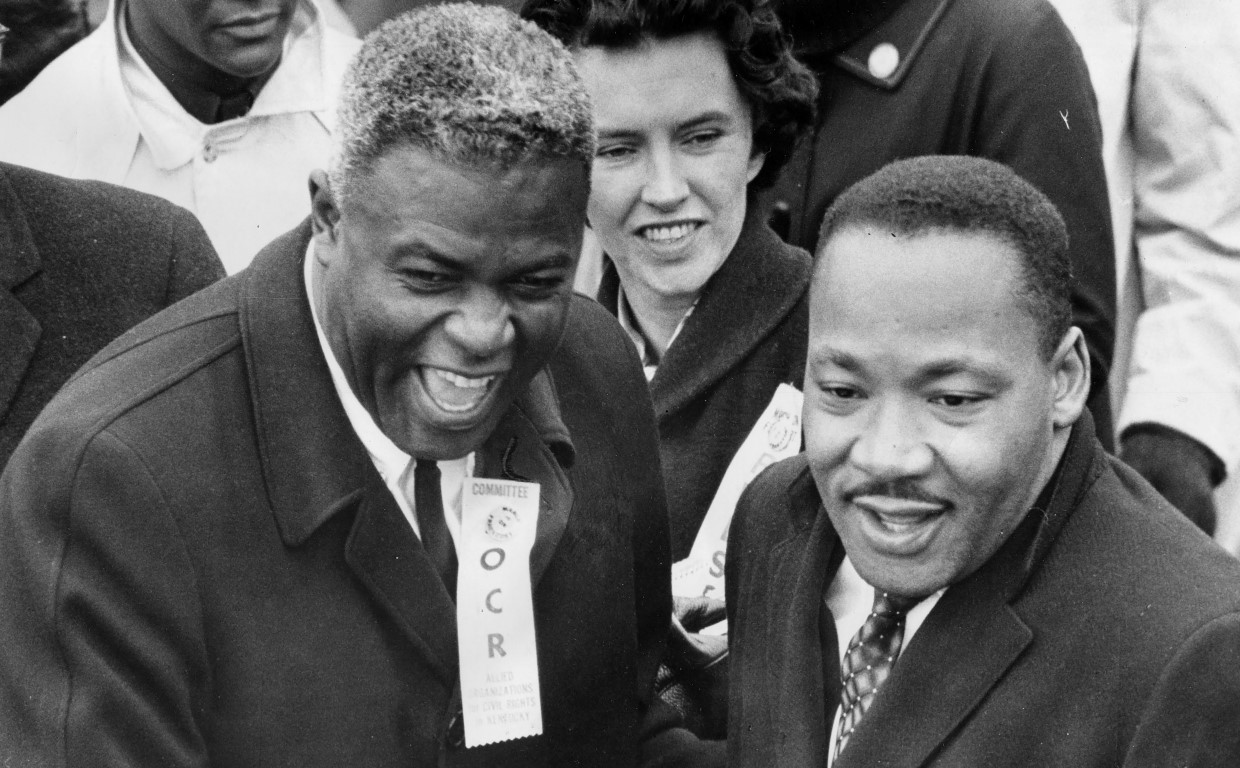
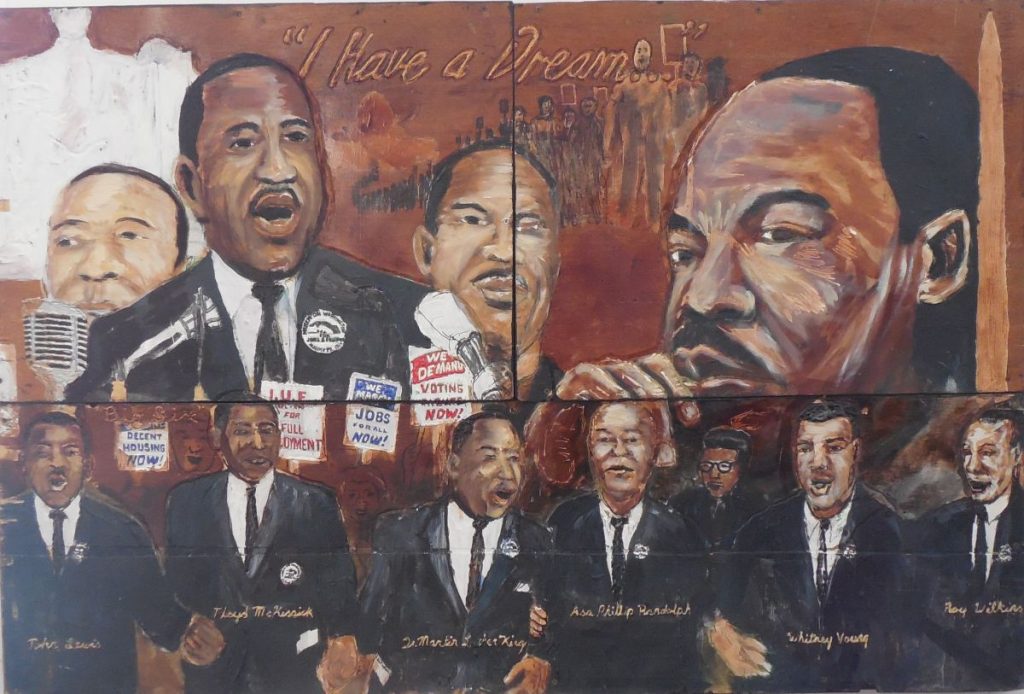
Jackie Robinson and Reverend Dr. Martin Luther King, Jr.
Martin Luther King Jr. had a huge impact on the sports world
Remembering Dr. King Beyond the Playing Field
On January 15, the Reverend Dr. Martin Luther King Jr. would have celebrated his 97th birthday. King never worked directly in sports, but the world of athletics during his lifetime reflected the same racial injustice he fought every day. In the 1950s and 1960s, segregation shaped professional and college sports in ways that now seem unthinkable. When King emerged as a national civil rights leader in 1955, American sports still operated under informal and formal systems of exclusion.
Major League Baseball had not fully integrated. Several teams still employed no Black players. The National Football League enforced an unofficial quota system. Teams typically limited themselves to four Black players. Coaches and executives barred Black athletes from positions like quarterback, center, and middle linebacker. They claimed those roles required intelligence and leadership, qualities they falsely denied to Black players. Washington owner George Preston Marshall refused to sign Black players until 1962, long after other teams integrated.
College Sports and Open Resistance
College football mirrored those injustices. Many Southern universities refused to admit Black players at all. That reality existed when King helped lead the Montgomery bus boycott. Even when Northern schools traveled south, discrimination followed. In 1947, the Cotton Bowl invited Penn State to play SMU in Dallas. Organizers wanted Penn State to bench Wally Triplett, a Black player. Penn State’s response became legendary. The players stood together and said, “We are Penn State.” Triplett played.
That moment mattered. It showed that athletes could force change by standing united. Similar pressure helped end the NFL’s informal color barrier in 1946. Los Angeles Coliseum officials told Rams owner Dan Reeves he could not lease the stadium unless he signed Black players. The Rams complied, and professional football began to change.
Pro Sports and Daily Humiliation
Progress did not mean equality. The Harlem Globetrotters dominated basketball in the 1950s and drew bigger crowds than the young NBA. Still, while they entertained fans across the South, players often could not stay in hotels or eat in restaurants where they performed. Talent did not protect them from Jim Crow.
The American Football League faced that reality in 1965. Players boycotted the league’s planned All-Star Game in New Orleans after encountering segregation throughout the city. The protest forced the league to move the game to Houston. That action sent a clear message. Players would no longer accept discrimination as part of the job.
King, Robinson, and Lasting Impact
Dr. King did maintain a close relationship with Jackie Robinson, the man who broke baseball’s color barrier in 1947. Robinson understood the connection between sports and social change. King understood it too. He once said, “Jackie Robinson made my success possible. Without him, I would never have been able to do what I did.” Robinson showed America that barriers could fall. King pushed the nation to tear the rest of them down.
King was assassinated in Memphis on April 4, 1968. His legacy lives far beyond politics or protest. It lives in locker rooms, on fields, and on courts where opportunity no longer depends on race. Sports did not lead the civil rights movement, but they reflected it. They changed because men like Dr. King forced America to confront itself.
The 2026 Allstate Sugar Bowl brings SEC power against SEC power as Ole Miss and Georgia meet in a College Football Playoff quarterfinal inside the Caesars Superdome. The Sugar Bowl, entering its 92nd edition, remains one of the sport’s crown‑jewel events, and this year’s matchup carries even more weight as part of the expanded CFP format. According to reporting from The Experiment and reinforced by national outlets including CBS Sports and ESPN, the game kicks off at 8 p.m. ET on January 1, 2026.
Both teams arrive at 12–1, both with legitimate national championship aspirations, and both representing the SEC’s continued dominance in the playoff era. Yahoo Sports and NBC Sports coverage throughout December has highlighted the intensity surrounding this rematch, with Georgia having handed Ole Miss its only loss earlier in the season.
Ole Miss: High‑Powered Offense, New Leadership
Ole Miss enters the Sugar Bowl with one of the nation’s most explosive offenses, averaging 37.5 points per game and ranking top‑10 nationally in scoring. Their passing attack, over 312 yards per game, has been a focal point of national analysis from ESPN and CBS Sports.
The Rebels’ storyline is complicated by coaching turnover. Lane Kiffin accepted the LSU job, leaving defensive coordinator Pete Golding to lead the team through the playoff run. Despite the transition, Ole Miss dominated Tulane 41–10 in the CFP First Round, a performance widely praised across Yahoo Sports and NBC Sports coverage.
Georgia: Battle‑Tested and Built for the Moment
Georgia, the SEC’s perennial powerhouse, enters the Sugar Bowl with championship pedigree and the nation’s most complete roster. ESPN’s preview coverage emphasizes Georgia’s balance — physical defense, efficient offense, and elite depth — all of which powered the Bulldogs to the No. 3 seed in the CFP.
Their earlier win over Ole Miss looms large, but the Bulldogs know rematches in January rarely follow the same script.
Broadcast Information
Network: ESPN
Kickoff: 8 p.m. ET
Location: Caesars Superdome, New Orleans
Additional Coverage: CBS Sports, NBC Sports, Yahoo Sports will provide pre‑ and post‑game analysis across digital and broadcast platforms.
What’s at Stake
A win sends either Ole Miss or Georgia to the CFP semifinals and one step closer to the 2026 National Championship. For Ole Miss, it would mark the biggest postseason breakthrough in program history. For Georgia, it’s another chance to reinforce its dynasty status.
college football championship weekend The 2025 college football season kicks off with one of the most electrifying Week 1 slates in recent memory. With playoff contenders
I’ve been a college sports fan for more than sixty years, and I’ve spent a large part of my professional career covering football, basketball, and Olympic sports. But one myth that athletic departments from coast to coast have pushed for decades is the idea that athletics are what attract students to a university. And now, with TV deals bigger than ever, that myth has only grown louder — as if academics somehow take a back seat to king football.
Despite raking in tens of millions from TV contracts, ticket sales, sponsorships, and donations, the uncomfortable truth is that roughly 75–80% of Power Four athletic departments still operate in the red. The money may look enormous on paper, but expenses outpace revenues at most ACC and Big 12 institutions, and even several SEC and Big Ten schools outside the elite tier. Private schools don’t release full numbers, but the trend lines point the same way. The NCAA’s 2023–24 financial summary confirms it: median expenses exceed median revenues across the subdivision.
And when these deficits hit, they’re covered not by student fees or institutional subsidies — which remain minimal at the Power Four level — but by athletic department reserves, donor infusions, and internal budget maneuvers. In other words, even in the era of billion‑dollar media deals, most big‑conference athletic departments are still losing money. The NCAA’s own financial reporting backs this up, showing that a significant share of its member schools continues to operate in the red despite unprecedented revenue growth.
The Unsustainable Arms Race
The bigger issue is whether this model is even sustainable. The Power Four have spent a decade locked in an arms race of coaching salaries, facilities, support staffs, and now NIL infrastructure — all escalating faster than revenues can keep up. Media deals may be massive, but they’re already spoken for the moment they arrive, swallowed by guaranteed contracts and ever‑rising travel and operating costs.
Athletic departments can paper over the gaps with reserves and donor money for a while, but those are finite cushions, not long‑term solutions. At some point, the math stops bending. The system depends on perpetual growth, yet the expenses are growing faster than the revenue streams that supposedly justify them. That’s the real warning sign: even the richest leagues in college sports are burning cash to stay competitive.
What Happens When the Arms Race Breaks the System
The real question is what happens if the arms race keeps accelerating — and the early signs aren’t subtle. As coaching salaries climb past NFL levels, NIL collectives balloon, and facilities projects push into nine‑figure territory, even the wealthiest programs are approaching a breaking point.
At some stage, conferences will either need new revenue streams or they’ll be forced into hard choices: cutting sports, restructuring budgets, or finally confronting whether the current model is built to survive. The next wave of realignment, private‑equity flirtations, and athlete‑employment lawsuits will only intensify the pressure. If expenses keep outpacing revenues, the system won’t collapse overnight — but it will bend, and eventually something gives. The question isn’t if the model changes, but who gets reshaped by it first.
The Myth of the Front Porch: Why Academics, Not Athletics, Attract Students
For decades, athletic departments have sold the idea that football is the “front porch” of the university — the shiny entryway that draws students in. But the data tells a very different story.
Students don’t choose universities because the football team wins on Saturday. They choose them because of:
Academic reputation
Research strength
Professional programs
Career placement
Faculty excellence
Campus resources and student life
These are the engines that drive enrollment, tuition revenue, and long‑term institutional stability.
Meanwhile, the academic side of the university generates billions through:
Tuition and fees
Federal and state research grants
Philanthropy tied to academic success
Medical centers and research hospitals
Graduate and professional programs
Corporate partnerships and innovation labs
These revenue streams dwarf anything athletics can produce — even in the Big Ten and SEC.
Why Academics Outperform Athletics Every Time
Look at the numbers:
A major research university can generate hundreds of millions to billions annually in research funding alone.
Enrollment revenue — tuition, housing, fees — is the single largest financial engine of every Power Four institution.
Academic reputation drives applications, not football rankings.
Donors who give to athletics often made their wealth through the education the university provided — not through sports.
Football may be the front porch, but the porch doesn’t hold up the house. The classrooms, labs, libraries, and degree programs do.
The Real Story Universities Don’t Want to Tell
The myth that athletics “pay for themselves” or “fund the university” has always been convenient — and always false. The truth is simpler and more powerful:
Athletics provide entertainment, community, and tradition — all valuable. But they are not the financial foundation of modern higher education.
The sooner universities acknowledge that reality, the sooner they can build a model that is financially sustainable, academically focused, and honest about what truly drives their success.
In March 2025, it appeared the National Basketball Association might soon resolve one of its lingering arena situations. Memphis Mayor Paul Young publicly expressed confidence that a deal to renovate the city’s aging arena, home of the Memphis Grizzlies, would be completed by the end of the summer. The proposed renovation carries an estimated cost of $550 million, with public funding already identified and available. At the time, Young said city officials and the franchise were working toward an agreement on the core lease principles, suggesting progress was being made behind the scenes.
That momentum has since slowed. The Grizzlies ownership has not signed a new lease agreement, despite the current deal with the city expiring in 2029. Without a finalized lease, construction on the renovations cannot begin. While the deadline is still several years away, the lack of urgency has raised questions about why negotiations remain unresolved and whether additional conditions are being discussed privately.
Public Funding Is in Place, But Details Are Missing
A portion of the renovation funding is expected to come from an increase in the Shelby County hotel-motel tax. The Tennessee legislature approved legislation in 2024 allowing the county to raise the tax, clearing a major financial hurdle for the project. With that mechanism now available, the city appears positioned to move forward once an agreement is reached.
What remains unclear is how much the Grizzlies ownership plans to contribute toward the $550 million renovation cost. There has been no public disclosure regarding a private investment from the franchise, nor any explanation for the extended delay in finalizing lease terms. Mayor Young has reiterated that he remains optimistic an agreement will be reached, but specifics about the remaining obstacles have not been shared.
An Arena With a Complicated History
The situation reflects a familiar pattern in the franchise’s history. In 2000, then-owner Michael Heisley explored relocation options for the Vancouver Grizzlies, evaluating six potential cities before choosing Memphis. The arena opened in 2004, providing the city with a major league venue and solidifying the franchise’s new home.
Two decades later, the building is widely viewed as outdated by modern NBA standards. As the league continues to emphasize upgraded facilities across its markets, Memphis finds itself in a holding pattern. The money is identified, political support appears intact, and the city wants to move forward. Until a new lease is signed, however, the future of the arena renovation remains uncertain.