Connect with us

Business

American Express’s CEO unveils a big upgrade to its $895 Platinum Card—and explains how he’s targeting Gen Z and Millennials

Published

on


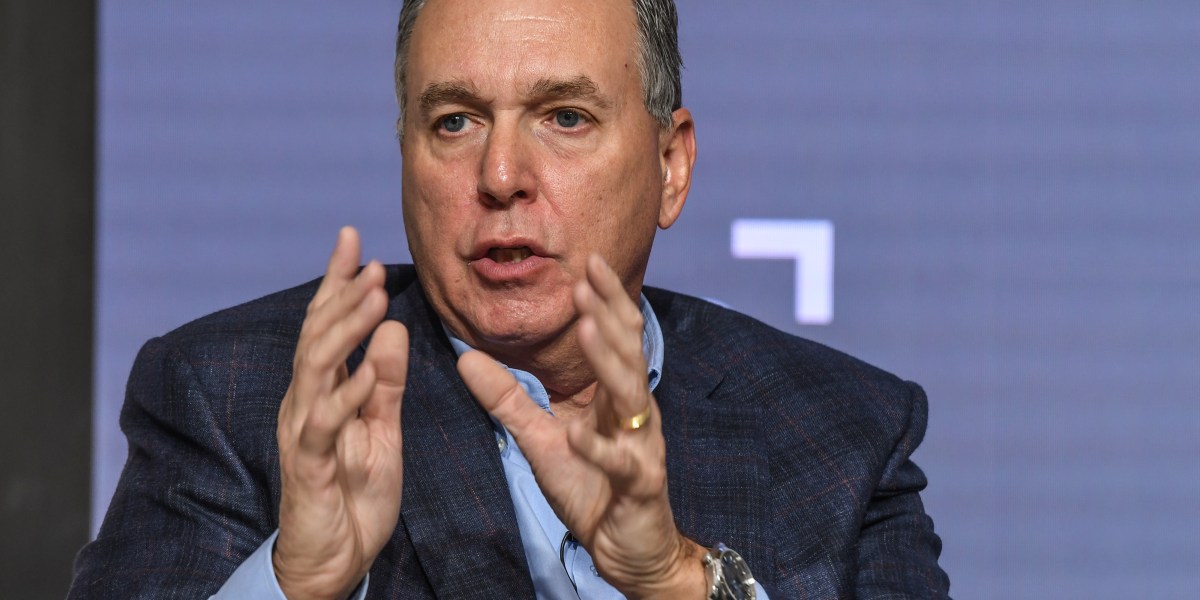
On this afternoon in early September, the American Express CEO is giving Fortune an exclusive preview of the new and enhanced benefits in store for its Platinum cardholders in the highly anticipated, forthcoming update, the first in four years, that they’ll unveil the morning of September 18. Seated in his glass framed office overlooking the Hudson River in Lower Manhattan, sporting a rose-hued jacket, tan jeans and loafers sans socks, the homespun Queens native—who seldom gives interviews and by the way, doesn’t drink coffee as he’s unimpressed by the aroma—is buzzing with such fervor over the coming goodies that you might think he’s on a super-caffeine high from the Diet Coke he’s sipping out of a traditional 8 ounce glass contour bottles that he insists “which is part of what makes it taste a lot better. It’s great marketing by Coke.”

Marketing it something Squeri knows quite a bit about—and will be relying on to sell the new card, whose annual fee will rise from the current $695 to $895. That’s ahead of the $795 charge for Platinum’s closest rival, the Chase Sapphire Reserve entry that got its own uplift in late June. But Squeri insists that the improved Platinum will provide the richest benefits of any widely-used card today. It’s also worth noting that the uplift represents the biggest investment Amex has ever in a card refresh. “If you use the credits, you’ll they’ll get over $3,500 a year in value on both the consumer and business cards,” he says. “At the $695 fee, that value was $1500 a year on the consumer card. People are going to do the math. They’re going to say, wait a minute, you want me to pay $200 extra for over $1,000 in additional value?” And if people really feast on the new benefits, they could get even more from the new menu, Squeri avows.

Squeri emphasizes that Amex is doubling-down on the pioneering foray it first made during the pandemic: Moving heavily into streaming, wellness, shopping, restaurants and other “lifestyle” areas beyond the historic concentration in travel.  (The press release issued this morning details the entire roster.) Cardmembers get a $100 a month credit, or $400 a year, at elite restaurants booked on the Amex-owned Resy site, $120 towards an Uber One membership that provides free delivery on eligible eatery and grocery orders, $300 ($75 a quarter) towards yoga and running gear or other apparel at Lululemon, and $200 for an Oura ring that tracks a wide range of health metrics. The digital entertainment benefit that adds Paramount+ and YouTube Premium to the previous list that includes the likes of Disney+, Hulu and the New York Times gets lifted from $20 to $25 a month. And cardholders keep all the sundry existing benefits ranging from credits for Walmart+ and Equinox memberships (both $300 a year) to purchases at Saks ($100).

On the travel side, it’s mainly enhancements to today’s perks. For hotels, Amex is tripling the annual credit for stays booked through American Express Travel from $200 to $600 at the mainly five-star hotels at its Fine Hotels & Resorts and slightly less fancy Hotel Collection offerings, a list that includes such choices as the Amman properties around the world and the newly-refurbished Waldorf Astoria in Manhattan. Cardmembers get early check-in and 4:00 checkout privileges, as well as $100 towards such extras as food and beverage or spa services as varied as facials and saunas. Squeri stresses the sumptuous value cardmembers can reap from exploiting Amex’s hotel rewards. “We offer 3100 hotels that offer those things,” he says. “We have the largest array of any card company, and it keeps growing. You get early check-in and late checkout that gives you extra hours at the hotel. You can get the $100 in incidentals per stay, and you can get it any time you go to one of our hotels. You also get a free breakfast each day, we’ve all had hotel breakfasts for two people and we all know they’re not cheap!”

Dining is now the biggest spending category for AMEX, and younger folks are the driver

Squeri highlighted an historic surge in spending at restaurants that strongly shaped the new suite of rewards. “In the travel and entertainment segment that includes airfare, restaurants and dining, the latter used to be number three,” he says. But it was the fastest growing T&E area in Q1 and Q2 of this year.  That trend inspired Amex to introduce the $400 a year award for reservations through Resy. The card colossus acquired the site in 2019, a year after Squeri became CEO. Today, Resy takes over 100 million reservations a year; all-comers are welcome, but only Amex cardholders get special treatment.

A big bonus for Amex customers: scoring tables at top, hard-to-get-into restaurants. The Resy network encompasses many Michelin star and sundry award winning locales including Le Bernadin in New York, Alinea in Chicago, and Canlis in Seattle. Some of those places often hold “inventory” in reserve for cardholders, or put them at the top of waiting lists over non-Amex folks who booked earlier. Why do these coveted addresses offer Amex those deals? “It’s simple, because the Amex cardholder will order the more expensive bottle of wine or order the steak or it’s going to be a corporate cardholder on an entertainment budget,” says Squeri. Adds Resy CEO Pablo Rivero, “Card members with the Resy credit spend 25% more at U.S. Resy restaurants once the benefit launched [Resy benefits were introduced in 2024 on several other Amex cards]. The restaurants want to fill up with the people who spend the most.”

Increasingly, that cohort encompasses the Gen Z’ers (up to age 27) and Millennials (28 to 44), a demo that Squeri’s been a first mover in courting. “Those two groups use their cards at restaurants 60% more on average than boomers or Gen X’ers combined,” notes Rivero. Together, those younger generations account for 35% of all U.S. consumer spending for Amex, up from 19% in 2019. And the Gen Z and Millennials crowd tilt heavily to acquiring fee-based cards like Gold and Platinum.

Squeri’s broken fresh ground by both offering super-rich bennies overall, and tailoring the offerings to the customers of the future, those affluent, free-spending, adventure seeking folks from their mid-20s to mid-40s. For Steve Squeri, that’s the formula for winning customers who’ll stay onboard for decades to come.

Fortune Global Forum returns Oct. 26–27, 2025 in Riyadh. CEOs and global leaders will gather for a dynamic, invitation-only event shaping the future of business. Apply for an invitation.


Source link

Continue Reading

Business

America’s $38 trillion national debt will exacerbate generational imbalance, says think tank

Published

on


The United States’ current borrowing trajectory will place an “undue burden on future generations,” an economic think tank has warned, with younger generations facing a higher interest rate environment, slower economic growth, and stalling wage increases.

The latest research from the American Action Forum chimes with concerns across both the public and private sectors. Everyone from JPMorganChase CEO Jamie Dimon to Fed chairman Jerome Powell is nervously eyeing the nation’s $38 trillion debt burden. The government has paid $10 billion a week to service the debt for the first few months of the 2026 fiscal year.

Economists are concerned that, at some point, the growth of the American economy will become so disconnected from the borrowing of its government that bond buyers will demand higher premiums on their loans. The worry is that the central bank will intervene by increasing the money supply—kick-starting an inflationary cycle—but that ultimately the government may have to cut back on spending.

Bridgewater Associates founder Ray Dalio has described this scenario as an economic “heart attack,” with government investment squeezed out by the need for the country to maintain its debt obligations.

Younger people will face the sharpest end of that outcome, warned Jordan Haring, director of fiscal policy at the American Action Forum. Haring, formerly a senior policy analyst at the Committee for a Responsible Federal Budget (CRFB) wrote in a note this week: “The United States’ high debt load exacerbates generational imbalances. These imbalances will ultimately burden younger and future generations with higher interest payments, slower economic growth, slower income growth, and a greater burden to bear for future tax or spending changes.”

She continued: “Without significant policy changes to reduce debt growth, future generations will inherit a budget where significant resources are locked into servicing past borrowing.”

“As interest costs rise, the federal government will have less money available for education, infrastructure, or scientific research—areas that directly support long-term prosperity. Future taxpayers will face higher tax burdens or reduced government services simply to cover the costs created by previous budget deficits.”

Haring pointed to the discrepancies in budgets between education and health services, for example. Already the gap is large: In 2025, the Department for Education requested $82.4 billion for its budget, while in 2024 Medicaid spending totalled more than $900 billion, per the Medicaid and CHIP Payment and Access Commission.

With an ageing population, it is likely that spending on social care will increase over the coming decades. Lower birth rates will mean fewer entrants into the ranks of the economically active to maintain the revenues gathered by the government.

While the accuracy of the conservative think tank’s research has been criticised in the past, Haring’s stance has been echoed by the likes of BlackRock’s Larry Fink.

Last year, Fink urged corporate leaders and politicians to pursue “an organized, high-level effort” to rethink the retirement system. In a letter to BlackRock investors, Fink wrote: “The federal government has prioritized maintaining entitlement benefits for people my age (I’m 71) even though it might mean that Social Security will struggle to meet its full obligations when younger workers retire.”

He added: “It’s no wonder younger generations, Millennials and Gen Z, are so economically anxious. They believe my generation—the baby boomers—have focused on their own financial well-being to the detriment of who comes next. And in the case of retirement, they’re right.”

The Great Wealth Transfer option

With a shift in economic activity from one generation to the next also comes with new flows of wealth, and this is something governments around the world will be looking to leverage, according to experts.

Studies have found that over the next 20 to 30 years as much as $124 trillion will be passed down from older generations to their younger counterparts, though UBS puts the figure of the “Great Wealth Transfer” at $80 trillion. Baby boomers—people born between 1946 and 1964—are the wealthiest generation in history, and as these individuals begin passing on their assets, sums will go immediately to their Gen X, millennial, and Gen Z successors, and some cash will go to spouses.

“The change in wealth comes at a time when many governments around the world have high debt and deficits. It seems unrealistic to suppose that governments will just sit idly by as this wealth moves around. We would expect governments to attempt to mobilize that wealth to help fund their debt, but in doing so that denies private sector investment access to some of those funds.”


Source link

Continue Reading

Business

Meet 25 rising execs inside the Fortune 500

Published

on


Good morning. Major technology shifts often spur the rise of a new generation of leaders. Satya Nadella’s track record in building Microsoft’s cloud business earned him the top job in 2014. Arvind Krishna’s early bet on cloud and AI made him an obvious choice to run IBM, as did Ginni Rometty’s reputation in disruptive technologies before him. Doug McMillion’s push for e-commerce proved pivotal in becoming CEO of Walmart and transforming the retailer while there. Go back to 1989 and a digital-first Stan Bergman was champing at the bit to transform Henry Schein.

But technical savvy alone does not a leader make. For a glimpse of who’s likely to take the lead in this next era for the Fortune 500, check out theFortune Next to Lead list that’s out this morning. My colleague Ruth Umoh spent months talking to board directors, management consultants, leadership advisors, recruiters, and current and former CEOs to identify 25 rising executives inside the Fortune 500 who exhibit the skills and mindset of a new breed of CEO. 

Candidates were evaluated across several dimensions, from the scale and impact of their role with the enterprise to their vision and influence beyond the company. There’s Josh D’Amaro of Disney, who oversees a worldwide experiences division embarking on a $60 billion expansion of parks, resorts, cruise ships, and next-generation guest experiences. Within Microsoft, Scott Guthrie’s record at Azure has put him at the center of the company’s cloud and AI strategy. Donna Langley at NBCUniversal is redefining the studio’s multi-platform strategy, while General Motors’ Mark Reuss oversees a broad operational portfolio, from engineering and manufacturing to battery strategy and global markets, making him a central architect of GM’s long-term competitiveness. Keep an eye, too, on Marianne Lake of JPMorgan Chase and Kate Gutmann of UPS.

As always, I’d love to hear your thoughts on candidates you think deserve a spot, and what qualities you think will determine success in the next generation of Fortune 500 CEOs.

Contact CEO Daily via Diane Brady at diane.brady@fortune.com

Top news

New jobs data

Today is a quirky jobs day that will shed some light on the state of the U.S. economy. The Bureau of Labor Statistics is releasing jobs numbers for November and October. But the data will be patchy because of disruptions caused by the government shutdown; there will be no October unemployment report, for instance. “We’re going to have to look at [the data] carefully and with a somewhat skeptical eye” because it may be “distorted by very technical factors,” Fed Chair Jerome Powell said.

PayPal as a bank

PayPal is taking advantage of the Trump administration’s looser rules towards fintech companies and applying to become a bank. The payments company says the designation will allow it to lend more to small businesses. 

Introducing the U.S. ‘tech force’

The Trump Administration on Monday unveiled what it’s calling the U.S. “tech force” of 1,000 early career engineers and other specialists to research and develop AI and financial products for the federal government. Companies like Nvidia, Palantir, Amazon and Google will partner with the government on the initiative and second some of their own top talent to join its ranks. 

Ford’s EV bust

Ford will record a $19.5 billion impairment for the rollback of parts of its EV strategy. The Detroit carmaker is contending with lower-than-expected demand for EVs and plans to halt production of some pure electric vehicles in favor of hybrid models. 

Fed Chair finalists

President Trump could announce his pick for Fed chair before Christmas. Fortune’s Eleanor Pringle introduces us to the finalists and dissects their on-record opinions about the running of the central bank. This weekend, prediction markets were betting that the race had narrowed to a Kevin vs. Kevin contest

McKinsey gets lean

McKinsey is planning to shirk its non-client facing departments by about 10% in coming months as it contends with a slowdown in its traditional services and flatlining revenue. Governments in China and Saudi Arabia, for instance, have cut back on using consulting firms. 

Companies’ ‘93-7 split’ 

Bill Briggs, Deloitte’s chief technology officer, told Fortune’s Nick Lichtenberg that companies are pouring 93% of their AI budget into technology and only 7% into the people expected to use it. That lopsided investment is all wrong, Briggs says, since it focuses on the physical “ingredients” of AI and not the culture, workflow, and training needed to make the technology effective.

The markets

S&P 500 futures are down 0.25% this morning. The last session closed down 0.16%. STOXX Europe 600 was down 0.05% in early trading. The U.K.’s FTSE 100 was down 0.46% in early trading. Japan’s Nikkei 225 was down 1.56%. China’s CSI 300 was down 1.2%. The South Korea KOSPI was down 2.24%. India’s NIFTY 50 was down 0.64%. Bitcoin went to $87K.

Around the watercooler

Google cofounder Sergey Brin said he was ‘spiraling’ before returning to work on Gemini—and staying retired ‘would’ve been a big mistake’ by Marco Quiroz-Gutierrez

Former Meta integrity chief says new report reveals ‘disappointing’ ad fraud epidemic at the social-media giant by Lily Mae Lazarus

‘I had to take 60 meetings’: Jeff Bezos says ‘the hardest thing I’ve ever done’ was raising the first million dollars of seed capital for Amazon by Dave Smith

What happens to old AI chips? They’re still put to good use and don’t depreciate that fast, analyst says by Jason Ma

CEO Daily is compiled and edited by Claire Zillman and Lee Clifford.


Source link

Continue Reading

Business

80% of American Christmas trees are fake. They’re also tariffed

Published

on


On a recent December day, Mark Latino and a handful of his workers spun sheets of vinyl into tinsel for Christmas tree branches. They worked on a custom-made machine that’s nearly a century old, churning out strands of bright silver tinsel along its 35-foot (10-meter) length.

Latino is the CEO of Lee Display, a Fairfield, California-based company that his great-grandfather founded in 1902. Back then, it specialized in handmade velvet and silk flowers for hats. Now, it’s one of the only companies in the United States that still makes artificial Christmas trees, producing around 10,000 each year.

Tariffs and trees

Tariffs shone a twinkling light this year on fake Christmas trees — and the extent to which America depends on other countries for its plastic fir trees.

Prices for fake trees rose 10% to 15% this year due to the new import taxes, according to the American Christmas Tree Association, a trade group. Tree sellers cut their orders and paid higher tariffs for the stock they brought in.

Despite those issues, tree companies say they aren’t likely to shift large-scale production back to the U.S. after decades in Asia. Fake trees are labor-intensive and require holiday lights and other components the U.S. doesn’t make, said Chris Butler, CEO of the National Tree Co., which sells more than 1 million artificial trees each year.

Americans are also very price-sensitive when it comes to holiday décor, Butler said.

“Putting a ‘Made in the U.S.A.’ sticker on the box won’t do any good if it’s twice as expensive,” Butler said. “If it’s 20% more expensive, it won’t sell.”

Americans prefer fake trees

About 80% of the U.S. residents who put up a Christmas tree this year planned to use a fake one, according to the American Christmas Tree Association. That percentage has been unchanged for at least 15 years.

Mac Harman, the founder and CEO of Balsam Brands, which sells hundreds of thousands of Balsam Hill trees each year, said Americans like to set up their trees on Thanksgiving and leave them up for weeks, which dries out fresh-cut trees. Others prefer fake trees because they’re allergic to the mold spores on real trees, he said.

Americans also like convenience; 80% of the fake trees sold each year have the lights already strung on them, Butler said.

That preference is one reason artificial tree production shifted away from the U.S., first to Thailand in the early 1990s and to China about a decade later. Winding lights around the branches is time-consuming and tedious, Harman said.

“Where are we going to get 15,000 people in America who want to string lights on Christmas trees?” Harman said.

Labor-intensive work

It takes an hour or two to make an artificial Christmas tree, from molding and cutting the needles to tying branches together and attaching the lights, Butler said. Workers in China, where 90% of fake trees are made, are paid $1.50 to $2 per hour, he said.

Harman said the workers who wrap the lights on Balsam Hill’s trees are so efficient “it’s like watching an Olympian.”

One of Balsam Brands’ Chinese partners employs 15,000 to 20,000 people; another in Indonesia has up to 10,000, he said. Many are seasonal workers, since orders for Christmas décor slow down between October and February.

Balsam Brands, which is based in Redwood City, California, studied whether it could make faux trees in Ohio during the first Trump administration, when President Donald Trump threatened -– but eventually delayed –- tariffs on imported Christmas décor, Harman said.

The company hired consultants and considered automating some work. But it concluded a tree that currently sells for $800 would cost $3,000 if it was made in the U.S. Harman said Balsam couldn’t even find a U.S. company to make the pair of gloves it includes in each box for fluffing out branches.

American-made trees

Lee Display employs three or four people for most of the year, adding more during the holiday rush to help with installations and displays. About half its business is making custom displays for companies such as Macy’s, while the other half is selling directly to consumers.

Latino said he likes that he can produce an order quickly instead of waiting for it to ship from overseas.

“You have more control over it. I like to think that everything here is either my fault or my mistake or my careful planning and skill,” he said.

The tariffs still affected Lee Display. Latino’s son James, who leads business development and marketing, said the company didn’t import lights or decorations from China this year and relied on items it already had in stock. It’s getting low on lights, so next year it will have to pay more to import them, he said.

Responding to tariffs

Some artificial tree companies are branching out so they’re less reliant on China. National Tree Co., which is based in Cranford, New Jersey, moved some manufacturing to Cambodia in 2024, and could source all its trees from outside China by next year if it wanted to, Butler said.

But diversifying their suppliers didn’t make those companies immune from the impact of tariffs either. In April, the Trump administration threatened a 49% tariff against products from Cambodia. That rate was eventually reduced to 19%. Tariffs on artificial trees from China also bounced around but now average 20%, according to the American Christmas Tree Association.

Butler said his company imported fewer trees this year and also raised prices by 10%. He said he used a lot of the money to offer customer discounts since demand was weak because of consumer worries about the economy.

“It’s a discretionary item. People say, ‘I can wait one more year,’” Butler said.

Balsam Brands cut its workforce by 10%, canceled travel, froze raises and even stopped serving lunch in the office once a week to absorb the impact of tariffs, Harman said. It also raised tree prices by 10%.

Harman said his sales are down 5% to 10% this year in the U.S. but up 10% or more in Germany, Australia, Canada and France. That tells him tariffs have decreased U.S. demand.

“If a merry Christmas is measured in how many decorations people put up, by that measure it’s going to be a slightly less merry Christmas,” he said.

___

AP Video Journalist Terry Chea contributed from Fairfield, California.


Source link

Continue Reading

Trending

Copyright © Miami Select.