Connect with us

Business

Amazon will launch AI-powered smart classes for delivery drivers amid automation, efficiency push

Published

on


For Amazon delivery drivers, new glasses promise something more than just clearer vision or the blocked sun glare.

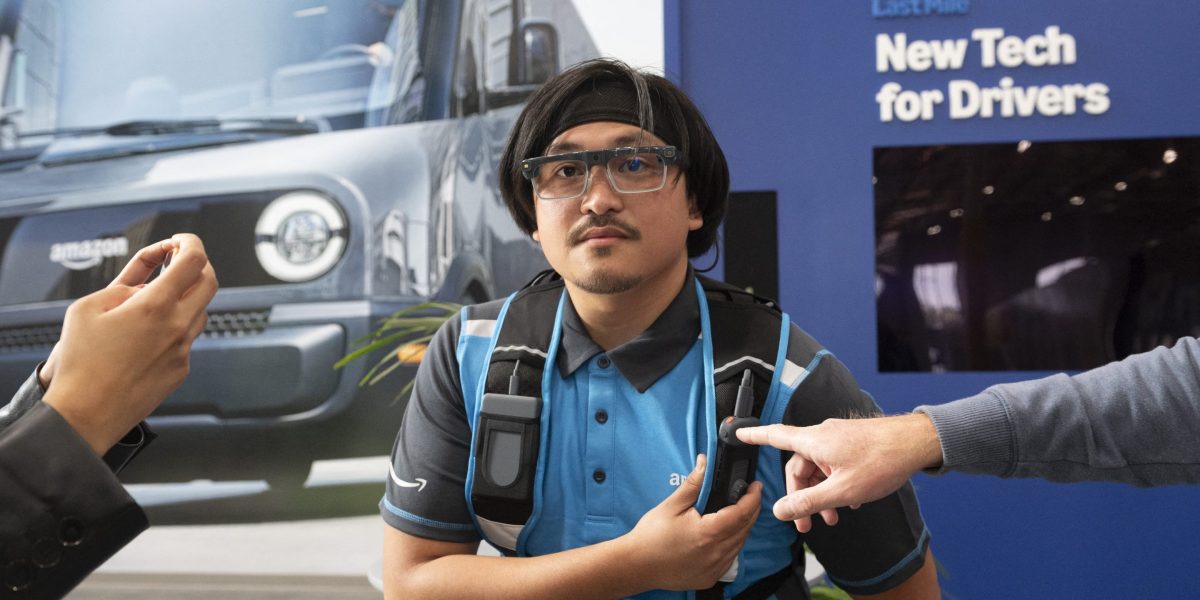
Amazon is developing AI-powered smart glasses for its delivery drivers, the company said in a Wednesday blog post. The glasses will allow drivers to scan packages, following detailed walking directions, and document proof-of-delivery without their phones. Using cameras, as well as AI-powered sensing abilities, the technology will create an augmented reality display for drivers that includes information like hazards, as well as maps that direct drivers to particular building unit numbers. 

The glasses will automatically activate once a driver parks at a delivery location and can support prescription and transition lenses within its design. Eliminating needing to use a phone, as was the provision of convenience instructions, is aimed to increase the safety and efficiency of the delivery process, the company said.

Future iterations of the glasses aim to give drivers “real-time defect detection” if they drop off a package at a wrong address. The device will also be able to adjust to low-light conditions and detect pets in customers’ yards.

Expedited delivery has remained a hallmark of Amazon’s business as it competes with the growing e-commerce capabilities of Walmart and other retail giants. Amazon announced in June a $4 billion investment in tripling its delivery network size, particularly in rural areas, by 2026. One Amazon delivery driver made on average 65,700 deliveries in 2024, translating to 100,375 packages annually, according to data compiled by CapitalOne Shopping. That’s about 27 deliveries per hour.

Amazon’s AI-powered classes will show navigation and delivery instructions on its display.

LAURE ANDRILLON/AFP—Getty Images

Reuters reported the product’s development last November. Anonymous sources told the outlet that while the glasses could increase driver productivity by freeing up hand space for workers to carry more packages, the company may have trouble developing a battery able to last an entire shift, which can be up to 10 hours. Drivers may also not want to wear the devices, which may be uncomfortable or distracting, the sources said.

Amazon did not respond to Fortune’s request for comment on concerns about the battery duration or comfortability of the glasses. 

Amazon’s automation push

In addition to AI-powered glasses for drivers, Amazon is also developing operational technologies for warehouse workers, the company announced Wednesday. Blue Jay, a robotics system using multiple arms to lift and sort packages, aims to mitigate the need for employees to lift heavy items. Project Eluna is an agentic AI model that will monitor numerous dashboards and make decisions, such as about reducing sorting bottlenecks, with the goal to lessen the “cognitive load” of workers. The AI agent will be piloted at a Tennessee fulfillment center during the holiday season.

The company’s automation push has brought with it concern about the future of human employment. Some AI experts have said automation processes will surely displace human workers, with University of Louisville professor of computer science Roman Yampolskiy saying AI could spike unemployment levels up to 99% in the next five years—a more eye-popping figure than even Anthropic CEO Dario Amodei’s projection of the technology replacing 50% of entry-level white-collar jobs in the same period.

“Before we always said, ‘This job is going to be automated, retrain to do this other job,’” Yampolskiy said in an episode of The Diary of a CEO podcast last month. “But if I’m telling you that all jobs will be automated, then there is no plan B. You cannot retrain.”

A New York Times investigation published on Tuesday reported, citing internal documents, Amazon plans to automate 75% of its operations. That translates to roughly 600,000 jobs for which the company would not need to hire in the future.

Amazon spokesperson Kelly Nantel said the investigation did not accurately reflect the company’s hiring strategy, and that the company recently announced plans to fill 250,000 positions ahead of the end-of-year holiday push.

“Leaked documents often paint an incomplete and misleading picture of our plans, and that’s the case here,” Nantel told Fortune in a statement. “In this instance, the materials appear to reflect the perspective of just one team and don’t represent our overall hiring strategy across our various operations business lines—now or moving forward.”

Amazon executives have made an effort to assuage anxieties about the future of employment. Amazon Robotics’ chief technologist Tye Brady told Fortune in May the company’s automation advancements are meant to enhance, not replace, the jobs of humans. The interview at Fortune’s Brainstorm AI conference in London took place after Amazon announced the launch of Vulcan, a robot arm with a sense of touch.

“I will be unabashedly proud that we aim to eliminate, I mean eliminate, every menial, mundane, and repetitive job out there,” Brady said. “And if it’s repetitive, we want to automate that, because we will never run out of things to do for our employees. We want them to focus on higher-level tasks.” 

“People are amazing at using common sense, reasoning, and understanding complex problems,” he continued. “Why would you not use that?”


Source link

Continue Reading

Business

U.S. trade chief says China has complied with terms of trade deals

Published

on


Trade Representative Jamieson Greer said China has been complying with the terms of the bilateral trade agreements and that the US is constantly monitoring commitments made by China in a bid to maintain a stable trade relationship.

“With China, it’s always we verify and we monitor and we watch the commitments. The commitments are quite specific,” Greer said Sunday on Fox News’ The Sunday Briefing. “So all of these things that we’ve agreed to with the Chinese recently are very concrete, we can monitor them with some ease, and so far, we’re seeing that they’re in compliance.”

Greer said China has gotten approximately “a third” of the way through its soybean purchase commitment for this growing season.

Bloomberg previously reported that after a series of orders placed in late October — the first of this season — China’s purchases of American soybeans appeared to have stalled. 

President Donald Trump and Chinese President Xi Jinping in late October agreed to extend a tariff truce, roll back export controls and reduce other trade barriers. But some elements of the deal — including the soybean purchases, sale of social media app TikTok and an increase in licenses to export critical rare earths from China — remain in progress.

US Treasury Secretary Scott Bessent and Greer held a video call with Chinese Vice Premier He Lifeng on Friday, according to China’s state-run news agency Xinhua, during which the officials had an “in-depth and constructive” discussion in which they vowed to keep stable ties and address “respective concerns” on trade and the economy, the outlet said.

Read More: Top US, Chinese Officials Pledge Cooperation on Trade Deal

Bessent on Sunday told CBS News’ Face the Nation that China will not speed up purchases, but they are still expected to take place this crop season and said soybean prices are up 12% to 15% since the agreement with China. He also said he divested from a soybean farm to comply with an ethics agreement

The Trump administration is expected to release its long-awaited farm aid plan this week, US Agriculture Secretary Brooke Rollins said in a cabinet meeting last Tuesday.

Asked whether chipmakers like Nvidia should give China advanced chips or if doing so would pose a security risk to the US, Greer expressed a need for the US to be cautious.

“My own view is we need to be very cautious about this,” Greer said on Fox News. “We want companies’ bottom lines to do well, but as policymakers, we need to make sure that the national security is placed first and foremost, and that’s why you’ve heard President Trump talk about the types of chips that maybe would be restricted and there’s always an open discussion on where that threshold lies, and it changes over time.”


Source link

Continue Reading

Business

HP’s chief commercial officer predicts the future will include AI PCs that don’t use the cloud

Published

on


Increased focus on “privacy and security” may open the door for AI-enabled devices rather than rely entirely on cloud computing and remote data centers. 

“In a world where sovereign data retention matters, people want to know that if they input data to a model, the model won’t train on their data,” David McQuarrie, HP’s chief commercial officer, told Fortune in October. Using an AI locally provides that reassurance.

HP, like many of its devicemaking peers, is exploring the use of AI PCs, or devices that can use AI locally as opposed to in the cloud. “Longer term, it will be impossible not to buy an AI PC, simply because there’s so much power in them,” he said. 

More broadly, smaller companies might be served just as well by a smaller model running locally than a larger model running in the cloud. “A company, a small business, or an individual has significant amounts of data that need not be put in the cloud,” he said. 

Asian governments have often had stricter rules on data sovereignty. China, in particular, has significantly tightened its regulations on where Chinese user data can be stored. South Korea is another example of an Asian country that treats some locally sourced data as too sensitive to be housed overseas. 

Governments the world over, and particularly in Asia, are also investing in local sovereign AI capabilities, trying to avoid relying entirely on systems and platforms housed wholly overseas. South Korea, for example, is partnering with local tech companies like search giant Naver to build its own AI systems. Singapore is investing in projects like the Southeast Asian Languages in One Network (SEA-LION), which are better tailored to Southeast Asian countries. 

Asian AI adoption

Asia is HP’s smallest region, but also its fastest-growing. Revenue from Asia-Pacific and Japan grew by 7% over the company’s 2025 fiscal year, which ended in October, to hit $13.3 billion. That’s around a quarter of HP’s total revenue of $55.3 billion. (HP’s other two regions are the Americas; and Europe, the Middle East, and Africa.)

McQuarrie also suggested that there was an opportunity to be “disruptive” in Asia. While many business leaders have been eager to embrace AI, at least rhetorically, actual adoption is proving more difficult. A recent survey from McKinsey reports that two-thirds of companies are still in the experimentation phase of AI. 

But McQuarrie believed that AI adoption in Asia could be “just as quick, if not quicker,” than other regions. 

Asia seems to be more comfortable with the use of AI, at least when it comes to users. An October survey from Pew found that fewer people in countries like India, South Korea and Japan reported feeling “more concerned than excited” about AI compared to the U.S. 

When it comes to convincing more companies to adopt AI, let alone AI PCs, McQuarrie said the answer was to make AI functions as seamless as possible, so “that it doesn’t really matter whether you understand that you’re embracing AI or not.”

“What we’re doubling down on is the future of work,” McQuarrie said. “The future of work is a device that makes your experience better and your productivity greater.”

“The fact that we’re using AI in the background? They don’t need to know that.”


Source link

Continue Reading

Business

Trump administration waives part of a Biden-era fine against Southwest Air for canceled flights

Published

on


The U.S. Department of Transportation is waiving part of a fine assessed against Southwest Airlines after the company canceled thousands of flights during a winter storm in 2022.

Under a 2023 settlement reached by the Biden administration, Southwest agreed to a $140 million civil penalty. The government said at the time that the penalty was the largest it had ever imposed on an airline for violating consumer protection laws.

Most of the money went toward compensation for travelers. But Southwest agreed to pay $35 million to the U.S. Treasury. Southwest made a $12 million payment in 2024 and a second $12 million payment earlier this year. But the Transportation Department issued an order Friday waiving the final $11 million payment, which was due Jan. 31, 2026.

The department said Southwest should get credit for significantly improving its on-time performance and investing in network operations.

“DOT believes that this approach is in the public interest as it incentivizes airlines to invest in improving their operations and resiliency, which benefits consumers directly,” the department said in a statement. “This credit structure allows for the benefits of the airline’s investment to be realized by the public, rather than resulting in a government monetary penalty.”

The fine stemmed from a winter storm in December 2022 that paralyzed Southwest’s operations in Denver and Chicago and then snowballed when a crew-rescheduling system couldn’t keep up with the chaos. Ultimately the airline canceled 17,000 flights and stranded more than 2 million travelers.

The Biden administration determined that Southwest had violated the law by failing to help customers who were stranded in airports and hotels, leaving many of them to scramble for other flights. Many who called the airline’s overwhelmed customer service center got busy signals or were stuck on hold for hours.

Even before the settlement, the nation’s fourth-biggest airline by revenue said the meltdown cost it more than $1.1 billion in refunds and reimbursements, extra costs and lost ticket sales over several months.


Source link

Continue Reading

Trending

Copyright © Miami Select.