Connect with us

Business

Alexandr Wang says the next Bill Gates will be a 13-year-old who is ‘vibe coding’ right now

Published

on


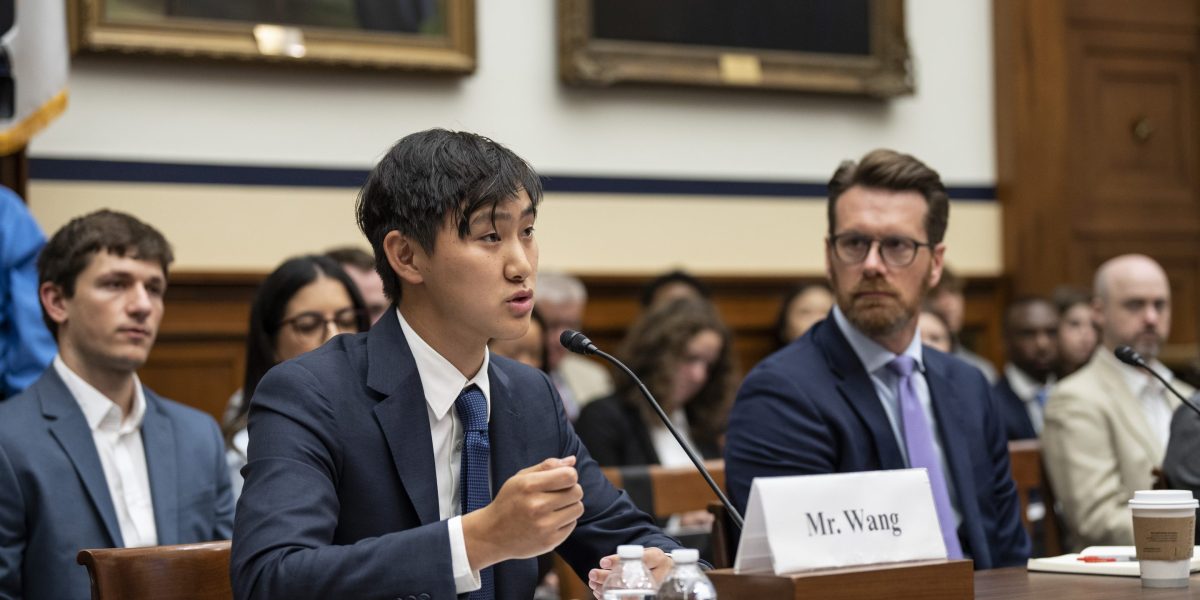
Alexandr Wang—who became the world’s youngest self-made billionaire at 24—is now, at 28, running one of the most ambitious AI efforts in Silicon Valley. In his first 60 days at Meta, he built a 100-person lab he described to TBPN hosts John Coogan and Jordi Hays as “smaller and more talent dense than any of the other labs.” 

His goal: nothing less than superintelligence.

Wang, with his aerial view of the industry, has advice for kids, especially those in Gen Alpha now entering middle school: Forget gaming, sports, or traditional after-school hobbies. 

“If you are like 13 years old, you should spend all of your time vibe coding,” he said in his recent TBPN interview. “That’s how you should live your life.”

Why is this a generational moment for Gen Z?

For Wang, the reasoning is simple. Every engineer, himself included, is now writing code he believes will be obsolete within five years.

“Literally all the code I’ve written in my life will be replaced by what will be produced by an AI model,” he said.

That realization has left him, in his words, “radicalized by AI coding.” What matters most now isn’t syntax, or learning a particular language, but time spent experimenting with and steering AI tools.

“It’s actually an incredible moment of discontinuity,” Wang said. “If you just happen to spend 10,000 hours playing with the tools and figuring out how to use them better than other people, that’s a huge advantage.”

Teenagers have a clear advantage over adults: time and freedom to immerse themselves in new technology. And while in the past, entrepreneurial teenagers leveraged this time to be “sneaker flippers” or run Minecraft servers, Wang says the focus should now be on the code.

He compares the moment to the dawn of the PC revolution. The Bill Gateses and Mark Zuckerbergs of the world had an “immense advantage” simply because they grew up tinkering with the earliest machines. 

“That moment is happening right now,” Wang said. “And the people who spend the most time with it will have the edge in the future economy.”

Is superintelligence coming?

Wang isn’t coy about Meta’s ambitions. He calls the company’s infrastructure, scale, and product distribution unmatched. 

“We have the business model to support building literally hundreds of billions of dollars of compute,” he said.

His team, just over 100 people, is deliberately designed to be “smaller and more talent dense” than rivals. “The other labs are like 10 times bigger,” Wang said, but their lab had “cracked” coders. 

The lab is split into three pillars: research, product, and infrastructure. Research builds the models Wang says will “ultimately be superintelligent.” Product ensures they get distributed across billions of users through Meta’s platforms. And infrastructure focuses on what he calls “literally the largest data centers in the world.”

Wang is particularly excited about hardware. Like many Meta executives now, he points to the company’s new smart glasses, which had a hilariously foppish demo, as the “natural delivery mechanism for superintelligence.”

Placed right next to the human senses, they will merge digital perception with cognition.

“It will literally feel like cognitive enhancement,” Wang said. “You will gain 100 IQ points by having your superintelligence right next to you.”

Why vibe coding matters

Vibe coding is the shorthand for this shift: using natural language prompts to generate and iterate on code. Rather than writing complex syntax, users describe their intent, and AI produces functioning prototypes.

The concept is spreading across Silicon Valley’s C-suites. Klarna CEO Sebastian Siemiatkowski has said he can now test ideas in 20 minutes, instead of burning weeks of engineering cycles. Google CEO Sundar Pichai revealed that AI already generates more than 30% of new code at the company, calling it the biggest leap in software creation in 25 years.

Wang takes that further. For him, vibe coding isn’t just a productivity hack, but a future cultural mandate. What matters isn’t the code itself — it’s the hours of intuition-building that come from pushing AI tools to their limits, which is why he urges Gen Alpha to start early.

“The role of an engineer is just very different now than it was before,” he said. 

A version of this story was published on Fortune.com on September 19, 2025.

More on Meta:

Join us at the Fortune Workplace Innovation Summit May 19–20, 2026, in Atlanta. The next era of workplace innovation is here—and the old playbook is being rewritten. At this exclusive, high-energy event, the world’s most innovative leaders will convene to explore how AI, humanity, and strategy converge to redefine, again, the future of work. Register now.


Source link

Continue Reading

Business

An AT&T exec manifested his C-suite position when he was earning his MBA

Published

on


How do you become a CISO? You make a step-by-step plan and follow it. At least, that’s how Rich Baich, who currently holds the title at AT&T, recalls getting his start.

“I was actually getting my MBA, and my last class was product marketing, and they said, ‘You are the product. Take yourself to the market,’” Baich said. “So, I literally came up with a plan to become a CISO, and I executed on it.”

That plan eventually ended up landing Baich his first gig as a CISO at data broker company ChoicePoint. At the time, he said, the idea of a C-suite role for information security was still nascent.

“When I look back on it was very interesting about what the role and the expectations in the boardroom and the C-suite was for CISO,” Baich said. “The challenges primarily were around helping the organization culturally understand: What does a CISO do and what value does it bring to the organization?”

In the beginning. Baich, who has now worn the CISO hat five times, sat down with IT Brew to discuss his career journey, recalling the first time he realized his interest in computers.

“We started doing computer programming in the Pascal language, and I thought just how interesting it was to create a Boolean logic if-then type of thing which could then cause you to take certain actions,” Baich said.

That fascination stuck with Baich even as he attended the Naval Academy and later completed military service: “I focused in areas like surface warfare and then cryptology, information warfare, and space.”

Critical point. The similarities between the military and Baich’s CISO role at ChoicePoint and later, American Insurance Group and Wells Fargo, were striking.

“Luckily for me, cybersecurity is as close to being in the military as you can get from most jobs, because you’re constantly trying to defend against adversaries that are trying to obviously, either do harm or form some type of mischievous activity.”

When reflecting on his experience at several top companies in the critical infrastructures sector, Baich said regulations have their value, but believes it can slow down organizations.

“Oftentimes, it can cause you to have to focus in areas that may not be the most important, but you need to make sure you meet those regulatory requirements,” Baich said. He was up for the challenge, joining the CIA in 2022 as CISO and director of the office of cybersecurity.

Jennifer Ewbank, founder of Andaman Strategic Advisors and a former deputy director of CIA for digital innovation, told IT Brew that Baich was her pick for the role, given his “ability to translate complex matters into simple,clear priorities” and his “desire to serve his country.” She added that Baich came into the organization with the goal of understanding its needs and made a large impact, despite his short stint there.

“He came in sincerely wanting to study and understand and meet everyone and appreciate the unique skills that they had and the strengths that they brought to the mission,” Ewbank said. “That approach, I thought, was very effective.”

AT&T…&Rich! After a year at the CIA, Baich joined AT&T as CISO and SVP in 2023, with the goal of helping the company modernize.

“Technology has not been [standing] still. Everything from satellites to quantum to AI, all those emerging technologies,” Baich said. “As a result of that, we need to have an appropriate workforce to be able to defend against all those.”

Part of that included building AI literacy among AT&T employees. Baich estimates that, in the past year, his team spent more than 16,000 hours completing AI training and labs. Employees are also creating short videos of AI use cases that are circulated within the organization for learning purposes.

“It’s not just about learning about AI, because it’s like going to school. Just because you learn about biology does not mean you’re going to operate on somebody,” Baich said. “We want to give that foundation for either new employees or older employees, to get everyone comfortable, to understand how AI works.”

The company has also spent time boosting its security down its customer stack. The company disclosed a breach in March 2024 containing a data set from 2019 that impacted 7.6 million current account holders, along with another incident in July 2024 involving customer data from a third-party cloud platform. Earlier this year, it disclosed a strategic agreement with Palo Alto Networks to deliver “secure connectivity solutions” to aid businesses and their security needs. Meanwhile, the company’s threat protection offering, AT&T Dynamic Defense, that “filters out bad traffic” has been hard at work. The company estimates it blocks 30 billion threats per month.

Baich also spends time bolstering the company’s collective defense against threats by collaborating with others in the industry. The company established an information-sharing agreement that allows it to share information with CISOs and operators in 7 countries.

“We’re only as strong as the weakest link amongst us all,” Baich said. “We all want to learn from each other.”

This report was originally published by IT Brew.


Source link

Continue Reading

Business

Sneaking unemployment rate means the U.S. economy is inching closer to triggering Sahm Rule

Published

on


While America’s labor market may not be collapsing, Moody’s Analytics has highlighted that it is inching steadily closer towards a key recession indicator, with analysts now placing the probability of an economic contraction at around 40%.

According to the Bureau of Labor Statistics (BLS), the unemployment rate for November edged up to 4.6%, continuing the creep higher that analysts have been nervously monitoring throughout the year. The BLS noted a meagre 64,000 roles were created last month, showing little net change from April this year.

While 4.6% is not a dire figure—around 4% is seen as a reasonable rate of unemployment in a relatively stable economy—it is markedly higher than last November, when it was 4.2%. But it’s not necessarily the rate of unemployment that is making economists nervous. Rather, it’s the broader trend of decline and what this demonstrates about the trajectory of the economy.

In its most recent podcast episode of ‘Inside Economics’, Moody’s chief economist Mark Zandi and , senior director of economic research Dante DeAntonio observed that America is close to triggering the Sahm Rule.

The Sahm Rule, invented by former Fed economist Claudia Sahm, is a recession signal that is activated when the three-month moving average of the national unemployment rate rises by 0.5 percentage points or more, relative to the minimum of the three-month averages from the previous 12 months. In November, it stood at 0.43.

“We didn’t quite trigger it this month but we’re sort of on the precipice,” DeAntonio said. “If it stays at 4.6% next month we’ll trigger the Sahm Rule again. It’ll be exactly at the threshold just like we were in the middle of 2024.”

While the Sahm Rule is fairly accurate, the U.S. economy did not in fact fall into recession last year—thanks in part to the Fed engineering a “soft landing” via interest rate cuts. So will the same rule apply now and into 2026?

Cris deRitis, deputy chief economist at Moody’s Analytics, said he’d place a 40% likelihood on a recession occurring next year, explaining: “The trends are not our friends here.” His call is somewhat elevated from the consensus of Wall Street, which places the odds at 30 to 35%.

DeAntonio and Zandi agreed with their colleague, with the latter saying: “The thing that makes me nervous and adds to my level of angst … [is] one reason why job growth is weaker is less labor supply, because of the immigration policy. That gets you to the 50k to 75k breakeven monthly job number. That by itself, if nothing else was going on, is already pretty weak, and that goes to lack of bodies and lack of people to work.” The breakeven number is the monthly jobs growth figure needed to keep the unemployment rate steady.

Demand for workers is falling, and AI is a reason

If the unemployment level is relatively stable because of lack of supply, that means demand from employers is incredibly weak, Zandi said: “We could trace it back to the tariffs, we can trace it back to some of the other deglobalization efforts that the administration has engaged in, including immigration policy because immigrants are consumers … but the other factor is AI.”

So far the impact from AI has been only “modest” the Moody’s economist reasoned, perhaps impacting younger market entrants as opposed to the wider market. But what happens when the productivity gains from AI really become clear?

“That’s at least the betting in the stock markets, stock investors are buying AI stocks thinking that we’re going to see big adoption rates by businesses, that it’s gonna raise productivity growth, it’s gonna raise profitability … if they’re half right or even a quarter right then we’re in a world of outright job decline, all else being equal.”

Join us at the Fortune Workplace Innovation Summit May 19–20, 2026, in Atlanta. The next era of workplace innovation is here—and the old playbook is being rewritten. At this exclusive, high-energy event, the world’s most innovative leaders will convene to explore how AI, humanity, and strategy converge to redefine, again, the future of work. Register now.


Source link

Continue Reading

Business

Down Arrow Button Icon

Published

on


CEO burnout may be hiding in plain sight. The CEO of Calm, the world’s top sleep and meditation app, said business leaders are losing sleep, feeling drained, and contemplating quitting their jobs. But when asked how they are, they say they’re doing just fine.

Calm chief executive David Ko, speaking to an audience at the Fortune Brainstorm AI conference earlier this month, said his company did a survey of more than 250 C-suite executives, and posed a simple question to them: “How are you doing?”

“Most people said that they were doing good,” Ko said.

But when Ko broke down wellness metrics, from if leaders felt anxious or depressed to mentally present at work, the results were starkly different: 48% of respondents reported being overwhelmed, and a quarter said they were feeling anxiety or depression. Moreover, 34% said they were mentally drained, and 40% reported being unable to be mentally present on the job. Half of the survey participants said they thought of stepping down from their positions.

Ko also asked executives to compare their energy to a battery, arguing it’s a more accessible metric for individuals to assess their mental health. Only one in four executives said their batteries were “fully recharged.”

“Most leaders, like in this room, are operating at about 20%,” Ko said. “Think about what that means.”

The cost of CEO burnout

Burnout, which the majority of small-to-medium business executives report feeling, can not only result in leaders taking more sick days, higher absenteeism, and greater turnover, but can also gnaw at companies’ bottom lines. A study published by the American Journal of Preventive Medicine in April found burned-out workers can cost a workplace an average of $3,999 per hourly worker, and up to more than $20,000 per executive. The social contagion effect, in which employees pick up on the mood of their colleague or superior, can result in a “downward spiral” for the whole office, human resources experts said.

Ko said companies that have invested in mental health interventions report less burnout, higher returns in investments, and greater engagement. Nearly 85% of individuals Calm surveyed reported believing mental health directly impacts a company’s bottom line.

The CEO said mental health interventions, such as using a mindfulness app like Calm, can help employees process AI anxiety, particularly amid growing concerns of AI displacing human workers. According to a Pew Research Center report from February, more than half of employees surveyed said they’re worried about the impact of the technology in the workplace in the future. Calm, for its part, has integrated AI-guided meditations into its app, and Ko suggested his mindfulness app can not only alleviate AI anxiety through mindfulness, but also by having users engage with AI directly.

“In a world that’s currently being transformed by AI, organizations are realizing that our greatest assets aren’t just the technology,” he said. “It’s the people behind them.”


Source link

Continue Reading

Trending

Copyright © Miami Select.