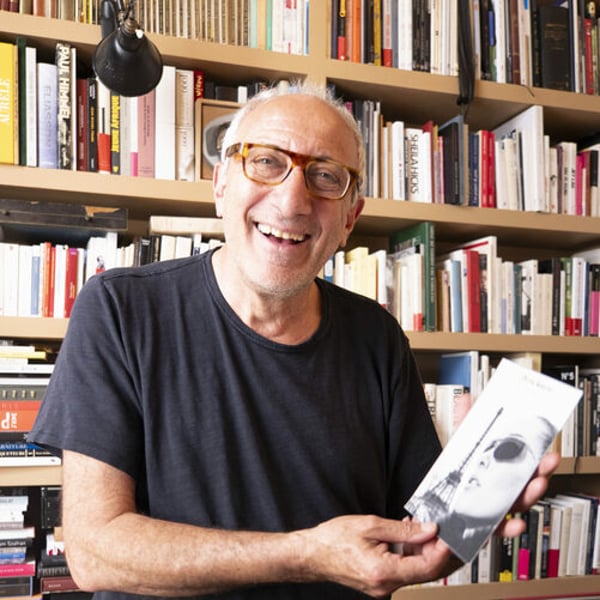
French eyewear label Solamor is gearing up for a long-anticipated relaunch, nearly four years after acclaimed designer Alain Miklitarian stepped in to take over the brand. Its first official collection under his creative direction will premiere this September at the Silmo Paris optics and eyewear trade show.
Alain Miklitarian has joined forces with Ludovic Edouard Dader to take over Solamor – Samuel Gut
Miklitarian has teamed up with Ludovic Edouard Dader, owner of the Paris-based boutique Eyeshowroom, to lead the revival. The project has been years in the making, shaped by trial and error. Before finalizing a concept they were proud of, the duo went through several rounds of prototype designs that never made it to production. Every step was guided by a shared goal: to bring Solamor back without compromising its legacy of craftsmanship. “I’ve always been drawn to this brand,” Miklitarian said. “It’s been on my radar for years, but the timing never aligned—until Ludovic reached out and brought the opportunity to life.”
A first look coming this September
Miklitarian initially hesitated to join the project, but in 2021, he committed fully, bringing financial backing and technical know-how. The early prototypes fell short of expectations, delaying the launch. From the outset, he and Dader made one thing non-negotiable: they wouldn’t attach the Solamor name to anything less than exceptional. They partnered with Japanese manufacturer Nakanishi to uphold the brand’s luxury standards and selected titanium for the frames.
The result is a Made in Japan collection, with two models set to preview at Silmo Paris. The full lineup includes twelve styles—offering both standard and customizable options—and will launch by the end of the year.
While developing the line, Miklitarian referenced Solamor’s archives but intentionally introduced modern design details. Still, he steers clear of leaning too heavily on vintage material. “If you dig into the archives too much, it starts to feel like plagiarism,” he said. He aims to honor the brand’s legacy while keeping the aesthetic relevant and forward-looking.
Customization plays a big role in the relaunch. The Sport 1000, one of the standout styles, will be available at different price points — from €450 to €1,000, and up to €2,000 for the gold-plated 2027 edition. Prices vary depending on the frame and lens quality.
Lens options range from durable polycarbonate with classic finishes to high-performance polyurethane that mimics mineral glass. The more advanced lenses offer better brightness and polarized glare reduction. “Solamor isn’t a sports brand,” Miklitarian added, “but I’m using every tool available.”
Target: Made in France by 2027
Although Miklitarian stands by the quality of the Japan-made collection, he admits the experience came with a bittersweet edge. “I had to adapt to Japanese production methods, but there’s still an aftertaste — the brand was born in the Jura region, and it misses that French système D spirit that gives it its charm,” he said.
He and Dader now plan to bring production back to France by 2027 — a move that would also allow Miklitarian to reconnect with long-standing industrial partners. “It’s not just about flying the Made in France flag,” he said. “It’s about working with manufacturers with the expertise to craft exceptional products.”
This approach is part of a bigger strategy. Although Italy continues to lead the global eyewear market — driven by giants like EssilorLuxottica, which reported €26.5 billion in revenue in 2024 — Miklitarian believes French craftsmanship still sets itself apart. “Walk into a French factory and you’ll see it — the way metal is worked, how materials are shaped and finished. That’s the kind of expertise we still have,” he said.
Reviving Solamor wasn’t a spur-of-the-moment decision. Miklitarian had been contemplating it for years. Now in his 70s, he brings decades of experience at the crossroads of design and social impact — from launching his namesake label and co-creating Starck Eyes to founding Mikli Diffusion, an initiative that made art more accessible to the visually impaired.
With this relaunch, he’s breathing new life into one of France’s heritage brands. Founded in 1946 by Georges Lissac, Solamor became a fixture in both cinema and fashion, worn by icons like Jean-Luc Godard, Michèle Morgan and Jean-Paul Belmondo.
The brand was founded in 1946 by Georges Lissac – Samuel Gut
Crafting a premium identity
Solamor is positioning itself as a high-end contender in a competitive market dominated by fashion houses such as Dior, Saint Laurent and Chanel. But Miklitarian insists the brand will stand out not for its name, but for its craftsmanship.
He’s well aware of the challenges ahead. “Luxury brands are slowing down. With unstable economies and global tensions, any brand without a solid foundation could be at risk,” he said. To stay agile, Miklitarian and Dader plan to keep operations lean — outsourcing most tasks and limiting the core team to just five people.
For now, Solamor does not plan to sell directly to consumers. Instead, it will distribute through opticians and operate under a B2B model, working only with what Miklitarian calls “committed and willing” partners. If direct-to-consumer sales are introduced later through the brand’s website, he emphasizes the platform must provide value and support — not serve purely as a sales channel.
While no direct data is available for the brand itself, industry publication Acuité reported a 0.9% increase in optician sales for 2024 — a positive sign for Solamor’s distribution strategy.
Artificial intelligence (AI) continues its march to transform businesses’/consumers’ lives with customer advocacy platform Mention Me launching ‘AI Discovery IQ’, a free-to-use tool that “helps brands reach target consumers in the new age of generative AI search”.
Kirill KUDRYAVTSEV / AFP/Archives
It claims to allow brands to “instantly audit how discoverable they are within popular AI systems” such as ChatGPT, Claude, Gemini and Perplexity.
According to Mention Me, 62% of UK consumers now turn to generative AI tools for product recommendations, brand discovery and comparisons, “bypassing traditional search engines entirely [so] businesses are under pressure to respond to this behaviour change,” said the platform’s CEO Wojtek Kokoszka whose platform works with firms including Charlotte Tilbury, Huel and Puma, “helping marketing teams to boost consumer awareness and sales”.
With AI, it says the modern customer journey, powered by natural language prompts instead of outdated keyword strings, means consumers are 4.4 times more likely to convert if they find a brand through a large language model (LLM).
“The rise of ‘agent-mode’ assistants and AI-driven voice search has pushed brands into a new world of digital visibility. Despite this, most brands have little to no insight into how they appear in AI-generated answers”, said Kokoszka.
AI Discoverability IQ claims to give brands an overall LLM discoverability score, specific details on areas such as technical website elements, content and structured data, and actionable recommendations to improve their AI discoverability.
Its tool generates “measurable, trackable outputs” like AI Visibility Score, brands’ prompt-based results, and a side-by-side comparisons with their competitive set. This means brands “can react quickly to improve their discoverability scores” with Mention Me’s wider suite of products and unique first-party data.
It’s also “innovating and evolving” its platform to include more capabilities, such as the ability to benchmark against competitors, to drive further improvements for marketing leaders in the age of AI.
Mention Me CMO Neha Mantri said: “AI Discoverability is not yet a named practice within most marketing teams; the same way SEO wasn’t in the early 2000s. But when up to 31% of consumers say they’re more likely to trust responses from generative AI than traditional search results, this needs to change. Mention Me is naming the problem and providing a solution at just the right time.”
A host of celebrities and high-end brands have donating goods to ensure Savile Row’s latest annual ‘Pop-Up Crisis’ store will continue to support the Crisis charity event that has so far raised over £650,000 since 2018.
Image: Crisis charity
Across 8-13 December, the pop-up store at 18-19 Savile Row in London’s Mayfair will sell a curated selection of designer clothing, past stock and samples from luxury brands.
Celebs donating goods include Rosie Huntington-Whiteley, Naomie Harris, David Gandy, Jarvis Cocker, Louis Partridge, Jamie Redknapp and Emma Corrin, among others, for a week-long event and raffle with all proceeds going to help end homelessness across Britain.
Hosted by landlord The Pollen Estate, the temporary shop is also selling designer goods donated by Savile Row tailors including Mr Porter, Wales Bonner, Crockett & Jones and many other luxury brands from Barbour, Tod’s to Manolo Blahnik and Watches of Switzerland Group.
This year, celebrity model and fashion entrepreneur David Gandy will also be curating an exclusive online edit on shopfromcrisis.com, including donations from his own wardrobe as well as items from friends including Redknapp’s brand Sandbanks, Hackett and Aspinal of London.
Gandy said: “Having supported Crisis for a number of years, I’m delighted to have had the opportunity to curate my own online edit this year with the help of some of my close friends. It means a lot to know that donations from my own wardrobe are going towards such an important cause. Whether you’re looking for the perfect Christmas gift or to treat yourself, your purchase can help make a real difference to people facing homelessness this Christmas.”
Liz Choonara, executive director of Commerce and Enterprise at Crisis, added: “Pop-Up Crisis is such an iconic event in the Crisis calendar and one that we look forward to every year. We’re thrilled to be partnering with the team once again for another week celebrating the iconic craftsmanship and style of Savile Row – with all proceeds going towards our crucial work to end homelessness.”
Specialist outdoor clothing producer Dryrobe has won a trademark case against a smaller label. The win for the business, which produces waterproof towel-lined robes used by cold water swimmers, means the offending rival must now stop selling items under the D-Robe brand within a week.
Image: Dryrobe
A judge at the high court in London ruled the company was guilty of passing off its D-Robe changing robes and other goods as Dryrobe products and knew it was infringing its bigger rival’s trademark reports, The Guardian newspaper.
The company said it has rigorously defended its brand against being used generically by publications and makers of similar clothing and is expected to seek compensation from D-Robe’s owners for trademark infringement.
Dryrobe was created by the former financier Gideon Bright as an outdoor changing robe for surfers in 2010 and became the signature brand of the wild swimming craze.
Sales increased from £1.3 million in 2017 to £20.3 million in 2021 and it made profits of £8 million. However, by 2023 sales had fallen back to £18 million as the passion for outdoor sports waned and the brand faced more competition.
Bright told the newspaper the legal win was a “great result” for Dryrobe as there were “quite a lot of copycat products and [the owners] immediately try to refer to them using our brand name”.
He said the company was now expanding overseas and moving into a broader range of products, adding that sales were similar to 2023 as “a lot of competition has come in”.