Connect with us

Sports

Alabama vs. Oklahoma Game Preview

Published

on


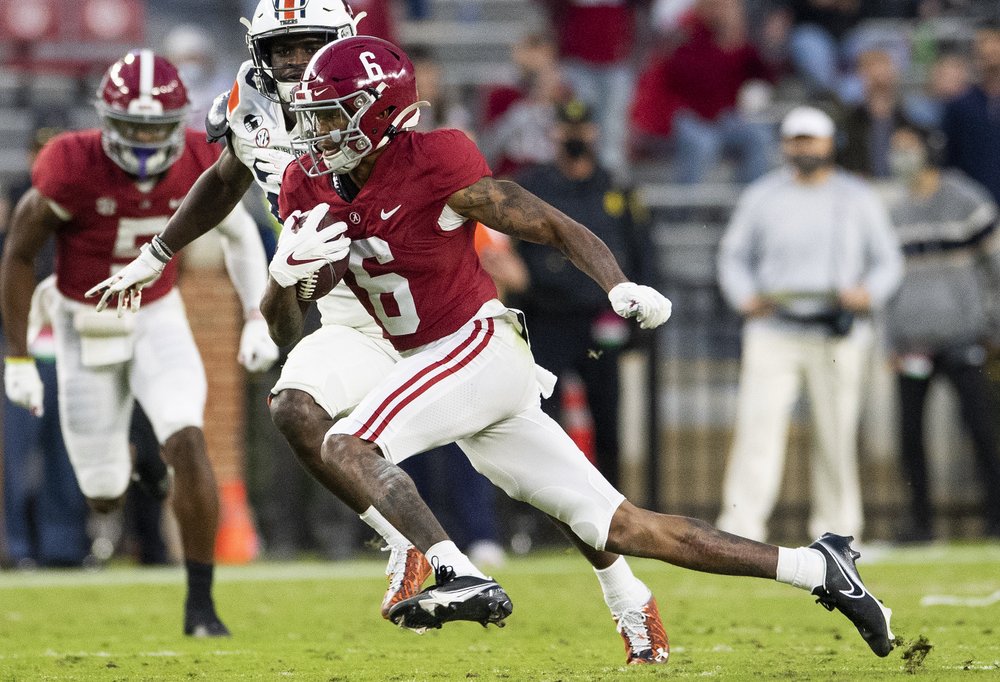
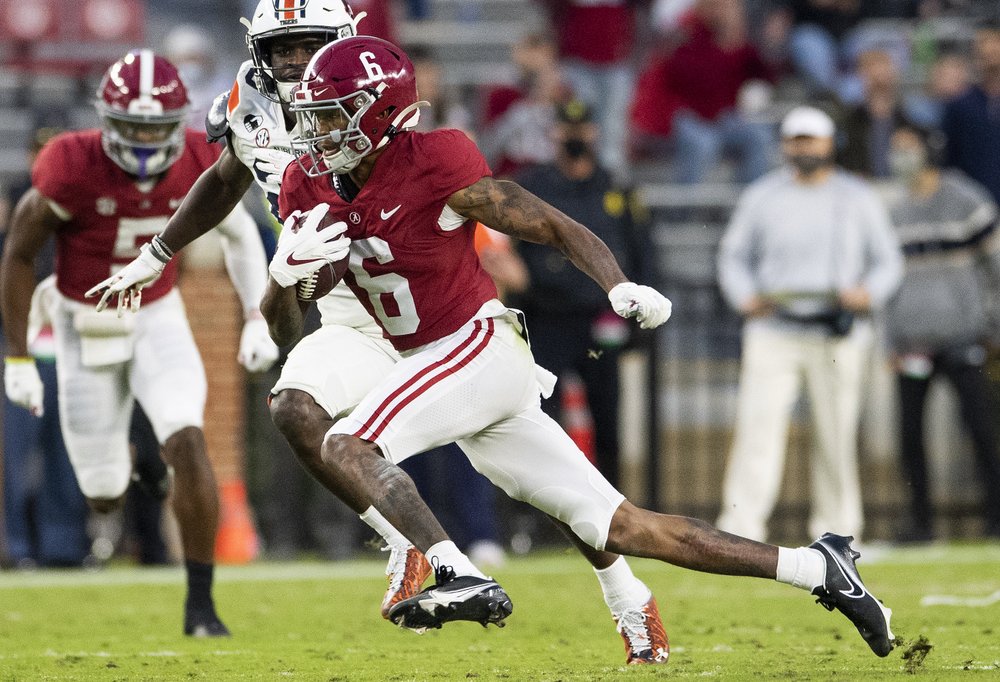
Alabama wide receiver DeVonta Smith (6) breaks free for a touchdown against Auburn during an NCAA college football game Saturday, Nov. 28, 2020, in Tuscaloosa, Ala. (Mickey Welsh/The Montgomery Advertiser via AP)

By: Matthew Weatherby

Alabama and Oklahoma are set to square off on Friday night in Norman to kick off the 2025-26 edition of the College Football Playoffs.

Both of these teams enter the playoffs with more questions than answers. But, for both sides, those questions stem from injury problems that have plagued both teams in the latter half of this season. For Alabama, though, one question has been resolved, and that is whether Kalen Deboer will still be their coach for the future. While Kalen recommitted himself to the Tide on Sunday, that will do them no good in terms of the true key on Friday, who makes it off the injury report.

SPORTS TALK GEORGIA

SPORTS TALK FLORIDA

Injuries

For Alabama, they are just hoping to get some guys back on offense. Jam Miller, Josh Cuevas, and Kam Dewberry all missed the SEC Championship. A game where Alabama’s offense was only able to score 7 points and put up a total of -3 rushing yards against Georgia. Getting some continuity back on the offensive side of the football for Alabama is going to be necessary against an Oklahoma defense that ranked first in the SEC in total defense this year. Alabama is also hopeful to get standout D-lineman LT Overton back from injury after he missed the SEC title game. (It must also be noted that there is a RUMOR going around regarding a potential Ty Simpson injury that he has been dealing with over the last couple of weeks)

On Oklahoma’s side of things, they hope to get R. Mason Thomas back from injury. Prior to his injury against Tennessee, Thomas had totaled 6.5 sacks over 8 games, along with 2 forced fumbles. His play over 8 games was good enough for him to be voted to the All-SEC First Team Defense.

I do have one more thing on Oklahoma’s injuries. What about John Mateer? After his hand injury against Auburn, the Oklahoma offense has appeared handicapped. Mateer has only thrown for more than 225 yards in a game once since the injury, and that was their regular-season finale against LSU, where he also threw 3 interceptions. But I have a theory regarding Mateer’s health. His hand needed time to heal after the surgery, and that was something he was’t really afforded. The amount of time needed for the hand to heal was supposed to be a couple of weeks. The Sooners will have had 3 weeks off between games come Friday night. Was this the amount of time needed for Mateer’s hand to heal?

On the field

I talked about those Alabama injuries earlier, and they are important because the version of Alabama’s offense everyone saw in Atlanta will not be enough if it shows up in Norman, Oklahoma, on Friday night. The pieces that they hope to get back should lead to that. Jam Miller is a much more well rounded Running Back than the guys sitting behind him. But where his value lies is in his pass protection. It was something that Alabama struggled with in the SEC Championship. In addition, Josh Cuevas and Kam Dewberry will also be helpful in protecting Ty Simpson. Cuevas’s being back will have a big impact on Alabama in 3rd down situations. He was Ty Simpson’s safety blanket all year.

Bama’s offense will be in better shape health-wise, but will it be enough? All outside factors have shifted away from Alabama in this game. They will not have had the same amount of rest that Oklahoma has had. Maybe that is a good or bad thing; you never really know when it comes to longer rest for teams, but when you look at Alabama’s injury report, you would assume that fairs better for the Sooners. Not to mention, Oklahoma will be playing at home. A place where they beat the Crimson Tide 24-3 last season. For Alabama even if they get those guys back to full health will it matter?

Oklahoma’s defense, by metrics, is better than Georgia’s. People also seem to forget that, prior to Alabama losing those guys on offense to injury, they still were not a particularly efficient or effective running team. They also have not been able to stretch the ball downfield very much this year. That is an area where you need Ryan Williams to step up. He has not been the same guy that he was last year. And without the threat of explosives, the Alabama offense will then be tasked with driving the ball down the field consistently against this Oklahoma defense. When you’re asked to do that without a consistent running game, your margin for error is razor-thin.

Why Oklahoma could Roll

If Oklahoma’s offense finds itself after the break, I do not think that this game will be particularly close. People talk about Alabama’s issues after their injuries, but they were always present for Alabama. The injuries they suffered just exposed them to a greater extent. For Oklahoma, John Mateer was heisman candidate prior to his injury. All you need from Mateer and this offense on Friday is 2-3 good drives. 17 points could be enough to win this game for Oklahoma.

This game will obviously be about the defenses, but I believe that Oklahoma’s offense has a higher ceiling than Alabama’s coming out of the break. As for Bama, this is a game where they have to win the margins. Something they did not do against Oklahoma earlier in the year, or the last time we saw them against Georgia. If Alabama were to win this game, it would be because it also won the turnover battle, time of possession, and average starting field position.

Prediction + Betting/Analytics

Prediction: Oklahoma

Spread: Alabama -1.5

According to ESPN Analytics, Alabama has a 50.9% chance to win on Friday.


Source link

Continue Reading

Sports

Indianapolis City Officials Take Another Step In An Attempt To Build A Soccer Stadium

Published

on


MLS Commissioner Don Garber

Momentum Builds for an MLS Stadium Plan

Plans to build a Major League Soccer stadium in Indianapolis appear to be gaining traction, despite significant uncertainty surrounding whether the city will ever land an MLS expansion franchise. The Capital Improvement Board has approved moving forward with pre-construction planning on a parcel of city-owned land, signaling renewed political interest in a project that has stalled before.

A key step came in 2025, when the Indianapolis Airport Authority Board agreed to sell its downtown heliport site to the city. That property has emerged as a potential location for a soccer-specific stadium. City officials view the site as strategically located and suitable for large-scale redevelopment tied to professional sports.

Expansion Questions Remain

While local momentum has increased, Major League Soccer has not signaled similar urgency. In July 2024, MLS Commissioner Don Garber stated that San Diego marked the end of league expansion for “a period of time.” That statement directly conflicted with the efforts of Indianapolis Mayor Joe Hogsett, who continued pushing for an MLS franchise despite the league’s public stance.

Those efforts also created friction locally. The mayor sought to position Indianapolis for MLS by backing a stadium plan that effectively displaced the United Soccer League’s Indy Eleven ownership group from land where they had hoped to build their own venue. The move underscored a broader shift in city priorities toward chasing a top-tier franchise, even without assurances from the league.

The Indy Eleven Fallout

On June 3, 2024, the Indianapolis City-County Council approved a new special taxing district designed to support a potential MLS stadium. In doing so, the council withdrew financial backing previously tied to the Indy Eleven’s stadium plans. The Indy Eleven ownership group believed it had reached an agreement with city leaders to develop a stadium-village project supported by a special tax district.

That project carried an estimated price tag approaching $1 billion and would have relied on redirected tax revenues to offset construction costs. In late June 2024, the Indianapolis Metropolitan Development Commission granted final approval for a stadium tied to that plan. Shortly thereafter, the project went dormant, leaving the Indy Eleven without a clear path forward.

A Stadium Without a Team

Garber visited Indianapolis in February 2025, but he offered no indication that the city would move to the front of the line if MLS resumes expansion. No ownership group has emerged to bid for an Indianapolis franchise, a critical requirement for league consideration.

Despite that reality, the city now controls a parcel of land suitable for a stadium. Indianapolis finds itself in a familiar position: advancing public planning and financial mechanisms for a professional sports venue without a confirmed team, owner, or league commitment. Whether that strategy leads to an MLS franchise—or another stalled stadium proposal—remains unresolved.

Evan Weiner’s books are available at iTunes – https://books.apple.com/us/author/evan-weiner/id595575191

Evan can be reached at evan_weiner@hotmail.com

Joe Hogsett


Source link

Continue Reading

Sports

Oklahoma City Is Building A Soccer Venue

Published

on


The planned Oklahoma City will also host concerts

Oklahoma City Commits to USL Soccer

Oklahoma City will add a United Soccer League franchise in 2028, and the city has already committed to building a new soccer-specific stadium to make that happen. The venue will seat roughly 10,000 fans and will cost taxpayers about $121 million. The team owner donated the land for the project, which city leaders have framed as a public-private partnership designed to spark redevelopment and long-term economic growth.

City officials first explored the idea of a soccer stadium in 2019. At that time, estimates suggested a modest facility with a price tag of about $40 million. Since then, the scope of the project has expanded dramatically, both in size and cost, reflecting a broader vision that goes well beyond soccer alone.

Stadium-Village and Tax Structure

The stadium will anchor a larger stadium-village development, a familiar model used in many cities pursuing professional sports teams. Oklahoma City plans to use a special financial structure in which all sales tax generated within the stadium district flows back to the stadium developer. Under this arrangement, tax revenue that would normally support the city’s general fund instead helps offset construction and development costs tied to the project.

Supporters argue that the district will generate new economic activity that would not otherwise exist. Critics point out that these mechanisms often shift public dollars toward private development while limiting the immediate fiscal benefit to the broader city.

City Hall’s Economic Vision

Mayor David Holt has strongly backed the project and views it as another step in Oklahoma City’s long-term investment in sports-driven development. He has consistently argued that sports facilities have played a key role in reshaping the city’s image, economy, and downtown footprint.

Holt has cited previous projects involving whitewater, softball, basketball, and baseball as proof that public investment in sports infrastructure can deliver tangible community benefits. He believes soccer, as the world’s most popular sport, represents a logical next step in that strategy and one the city committed to when it launched the MAPS 4 initiative in 2019.

Rising Costs and Public Commitments

The original stadium budget grew over time with the addition of tax increment financing funds and later received a significant boost through a voter-approved bond issue in October. City leaders now say the revised budget finally matches the ambition of the project and allows Oklahoma City to pursue its short-term soccer goals.

At the same time, the city is also moving forward with a new basketball arena expected to cost taxpayers around $1 billion. Together, the two projects represent a massive public investment in sports infrastructure, one that places Oklahoma City among the most aggressive markets in the country when it comes to taxpayer-funded venues.

Whether these projects deliver the promised jobs, development, and economic return remains a question only time can answer.Evan Weiner’s books are available at iTunes – https://books.apple.com/us/author/evan-weiner/id595575191

Evan can be reached at evan_weiner@hotmail.com

Planned Oklahoma City soccer stadium


Source link

Continue Reading

Sports

Mississauga Mayor Wants To Build A Soccer Stadium

Published

on


Canadian Premier League

Mississauga Stadium Fever Crosses the Border

Building small, soccer-specific stadiums has become a popular idea among mayors in smaller U.S. cities, and that enthusiasm has now crossed into Canada. Mississauga, Ontario — located roughly 20 miles west of Toronto — has joined the conversation. Mayor Carolyn Parrish has publicly stated that a 7,500-seat soccer stadium in Mississauga’s City Centre remains one of her priorities, even though the concept has lingered for several years without a concrete plan.

The idea itself is not new. Mississauga City Council first discussed the possibility of a soccer stadium in 2021, when early estimates suggested a construction cost of about $50 million Canadian, or roughly $36 million U.S. At the time, council members framed the proposal as a way to enhance the city’s profile and tap into soccer’s growing popularity.

Economic Promises and Tourism Hopes

In 2021, city officials outlined several reasons why Mississauga “needed” a soccer stadium. Supporters believed a venue could attract tourists to the city, not only for a potential professional team but also for youth tournaments and regional events. The assumption was that visiting teams, families, and fans would spend money locally, boosting restaurants, hotels, and nearby businesses.

That same thinking has driven stadium proposals in dozens of North American cities, where leaders often point to tourism and economic spillover as justification. Whether those benefits materialize at the projected scale remains an open question, particularly for mid-sized municipalities competing with nearby major markets.

World Cup Aspirations

Another motivation behind the original discussion centered on the 2026 Men’s World Cup. Toronto will host six matches, and Mississauga leaders hoped proximity alone could translate into economic opportunity. The idea was that a local stadium might host World Cup training sessions or related events, allowing some of the tournament’s spending to spill over into the city.

That argument relied heavily on timing and circumstance. With the World Cup now approaching, no stadium project has advanced beyond discussion, and there is no indication that Mississauga will play a formal role in the tournament beyond being part of the Greater Toronto Area.

League Ambitions Without a Team

City leaders also hoped a stadium could help Mississauga land a Canadian Premier League franchise. In 2021, CPL ownership discussed plans to expand from eight to 16 teams by 2026. The league, which launched in 2017, already operates clubs in Toronto and nearby Hamilton, with Montréal joining this year.

Mayor Parrish has acknowledged the core challenge. “We’ve got the land lined up, we just have to find a team,” she said, adding that construction costs would not be “exorbitantly expensive.” For now, however, Mississauga has neither a confirmed franchise nor a financing plan. What remains is an idea — one that reflects a broader trend of stadium optimism, but one still waiting for substance.

Evan Weiner’s books are available at iTunes – https://books.apple.com/us/author/evan-weiner/id595575191

Evan can be reached at evan_weiner@hotmail.com


Source link

Continue Reading

Trending

Copyright © Miami Select.