Connect with us

Business

Airlines plead for end of government shutdown as unpaid air traffic controllers prepare for busy holiday travel

Published

on


The government shutdown is completing its first full month, and airlines have just about had enough.

Aviation industry leaders are urging Congress to end the shutdown out of concern for the wellbeing of air traffic controllers working without pay, as well as on air travel ahead of a busy holiday season.

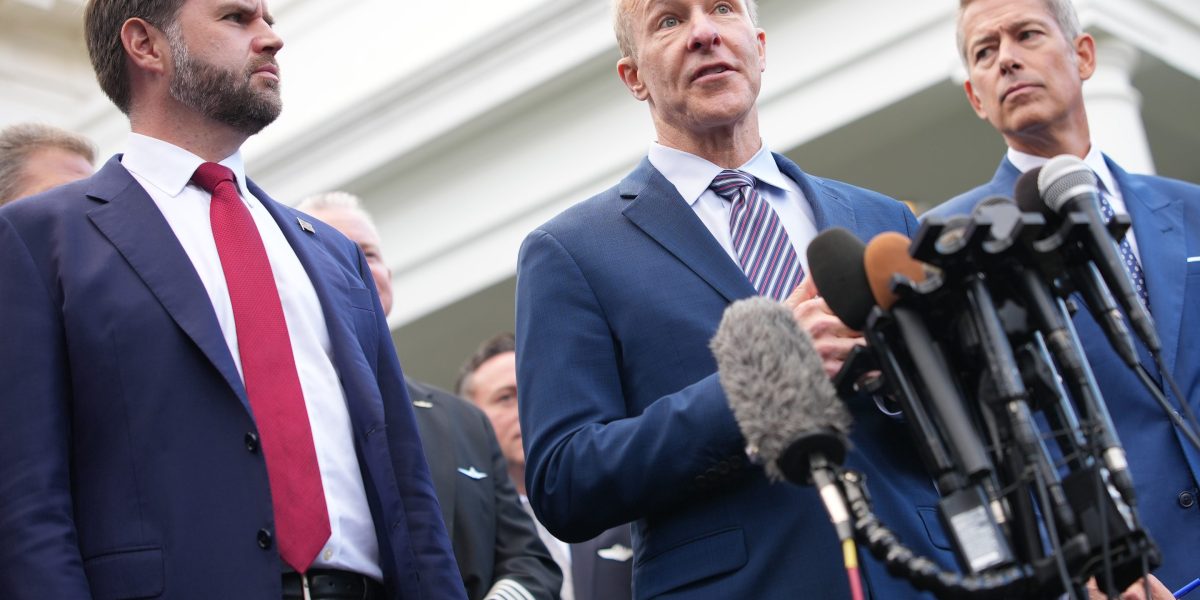
“It’s putting stress on people. It’s not fair to those people. It’s also putting stress on the economy,” United Airlines CEO Scott Kirby told reporters outside of the White House on Thursday. “Airlines are a pretty good real-time indicator of the economy, and we start to see, still minor, but steep booking impact. And you see that happening in the economy. We put the whole economy at risk.”

Kirby called for bipartisan agreement on a clean continuing resolution to reopen the government. He, as well as industry leaders like Transportation Secretary Sean Duffy and Chris Sununu, the former Republican governor of New Hampshire and current CEO of industry trade group Airlines for America, met with Vice President JD Vance on Thursday to discuss the impact on the government shutdown on aviation, Bloomberg reported

American Airlines confirmed to Fortune that CEO Robert Isom was in attendance at the Thursday meeting. The airline said air traffic controllers working without pay was “unacceptable.”

“Congress needs to reach a bipartisan agreement to re-open the government as quickly as possible to pay our air traffic controller, [Transportation Security Administration], and [Customs and Border Protection] colleagues,” the airline told Fortune in a statement. “The quickest way to end this shutdown and get these workers paid is by passing a clean continuing resolution. A prolonged shutdown will lead to more delays and cancellations—and the American people, especially during the busy holiday season, deserve better.”

Strain on air traffic controllers and travelers

Aviation has remained a flashpoint during the government shutdown, with more than 13,000 air traffic controllers, deemed essential workers, working without pay, mounting stress on employees already navigating an ongoing shortage for more than a decade. Before the shutdown, 91% of U.S. air traffic control centers operated below the Federal Aviation Administration’s recommended staffing levels. During the shutdown, many are working six-day weeks of 60 hours or more.

Air traffic controllers received their last paycheck on Tuesday, and are feeling the financial pressures of working without wages. Some have resorted to becoming restaurant servers and Uber drivers on the side to make ends meet.

“It’s a world where they are now not only leaning on each other, they’re leaning on getting other jobs, going to their primary job in the day, and then in the evening, going out and having to do some level of a secondary job,” Nick Daniels, president of the National Air Traffic Controllers Association, told Fortune.

Some workers have held “sick-outs,” refusing to work until they are paid. These absences have already caused disruptions to air travel. According to Flightaware.com, there were more than 7,300 flight delays to and from U.S. airports on Thursday, as well as more than 1,250 cancellations.

The shutdown will approach a record-setting length, approaching its 34th day on Monday, when the Senate reconvenes, matching the longest funding lapse in U.S. history. According to the Congressional Budget Office, the shutdown could account for nearly $14 billion in losses to the real GDP that will not be recouped. While more than 700,000 government employees are going without pay during this period, others, including ICE agents, will still receive checks. 

As the White House continues to pressure Democrats to end the shutdown, many Americans believe the onus to resolve the funding lapse is on Republicans. A Washington Post-ABC News-Ipsos poll this week found 45% of U.S. adults believe Trump and the GOP are primarily responsible for the shutdown. One-third of respondents blamed Democrats, and 22% weren’t sure.


Source link

Continue Reading

Business

The Coast Guard has seized a record amount of cocaine while Trump says interdiction has failed

Published

on


 In justifying American military strikes on boats suspected of smuggling drugs, President Donald Trump has asserted that the longtime U.S. strategy of interdicting such vessels at sea has been a major failure.

“We’ve been doing that for 30 years,” he said last month, “and it’s been totally ineffective.”

Trump’s comments came around the same time that the U.S. Coast Guard announced it had set a record for cocaine seizures — a haul of 225 metric tons of the drug over the previous year. That milestone, however, has not dissuaded the Republican president from upending decades of U.S. counternarcotics policy.

Under Trump, the U.S. military has blown up 20 suspected drug boats, resulting in 80 deaths, in the Pacific Ocean and Caribbean Sea. Trump and other top officials have contended that such boats are being operated by narco-terrorists and cartel members with deadly drugs bound for America.

The strikes have generated international pushback from foreign leaders, human rights groups, Democrats and some Republicans who have raised concerns that the United States is engaging in extrajudicial killings that undermine its stature in the world.

Veterans of the drug war, meanwhile, say U.S. resources would be better spent doubling down on the traditional approach of interdicting drug boats, especially in the long term. That is because crews of drug boats frequently have valuable intelligence that can help authorities better target cartels and trafficking networks. Dead men, they say, tell no tales.

The Coast Guard has fought the drug war a long time

The Coast Guard for decades has interdicted small vessels suspected of smuggling illicit narcotics. Much of that work is focused on halting shipments of cocaine, most of which is produced in the jungles of Colombia.

Working with partner nations and other federal agencies — the Drug Enforcement Administration, the departments of State and Justice as well as U.S. Southern Command’s Joint Interagency Task Force-South in Key West, Florida — the aim is to inflict heavy losses on traffickers and limit the amount of drugs entering the U.S.

That campaign, by at least one measure, has never been more successful, despite constant complaints by the Coast Guard that it lacks funding to seize even more drugs.

The Coast Guard’s recent record cocaine seizure was almost 40% higher than the past decade’s annual average. The haul included 38 tons of cocaine offloaded by the cutter Hamilton when it returned from a two-month patrol. It was the largest amount confiscated by a single Coast Guard ship during a deployment, the Coast Guard reported. The interdictions have continued as part of what’s known as Operation Pacific Viper even during the federal government shutdown, with several cutters reporting major seizures last month.

In almost every case, drug smugglers have been brought to the U.S. for prosecution, and valuable information about ever-changing smuggling routes and production methods was collected — all without any loss of life and a far lower cost to American taxpayers. Experts said each missile strike is likely to cost far more than the payload of cocaine on every ship.

“The Coast Guard has extraordinary powers and authorities to do effective drug interdiction without killing unidentified people on small boats,” said Douglas Farah, a national security expert on Latin America and president of IBI Consultants. “When resourced, they are far more effective, sustainable and likely legal than the current Pentagon-led operations.”

Trump administration officials say strategy needed to change

Secretary of State Marco Rubio this week defended the shift in strategy, saying that “interdictions alone are not effective.”

“Interdictions have limited to no deterrent effect,” he added. “These drug organizations, they’ve already baked in the fact they may lose 5% of their drug shipments. It doesn’t stop them from coming.”

Part of the problem is that demand for cocaine is high, and supplies have never been so robust, according to authorities and experts. A sign of that trend: Cocaine prices have been hovering at historical lows for more than a decade.

The Coast Guard also does not have enough vessels or crew to halt it all. At most, it seizes not even 10% of the cocaine that officials believe flows to the U.S. on small vessels through what is known as the “Transit Zone” — a vast area of open water larger than Russia.

Cocaine shipments bound for the U.S. primarily work their way up the west coast of South America to Central America and then overland into the U.S. via Mexico. Shipments heading to Europe are smuggled through the Caribbean, often hidden in container ships.

Such interdiction efforts target cocaine, not fentanyl

In social media posts, Trump has claimed that his strikes have blown up boats carrying fentanyl and that each destroyed vessel has saved 25,000 American lives. According to experts and former U.S. counternarcotics officials, Trump’s statements are either exaggerations or false.

For the past decade, U.S. officials have sounded the alarm about rising overdose deaths in the U.S., particularly from opioids and synthetic opioids. Overdose deaths from opioidspeaked in 2023 at 112,000 but dropped to 74,000 in April. Experts have attributed that decline mostly to Biden administration efforts to boost the availability of lifesaving drugs that prevent overdose deaths.

The drug flowing to the U.S. from South America is cocaine. Fentanyl, on the other hand, is typically trafficked to the U.S. overland from Mexico, where it is produced with chemicals imported from China and India. Cocaine overdose deaths are less frequent than those from fentanyl. In the last year, just under 20,000 people in America died from cocaine overdoses, federal data shows.

Trump and administration officials have also claimed that the crews of targeted vessels were narco-terrorists or members of cartels.

The Associated Press visited a region in Venezuela from which some of the suspected boats have departed and identified four men who were killed in the strikes. In dozens of interviews, residents of the region and relatives said t he dead men were mostly laborers or fisherman making $500 a trip.

Law enforcement officials and experts echoed those findings, saying the smugglers captured by the Coast Guard are hired for little money to ferry drugs from point A to point B.

“They are hardly kingpins,” said Kendra McSweeney, an Ohio State University geographer who has spent years researching U.S. drug policies.

Trump administration officials recently promoted big seizures

In April, months before Trump launched his military campaign, his attorney general, Pam Bondi, traveled to South Florida to welcome home the Coast Guard cutter James from its latest antinarcotics patrol. It had seized 20 tons of cocaine worth more than $500 million.

Flanked by FBI Director Kash Patel, she praised a “prosecutor-led, intelligence driven approach to stopping these criminal enterprises in their tracks.”

“This is not a drop in the bucket,” said Bondi, standing in front of the vessel loaded with colorful, plastic-wrapped bales of narcotics stacked several feet high. “Behind you is half a billion dollars of pure, uncut cocaine.”


Source link

Continue Reading

Business

The 2026 class of American Rhodes scholars includes 5 students at U.S. military academies

Published

on


Five students at U.S. military academies and three each from Yale University, Harvard University and the Massachusetts Institute of Technology are among the 32 American winners named Sunday as 2026 Rhodes scholars.

The group includes students focused on housing, health outcomes, sustainability and prison reentry programs. They include:

Alice L. Hall of Philadelphia, a varsity basketball player at MIT who also serves as student body president. Hall, who has collaborated with a women’s collective in Ghana on sustainability tools, plans to study engineering.

Sydney E. Barta of Arlington, Virginia, a Paralympian and member of the track team at Stanford University, who studies bioengineering and sings in the Stanford acapella group “Counterpoint.” Barta plans to study musculoskeletal sciences.

Anirvin Puttur of Gilbert, Arizona, a senior at the U.S. Air Force Academy who serves as an instructor pilot and flight commander. Puttur, who is studying aeronautical engineering and applied mathematics, also has a deep interest in linguistics and is proficient in four languages.

The students will attend the University of Oxford as part of the Rhodes scholar program, which awards more than 100 scholarships worldwide each year for students to pursue two to three years of graduate studies.

Named after British imperialist and benefactor Cecil John Rhodes, the scholarship was established at Oxford in 1903. The program has more than 8,000 alumni, many of whom have pursued careers in government, education, the arts and social justice.


Source link

Continue Reading

Business

Most advanced US aircraft carrier adds to the growing fleet of warships near Venezuela

Published

on


The nation’s most advanced aircraft carrier arrived in the Caribbean Sea on Sunday in a display of U.S. military power, raising questions about what the new influx of troops and weaponry could signal for the Trump administration’s intentions in South America as it conducts military strikes against vessels suspected of transporting drugs.

The arrival of the USS Gerald R. Ford and other warships, announced by the Navy in a statement, marks a major moment in what the administration insists is a counterdrug operation but has been seen as an escalating pressure tactic against Venezuelan President Nicolás Maduro.

The Ford rounds off the largest buildup of U.S. firepower in the region in generations. With its arrival, the “Operation Southern Spear” mission includes nearly a dozen Navy ships and about 12,000 sailors and Marines.

The carrier’s arrival came as the military announced its latest deadly strike on a small boat it claims was engaged in ferrying illegal drugs. The military’s Southern Command posted a video on X on Sunday showing the boat being blown up, an attack it said took place Saturday in international waters of the eastern Pacific Ocean and killed three men. A request for more information from the military was not immediately answered.

Since early September, such strikes by the U.S. in the Caribbean and eastern Pacific have now killed at least 83 people in 21 attacks.

The carrier strike group, which includes squadrons of fighter jets and guided-missile destroyers, transited the Anegada Passage near the British Virgin Islands on Sunday morning, the Navy said.

Rear Adm. Paul Lanzilotta, who commands the strike group, said it will bolster an already large force of American warships to “protect our nation’s security and prosperity against narco-terrorism in the Western Hemisphere.”

Adm. Alvin Holsey, the commander who oversees the Caribbean and Latin America, said in a statement that the American forces “stand ready to combat the transnational threats that seek to destabilize our region.”

Holsey, who will retire next month after just a year on the job, said the strike group’s deployment is “a critical step in reinforcing our resolve to protect the security of the Western Hemisphere and the safety of the American Homeland.”

In Trinidad and Tobago, which is only 7 miles from Venezuela at its closest point, government officials said troops have begun “training exercises” with the U.S. military that will run through much of the week.

Minister of Foreign Affairs Sean Sobers described the joint exercises as the second in less than a month and said they are aimed at tackling violent crime on the island nation, which has become a stopover point for drug shipments headed to Europe and North America. The prime minister has been a vocal supporter of the U.S. military strikes.

The exercises will include Marines from the 22nd Expeditionary Unit who have been stationed aboard the Navy ships that have been looming off Venezuela’s coast for months.

Venezuela’s government has described the training exercises as an act of aggression. It had no immediate comment Sunday on the arrival of the aircraft carrier.

Meanwhile, Army Secretary Dan Driscoll said Sunday that U.S. troops have been training in Panama, underscoring the administration’s increasing focus on Latin America.

“We’re reactivating our jungle school in Panama. We would be ready to act on whatever” Trump and Defense Secretary Pete Hegseth needed, he told CBS’ “Face the Nation.”

The administration has insisted that the buildup of American forces in the region is focused on stopping the flow of drugs into the U.S., but it has released no evidence to support its assertions that those killed in the boats were “narcoterrorists.” Trump has indicated military action would expand beyond strikes by sea, saying the U.S. would “stop the drugs coming in by land.”

The U.S. has long used aircraft carriers to pressure and deter aggression by other nations because their warplanes can strike targets deep inside another country. Some experts say the Ford is ill-suited to fighting cartels, but it could be an effective instrument of intimidation for Maduro in a push to get him to step down.

Secretary of State Marco Rubio says the United States does not recognize Maduro, who was widely accused of stealing last year’s election, as Venezuela’s legitimate leader. Rubio has called Venezuela’s government a “transshipment organization” that openly cooperates with those trafficking drugs.

Maduro, who faces charges of narcoterrorism in the U.S., has said the U.S. government is “fabricating” a war against him. On his Facebook page, Maduro wrote on Sunday that the “Venezuelan people are ready to defend their homeland against any criminal aggression.”

Venezuela’s government recently touted a “massive” mobilization of troops and civilians to defend against possible U.S. attacks. Maduro and other officials in Venezuela’s socialist party also have been attending rallies this weekend to back the creation of neighborhood committees that will be in charge of increasing membership in Venezuela’s socialist party, and promoting the party’s policies.

Trump has justified the attacks on drug boats by saying the U.S. is in “armed conflict” with drug cartels while claiming the boats are operated by foreign terrorist organizations.

He has faced pushback from leaders in the region, the U.N. human rights chief and U.S. lawmakers, including Republicans, who have pressed for more information on who is being targeted and the legal justification for the boat strikes.

Senate Republicans, however, recently voted to reject legislation that would have put a check on Trump’s ability to launch an attack against Venezuela without congressional authorization.

Experts disagree on whether or not American warplanes may be used to strike land targets inside Venezuela. Either way, the 100,000-ton warship is sending a message.

“This is the anchor of what it means to have U.S. military power once again in Latin America,” said Elizabeth Dickinson, the International Crisis Group’s senior analyst for the Andes region. “And it has raised a lot of anxieties in Venezuela but also throughout the region. I think everyone is watching this with sort of bated breath to see just how willing the U.S. is to really use military force.”


Source link

Continue Reading

Trending

Copyright © Miami Select.