Business
AI is saving workers up to an hour a day — but 80% of companies aren’t using it yet

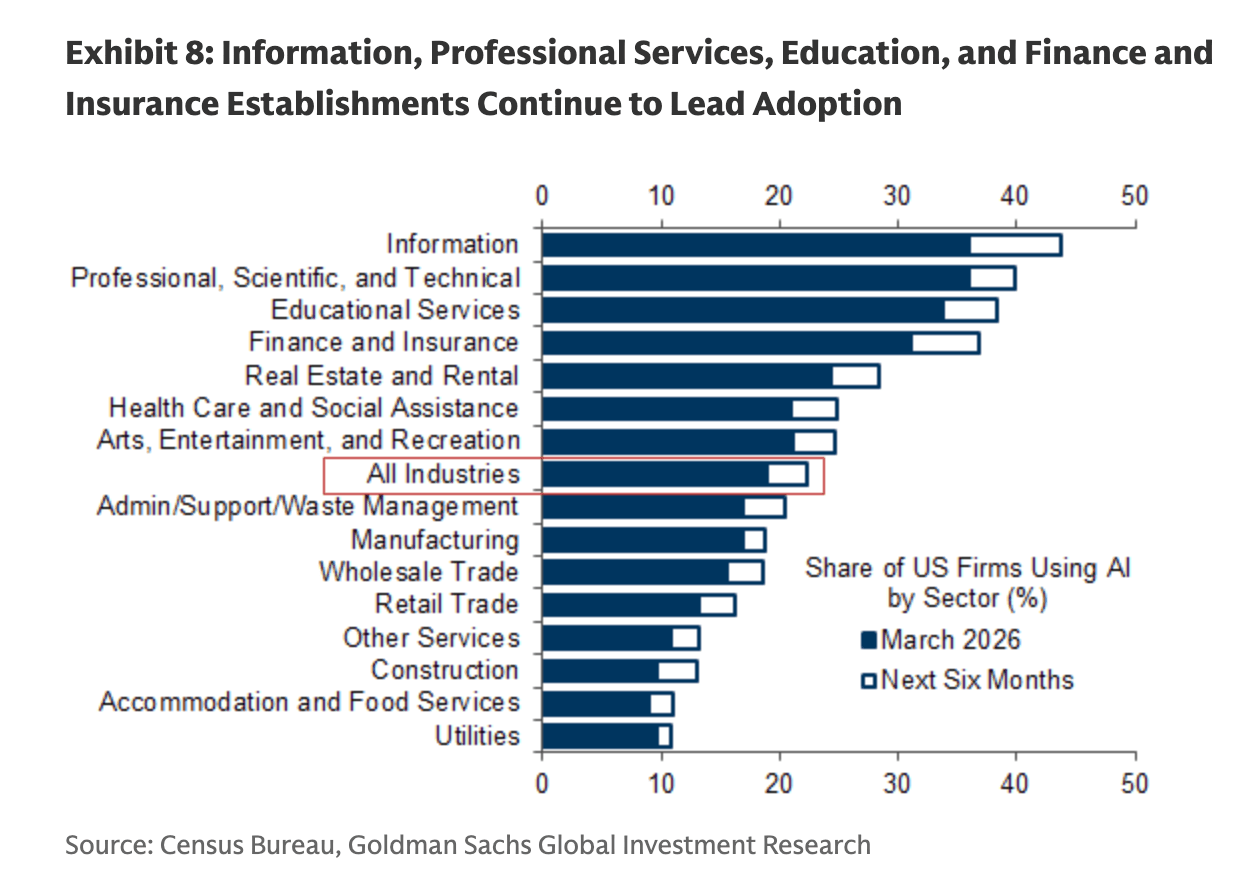
You’re probably sick of reading about artificial intelligence (AI), maybe, especially from this byline. But amid all the discussion, hype, and hysteria, Goldman Sachs economists Sarah Dong and Joseph Briggs have a sobering dose of reality in the data: fewer than 19% of U.S. establishments have adopted it.
The Census Bureau’s Business Trends and Outlook Survey, as reported in Goldman’s March 2026 AI Adoption Tracker, shows that the figure is essentially flat from the prior month, though it is expected to rise to 22.3% over the next six months. It shows that adoption, while growing, has yet to reach the tipping point that would make AI a standard workplace tool rather than a competitive advantage reserved for early movers. But the data also suggests that, when used correctly, it saves a huge amount of time.
Enterprise workers who use AI are getting back nearly an hour a day, according to data from OpenAI dated December 2025. Specifically, Goldman reported that employees at companies with ChatGPT enterprise accounts save an average of 40 to 60 minutes per day thanks to AI, and 75% say they can now complete tasks they previously couldn’t do at all. The catch, of course, is that almost no one is doing this yet.
“We continue to observe large impacts on labor productivity in the limited areas where generative AI has been deployed,” the Goldman economists wrote, going on to essentially agree with the OpenAI disclosure. “Academic studies imply a 23% average uplift to productivity, while company anecdotes imply slightly larger efficiency gains of around 33%.”
Put simply: the companies using AI are pulling ahead, and most of their competitors aren’t even in the race yet.
The adoption gap is widening
The adoption divide isn’t just between industries — it’s also stark by company size. Firms with more than 250 employees report an AI adoption rate of 35.3%, more than double that of smaller establishments. But smaller businesses are starting to close the gap: companies with 20 to 49 employees saw the largest recent increase in adoption, jumping 2.1 percentage points to 21.5%.
The sectors leading adoption are predictable — information services, professional services, finance and insurance, and education. Computing and web hosting firms top the list at 60% adoption. But broadcasting companies are expected to see the biggest surge over the next six months, according to Goldman’s analysis of Census Bureau data, signaling that the media and content industries are on the verge of a significant AI-driven transformation.

What most companies are missing
To be sure, the picture isn’t uniformly rosy. As Fortune reported last month, AI tools are also adding significant cognitive load for many workers, with time spent on some tasks increasing by as much as 346%, and deep-focus work hours dropping 2%. The time savings, it turns out, are often immediately reinvested in more work, not less.
Fortune also previously reported that some firms deploying AI are now completing product cycles that previously took 24 to 36 months in as little as six months — a compression of time-to-market that’s difficult to reverse once a rival has achieved it.
For the roughly 81% of U.S. firms not yet using AI, the data suggests they’re leaving a substantial productivity dividend on the table. OpenAI’s enterprise figures show that its business users are now sending 30% more messages than they were just months ago — a signal that once workers start using the tools, engagement compounds quickly.
These stakes aren’t lost on the C-suite. A Fortune survey of CFOs published last week found that executives privately expect AI-attributed layoffs to be nine times higher in 2026 than current public figures suggest — even as many of those same CFOs acknowledged a persistent gap between the productivity gains they expected from AI and what they’ve actually measured so far.
The Goldman Sachs data, which shows real productivity acceleration in industries with higher adoption rates, suggests that the gap may be closing — but only for firms that have actually deployed the tools and done so correctly. To that point, Fortune reported last week that 77% of enterprises are actively pursuing AI initiatives — but many don’t know how to evaluate, procure, or deploy the tools effectively, leaving significant spend without measurable return.
The barriers to adoption are well-documented: insufficient employee skills, data security concerns, and difficulty identifying the right use cases, according to surveys from Deloitte, Gartner, and Bain & Company. But those barriers are softening. Bain found that more than 80% of reported AI use cases now meet or exceed expectations — a figure that undercuts the skepticism still common in many boardrooms.
For executives still evaluating whether to invest in AI tooling, Goldman Sachs’ data offers a clear warning: firms that have already deployed AI are beginning to show measurable productivity gains relative to those that haven’t.
The 40 to 60 minutes a day that AI saves isn’t just a worker convenience. Across a team of 50, that’s roughly 33 to 50 hours of recovered productivity — every single day. The companies already capturing that aren’t waiting for the technology to mature. They’ve decided the risk of waiting is greater than the risk of moving.
There’s a more human dimension to that calculus, too. As Fortune reported in January, many workers whose productivity has genuinely improved with AI still describe a quiet sense of loss — of craft, of autonomy, of the slower rhythms that once defined skilled work. The hour they’re getting back, some say, doesn’t quite feel like it belongs to them anymore.