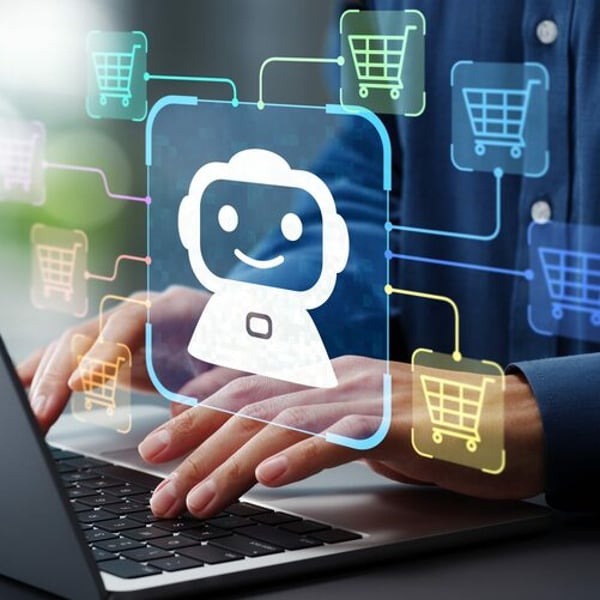
AI-assisted shopping is no longer a niche technology. Around 41% of consumers now use assistants to search for products, 33% to check reviews and 31% to find promotions, with Asia outpacing the West in these practices, according to a major study.
shutterstock
Entitled “Own the agentic commerce experience,” the study was conducted by IBM with 18,000 consumers across 23 countries. It finds that the use of virtual assistants has surged by 62% in two years.
Contrary to popular belief, however, the digitisation of the purchase journey is not the exclusive preserve of Gen Z, as Baby Boomers are already embracing AI, albeit with a persistent mistrust that platforms and e-tailers will need to address.
The study highlights a striking take-up of AI among seniors, with usage soaring by 92% among Baby Boomers and 82% among Generation X. While the physical point of sale remains a mainstay for 72% of shoppers, the customer journey is now decisively hybrid, with IBM identifying five broad consumer profiles.
Of these five profiles, “Smart Spenders” dominate the market, accounting for 46% of the panel. These buyers move between the web and in-store with a pragmatic aim: optimising their budget. At the other end of the spectrum, “Affluent Leaders who embrace AI” account for just 7% of volume, but they are a strategic target: three-quarters use AI to find products, and they are also highly active in social commerce.
The analysis segments the remainder of the panel into 19% “Conscious Connectors,” digitally engaged consumers seeking ethics and personalisation; 21% “Habit-Driven Shoppers,” loyal to physical retail out of routine; and 7% “Price-First Pragmatists,” a cohort resistant to digital channels and motivated exclusively by very low prices.
Resilience of strong brands
In an inflationary climate affecting even affluent households, AI is accompanying a shift towards increasingly “surgical” consumption. While 39% of buyers are trading down to cheaper alternatives and 29% to retailer own brands, overall consumption is not collapsing.
The study shows that strong brands are holding firm: 25% of customers remain loyal to their favourite labels despite price rises, and 20% are making trade-offs, saving on basics to treat themselves in “pleasure” or wellbeing categories.
Persistent mistrust
Yet the success of AI in customer journeys exposes a major point of friction in the agentic model. The system relies on extensive use of customer data, and mistrust remains widespread. Although 52% of consumers say they are comfortable sharing information, 83% simultaneously express concerns about security.
The consequences of a breach would be immediate: 23% of affluent consumers say they have already switched brands following a security incident. This mistrust also extends to the agentic tool itself, with only 24% of respondents placing complete trust in AI recommendations.
For now, companies are struggling to respond to this challenge. While 70% of executives consider integrating AI crucial to streamlining the experience, more than half (54%) are hampered by technical barriers to data integration, as well as a lack of in-house expertise, which for the time being limits the use of agents to basic customer service functions rather than transactional purchase assistance, the study indicates.
This article is an automatic translation. Click here to read the original article.
There was big news at luxury label Roksanda on Tuesday with the appointment of Patricia Sancho as its new CEO, effective immediately.
Roksanda CEO Patricia Sancho
The company said that “as the London-based fashion house enters a new phase of growth and global expansion, it will now be led by two women, and we couldn’t be more excited”.
Sancho brings more than 20 years of experience across luxury and premium fashion, “with a strong track record of partnering with creative leadership to deliver strategic clarity, operational discipline, and sustainable commercial performance”.
She has an undeniably impressive CV that includes a period as CEO of another luxe UK label, Temperley London, as well as co-MD of Inditex’s footwear and accessories Tempe unit, and recently CEO of Athena Consultancy. She founded that advisory agency in 2020.
“Known for her ability to balance creative integrity with business vision, she joins Roksanda at a pivotal moment in the brand’s evolution,” we’re told.
Her arrival comes after the company was sold in 2024 to The Brand Group but with founder and creative director Roksanda Ilinčić staying in her role. Ilinčić said of the latest move: “As we evolve as a brand, staying true to our creative codes and values is essential. Patricia brings strategic insight, commercial experience, and a deep respect for creativity.”
Meanwhile Sancho added that she’s a long-time admirer of “Roksanda’s vision and artistry. My focus will be on driving thoughtful growth anchored in the brand’s core values — preserving its femininity, strength, and emotion — while shaping a clear offering and business strategy for the future. This is about growing with intention and integrity”.
As mentioned, Roksanda was sold in 2024 — specifically in May of that year — to brand development platform The Brand Group shortly after filing notice of intent to appoint administrators as it navigated a very tough market backdrop. It joined the still-new Vivere label as part of fashion entrepreneur Damian Hopkins’ growing empire.
Fans of brands as varied as Le Creuset, Elf Beauty, Michaels Cos. and the Miami Heat can make a gamble: Spend some nominal amount of money to get merchandise worth much more. The catch? Shoppers don’t know what they’re getting until they open the box- a phenomenon known as “mystery” or “blind” shopping.
Elf Beauty reported a positive response to its mystery bundles – Elf Beauty
“It’s gamified commerce,” said Shreyas Sekar, assistant professor of operations management at the University of Toronto Scarborough, who has closely tracked the rise of blind boxes. The practice, long popular in parts of Asia, has spread to the US, UK, and Canada over the last three or four years, Sekar said, with more new companies jumping on the trend each year.
It’s partly thanks to Labubus, the wildly popular furry dolls that come in blind-box packaging. Their growth among US consumers, Sekar said, has served as a proof of concept for the viability of mystery shopping in markets outside of Asia. Pop Mart International Group, the Chinese company that owns Labubu, reported revenue in the Americas surged nearly 1,300% in the latest quarter.
Now, other retailers are realising they too can drive buzz- and at times offload unwanted merchandise- by playing up the secrecy angle.
Blind boxes are “a chance to gamble on getting something great,” said Jackie Mitchell, a 28-year-old social media influencer, in an interview. Last year, she recorded herself opening a Le Creuset mystery box she bought at the brand’s event in Columbus, Ohio. She estimated her haul- two plates, a skillet and a cast iron Dutch oven- was worth more than $600. To be eligible to buy the $50 box, she had to buy a $25 VIP ticket to the event and spend at least $150 there.
But as with any gamble, it doesn’t come without risk. Like the kid who receives a sweater instead of Legos for his birthday, shoppers at times have been disappointed by the contents of the boxes. And many of them air their grievances on social media.
Le Creuset faced customers’ frustration after selling mystery boxes at an event in Hartford, Connecticut. One TikTok content creator, who identifies herself as Linda from Buffalo, posted multiple videos criticizing the brand for what she said were lower values of mystery box merchandise from the event.
“The value of the boxes in everywhere else in the US was over that $675 amount, for the most part,” she said in one video. “And when it got to the Hartford event, $300.”
Le Creuset apologised to customers, acknowledging the event and mystery boxes “did not live up to expectations.” It called on customers who “received a mystery box below the guaranteed $300 value, or damaged product” to contact the company directly “to make things right.”
The company didn’t respond to a request for comment from Bloomberg.
Despite the risks, mystery boxes are showing up everywhere, from craft beer retailers to sports merchandise. Elf started selling six cosmetic mystery bundles, each with five to eight items, in early November, with the company advertising savings up to 50% off the normal price of the products included. The boxes contained bestselling items rather than “leftovers,” according to chief brand officer Laurie Lam. One of the kits sold out a week after launching.
“It was undeniable that we saw blind boxes take off,” Lam said, adding that “Pop Mart was a factor.”
The boxes are even showing up in food service. Cava offered “blind-bagged plushies” modelled after its pita chip flavours with its limited-time hot harissa meal last year. The surprise and collectability factor gave customers a reason to visit in-person, according to chief experience marketing officer Andy Rebhun. Cava had to rush to restock and ultimately sold more than 33,000 plushies and meals, with some guests purchasing specifically for the collectible.
“The trend works in the food and restaurant space when it’s not shoehorned in,” Rebhun said. He added that the trend may push “brands to think creatively about how to turn meals into experiences.”
It’s unclear how long mystery boxes will remain hot with shoppers, but they’ve emerged as a useful tool for companies that want to pare down their inventories. Brands should be sure to communicate with consumers, however, to set expectations, says Sarah Williams, who has built a business as a mystery and subscription box coach.
“You want to get that inventory off your shelves and back into the bank account,” Williams said. “My biggest advice is transparency- if it’s overstock, I’m going to put that in the description.”
Since starting her blind-box consulting business around 2020, Williams says she has coached over 7,000 clients. She’s also been running her own subscription-box service from Texas for the last nine years. The boxes often follow a theme- such as “teachers tees” or “Christmas clearance.” Contents range from custom shirts and mugs with inspirational quotes to tumblers and jewellery.
“When I put my boxes together, I make sure to include something of equal value in each box so no one is truly disappointed,” she said. “You want them to feel excited and like they got a good deal.”
Kaylie Wall, who owns a Barre3 fitness studio in Carlsbad, California, said she used mystery bags during the holidays to help reduce excess merchandise that built up this year, especially $22 grip socks that are required for classes. In November, she created about 20 bundles, classified by size, each with three pairs of socks for $33 as part of the location’s three-year anniversary sale.
Some customers were sceptical, but others were curious, she said. A couple of them made unboxing videos to share with friends.
“It’s basically a way to get rid of merchandise we’ve had for a long time,” Wall said. “I’m definitely not going to order as many Christmas socks this year.”
Italian fashion is ready to shift up a gear with Pitti Uomo. The fair that opens the menswear season is spearheading the sector’s recovery, as it seeks to put behind it a 2025 marked by conflict and trade wars. So says politician Adolfo Urso at the opening of the 109th edition of the Florentine trade show at the Fortezza da Basso (running from January 13 to 16). “Pitti is the event that opens the year of Made in Italy, a showcase for Italian style and manufacturing. Today, as it was 70 years ago, we must be the country of the industrial renaissance in the West,” says the minister.
The inauguration of Pitti Immagine Uomo 109
“Last year we faced a stormy sea. We resisted better than others and better than we could have imagined,” continues Urso, who, among the government’s measures, recalls work on introducing anti-ultra-fast-fashion regulations and a three-year hyper-amortisation scheme. Also in the pipeline is the SME bill, currently before the Chamber of Deputies, which contains several tools to support businesses, including the transfer of skills between generations, with the possibility of using retiring workers to train those under 35. “Beauty and the well-made must also go hand in hand with respect for sustainability and legality,” Urso stressed.
“2026 will also be the year of new markets,” continues the minister, who welcomes the EU-Mercosur agreement being finalised next week. “Other free-trade agreements are in the pipeline, with the United Arab Emirates, India, all the way to South-East Asia and Oceania. Finally, starting with Pitti and at major Italian events, we will, for the first time, open the House of Made in Italy: a Ministry office that will help companies with investment (Transition 5.0 or tax credits) and internationalisation,” Urso reveals.
“In the past two years the fashion system has lost 13-15 billion in turnover. 2025 was a complex year, but we have hit rock bottom. Now we can see clearer skies ahead and we have to push small and large companies together to recreate a new ecosystem starting from Pitti, from Tuscany,” echoes Luca Sburlati, president of Confindustria Moda.
Among the issues brought to the table by the head of the federation is the mobilisation of private savings. “It would give a boost to the listing of small businesses.” There are also high expectations for the 10-year strategic plan, “which we will present to the government in the coming weeks. The goal is to take the unique strengths of our country abroad as well. We hope to extend the agreement with Mercosur to countries such as Mexico, known for cotton sourcing,” Sburlati explains.
“Pitti is the only truly global fair for menswear and the only one that has evolved in recent years,” argues Antonio De Matteis, president of Pitti Immagine. “We must also protect the distribution chain, which is suffering today. We need to find a new generation of retailers and restore safety to the streets of our historic centres,” says De Matteis, who reveals he is studying the first overseas editions of Pitti Uomo. “We are evaluating opportunities to take the event beyond national borders and stage one-off editions to make our brands known in new, expanding markets.”
“Fashion is in crisis and is split between those who are slowing down and those who are flying. But there is also strong momentum at a national level in the interest of the industrial fabric,” says Matteo Zoppas, president of ICE. “At Pitti this year we are bringing 350 buyers, almost half of those present at the fair. They are strategically important. Pitti as a brand attracts global excellence and we are considering possible international expansion. From the government we have more and more resources and they need to be invested in this direction. There is also a spotlight on second-hand, which will reach 250 billion in turnover in the short term,” Zoppas notes.
At the end of the conference, Raffaello Napoleone, CEO of Pitti Immagine, presented the Pitti Immagine 2026 award to UniCredit, the fair’s main partner since 2020. “Giorgio Armani said that fashion is the strongest cultural expression because it tells us where we are and where we want to go. Our fashion-bank partnership started during Covid. We want to lay the foundations for a collaboration that truly adds value to Made in Italy. In Italy we have 50,000 companies linked to fashion manufacturing (in France there are 35,000). The Italian fashion system is too fragmented. It needs support to grow,” Areni concludes.
This article is an automatic translation. Click here to read the original article.