Connect with us

Business

AI bubble talk grips the market. But in the C-suite there’s more FOMO over AI’s benefits than fear of an AI bustup
Published

on


Hello and welcome to Eye on AI. In this edition…Nvidia becomes the first $5 trillion market cap company…Anthropic finds AI models have ‘introspection,’ of a kind…and Meta, Alphabet, and Microsoft tell investors just how much they’ve been spending on AI data centers. 

Hello, it’s Jeremy here. I’m just back from Fortune Global Forum in Riyadh, where AI was very much a central feature in many of the discussions. I will provide a few insights from what I learned there.

Of course, there was a lot of discussion at the event about whether there’s an “AI bubble”—and that was before we got the latest earnings and cap ex numbers from Meta, Microsoft, and Alphabet. Wall Street’s disparate reactions to the companies’ quarterly report cards show the market’s growing impatience to see tangible results from hefty AI investments. They will only support companies who can show they are seeing notable revenue impact today.

Why the market reacted so differently to Meta’s, Microsoft’s and Alphabet’s capex numbers

Consider Alphabet, which saw its shares climb after its earnings report. With its quarterly search revenues growing 14.5% year-over-year, and cloud revenues up 32%, Alphabet continues to defy concerns that AI poses an existential innovator’s dilemma to its core advertising-based business model. By contrast, Meta said capital expenses on AI data centers next year would be even larger than the already whopping $70 billion to $72 billion it’s spending this year as CEO Mark Zuckerberg races to build “super-intelligence,” an incredibly ambitious effort with limited immediate revenue impact. Investors weren’t having it, and Meta’s shares got hammered, dropping 9% in pre-market trading.

Investor reaction to Microsoft’s earnings fell somewhere between these two extremes. Like Alphabet, it reported revenue numbers that exceeded consensus analyst forecasts, but not by much, and it also said capital expenditures would climb more than analysts had anticipated. So it saw its shares slide about in line with investors’ disappointment in the size of the gap between revenue acceleration and capital expense growth, even though Microsoft’s cloud computing sales were up an impressive 40% from last year, a figure it largely attributed to AI spending.

What was striking at Fortune Global Forum, however, was how little global executives seemed to care about these financial market dynamics. If there was any consensus from the discussions in Riyadh, it was that the current moment is a lot like the early days of the internet or the roll out of cloud computing in the mid-2000s and early-2010s. In other words, a real technological transformation is underway. Yes, it might involve some companies becoming overvalued—as did happen with the internet boom. But almost all agreed that AI is going to have a transformative and lasting impact on their companies, and on the world economy, even if there is a market correction.

Executives are finding value in AI

At an IBM-sponsored dinner at FGF that Fortune-hosted, Ana Paula Assis, IBM’s senior vice president and chair for EMEA and growth markets, said that, in her experience, it wasn’t the fear of an AI bubble—the concern that AI might just a flash in the pan that doesn’t live up to the hype—that held companies back from investing in the technology. Instead, it was the speed of AI innovation that was actually the problem. Some companies, she said, seemed worried they would build systems around one set of models and capabilities, only to have those eclipsed in just a few months or a year, requiring them to change those workflows and swap models again. She described some potential customers as “like deer in the headlights” dazzled and frozen in place by the pace of change.

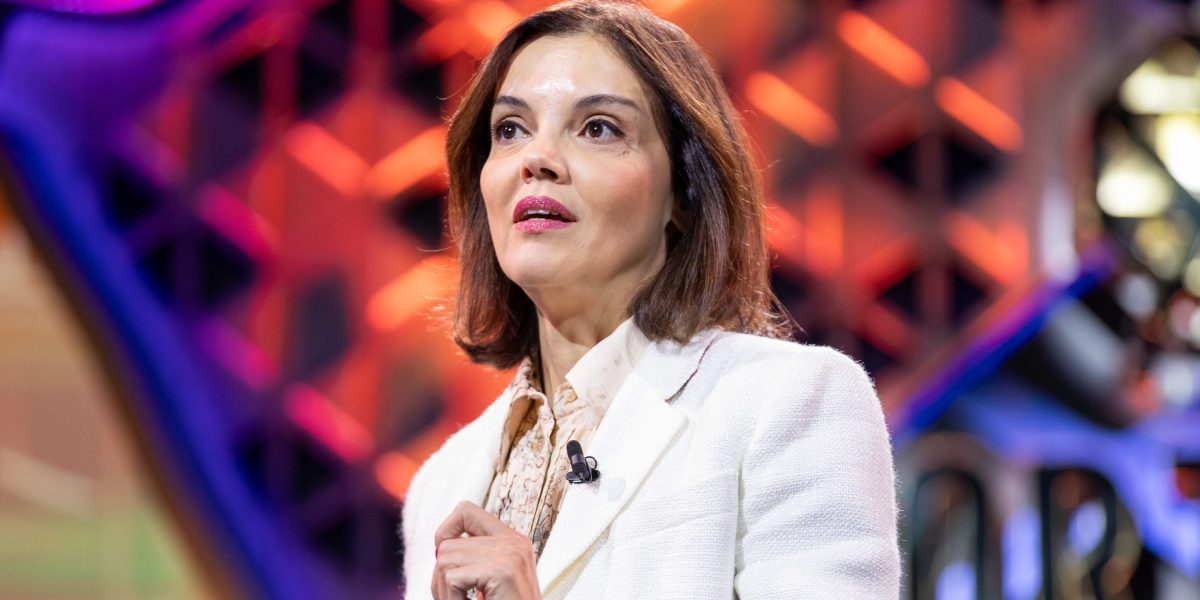
On stage at the conference, Ruth Porat, the president and chief investment officer at Alphabet, echoed Assis’s view to some degree. She noted that there was a big disparity between the speed of AI advances and the speed at which companies were adopting the technology. She said this disparity was largely the result of how difficult it is for large enterprises to change internal processes in general. And to get the most out of AI requires companies to rethink every process, she said, so it is perhaps not surprising that this is happening much more slowly than the rate at which AI companies, including Google, are rolling out new AI models and capabilities.

IBM put out some survey results this week for EMEA enterprises that show companies are indeed moving ahead with deploying AI at scale. Its survey of 3,500 senior executives in 10 countries found that two-thirds reported “significant productivity gains” from deploying AI. In some sectors, such as finance, the figure was 72%. Adoption in Saudi Arabia was even higher still—84%. What’s more, across EMEA, 92% of those surveyed were confident that AI agents would deliver ROI within the next two years. (Which may prove the point about the tech capabilities running far ahead of adoption. You might remember how many top tech execs declared 2025 to be “the year of AI agents.” I guess the real year of AI agents might be 2027!)

Ok, with that, here’s more AI news.

Jeremy Kahn
jeremy.kahn@fortune.com
@jeremyakahn

FORTUNE ON AI

Character.AI bans teens from talking to its chatbots amid mounting lawsuits and regulatory pressure—by Beatrice Nolan

Everyone thinks AI is replacing factory workers, but Amazon’s layoffs show it’s coming for middle management first—by Eva Roytburg

Martin Sorrell says AI has already ‘missed the Oppenheimer moment’—by Allie Garfinkle

Longevity science is on the cusp of major breakthroughs thanks to AI, but significant ‘data gaps’ need to be filled, expert says—Alexei Oreskovic

AI IN THE NEWS

Nvidia becomes world’s first $5 trillion company as it reveals $500 million order backlog. The AI chip company became the first business ever to reach a $5 trillion market capitalization, after its shares rose earlier in the week following several announcements by its CEO and founder, Jensen Huang, at a developer conference in Washington, D.C. Huang revealed that the company has a $500 billion order backlog for its latest Blackwell GPUs and its upcoming Rubin GPUs. The company has also recently announced deeper partnerships and investments with OpenAI, Oracle, and Eli Lilly. Nvidia has seen its market cap add $3 trillion in value since early 2024. Read more from The Wall Street Journal here.

Fed Chair Powell says AI boom not comparable to dot com bubble. U.S. Federal Reserve Chair Jerome Powell said the current artificial intelligence boom differs from the dot-com bubble because today’s leading companies—and here he seems to have been referring to the likes of Nvidia, Alphabet, Microsoft, and Meta, as opposed to the AI model makers such as OpenAI and Anthropic—actually generate profits. He also noted that the AI boom is driving tangible economic growth through investments in data centers and chips. (Although it should be said that the dot com bubble also fueled capital investment in fiber optics and networking equipment.) He contrasted this with the 1990s internet frenzy, when many high-valued firms collapsed after failing to turn a profit. You can read more from CNBC here.

Anthropic says cutting-edge AI models may have a kind of introspection. The AI company said its Claude Opus 4 and 4.1 models exhibit early signs of introspection—the ability to detect and describe aspects of their own internal states rather than just generate plausible text. In experiments, Anthropic researchers “injected” specific neural activation patterns that they knew were associated with particular concepts into the model at times when it was not considering topics related to those concepts. It then asked the model whether it noticed anything different about its thinking in these instances. The models were able to correctly identify some of these “thoughts” as not their own some of the time, indicating a limited form of self-monitoring, according to the Anthropic researchers. This introspective behavior, however, was highly inconsistent—occurring only about 20% of the time—and its underlying mechanisms remain unclear. Anthropic cautions that while intriguing, these findings do not imply human-like self-awareness but could help advance future work on model transparency and interpretability. You can read more in Anthropic’s blog post on the research here.

Study finds top AI models can’t construct predictive “world models.” A group of researchers from the non-profit AI lab the Basis Research Institute and affiliated with MIT, Harvard University, the University of Montreal, the University of Cambridge and Cornell University, built a new benchmark to test how leading LLMs perform at tasks that require understanding a virtual world, including discovering links between cause and effect and the “rules” by which the world operates. Their new “AutumnBench” involves a suite of 43 grid-world environments with 129 tasks, including predicting which objects are behind an obstruction, planning, and detecting what’s changed in a scene and the likely cause. They looked at how three state-of-the-art reasoning models— Anthropic’s Claude 4 Sonnet, Google’s Gemini 2.5 Pro, and OpenAI’s o3—compared against 517 human participants. They allowed the test subjects to spend some time exploring each virtual world and deploying strategies to figure out the rules of the world before testing them on the tasks. The results show that humans significantly outperform the AI models across all task types and environments. What’s more, they found that the models fail to adopt human-like strategies for determining the rules of the virtual worlds and how to perform the tasks, such as hypothesis-testing and updating their beliefs to account for new evidence. You can read the research paper here.

AI CALENDAR

Nov. 10-13: Web Summit, Lisbon. 

Nov. 26-27: World AI Congress, London.

Dec. 2-7: NeurIPS, San Diego.

Dec. 8-9: Fortune Brainstorm AI San Francisco. Apply to attend here.

EYE ON AI NUMBERS

$78.2 billion

That’s the amount that just Meta, Microsoft, and Alphabet collectively spent building new AI data centers and buying AI hardware in the three months between the end of June and the end of September. And all three companies signaled they plan to continue to ramp up that spending further over the next quarter and throughout 2026. You can read more here from the Financial Times. 


Source link

Continue Reading

Business

Despite AI bubble fears, Warren Buffett’s Berkshire Hathaway buys shares of hyperscaler Alphabet

Published

on


Wall Street has been consumed for months with fears that the artificial intelligence boom is actually a bubble about to pop, but that didn’t stop Berkshire Hathaway from buying shares of a top AI hyperscaler.

Warren Buffett’s conglomerate revealed in a regulatory filing late Friday that it purchased 17.8 million shares of Google parent Alphabet during the third quarter. The stock jumped 4% in after-hours trading yesterday.

It was the biggest stock addition last quarter and was worth about $4.3 billion at the end of September. Berkshire also bought shares of Chubb, Domino’s Pizza, Sirius XM and Lennar.

Meanwhile, Berkshire maintained its position in Amazon, another AI hyperscaler, in the third quarter.

The addition of Alphabet comes amid a massive rally. Even after the most recent AI-fueled stock market selloff, Alphabet shares are still up 46% this year.

To be sure, Alphabet has been on Berkshire’s radar in the past. In 2019, Buffett’s right-hand man at the time, the late Charlie Munger, admitted that he felt “like a horse’s ass for not identifying Google better. I think Warren feels the same way.”

Back then, Google’s dominance in search piqued Berkshire’s interest. But today, the company is among the tech giants leading the charge into AI.

Alphabet, Amazon, Meta Platforms and Microsoft alone are spending hundreds of billions of dollars a year with no signs of a slowdown.

Morgan Stanley has estimated AI hyperscalers plan to spend about $3 trillion on data centers and other infrastructure through 2028.

The relentless capital expenditures, much of which is coming via debt, have made Wall Street nervous about whether AI companies will be able to translate all those outlays into sustainable revenue and profits.

With Buffett due to step down as Berkshire’s CEO by year’s end, it’s not immediately clear whether he, successor Greg Abel, or another top executive made the call to buy Alphabet stock.

And investors may not hear directly from the “Oracle of Omaha” on the matter. In a letter published Monday, Buffett said he’ll be “going quiet,” and will no longer write Berkshire’s annual report, nor talk “endlessly” at the annual meeting.

Leading up to Buffett’s departure, Berkshire has been taking a cautious stance on the stock market as well as company acquisitions, sending its cash pile to record highs.

Buffett’s closely followed stock portfolio continued to shrink overall, as last quarter marked three straight years of net selling. The most recent round of selling included more shares of Apple, which Berkshire has been steadily offloading for more than a year.


Source link

Continue Reading

Business

Trump, who mocked Biden’s use of autopen, caught posting identical signatures on pardons

Published

on


The Justice Department posted pardons online bearing identical copies of President Donald Trump’s signature before quietly correcting them this week after what the agency called a “technical error.”

The replacements came after online commenters seized on striking similarities in the president’s signature across a series of pardons dated Nov. 7, including those granted to former New York Mets player Darryl Strawberry, former Tennessee House speaker Glen Casada and former New York police sergeant Michael McMahon. In fact, the signatures on several pardons initially uploaded to the Justice Department’s website were identical, two forensic document experts confirmed to The Associated Press.

Within hours of the online speculation, the administration replaced copies of the pardons with new ones that did not feature identical signatures. It insisted Trump, who mercilessly mocked his predecessor’s use of an autopen, had originally signed all the Nov. 7 pardons himself and blamed “technical” and staffing issues for the error, which has no bearing on the validity of the clemency actions.

The questions about Trump’s signature come amid a new flurry of clemency and weeks after the president claimed to not even know Changpeng Zhao, a crypto billionaire he pardoned last month. He said in an interview with 60 Minutes that the case had been “a Biden witch hunt.”

“A basic axiom of handwriting identification science is that no two signatures are going to bear the exact same design features in every aspect,” said Tom Vastrick, a Florida-based handwriting expert who is president of the American Society of Questioned Document Examiners.

“It’s very straightforward,” said Vastrick, who compared the apparently identical images, now only visible through the online Internet Archive, with the replacements at AP’s request.

Chad Gilmartin, a Justice Department spokesperson, said the “website was updated after a technical error where one of the signatures President Trump personally signed was mistakenly uploaded multiple times due to staffing issues caused by the Democrat shutdown.”

“There is no story here other than the fact that President Trump signed seven pardons by hand and DOJ posted those same seven pardons with seven unique signatures to our website,” Gilmartin said in a statement to AP, referring to the latest wave of clemency Trump has granted in recent weeks.

White House spokesperson Abigail Jackson wrote in an email that Trump “signed each one of these pardons by hand as he does with all pardons.”

“The media should spend their time investigating Joe Biden’s countless auto penned pardons, not covering a non-story,” she wrote.

Trump has been an outspoken critic of Biden’s use of the autopen to conduct executive business, going as far as to display a picture of one such device in place of a portrait of his predecessor in a new “Presidential Walk of Fame” he created along the West Wing colonnade. His Republican allies in Congress last month released a blistering critique of Biden’s alleged “diminished faculties” and mental state during his term that ranked the Democrat’s use of the autopen among “the greatest scandals in U.S. history.”

The Republicans said their findings cast doubt on all of Biden’s actions in office and sent a letter to Attorney General Pam Bondi urging a full investigation.

“Senior White House officials did not know who operated the autopen and its use was not sufficiently controlled or documented to prevent abuse,” the House Oversight Committee found. “The Committee deems void all executive actions signed by the autopen without proper, corresponding, contemporaneous, written approval traceable to the president’s own consent.”

On Friday, Republicans who control the committee released a statement that characterized Trump’s potential use of an electronic signature as legitimate, which it distinguished from Biden’s.

But Rep. Dave Min, a California Democrat on the House Oversight Committee, seized on the apparent similarities in the initial version of the pardons and called for an investigation of the matter, deploying the Republican arguments against Biden in a statement to AP that “we need to better understand who is actually in charge of the White House, because Trump seems to be slipping.”

Regardless, legal experts say the use of an autopen has no bearing on the validity of the pardons.

“The key to pardon validity is whether the president intended to grant the pardon,” said Frank Bowman, a legal historian and professor emeritus at the University of Missouri School of Law who is writing a book on pardons. “Any re-signing is an obvious, and rather silly, effort to avoid comparison to Biden.”

Much of Trump’s mercy has gone to political allies, campaign donors and fraudsters who claimed they were victims of a “weaponized” Justice Department. Trump has largely cast aside a process that historically has been overseen by nonpolitical personnel at the Justice Department.

Casada, a disgraced former Republican speaker of the Tennessee House, was sentenced in September to three years in prison. He was convicted of working with a former legislative aide to win taxpayer-funded mail business from state lawmakers who previously drove Casada from office amid a sexting scandal.

Strawberry was convicted in the 1990s of tax evasion and drug charges. Trump cited the 1983 National League Rookie of the Year’s post-career embrace of his Christian faith and longtime sobriety when pardoning him.

McMahon, a former New York City police sergeant, was sentenced this spring to 18 months in prison for his role in what a federal judge called “a campaign of transnational repression.” He was convicted of acting as a foreign agent for China after he tried to scare an ex-official into going back to his homeland.

McMahon’s defense attorney, Lawrence Lustberg, said he was not aware the pardon documents had been replaced until he was contacted Friday by an AP reporter.

“It is and has always been our understanding that President Trump granted Mr. McMahon his pardon,” Lustberg wrote in an email.

___

Mustian reported from Natchitoches, Louisiana. AP reporter Eric Tucker contributed reporting from Washington.


Source link

Continue Reading

Business

Trump finally breaks with MAGA stalwart Marjorie Taylor Greene after flood of vicious criticism, labeling her ‘wacky’

Published

on


President Donald Trump has publicly called it quits with one of his most stalwart MAGA-world supporters, calling Georgia Rep. Marjorie Taylor Greene “’Wacky’ Marjorie” and saying he would endorse a challenger against her in next year’s midterms “if the right person runs.”

The dismissal of Greene — once the epitome of “Make America Great Again,” sporting the signature red cap for President Joe Biden’s 2024 State of the Union address and acting as a go-between for Trump and other Capitol Hill Republicans — appeared to be the final break in a dispute simmering for months, as Greene has seemingly moderated her political profile. The three-term U.S. House member has increasingly dissented from Republican leaders, attacking them during the just-ended federal government shutdown and saying they need a plan to help people who are losing subsidies to afford health insurance policies.

Accusing the Georgia Republican of going “Far Left,” Trump wrote that all he had witnessed from Greene in recent months is “COMPLAIN, COMPLAIN, COMPLAIN!” adding, of Greene’s purported irritation that he doesn’t return her phone calls, “I can’t take a ranting Lunatic’s call every day.”

In a response on X, Greene wrote Friday that Trump had “attacked me and lied about me.” She added a screenshot of a text she said she had sent the president earlier in the day about releasing the Jeffrey Epstein files, which she said “is what sent him over the edge.”

Greene called it “astonishing really how hard he’s fighting to stop the Epstein files from coming out that he actually goes to this level,” referencing next week’s U.S. House vote over releasing the Epstein files.

Writing that she had supported Trump “with too much of my precious time, too much of my own money, and fought harder for him even when almost all other Republicans turned their back and denounced him,” Greene added, “I don’t worship or serve Donald Trump.”

Trump’s post seemingly tied a bow of finality to fissures that widened following this month’s off-cycle elections, in which voters in the New Jersey and Virginia governor races flocked to Democrats in large part over concerns about the cost of living.

Last week, Greene told NBC News that “watching the foreign leaders come to the White House through a revolving door is not helping Americans,” saying that Trump needs to focus on high prices at home rather than his recent emphasis on foreign affairs. Trump responded by saying that Greene had “lost her way.”

Asked about Greene’s comments earlier Friday as he flew from Washington to Florida, Trump reiterated that he felt “something happened to her over the last month or two,” saying that, if he hadn’t gone to China to meet leader Xi Jinping, there would have been negative ramifications for jobs in Georgia and elsewhere because China would have kept its curbs on magnet exports.

Saying that people have been calling him, wanting to challenge Greene, Trump added, “She’s lost a wonderful conservative reputation.”

Greene’s discontent dates back at least to May, when she announced she wouldn’t run for the Senate against Democratic incumbent Jon Ossoff, while attacking GOP donors and consultants who feared she couldn’t win. In June, she publicly sided with Tucker Carlson after Trump called the commentator “kooky” in a schism that emerged between MAGA and national security hardliners over possible U.S. efforts at regime change in Iran.

That only intensified in July, when Greene said she wouldn’t run for governor. Then, she attacked a political “good ole boy” system, alleging it was endangering Republican control of the state. Greene embarked on a charm offensive in recent weeks, with interviews and appearances in media aimed at people who aren’t hardcore Trump supporters. Asked on comedian Tim Dillon’s podcast if she wanted to run for president in 2028, Greene said in October, “I hate politics so much” and just wanted “to fix problems” — but didn’t give a definitive answer.

That climaxed with an appearance on Bill Maher’s HBO show “Real Time,” followed days later by a Nov. 4 appearance on ABC’s “The View.” Some observers began pronouncing Greene as reasonable as she trashed Republican House Speaker Mike Johnson of Louisiana for not calling Republicans back to Washington and coming up with a health care plan.

“I feel like I’m sitting next to a completely different Marjorie Taylor Greene,” said “The View” co-host Sunny Hostin.

“Maybe you should become a Democrat, Marjorie,” said co-host Joy Behar.

“I’m not a Democrat,” Greene replied. “I think both parties have failed.”

___

Jeff Amy contributed reporting from Atlanta.


Source link

Continue Reading

Trending

Copyright © Miami Select.