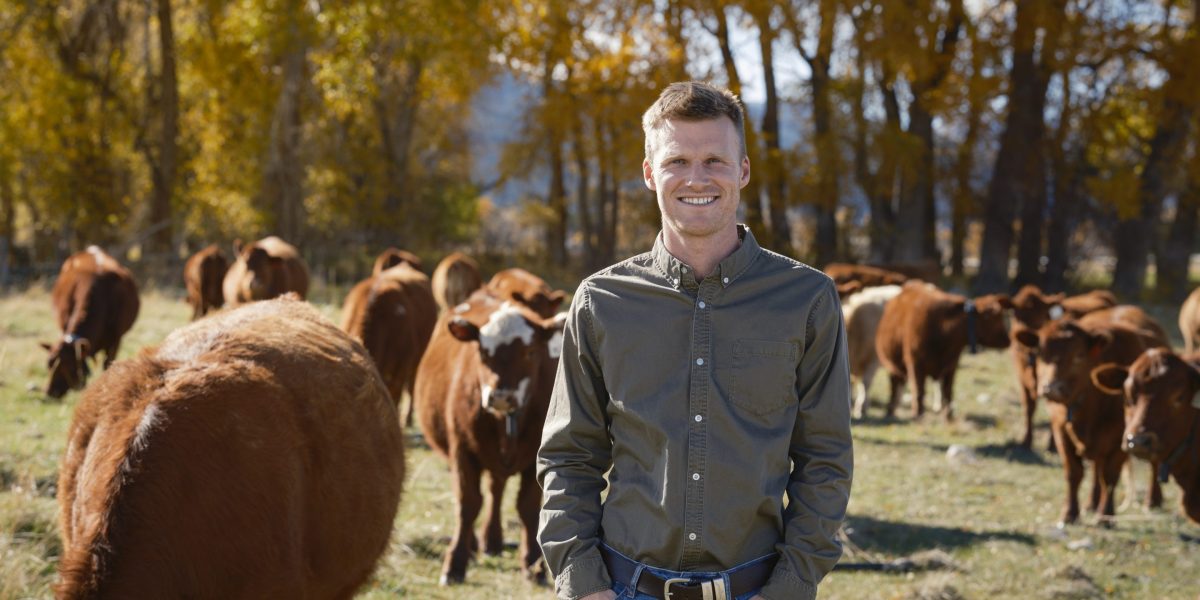
Growing up on a dairy farm in the rolling green hills of New Zealand’s Waikato region in the upper northwest of the country, Craig Piggott’s days began before dawn. But even as daybreak crept across the fields, he was never alone in those early hours. Running a dairy farm was a full family effort: shifting stock, monitoring for health issues and pregnancy, maintaining fences—everyday tasks that, while essential, are incredibly tedious and time-consuming.
But those tireless days lent him the discipline required to pursue a career in tech, and motivated him to improve the agricultural business. In 2017, Piggott, then age 23, founded agricultural tech firm Halter. Using AI, which Halter dubbed the “cowgorithm,” the company tracks an extensive amount of biological data. Halter then takes this data and offers solar-powered “smart collars” for cattle, a technology capable of tracking everything from a cow’s eating patterns and movement, to monitoring calving recovery. Piggott has transformed Halter into a mammoth global operation. Last month, the company raised $220 million in Series E funding, led by Peter Thiel’s Founders Fund at a $2 billion valuation.
“I just felt that ag[riculture] was underserved by technology, and there was a lot of opportunity to help farming and ranches with tech,” Piggott told Fortune. “No one was really playing in that space, and so that was kind of the initial thesis.”
As AI stretches its tendrils across the global economy, even industries seemingly far removed from modern technology are undergoing their biggest transformation in decades. A recent report from Bank of America found that as of 2024, over half of the world’s farmers have adopted, or were willing to adopt, precision agriculture or AI-enabled technology. That’s meant to expand the emerging agtech business to a $34 billion operation by 2034, according to the Bank of America note, with agtech firms raising $7 billion in 2025 alone, up nearly 4% year over year.
Farmers and ranchers today are in a crunch. Climate volatility, for one, is tightening the constraints of agriculture. More frequent droughts, heat stress, and flooding have hindered crop productivity globally. What’s more, the Iran war has placed even greater stress on farmers, spiking energy and fertilizer costs.
The cowgorithm in action
For Daniel Mushrush, a fifth-generation American cattle rancher, the technology has addressed some of the critical problems bogging down farmers across the U.S. The 40-year-old was one of Halter’s first customers, implementing the tech on his 16,000-acre ranch in the rocky Flint Hills of Chase County, Kans. Mushrush said his ranch has significant leveraged debt in an effort to grow the business. He uses the technology to push production and increase harvest efficiency, helping to make debt payments and remain competitive against recreational land buyers, who tend to have more capital.
“This is the first technology in my career that is, in my opinion, true innovation,” Mushrush told Fortune. “This is the biggest thing since barbed wire to the cattle industry.”
For Mushrush, a typical day starts as soon as he pours himself a cup of coffee and opens the Halter app. At this point, the cows have already moved themselves using sound cues (and an occasional low-vibrational shock for the more stubborn cows), as the rancher scheduled them to move at 4 a.m. What would have taken him three hours, to manually move poly rope and hot fences—a task that’s particularly difficult in the jagged terrain of Kansas’s Flint Hills—a simple glance at his phone has allowed him to sleep in, even if for just a little while. All that extra time saved means Mushrush gets to sip his morning cup of joe a little slower.
Mushrush said the technology has freed up nearly six hours per day. “Maybe I’m working a job and a half or two jobs now as opposed to two and a half jobs, which is what happens in agriculture a lot,” he said.
The possibilities don’t stop there. Instead of driving a 25-mile loop on an ATV for four hours to check the property for soon-to-be mothers, Mushrush uses Halter to ensure none of the cows have calved. And if there are any calves born, the tech can reserve premium grass for young calves who need nutrients the most, enabling them to grow up to 40 pounds heavier compared with those in the past, according to Mushrush.
The technology still faces some hurdles, particularly the high financial cost, especially in an industry where ranchers typically aim to keep variable costs near zero. Currently, the starting price stands at $9.90 per cow per month, which adds up as some ranches in the U.S. house more than 1,000 cows. It’s also difficult to build at scale, according to Mushrush, as cattle ranching environments are extremely diverse. Breed behavior, grazing density, and different terrains pose a challenge for the technology, to achieve a universal platform that works for every rancher.
Mushrush said thanks to Halter’s technology saving him countless hours of work, he’s been able to spend more time with his four kids, and can now watch them compete at track meets and volleyball games.
This shift toward a more sustainable lifestyle is what Piggott intended when he founded Halter. The company is currently exploring opportunities to further enhance ranch workflows. That includes drones equipped with AI that could count hay bales or check for water leaks. Piggott also hopes the tech will help with farm succession, making the industry more appealing to a younger, tech-savvy generation. He attributes much of the evolution of the technology to partnerships with customers like Mushrush using it in the field.
“How invested they are and how much they want it to work and how actively they’re engaged in giving us feedback and requesting stuff, that’s just been awesome,” Piggott said. “We are just so grateful for … the customers we have helping steer the ship.”