Connect with us

Politics

After Charlie Kirk’s killing a growing chorus of conservatives wants his critics ostracized or fired

Published

on


“This pattern that we’ve seen for decades seems to be happening much more now and at this moment than it ever has before,” said Adam Goldstein of the Foundation for Individual Rights and Expression. He dates the urge to persecute people for their private views on tragedies at least to the Sept. 11, 2001, attacks. “If there was ever time to support the better angels of our nature, it’s now.”

Goldstein noted that it’s unpopular speech, like people praising the assassination, that stands as the greatest test of acceptance of the First Amendment — especially when government officials get involved. “The only time you’re really supporting free speech is when it’s unpopular,” Goldstein said. “There’s no one out there trying to stop people from loving puppies and bunnies.”

Utah Gov. Spencer Cox, a Republican, has cautioned that the motive for the assassination has not been confirmed. He said the suspect in custody clearly identifies with the political left and had expressed dislike of Kirk before the shooting. But he and other authorities also say the suspect was not known to have been politically engaged.

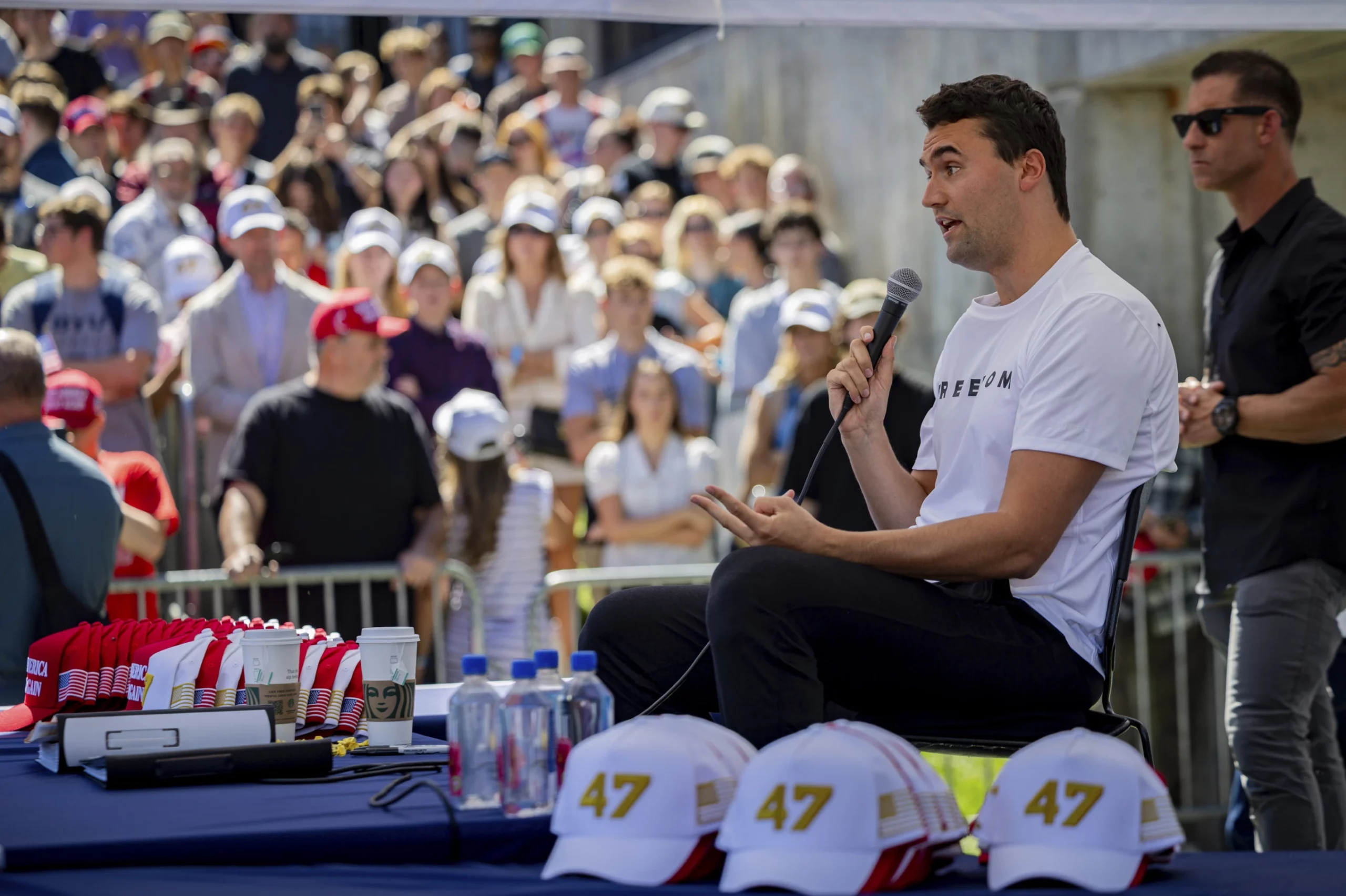
Kirk was seen as an architect of President Donald Trump’s 2024 election win, helping to expand the Republican outreach to younger voters. That means many conservatives see the remarks by liberals as fomenting violence, rather than as acts of political expression.

“I think President Trump sees this as an attack on his political movement,” said Sen. Lindsey Graham, a South Carolina Repoublican, on NBC as he noted the two assassination attempts against Trump as well as Kirk’s killing. “This is unique and different. This is an attack on a movement by using violence. And that’s the way most Republicans see this.”

Sen. Marsha Blackburn, a Tennessee Republican, who is running for governor, called on social media for the firings of an assistant dean at Middle Tennessee State University and professors at Austin Peay State University and Cumberland University.

All three lost their jobs for comments deemed inappropriate for expressing a lack of sympathy, or even for expressing pleasure, in the shooting of Kirk. One said Kirk “spoke his fate into existence.”

Because conservatives previously felt canceled by liberals for their views, Trump on his first day back in office signed an executive order prohibiting everyone in the federal government from engaging in conduct that would “unconstitutionally abridge the free speech of any American citizen.”

In February at the Munich Security Conference, Vice President JD Vance criticized the preceding Biden administration for encouraging “private companies to silence people who dared to utter what turned out to be an obvious truth” regarding the pandemic. He assailed European countries for censoring political speech.

“Under Donald Trump’s leadership, we may disagree with your views, but we will fight to defend your right to offer it in the public square, agree or disagree,” Vance said at the time.

Still, the Trump administration has also cracked down on immigrants and academics for their speech.

Goldstein noted that Trump’s State Department in the minutes after Kirk’s death warned it would revoke the visas of any foreigners who celebrated Kirk’s assassination. “I can’t think of another moment where the United States has come out to warn people of their impending cancellation,” Goldstein said.

The glimmer of bipartisan agreement in the aftermath of the assassination was in a sense that social media was fueling the violence and misinformation in dangerous ways.

“I can’t emphasize enough the damage that social media and the internet is doing to all of us,” Cox said on NBC’s “Meet the Press.” He said “the most powerful companies in the history of the world have figured out how to hack our brains get us addicted to outrage.”

But many Republican lawmakers have also targeted traditional news media that criticized Trump for contributing to a toxic political climate with his consistent rhetoric painting anyone against him as an enemy.

On Fox News’ “Sunday Morning Futures,” Sen. Katie Britt, an Alabama Republican, blamed news outlets for having guests on who called Trump a “facist” or compared him to the Nazi leader Adolf Hitler.

Such statements have been borne out of Trump’s attempt to overturn his 2020 election loss, his pardoning of Jan. 6 rioters and a range of policy differences. Among them, his deportations, deployment of the National Guard, mass firings of federal employees and his scorn for the historic limits on the power of the presidency.

But for Britt, those expressions were unfair, inaccurate and triggered violence.

“There must be consequences with regards to people spewing that type of hate and celebration in the face of this,” Britt said. “And I believe that there will be.”

___

Republished with permission of The Associated Press.


Source link

Continue Reading

Politics

Boca Raton police union endorses Fran Nachlas for Mayor

Published

on


Boca Raton Deputy Mayor Fran Nachlas’ campaign to remove “Deputy” from her title just got a boost from the city’s police union.

The Fraternal Order of Police, Lodge 35, is endorsing Nachlas due to her “consistent support for public safety, dedication to community partnership, and commitment to responsible leadership.”

Boca Raton will “continue to thrive as a safe, vibrant, and forward-moving community” under Nachlas’ mayoralty, the group added in its statement announcing the support.

“Fran has been a dedicated supporter of law enforcement and a strong advocate for our community,” the organization said in a separate Instagram post.

“Your steadfast commitment to ensuring the safety and well-being of our citizens, along with your keen understanding of the unique challenges faced by our officers, exemplify exceptional leadership and dedication. We have complete confidence in your ability to lead with integrity, compassion, and unwavering commitment to the community.”

Nachlas said in a statement that she is “profoundly honored” by the nod.

“Our officers put their lives on the line every day to keep our community safe, and their trust means the world to me,” she said. “As Mayor, I will continue to prioritize public safety, strengthen community partnerships, and ensure our police have the resources and support they need.”

Nachlas was named Boca’s Deputy Mayor in March. She is a past Chair of the Boca Raton Community Redevelopment Agency and member of the Boca Raton Community Advisory Council. She now serves on the Palm Beach County Transportation Planning Agency Governing Board, Florida League of Cities Development, Code Compliance and Redevelopment Committee in addition to her City Council duties.

She is one of three candidates competing to succeed term-limited Mayor Scott Singer, along with Boca Raton Council member Andy Thomson and Mike Liebelson, an energy executive-turned-adviser.

Nachlas and Liebelson are Republicans. Thomson is a Democrat.

Boca Raton’s municipal election is on March 10, 2026.


Source link

Continue Reading

Politics

Children’s Movement salutes trio of lawmakers who drove early learning wins in 2025

Published

on


The Children’s Movement of Florida gathered a full room of advocates and lawmakers to recognize three legislators who helped steer early learning priorities across the finish line during the 2025 Legislative Session.

At a ceremony at the Governors Club in Tallahassee, the organization presented its Early Childhood Champion Award to Republican Sen. Alexis Calatayud, Democratic Rep. Robin Bartleman and Republican Rep. Chase Tramont. The Children’s Movement praised the lawmakers’ work expanding access to the state’s School Readiness program and strengthening support for children with special needs.

The group said the trio played central roles in improving tuition assistance and ensuring families aren’t shut out of early learning opportunities as incomes rise.

“Sen. Calatayud, Rep. Bartleman, and Rep. Tramont demonstrate the bipartisan consensus that investing in early learning is good for our state — benefiting not only children and families, but also the state’s workforce and economy,” said Madeleine K. Thakur, President and CEO of The Children’s Movement.

“Their commitment to increasing access for Florida families is an important contribution to our birth-20 education system, and enables true parent choice for the earliest years before kindergarten.”

Calatayud’s bill on the School Readiness program (SB 1102) contained changes designed to make it easier for providers to receive special needs differential funding. The new law also requires participating programs to complete 10 hours of inclusive-practices training before receiving the additional dollars, a move supporters say helps ensure children with special needs can be served effectively.

The House companion, sponsored by Bartleman and Rep. Dana Trabulsy (HB 877), cleared all committees before lawmakers opted to take up the Senate version.

Calatayud also joined Tramont in spearheading legislation tying income thresholds for the School Readiness program to a percentage of the state median income rather than the federal poverty level, among other changes. Advocates argued the shift was necessary as Florida’s minimum wage continues to climb, pushing some working families out of eligibility even as costs rise.

Their proposals were ultimately rolled into the House’s broader education package (HB 1255).

The Children’s Movement of Florida is a nonprofit, nonpartisan coalition formed in 2010 to make early childhood development a top state priority. The group describes itself as Florida’s “leading voice on early childhood,” working both at the grassroots level — with community engagement and volunteer initiatives — and at the state level, by shaping policy and mobilizing support for early-childhood investment statewide.

The organization said this year’s progress highlights how sustained attention from lawmakers can reshape outcomes for children during their most formative years. The organization pledged to continue working with legislators and state agencies heading into 2026 to protect and expand access to early learning support across Florida.


Source link

Continue Reading

Politics

Did immigration turn Miami blue?

Published

on


Miami’s mayoral race ended Tuesday night with a political shift that would have seemed unlikely just a year ago: The election of a Democrat, Eileen Higgins, to replace term-limited Republican Mayor Francis Suarez. In a city that voted for Donald Trump by less than a point in the 2024 presidential election, the result raises a fundamental question about how Miami’s electorate is evolving.

Many issues shaped this Fall’s campaign, including cost of living, corruption, and fatigue over the area’s political dynasties. But one factor over which the city has no direct control appears to have also played an important role: immigration. Specifically, the aggressive national immigration policies associated with the Trump and DeSantis administrations.

Few American cities are as deeply defined by immigration as Miami. More than 58% of Miami-Dade residents are foreign-born, According to an analysis by the Forum for Together, making the county one of the most immigrant-dense metropolitan areas in the United States. Roughly 72% of Miami’s foreign-born population comes from Latin America, and more than half of all households speak a language other than English at home. Immigrants also fuel Miami’s economy, making up nearly 66% of the labor force, including significant representation in health care, construction, hospitality, and professional services.

This demographic reality helps explain why immigration has long been more than a talking point in Miami — it is personal. And in recent years, the city has transformed into one of the most attractive destinations in the world to live and work. As outgoing Mayor Suarez likes to say, Miami has emerged as a bona fide capital of technology and finance, attracting entrepreneurs, venture capital, global corporations, and top talent drawn to its climate, culture, and international connectivity. With this growth has come a renewed understanding that Miami’s strength lies in its identity as a city built and sustained by people from other places, both inside and outside the United States.

Against this backdrop, the hardening of national immigration rhetoric appears to have pushed many Miami voters, including Republican-leaning Hispanics and No Party Affiliates, toward candidates seen as more protective of immigrants already living and working in the community.

National data underscores this trend. A November 2025 Pew Research Center survey found that majorities of Latinos disapprove of Trump and his policies on immigration and the economy. More strikingly, the survey showed that immigration — often assumed to motivate conservative voting — has in fact become a mobilizing issue for Latinos who oppose mass deportation and family separation. Latinos surveyed overwhelmingly rejected policies targeting long-standing undocumented residents, even when they supported stronger border controls.

A recent Kissimmee-based Kaplan Strategies poll highlighted how this dynamic is playing out locally: Miami voters overwhelmingly support border security, yet a majority also oppose blanket deportations of undocumented immigrants who have become rooted in the community. This dual view — security paired with compassion — reflects a nuanced position that does not align neatly with the national Republican message.

Over the last couple of months, an organization called Freedom and Opportunity Alliance launched a digital, television, and billboard campaign in the weeks leading up to Miami’s election. The group bills itself as supporting strong borders and the deportation of violent criminals, while also opposing the removal of long-established, law-abiding undocumented residents who contribute to local economies. The group’s ads, which ran across major platforms, sought to thread the needle between security and humanity, a balance consistent with voter sentiment.

When viewed together, the data tells a compelling story. Miami’s immigrant-rich population remains sensitive to rhetoric or policies that threaten broad deportation. While voters care deeply about safety and border enforcement, they are equally committed to protecting neighbors, coworkers, and families who form the city’s social and economic bedrock.

In this year’s mayoral race, that tension appears to have broken decisively toward the candidate who most aligned with Miami’s lived reality — not the national rhetoric.


Source link

Continue Reading

Trending

Copyright © Miami Select.