
Fashion
Adidas’ running business helped fuel growth in third quarter as net sales reached 6.6 billion euros


Published
January 21, 2026
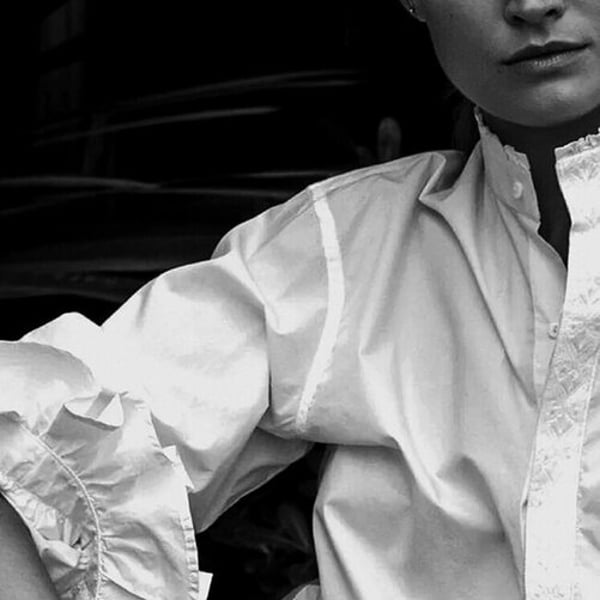
There are stories you simply couldn’t invent. The tale of Bourrienne Paris X, a finalist for the DHL 2025 Award, is one of them. The French shirtmaker for men and women, co-founded in 2017—among others—by two women with entirely different backgrounds, is now entering a phase that balances dynamic expansion with a quest for longevity, projecting growth of over 50% in 2025 and an equally high target for 2026.
The designer behind the Bourrienne Paris X collections is Cécile Faucheur. A former fashion design teacher, pattern cutter and stylist, she is now head of design at the brand she co-founded. Her research at the Musée de la Chemiserie in Argenton-sur-Creuse captivated both her and Charles Beigbeder (who had just taken over the Hôtel de Bourrienne in Paris), prompting them to dedicate a men’s shirting brand to the building.
Historical details and diverse trajectories
For her part, Carine Beigbeder, co-founder and CEO of Bourrienne Paris X, draws on a background that spans finance and entrepreneurship. She previously managed a listed small-cap fund at Financière Arbevel. Her analysis of companies’ business plans and strategies spurred her to take on an operational role—one she now fulfils at Bourrienne Paris X. A luxury brand, or at least on the way to becoming one, the label currently employs around ten people and is attempting to compete with luxury giants such as Hermès in a niche that has, until now, been very narrow: the shirt.

“The idea was to build a brand inspired by historical details and the shirtmakers of yesteryear. We realised that the men’s wardrobe had lost much of the richness it once had.”
Today, the Bourrienne Paris X wardrobe is rooted in both French stylistic heritage and modern fashion, having opened up to womenswear as early as its second season. This now accounts for more than half of the house’s turnover.
In search of quality materials
“For women, the shirt was a vehicle of emancipation as womenswear became uncorseted and a little freer. It wasn’t necessarily at the same time, but that’s not the point,” explained Beigbeder.
Bourrienne Paris X now goes beyond the shirt and has launched men’s trousers on pre-order, cut from a very heavy Belgian linen, “as if coated with a fine layer of beeswax, which gives it a very new and very innovative look,” in the CEO’s words.

At Bourrienne Paris X, the linen comes from Belgium, the poplin from Italy, the embroidered trims inspired by the Hôtel de Bourrienne are made by a century-old manufacturer in northern France, the pleating by a Breton artisan, and the mother-of-pearl is sourced from Australia. The shirts, meanwhile, are made in Portuguese and Romanian workshops, and the house is considering other production sites elsewhere in Eastern Europe.
Priority given to digital
Soon to mark its tenth anniversary, Bourrienne Paris X is now in its third year of profitability. Struck by the Covid-19 pandemic after a loss-making start, the brand managed to “keep its head above water,” thanks to digital, which provides sufficient data to respond to its customers’ tastes. The company has self-financed its digital investments and plans to double them in 2026 to accelerate growth, a priority given that its e-commerce site generates over 50% of its sales.

Bourrienne Paris X also invests in SEO, and in Google, Pinterest and Meta campaigns tailored to each of the countries where it is sold, namely the United States, England, Switzerland, Canada and Australia. Customs duties, included in the final price across the Atlantic, are no longer an issue for the brand, thanks to the purchasing power of its American customers.
International expansion
With 60% of its sales generated abroad, the label is stocked by a number of department stores, including Le Bon Marché’s men’s department in Paris, as well as Bongénie in Geneva and Zurich, Lane Crawford in Hong Kong, and Isetan, Tomorrowland, United Arrows and Wako in Japan. This is why it is presenting its project to the DHL Prize jury this year.

The brand remains based at 58 Rue d’Hauteville, opposite the Hôtel of the same name, in the 10th arrondissement of Paris. It’s not unusual for curious customers to be invited to discover the place that inspires the brand with each new collection. The brand’s desire to prioritise digital shapes its approach to welcoming investors, whose most valuable contribution would be their expertise.
For the time being, beyond the brand’s growth, Beigbeder is focused on a mission that is no less important: ensuring that Bourrienne Paris X stands the test of time. A “real challenge” consisting of remaining faithful to the house’s convictions and avoiding, as far as possible, the pull of passing trends.
This article is an automatic translation.
Copyright © 2026 FashionNetwork.com All rights reserved.


L’Oreal to invest $383 million in Indian beauty tech hub

Gates Foundation, OpenAI unveil $50 million ‘Horizon1000’ initiative to boost healthcare in Africa through AI

Djimon Hounsou’s Baby Mama Arrested For Allegedly Assaulting Him
-

 Politics8 years ago
Congress rolls out ‘Better Deal,’ new economic agenda
-
Entertainment9 years ago
New Season 8 Walking Dead trailer flashes forward in time
-
Politics9 years ago
Poll: Virginia governor’s race in dead heat
-
Politics8 years ago
Illinois’ financial crisis could bring the state to a halt
-
Entertainment9 years ago
The final 6 ‘Game of Thrones’ episodes might feel like a full season
-
Entertainment9 years ago
Meet Superman’s grandfather in new trailer for Krypton
-
Business9 years ago
6 Stunning new co-working spaces around the globe
-
Tech8 years ago
Hulu hires Google marketing veteran Kelly Campbell as CMO