Connect with us

Business

Accenture’s $865 million reinvention includes saying goodbye to people without the right AI skills

Published

on


Accenture’s fourth-quarter earnings not only surpassed expectations but also marked a moment when the consulting giant, which is playing a pivotal role in corporate America’s adoption of artificial intelligence (AI), disclosed its own AI-related reorg. The company initiated a “six-month business optimization program,” recording up to $865 million in related charges, which includes a new talent strategy with three prongs. These charges include two divestitures of previously acquired companies, the company said.

First, its primary focus is investing in upskilling people, next it will be “exiting people in a compressed timeline where reskilling is not a viable path for the skills it needs,” and third it will identify areas to drive more operating efficiencies. Sweet said on the subsequent earnings call that Accenture expects savings of more than $1 billion from its business optimization program, which the company says will be invested into the business and its people. Regarding exits, she said Accenture is “trying to, in a very compressed talent timeline where we don’t have a viable path for skilling, sort of exiting people so we can get more of the skills in we need.” On the earnings call with analysts, Sweet said the company still expects to increase headcount overall in 2026.

Investing in upskilling

“We are investing in upskilling our reinventors,” Sweet said on the call, using the term that Accenture adopts for all of its employees. She said she sees a “huge difference” in how people are using AI in their individual lives that is incredibly easy and how to use it in an enterprise. Many companies are grappling with “fragmented processes and siloed organizations” and leaders need new skills to shape a business strategy that makes the most of AI. “The workforce needs new skills to use AI and new talent strategies and related competencies must be developed.”

“It is well recognized that advanced AI has taken the mindshare of CEOs, the C-suite and boards faster than any technology development we’ve seen in the past two decades,” Sweet said. At the same, time, she noted the widespread reporting that “value realization has been underwhelming for many” and, besides some digital-native firms, companies are finding adoption at scale to be slow-going. That’s why clients are turning to Accenture, she added. To put it in perspective, Accenture has roughly 9,000 clients and reported 37 new clients with quarterly bookings greater than $100 million in the fourth quarter alone—it reported 129 such bookings for the year. That is “reinvention” at massive scale.

Later during the call, Sweet said “gen AI seemed so simple” early on in its implementation, but Accenture is increasingly finding that “it’s not the technology that is the biggest barrier. It is actually being able to get the mindset reorganized around how best to use it, the ability to do the change management, the process reinvention.” For example, she said, most CEOs would say their organization is too siloed, and many clients have a good proof of concept, “but then just can’t scale it.”

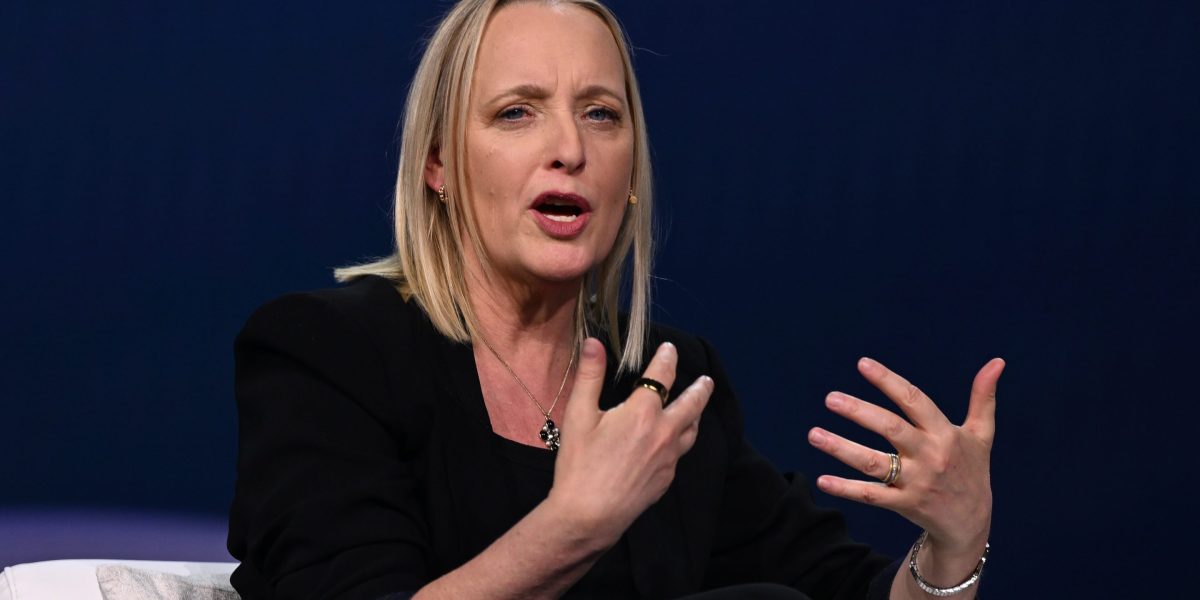
Shortly before the earnings release, Sweet sat down with Fortune’s Alyson Shontell, and elaborated on how Accenture is grappling with this transformation just as much as its clients. This included the emotional and strategic difficulties involved with the departures of senior team leaders depart and overhauling structural models, some of them established over many years.

Humility and courage to reinvent yourself

Sweet told Shontell: “First of all, I think we’re a good lesson in something that I’m advising CEOs all about: in order to capture the opportunity with AI, you really have to be willing to rewire your company.” She added that many times when she hears clients say that they aren’t seeing a return on investment from AI, “it’s because they’re trying to apply it to how they operate today.”

Sweet added that collaboration is “super important” but it’s “not a business strategy.” Accenture has to be the reinvention partner of choice for all its clients, she said, and that extends to Accenture’s own affairs. Along the way, they realized this was “harder than it needed to be, because our strategy and our structure were not aligned.”

Sweet told Shontell that it was clear that “we really have to change, and this change is so big, this is reversing five decades of how we’re working.” If there isn’t alignment between strategy, structure, ways of working and ways of measuring performance, she added, then “we just simply are not going to be able to go fast enough, and it’s not delivering what our clients need.”

Restructuring on this scale presents immense challenges for employees. “For our people and our clients, it was hard … How do you have the courage to do that? That’s where you have the humility, but also this idea of embracing change and innovation.” Sweet said Accenture’s culture of change enabled it to “ultimately make the hard decisions, which is what we’ve done.”

Fortune Global Forum returns Oct. 26–27, 2025 in Riyadh. CEOs and global leaders will gather for a dynamic, invitation-only event shaping the future of business. Apply for an invitation.


Source link

Continue Reading

Business

On Netflix’s earnings call, co-CEOs can’t quell fears about the Warner Bros. bid

Published

on


When it comes to creating irresistible storylines, Netflix, the home of Stranger Things and The Crown, is second to none. And as the streaming video giant delivered its quarterly earnings report on Tuesday, executives were in top storytelling form, pitching what they promise will be a smash hit: the acquisition of Warner Brothers Discovery.

The company’s co-CEOs, Ted Sarandos and Greg Peters, said the deal, which values Warner Brothers Discovery at $83 billion, will accelerate its own core streaming business while helping it expand into TV and the theatrical film business. 

“This is an exciting time in the business. Lots of innovation, lots of competition,” Sarandos enthused on Tuesday’s earnings conference call. Netflix has a history of successful transformation and of pivoting opportunistically, he reminded the audience: Once upon a time, its main business entailed mailing DVDs in red envelopes to customers’ homes. 

Despite Sarandos’ confident delivery, however, the pitch didn’t land with investors. The company’s stock, which was already down 15% since Netflix announced the deal in early December, sank another 4.9% in after-hours trading on Tuesday. 

Netflix’s financial results for the final quarter of 2025 were fine. The company beat EPS expectations by a penny, and said it now has 325 million paid subscribers and a worldwide total audience nearing 1 billion. Its 2026 revenue outlook, of between $50.7 billion and $51.7 billion, was right on target.  

Still, investors are worried that the Warner Bros. deal will force Netflix to compete outside its lane, causing management to lose focus. The fact that Netflix will temporarily halt its share buybacks in order to accumulate cash to help finance the deal, as it disclosed towards the bottom of Tuesday’s shareholder letter, probably didn’t help matters. 

And given that there’s a rival offer for Warner Bros from Paramount Skydance, it’s not unreasonable for investors to worry that Netflix may be forced into an expensive bidding war. (Even though Warner Brothers Discovery has accepted the Netflix offer over Paramount’s, no one believes the story is over—not even Netflix, which updated its $27.75 per share offer to all-cash, instead of stock and cash, hours earlier on Tuesday in order to provide WBD shareholders with “greater value certainty.”) 

Investors are wary; will regulators balk?

Warner Brothers investors are not the only audience that Netflix needs to win over. The deal must be blessed by antitrust regulators—a prospect whose outcome is harder to predict than ever in the Trump administration.

Sarandos and Peters laid out the case Tuesday for why they believe the deal will get through the regulatory process, framing the deal as a boon for American jobs.

“This is going to allow us to significantly expand our production capacity in the U.S. and to keep investing in original content in the long term, which means more opportunities for creative talent and more jobs,” Sarandos said.

Referring to Warner Brothers’ television and film businesses, he added that “these folks have extensive experience and expertise. We want them to stay on and run those businesses. We’re expanding content creation not collapsing it.”

It’s a compelling story. But the co-CEOs may have neglected to study the most important script of all when it comes to getting government approval in the current administration; they forgot to recite the Trump lines. 

The example has been set over the past 12 months by peers such as Nvidia’s Jensen Huang and Meta’s Mark Zuckerberg. The latter, with his company facing various federal regulatory threats, began publicly praising the Trump administration on an earnings call last January. 

And Nvidia’s Huang has already seen real dividends from a similar strategy. The chip company CEO has praised Trump repeatedly on earnings calls, in media interviews, and in conference keynote speeches, calling him “America’s unique advantage” in AI. Since then, the U.S. ban on selling Nvidia’s H200 AI chips to China has been rescinded. The praise may have been coincidental to the outcome, but it certainly didn’t hurt.

In contrast, the president went unmentioned on Tuesday’s call. How significant Netflix’s omission of a Trump call-out turns out to be remains to be seen; maybe it won’t matter at all. But it’s worth noting that its competitor for Warner Bros., Paramount Skydance, is helmed by David Ellison, an outspoken Trump supporter. 

It’s a storyline that Netflix should have seen coming, and itmay still send the company back to rewrite.


Source link

Continue Reading

Business

Americans are paying nearly all of the tariff burden as international exports die down, study finds

Published

on


After nearly a year of promises tariffs would boost the U.S. economy while other countries footed the bill, a new study shows almost all of the tariff burden is falling on American consumers. 

Americans are paying 96% of the costs of tariffs as prices for goods rise, according to research published Monday by the Kiel Institute for the World Economy, a German think tank. 

In April 2025 when President Donald Trump announced his “Liberation Day” tariffs, he claimed: “For decades, our country has been looted, pillaged, raped, and plundered by nations near and far, both friend and foe alike.” But the report suggests tariffs have actually cost Americans more money.

Trump has long used tariffs as leverage in non-trade political disputes. Over the weekend, Trump renewed his trade war in Europe after Denmark, Norway, Sweden, France, Germany, the United Kingdom, the Netherlands, and Finland sent troops for training exercises in Greenland. The countries will be hit with a 10% tariff starting on Feb. 1 that is set to rise to 25% on June 1, if a deal for the U.S. to buy Greenland is not reached. 

On Monday, Trump threatened a 200% tariff on French wine, after French President Emmanuel Macron refused to join Trump’s “Board of Peace” for Gaza, which has a $1 billion buy-in for permanent membership. 

“The claim that foreign countries pay these tariffs is a myth,” wrote Julian Hinz, research director at the Kiel Institute and an author of the study. “The data show the opposite: Americans are footing the bill.” 

The research shows export prices stayed the same, but the volume has collapsed. After imposing a 50% tariff on India in August, exports to the U.S. dropped 18% to 24%, compared to the European Union, Canada, and Australia. Exporters are redirecting sales to other markets, so they don’t need to cut sales or prices, according to the study.

“There is no such thing as foreigners transferring wealth to the U.S. in the form of tariffs,” Hinz told The Wall Street Journal

For the study, Hinz and his team analyzed more than 25 million shipment records between January 2024 through November 2025 that were worth nearly $4 trillion.They found exporters absorbed just 4% of the tariff burden and American importers are largely passing on the costs to consumers. 

Tariffs have increased customs revenue by $200 billion, but nearly all of that comes from American consumers. The study’s authors likened this to a consumption tax as wealth transfers from consumers and businesses to the U.S. Treasury.   

Trump has also repeatedly claimed tariffs would boost American manufacturing, butthe economy has shown declines in manufacturing jobs every month since April 2025, losing 60,000 manufacturing jobs between Liberation Day and November. 

The Supreme Court was expected to rule as soon as today on whether Trump’s use of emergency powers to levy tariffs under the International Emergency Economic Powers Act was legal. The court initially announced they planned to rule last week and gave no explanation for the delay. 

Although justices appeared skeptical of the administration’s authority during oral arguments in November, economists predict the Trump administration will find alternative ways to keep the tariffs.


Source link

Continue Reading

Business

Selling America is a ‘dangerous bet,’ UBS CEO warns as markets panic

Published

on


Investors are “selling America” in spades Tuesday: The 10-year Treasury yield is at its highest point since August; the U.S. dollar slid; and the traditional safe-haven metal investments—gold and silver—surged once again to record highs.

The CEO of UBS Group, the world’s largest private bank, thinks this market is making a “dangerous bet.”

“Diversifying away from America is impossible,” UBS Group CEO Sergio Ermotti told Bloomberg in a television interview at the World Economic Forum in Davos, Switzerland, on Tuesday. “Things can change rapidly, and the U.S. is the strongest economy in the world, the one who has the highest level of innovation right now.” 

The catalyst for the selloff was fresh escalation from U.S. President Donald Trump, who has threatened a 10% tariff on eight European allies—including Germany, France, and the U.K.—unless they cede to his demands to acquire Greenland.

Trump also threatened a 200% tariff on French wine and Champagne to pressure French President Emmanuel Macron to join his Board of Peace. Trump’s favorite “Mr. Tariff” is back, and bond investors are unhappy with the volatility.

But if investors keep getting caught up in the volatility of day-to-day politics and shun the U.S., they’ll miss the forest for the trees, Ermotti argued. While admitting the current environment is “bumpy,” he pointed to a statistic: Last year alone, the U.S. created 25 million new millionaires. For a wealth manager like UBS, that is 1,000 new millionaires a day. To shun that level of innovation in U.S. equities for gold would be a reactionary move that ignores the long-term innovation of the U.S. economy. 

“We see two big levers: First of all, wealth creation, GDP growth, innovation, and also more idiosyncratic to UBS is that we see potential for us to become more present, increase our market share,” Ermotti said. 

But if something doesn’t give in the standoff between the European Union and Trump, there could be potential further de-dollarization, this time, from Europe selling its U.S. bonds, George Saravelos, head of FX research at Deutsche Bank, wrote in a note Sunday. Indeed, on Tuesday, Danish pension funds sold $100 million in U.S. Treasuries, allegedly owing to “poor” U.S. finances, though the pension fund’s chief said of the debacle over Greenland: “Of course, that didn’t make it more difficult to take the decision.” 

Europe owns twice as many U.S. bonds and equities as the rest of the world combined. If the rest of Europe follows Denmark’s lead, that could be an $8 trillion market at risk, Saravelos argued. 

“In an environment where the geo-economic stability of the Western alliance is being disrupted existentially, it is not clear why Europeans would be as willing to play this part,” he wrote. 

Back in the U.S., the markets also sold off as the Nasdaq and S&P both fell 2% Tuesday, already shedding the entirety of Greenland’s value on Trump’s threats, University of Michigan economist Justin Wolfers noted. Analysts and investors are uneasy, given the history of Trump declaring a stark tariff before negotiating with the country to take it down, also known as the “TACO”—Trump always chickens out—effect. Investors have been “burnt before by overreacting to tariff threats,” Jim Reid of Deutsche Bank noted. That’s a similar stance to the UBS bank chief: If you react too much to headlines, you’ll miss the great innovation that’s pushed the stock market to record highs for the past three years.

“I wouldn’t really bet against the U.S.,” he said.


Source link

Continue Reading

Trending

Copyright © Miami Select.