
Business
Accenture CEO Julie Sweet says Fortune 500s can survive AI. They have to be willing to reinvent themselves top to bottom
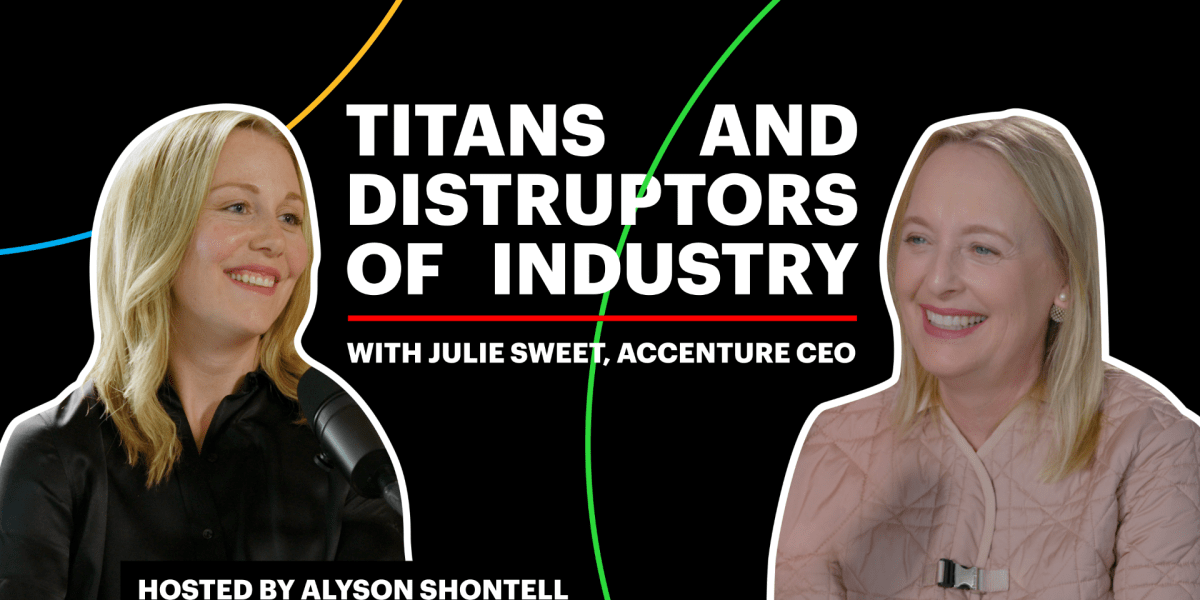
Julie Sweet is one of the most powerful executives in the world, overseeing a 770,000-person workforce at consulting giant Accenture. In her role, she speaks to more Fortune 500 CEOs than almost anyone—dozens of companies pay Accenture $100 million-plus in a single quarter to help them solve their biggest problems—so she has her finger on the pulse of the biggest issues in business today.
I sat down with Sweet for the launch of a new vodcast I’m hosting, Fortune 500: Titans and Disrupters of Industry (watch the full episode here, and subscribe on YouTube or Spotify). You can think of it as CEO Office Hours: If you get to spend a full hour with the most experienced business leaders on the planet, what wisdom can you extract?
Here’s some of what we discussed in our hour-long sit down:
On AI:
- How she uses AI in her personal life and in her CEO job.
- How long it will really take AI projects to pay off for businesses. (A recent market-moving MIT report suggested 95% of generative AI pilot projects are failing.)
- How companies should think about AI implementation, and whether or not agentic AI is worth the investment.
- Predictions on when we will get to Artificial General Intelligence (AGI) and what it will mean for the future of work.
On management and leadership:
- How to weigh a mid-life career change. Sweet was a high-powered lawyer at a top firm but left that career path in her 40s to join Accenture.
- How she got offered the top job—and how not to react if it feels like a stretch role.
- How she leads massive restructurings and gets her workforce on board—without written memos.
- Why one of her superpowers is asking for help, and a critical career lesson her dad taught her about being over-prepared.
On work, life and health:
- How she has battled cancer twice, and what each diagnosis has taught her about her priorities and long term goals.
Listen to the vodcast or read the transcript, which has been lightly edited for length and clarity, below.
3 big global trends CEOs are thinking about today: AI, a global geopolitical shift, and tariffs
I’d just love to start with an economic snapshot from your vantage point. What are the major things on your radar that are affecting your business, but also of the businesses of all the CEOs that seek your counsel and work with Accenture?
The obvious one has been tariffs and trade, and that affects countries differently. But there isn’t a country that’s not being touched by that. Second, there has been an ongoing shift in geopolitics. You’ve been seeing a shift in geopolitics for some time, like the role of the Middle East. We look at Southeast Asia as things have changed with China, and so making sure that you understand the opportunities and the challenges. So oftentimes people think about the supply chain, but it’s also a huge opportunity, and are you positioned to take advantage of where growth may come in the future? So those are two of the big ones.
And of course, you can’t walk past AI. When I think about AI, the thing that for me is so exciting is that the last several years have been a series of what were once black swan events, and now CEOs around the world have a powerful set of tools that they didn’t have for some of those events before. Now, those tools are hard and they’re complex, and they have a lot of different aspects to consider, but as I look forward, it’s very rare as a CEO that you’re handed something that is brand new, that wasn’t part of the toolkit, and allows you to look at the world and really shape your future.
We talk a lot about, how do you set the next performance frontier? AI is definitely something that allows you to think very differently about your future trajectory. So those are the three big ones. There are more demographic changes. We can go on and on, but those are three that I’m talking to a ton of CEOs about. And of course, underlying all of that are the talent implications.
How Julie Sweet weighed a major career change in her 40s that set her up to be CEO
When you decided to come to Accenture, you already had a tremendous career as a lawyer, a career that most people wouldn’t have said, “Oh, I’m just going to forget this path.” You rose to partner at one of the top law firms within eight years. How do you weigh a big career change like that?”
One of the things I look back to, now, that not many people realize, was I made the change when I had a two-year-old and a three-year-old.
I respect that. I took this Fortune job when I had a newborn. Why not blow it all up at the same time?
Exactly. At the same time I’m like, Oh my gosh, what was I thinking?
I was in my office — and I loved my law firm, I loved the job — and I got a call. It was a headhunter talking about this great opportunity. I was 42 and my father had just passed away recently, and I think that definitely affected me, because he died quite young, at 68.
So I’m listening to this, and I’m like, you know what? I’m going to take a meeting. And when I did that, I said to myself, “I’m 42, I’m super successful, and I absolutely know what my future is going to be like at Cravath.” The deals would change, but I made partner and I could see my future. And then I interviewed with Accenture.
Their CEO, Bill Green, was incredibly charismatic. He had the best line ever for me that I just fell for hook, line, and sinker. He said, “I’m not looking for a lawyer,” which is kind of funny because he was hiring a general counsel. He said, “I’m looking for a business leader with legal experience.” And I’m like, that’s what I want to be. So I ended up taking the leap.
When I think back to it, I’m sure my dad’s passing had something to do with it, but also just the possibility of making an impact. And I’ve just—I was so fortunate, because I absolutely love Accenture. It’s an amazing company. I was very privileged to join, and I feel really privileged every day to lead this place.
So it sounds like a big new opportunity and challenge, a chance to try something new, but to really expand who you were. You’ve said that when you were 42 and you came in as General Counsel to Accenture, you didn’t have the skill set then to be the CEO — but you’re the CEO. So what happened? What was missing, and how did you work on those things?
Well, just to start with, I didn’t understand technology when I joined, and Accenture is all about technology. I figured out pretty quickly that if I wanted to be that business leader with legal experience, I had to deeply understand the business. And so after I’d been here nearly 12 months, I made friends with someone named Bhaskar Ghosh, who was running our India technology practice at the time. He would eventually become our Global Head of Technology and now my Chief Strategy Officer. I asked him, “Will you teach me technology?” And it really was because I thought of myself as a business leader, and I didn’t deeply understand the business that we were in.
We used to meet every two weeks for 18 months, and he would send me off to meet people, to learn things. I still remember the guy that taught me what cloud was and that really set me on a very different path. Because my boss at the time, Pierre Nanterme, saw me differently too. He saw me showing up differently and so did my colleagues.
And you weren’t embarrassed to ask for help?
I think one of my superpowers is asking for help. Maybe that goes back to humility and the idea of building great teams. And so I’ve always been that way. If you focus on how you deliver value, then it becomes very natural that you have to have a team and you have to ask for help, because at the level that we operate, no one delivers value alone.
That’s one of the things I coach a lot of people on, because they’ll come to me and say, well, “how do I network,” etc. And I’m like, look, don’t think about networking. Think about connecting with people that can help you deliver more value, or who you can help deliver more value and focus on that, as opposed to someone who can get you your next job.
The more value you can contribute to your company, the more likely you’re going to get that best next job. And I’ve always thought about that with my clients, right? What do my clients need? They need me to better understand this. And so that focus on value has really been, I think, a big part of my career trajectory.
@fortune Accenture CEO Julie Sweet sat down with Fortune Editor-in-Chief Alyson Shontell for the launch of Fortune’s new vodcast, Fortune 500 Titans and Disrupters, where she shared that “one of her superpowers is asking for help.” #Accenture #JulieSweet #success #leadership #Fortune #advice #career #business ♬ original sound – Fortune Magazine
What getting a major career opportunity — followed by a cancer diagnosis — taught Sweet about how to live with no regrets
A huge break that you got and deserved, frankly, was the North America CEO job at Accenture. How did you first know that that was something that you wanted, and how did it come about? That seems like a really big career moment and a really big opportunity.
I went from General Counsel straight to the head of North America. And I remember the moment this even became a possibility. Our CEO, Pierre Nanterme, and I were in Paris. He was French, and we were having our usual meeting. I was his general counsel. At the end of the meeting, he closes his notebook, and he pushes it aside, and he says to me completely out of the blue, “I think you could run this place someday, but you’d have to run something else first. You can’t go from General Counsel to CEO.”
So he thought you could be the CEO of the whole thing.
That’s what he said to me. He said, “Do you want that?” Now, at the time, what ran in my head immediately was something that—we had this incredible director, Dina Dublon, who had once talked to a group of women and she’d given this advice.
She said, “When someone gives you a stretch role,” – and let’s face it, moving from GC to being the global CEO is a stretch role– she said, “chances are that the person offering you a stretch role is as nervous or more nervous than you are. So don’t say anything like, ‘Are you sure?’”
It would have been really easy to do that because I was very close to Pierre and it would have been easy to say, “Oh, are you sure?”
What’s most remarkable about me being Global CEO is not that I’m the first woman or that I was a lawyer, but I’m actually the first CEO that didn’t start at Accenture out of college. So it had never occurred to me that Accenture would take someone who hadn’t grown up here to be CEO, and then you add on top of it that I was the general counsel. It wasn’t part of something I thought I could reasonably aspire to.
So I looked at him and I said, with Dina in my head, “Why, yes, I’d be interested. What did you have in mind as that interim step?”
He was really funny because he said, “Well, you know, products [one of our business units] are going to come available but that’s really big, ooh la la!” And he said, “Maybe the North America job.” So that was just an incredible moment.
And then one month later, I found out I had breast cancer.
Oh my gosh.
So I wasn’t thinking too much about running North America at the time, and he was so incredible to me. When I came back full time, the North America job actually opened up.
And you know, what an amazing company I work for, because I battled with all the different things around breast cancer for about nine months. I remember I came back in January of 2015 and it wasn’t like, “Julie’s been out” or anything. It was just, “Oh, she’s back.” The job became available.
Long story short, on June 1, 2015, I became the North America CEO, which was the stepping stone to be able to become the global CEO four years later.
There must be something so clarifying and distilling about getting a diagnosis like that. I’m curious how—and you’ve battled cancer now twice, including recently, how it’s changed you as a person. I’m sure it brings empathy, but also clarity of, how do I want to be spending my time? Am I doing the thing that I really want to be doing? Do I want to spend all this time at work?
When I go back to 2014, I had young kids. They were six and seven, which is always scary. At the time, I felt good about how I’d been living my life. I asked myself if I had any regrets and I actually felt like I struck the right balance given that obviously I chose a career [where] I was going to work a lot.
So that was a choice. But within that choice, I felt good about the choices that I had made in terms of time, and in the intervening years, I’ve used that as a litmus test. You can get sucked into different times being really busy. And so I would stop and ask myself, if something happened to me tomorrow, would I still feel like I didn’t have any regrets?
Sometimes I’d realize no, I would be regretful, and I’d have to adjust. So it helped me bring more balance over the ten years, and balance not like some Nirvana, but being able to stay focused on what’s important, which is my family and being with them. And then this latest time is a reminder.
As a working mom, what went to the wayside the most was a focus on my health. Then now, fortunately, the one thing I always did were self-exams, because I actually found my recent cancer through a breast self-exam. I really want to encourage women to make sure that they’re getting their mammograms and they’re doing their regular self-exams. Ultimately, because I caught it early, I’m here, and I was able to get through it pretty quickly. But this time around, for me, it was more of a wakeup call than just focusing on my health. It was a reflection on, I want to live a really long life. You get really clear: I want to live a really long life, and I want that to be a quality life.
I was reading this book by Peter Attia, Outlive, and he talks about having a health quality, not just life tenure. And what he talks about is: You want to have that last 10 years of your life be very high quality, and that means you’ve got to do things now. And so I’m super focused on making sure that I’m doing the things that I need to do now that are good for my health now, but also put me in a position that I have an opportunity in the last decade of my life to live it to the fullest.
@fortune Accenture CEO Julie Sweet is one of the most powerful executives in the world, overseeing a 770,000–person workforce at consulting giant Accenture. In an interview with Fortune Editor-in-Chief Alyson Shontell for Fortune’s new vodcast Fortune 500: Titans and Disruptors of Industry, Sweet said she manages her work-life balance by making sure she has “no regrets.” #Accenture #wlb #worklifebalance #health #worklife #balance #career #CEO #Fortune ♬ original sound – Fortune Magazine
How to make hard decisions with conviction and communicate effectively to a global team
We have a great profile of you out in Fortune. In it, Jane Fraser, who runs Citi, said, Julie is a great leader — a woman on a mission — who makes decisive, quick decisions. That seems to be something that’s trademark about your ability to lead: you are able to take a lot of noise and say, “This is the path we’re going down” with conviction. How do you make those decisions? Is it data? Is it gut?
It starts with a great team. What do I mean by that? I have a team that is constantly acting with humility, excellence, and confidence. We are constantly challenging each other and our assumptions. And when you have a team that thinks that way—not that they all think the same, in fact the exact opposite, because we put together teams with diverse experiences and ideas. But when you build a team that thinks that status quo is challenging assumptions [and] embracing change, it means you’re constantly questioning.
When you have that base, you have leaders to question and test things. Then I have a larger team, a global management committee, that is deeply steeped in our strategy. They own every dollar of revenue and cost and they are also constantly providing input. They’re there to bounce ideas off very, very quickly.
This was an innovation when I became the CEO in 2019 because the prior CEO only had his direct reports as the Global Management Committee, and I expanded that to my direct reports and the people who lead our services, like our products and our markets. I have about 45 people who are deeply steeped in our strategy, not just meeting once a year. Lots of companies have these kind of groups of leaders that are almost adjunct.
These are the leaders who are running the company, and they provide constant input. I cannot emphasize enough how important it is to have a body of leaders who know more than just their role, who believe that their role is also to lead the company, and that you can have this constant resource of input, so that as you’re testing ideas. That makes me able to make decisions with a lot of confidence, and to do so with my team.
Norma Burke/PA Images—Getty Images
I want to talk to you about the blowing up of things that you built, which is so hard to do. Right now, Accenture is doing a company-wide restructuring. You’re taking things that were in different silos and putting them together into one unified group. Team leaders of yours that were direct reports have left. This is hard stuff. How did you decide this was something you had to do? And then how do you start planning something so massive it touches the whole workforce that you have?
I think we’re a good lesson in something that I’m advising CEOs all about, which is that in order to capture the opportunity with AI, you have to be willing to rewire your company.
And many times, when clients are saying, “We’re not getting a lot out of AI,” it’s because they’re trying to apply it to how they operate today. Things like, cross-functional steering committees—Big Red Flag. You have to actually change how you’re doing it. Collaboration is super important, but it’s not a business strategy. So when the answer to using AI is to collaborate more— that’s another big red flag. And that’s really behind what we’ve done. Our strategy is to be the reinvention partner of choice for our clients, to be the one that helps them rewire. And we do that by bringing all of the capabilities that we have.
So we have industry knowledge, we have technical knowledge, we have data, AI, deep, functional and so our clients come to us because we bring that together as a single solution. Every quarter we have 30 clients, quarter in and quarter out with $100 million more in bookings. Like, that’s a proxy for reinvention.
What we realized was that we’re doing that for our largest clients, but it was harder than it needed to be, because our strategy and our structure were not aligned. So what we said was we really have to change, and this change is so big, this is reversing five decades of how we’ve worked, but if we don’t have an alignment between the strategy, the structure, the ways of working and then the ways we measure people, we just simply are not going to be able to go fast enough, and it’s not delivering what our clients need. At the end of the day, it always starts with, what do our clients need, and how do you get there?
Frankly, for our people and our clients, it was hard, and how do you have the courage to do that? That’s where you have the humility, but also this idea of embracing change and innovation, and one of our leadership essentials is about innovation. It allows you to take the step back and then ultimately make the hard decisions, which is what we’ve done. And they’re hard in one way, because there’s a lot of change in that. On the other way, it was super easy because it’s so clear that we need to do this.
What about when those changes mean that the org has to change and get smaller? The vanity metric in Silicon Valley right now isn’t necessarily even revenue. It is the employee to revenue ratio. When you have a workforce as large as Accenture, how do you think about that metric and making sure you’re really efficient? That has a cost to morale and all sorts of implications as well.
There are a few things that I always keep in mind.
First of all, transparency. Transparency builds trust. This change to our model that we made was not about cost, but it absolutely will be affected, because whenever you bring together business units, you find duplication and efficiencies. It wasn’t what drove it. What drove it is: what do our clients need and how do we make Accenture better able to be a company for reinventors and better able to be AI-enabled? But it absolutely will also make us more efficient. And I think being transparent is super important. And when it comes to the time when we identify those efficiencies, being very clear about it.
The other piece is—you talked a little bit about communication—I cannot emphasize enough the importance of really working on what that communication is. So when I went out to go ahead and make this announcement about our new growth model, the first thing I did was we innovated. It was the first time ever we announced something as big as this, and it is going to be the biggest change in our history. And we did it with no memo. Because reading it on a piece of paper would not have conveyed the why in the same way as hearing the excitement in my voice and understanding the passion we have for why we’re changing.
I didn’t know if anybody was going to open it, and, by the way, about 500,000 people have opened it and watched the video, which is unbelievable numbers. But it started with understanding that communication really matters.
And the second thing is practice. I did [a restructuring] back in 2019, and I’ve done it now again. It’s very hard, especially as CEO, to be told, “That’s not very good.” But I try to have no ego on communication, because it’s so important that we’re really clear. This is what I tell our people, and then I show it to leaders, and I get their feedback, and I do that over and over. [This kind of mass] communication is not done at the last minute. It’s not right before we’re sending the video out. It’s from the beginning. And that feedback makes the communication better.
I just can’t tell you how important this idea is of really working on communication skills is. All of the leaders who become my direct reports get a speech coach. They’re sort of like, “Wait a minute. I’m super successful!”
And I say, “Yes, and your job is to be the best communicator.”
We have a Leadership Essential that says, Have the courage to change and the ability to bring people along that journey, and so you have to be a great communicator. It’s something I really work on a lot.
So it’s really hard to communicate to your team and to learn how to master that. Is that something that you’ve learned over time, when you judge your early CEO communication looking back?
Change is both an art and a science. The science part is, for example, working on communication skills, thinking about what the mediums are, but it’s also measuring and using data.
We have something called the Transformation GPS, which is a database of change. And then we we compare where people are against that database to get benchmarks. And it can be brutal, right? Because oftentimes people are not exactly where you want, or they it may say they don’t understand your strategy. But that data is super important because it then informs how to communicate what actions to take. And that’s the science part.
The art part is being able to be empathetic, to have the messages for people, to put yourself in the position of someone and also to understand your culture.
The upbringing that shaped a Global 500 CEO
I want to talk about how this leadership mindset that you have formed. When you go back to your upbringing, what created this ambition in you? You don’t reach the level that you at are without some sort of personal drive.
I had incredible parents; hey were so innovative and didn’t realize it.
My mom grew up on a farm. When she graduated from high school, she wanted to be a nurse, and her father said: “You can be a beauty operator.” She got her beauty license, moved to California, married my father, and there she is with three kids. She went to to college when I was in eighth grade, and she ended up graduating my freshman year. So I watched my mom move from housewife to raising three kids working part time and going to college at a time when middle-aged women were not in college. And that was reinventing herself.
My father was a high school dropout who went to the army and he did so many things with me. I saw him later in life raise my nephew and then go to school himself to do flower arranging and then start another business.
So I had this incredible role model of parents who didn’t put themselves in a box. They dared to dream and they did it. Which is a great role model, and I’m sure I didn’t exactly understand it at the time, but when I look back, it’s not surprising to me that I did a lot of things.
When I was 17, I was a senior in high school, I won a scholarship and I went to the dinner for it. I sat next to a man who was on the board of directors.
He asked me what I was going to study in college and I said, “International relations.”
He said, “Well, what language?” And I said I studied French, which was a little boring. He said, “How about Chinese?”
And this was in 1985—people were not going to China in 1985. If they were going any place in Asia, it was Japan. And in Southern California is the perfect place to never leave.
I went home that night and I said to my parents, who didn’t have a passport, “I’m going to go to college, I’m going to study Chinese, I’m going to spend a year abroad.”
And they said, “That sounds great. That sounds crazy, [but] that sounds great.”
I had to have courage to be able to do that, but it didn’t even occur to me because I’d grown up believing that I could really do anything. If you fast forward to Accenture, when I joined here as a General Counsel, I knew nothing about technology. I mean, when I say nothing about technology, I mean, I had no idea—if someone had said what the cloud was, I’d point to the sky.
Your dad taught you a life lesson with your first piece of critical feedback. What happened?
You know, it’s amazing, because I’m 57 and I remember this like it was yesterday.
I was a sophomore in high school and I was trying to make money for college, and different service clubs would have speech contests. Lions Club had one, and I was in the semifinals. My dad, who, as I said, he painted cars for a living, had this little VW bug that made a lot of noise. He had one suit coat, and he would put his coat on and take me to these contests.
I went and I lost, and I lost to the daughter of one of the presidents of the Lions Club. On my way home that night, I was complaining because she was also kind of cutesy, and I’ve never been cutesy, so I was like, “Oh, she’s cutesy, and she’s this daughter.”
My father looks at me and he says, “First of all, you are never going to be the daughter of the President of the Lions Club. That’s not the family you were born into. I totally believe that you can do anything, but you have to be so much better than everyone else that they have to give it to you.”
And then he delivered the line: “And tonight, you were not.”
Ah, man, the cold truth!
It was hard to hear, and it was really my first piece of constructive feedback. But what a gift to me. Because the truth was, I was going to need to work harder in order to be in some of the places I wanted to be because of where I grew up.
I know that to achieve things, and whether that’s something I want to do in the community or for the company or for my personal life, I need to be both fearless and prepared. And those are the things that I think about a lot. Fearless and prepared.
Two characteristics of good leaders: Humility and a willingness to learn
What defines a good leader today that is different than a few years ago?
The idea of being a deep learner at the top is really critical, and that is not usual in a lot of companies. Many times the senior leaders, whether it’s the CEO or one level down, they’re the ones with all of the wisdom, right? They’ve gotten these big jobs. And so the idea of training for leaders is often like really odd to think about.
When I think back to 2013 when Accenture went through a big transformation, and that was with the advent of digital, we said every business would be a digital business. A couple of years later, I became the CEO of North America, and I got my technology leaders together and asked how many of them had taken training in the last five years?
It was a handful of people, and I was sitting there saying, “Guys, we have to have leader-led learning, because we’re doing something brand new.” It’s actually much more difficult now than in 2013 because AI touches everything. It touches the front office. It touches the products. It touches the customer.
As a senior leader, one of my number one jobs is being a great learner, because that’s not how we’ve developed leaders. It hasn’t been necessary. So it’s a major shift, and that’s why, when I talk about how CEOs are talking to each other, it is a very different the skill set and you’ve got to want to learn.

D Dipasupil/Getty Images for Fortune
There’s something democratizing and humbling about AI in that it affects every job, in every role, from entry level up to CEOs. There’s not a leader on the planet, that’s not thinking, am I still going to be relevant as AI hits in a year from now and six months from now, even three months from now, if I’m not doing something about it? Is that something that you’ve been experiencing yourself?
The important word you used was the word humbling. So one of our Leadership Essentials—so we have Leadership Essentials, and I always say that I read them once a week at least. They are laminated on my desk. I’m old fashioned in that sense. And one of the most important, says, lead with excellence, confidence and humility. Humility is what allows you to be a learner. It helps you build great teams, and it allows you to see that what you’ve done and how you led the company.
Six years in, I am now blowing up things that I put in place six years ago as being the brand new cool thing. And I truly believe that humility as a character trait is so critical right now as a leader.
When AI will actually start to impact the bottom line of businesses
When do you think AI will actually start to affect the bottom lines of businesses? Because right now a lot of people are throwing a lot of money trying to figure out this AI thing, and really it’s a big money pit, but it’s not really leading to more profitability yet. When do you think that change will happen? When will we see real progress?
It’s like you’re sitting in my meetings!
In the early stages of any kind of big evolution of technology — and I would argue this is a revolution — you do experimentation where the return isn’t necessarily clear. You’re trying to learn things. Since November 2022, when ChatGPT burst on the scene, we’ve done a lot of learning. It is super clear that it’s a very powerful technology. My number one piece of advice is that, as a CEO, you should not greenlight something that doesn’t have a direct tie to your PnL or something measurable that you already measure.
For example, at Accenture, we’re using agentic AI to speed our thought leadership to market. So in some cases, we’ve improved our from-idea-to-creative brief by 90% using agentic AI. And that’s something I measure, so it’s not a financial metric. But if you’re in my business, where ideas are everything, that’s my currency.
Being able to show that I can get them to our clients faster is something that creates real value for me, and we really have to shift to working on projects where it’s going to show up in the PnL.
How to effectively use AI in business and when to try agentic AI
How do you use AI in your personal life, in your work life? How does it make Julie more efficient?
I use it in both my personal life and my work life.
In my work life, we’re refreshing our strategy. Once upon a time I would have taken a senior manager and said, “Go look at this stuff and then come back to me with the analysis.”
Instead, GenAI is reviewing it, summarizing it, and then turning it into the PowerPoint that I need. And it’s doing it in minutes, as opposed to taking two weeks.
However, let’s be clear: that’s not going to change my bottom line. AI is a tool that’s like our workbench. I’m old enough to remember when we didn’t have PCs, and then we suddenly had PCs. It was a new tool. And that’s incredibly important. And this is the new tool bench.
The real promise of it is to use it at the core of your business, and be able to change your trajectory.
But you make a really good point. It’s just like the old days when automation came in and we said, don’t automate bad processes. In Accenture’s case, in fiscal year ’20, our corporate functions cost about 9% of revenue. Today it’s about 6% and we grew our revenue 58% during that time period, and we grew from 500,000 to 800,000 people. So it’s incredible the amount of costs we’ve taken out. We did that with classical AI without the use of GenAI or agentic AI.
The next chapter where we’re going to take out significant cost is going to come from GenAI and agentic AI, but if you haven’t gone on that first part of the journey, it’s not going to be effective to try to jump to agentic AI, because you’re going to be using it on processes that don’t make sense.
So our job is to help companies understand where they are and where they should make strategic bets versus partnering. We partner with those companies to make sure that the leapfrog moment can happen for each company, which is really at the intersection of their readiness, their strategy, and the ability of the technology to deliver.
How Fortune 500 companies can survive an AI future without getting disrupted and replaced
There was something that I saw recently, an interview with venture capitalist Vinod Khosla. He has bold predictions. One of his bold predictions is that in the 2030s, we will see the biggest demise of Fortune 500 companies that we’ve ever seen. It’s probably your job to make sure that doesn’t happen. But do you think that could be possible given the rate of change we’re seeing now with AI?
I always bet on companies and CEOs but I’m working around the world so I can tell you with absolute conviction that CEOs today are focused on making AI the biggest growth opportunity and not the thing that causes their demise.
It’s really different than prior technology waves in the speed at which CEOs and boards have recognized the importance.
When you go back and think about the move to the cloud, it took several years to convince people that this made sense, and now it’s totally different with AI, it’s happening much faster. When you see that kind of conviction universally across industries, I would predict that that prediction is not going to be the outcome. Because companies, when they do embrace the technology as opposed to fight it, it should amplify growth.
There are going to be challenges. There are certainly going to be challenges on like skills that go away. There’s a lot to manage, but it’s hard to explain just just how different it is. Since I’ve now lived through the whole digital transformation, the mindset at the top is very different, and that’s why I have a lot of confidence that we will figure this out to be a net positive.
But do you think it needs to be a drastic overhaul of organizations, of processes, of everything for that survival to happen? What do you think needs to happen for these Fortune 500 just stay on top.
One word, reinvention. You know, I first introduced this concept…
Reinvention, like top to bottom? Rip it all out?
The entire enterprise. We first said it in 2022 and at the time people were like, this is just a consulting thing.
Right – wasn’t AI supposed to kill you guys [in consulting?]
Exactly. And in 2022 I said, “This is going to be the decade where people have to reinvent using tech, data, and AI,” and now that language is not just being used by Accenture. Our clients are using it on their own.
So what it takes is reinvention, and that is where I spend a lot of time making sure that companies understand what that means. This isn’t about using AI on top of what you do today. If you’re not significantly changing the way you operate, then you’re not reinventing, and you’re not going to capture the value.
What I’m seeing is in every industry, there are leaders who are absolutely embracing reinvention. Whether it’s in manufacturing, where people are starting to use digital twins, or in core banking. You’re seeing it in every industry, and that is what it takes. It’s happening so much faster than the last big technology evolution, which was digital.
Julie’s boldest future prediction: AGI is coming, and coming soon
For final question: As a CEO, it’s your job to try as best you can to see around the corner. What’s your boldest prediction for where AI will take the workforce and the future of work in the next decade?
I do think in the next decade, we will get to AGI. I don’t know what that’s going to look like for intelligence. Super intelligent AI is smarter than us humans, yes. So if you go out a decade, I think we will reach a level of AI where it has super intelligence.
It’s scary, though. The P(doom) level people talk about, which is, what’s your percentage that this might actually kill us all? It’s high, even for someone like Alphabet CEO Sundar Pichai, who’s building it at Google.
No, it is. But I think if you’re talking a decade, you’re going to have a new level of AI, and I don’t think we know today how that will actually affect the workforce. What I do know is that the level of discussion among corporations and governments—nobody’s putting their head in the sand. They’re saying this is a super powerful technology. It’s going to get even more powerful.
I’m very confident, because I’m in these conversations all the time that companies and countries are focused on making sure that we’re thinking through, what will the implications are be? What are the guardrails? How do we make sure that when super intelligence comes, it isn’t like another Dark Web moment and that instead, we’re controlling it.
But you asked for my boldest assumption, and I do think that that will happen in the next decade. I’m also optimistic that we’ll be ready, and we need to continue to have those conversations. It’s something that I have a personal commitment to, and we have a company commitment to the responsible use of AI, and I’m seeing that across the globe. So I’m very optimistic that we’re going to be able to continue to use this technology for good.