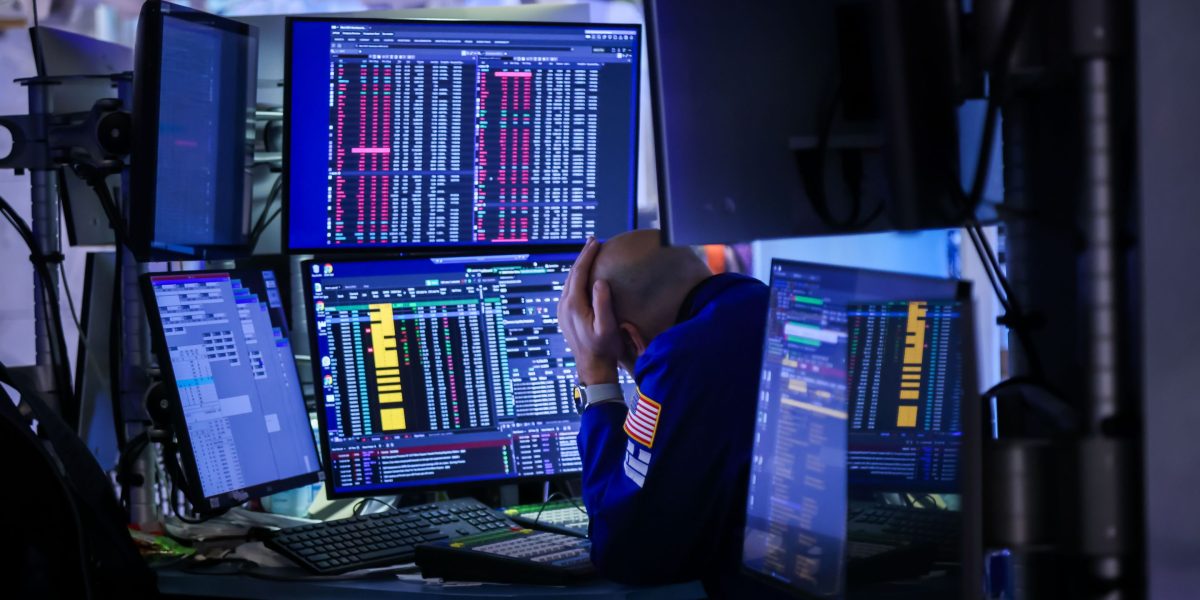
A top market analyst’s warning in late October about a looming “prisoner’s dilemma” and an “AI wobble” in the stock market became chillingly prescient this week as even bullish earnings from Palantir failed to stop a dramatic tech-led selloff.
The remarks came from Tony Yoseloff, managing partner and chief investment officer at Davidson Kempner Capital Management, in conversation with Goldman Sachs’ Tony Pasquariello, for the podcast Exchanges: Great Investors, recorded on Oct. 20 and released 11 days later.
Yoseloff posed some hypothetical questions about the much-covered question of “circular financing” in the artificial intelligence (AI) space, where the same firms are funding each other that are also selling to each other.
“So the way I like to think about it is: Is there going to be an AI wobble at some point? Are investors going to be concerned about how those CapEx dollars are being invested?” Right now, he continued, alluding to a famous game theory scenario, “there’s a little bit of a prisoner’s dilemma, let’s call it, among the larger firms. You have to invest in it because your peers are investing in it, and so if you’re left behind you’re not going to have the stronger competitive position to it.”
The investor continued by comparing today’s heavy concentration—where 10 stocks wield 40% of the S&P 500’s weight—to historic bubbles like the “Nifty Fifty” of the early 1970s and the dot-com surge at the millennium. He warned that in those eras, investors waited as long as 15 years just to recover losses after valuations cracked.
‘Big Short’ bet and the market’s response
The foreboding message arrived nearly synonymous with famed investor Michael Burry, best known for profiting from the subprime mortgage collapse, revealing a $1.1 billion short position against major AI bellwethers Nvidia and Palantir in early November. His move sent shockwaves through global markets already jittery about the narrowness of tech gains: Bank of America Research analysts noted the “Magnificent 7” tech stocks contributed more than 80% of the S&P 500’s total returns last month, heightening fears of a reversal.
Markets responded violently. Palantir shares, having soared 154% year-to-date and surging 7% after its Q3 earnings initially, reversed course and plunged nearly 8% in a single day. Asian and European indices followed suit, highlighting how tightly global sentiment is bound to a handful of AI leaders. In South Korea and Taiwan, for instance, one or two tech stocks accounted for nearly half the national index returns, illustrating Yoseloff’s “wobble” risk: Any crack in confidence could bring a swift, severe correction.
Palantir CEO Alex Karp was angry and typically outspoken as he appeared on CNBC’s “Squawk Box” the next day, when he was asked specifically about Burry’s short position. Karp responded that when he hears of short sellers attacking his company, “what I believe is clearly the most important software company in America and therefore in the world,” he said “it just is super-triggering, because these people, they could pick on any company in the world. They have to pick on the one that actually helps people, that actually has made money for the average person, that is actually supporting our war fighters.” Karp added it’s “crazy motivating” and he believes “the short sellers are constantly getting screwed by Palantir.” The company’s stock was trading down another 2% on Wednesday.
To Karp’s point about the company’s success, Palantir reported a record-setting quarter with $1.18 billion in revenue, besting estimates and boasting U.S. government contracts up 52% over the year. Karp’s combative tone on the earnings call, touting his “anti-woke” approach and Palantir’s government synergies, did little to calm investor jitters. Analysts voiced concern that even robust sales and guidance “don’t justify its valuation” given the scale of capex and the unproven returns from AI-driven bets. To their point, Palantir has a whopping price-to-earnings ratio of more than 100x.
Karp brushed aside critics of Palantir’s strategic direction, but a closer look at the trading floor suggested his boasts were no match for market structure. Yoseloff’s warnings about the prisoner’s dilemma—where tech giants are locked in costly, self-reinforcing arms races, largely because they cannot afford not to invest—seemed vindicated as even strong results triggered a sell-the-news spiral. Top Wall Street CEOs piled on, with Goldman’s David Solomon and Morgan Stanley’s Ted Pick both projecting corrections of up to 20% for stock valuations.
With both analyst warnings and high-profile action heralding a potential regime shift in markets, the AI sector’s “wobble” may only be beginning. As Palantir’s swift reversal shows, confidence in continual AI-driven growth is no longer bulletproof. If the “prisoner’s dilemma” continues, there is a risk “dead capital” could haunt tech valuations for years to come—as happened after past bubbles.
Yet for seasoned investors like Yoseloff, the period ahead promises not just volatility, but new opportunities, as “absolute return strategies” thrive when markets finally force a separation between true winners and casualties of unmet expectations. In that sense, the fears that Palantir’s earnings could not vanquish may yet prove to be the financial world’s next big inflection point.
For this story, Fortune used generative AI to help with an initial draft. An editor verified the accuracy of the information before publishing.
I love watching “Next Man Up” basketball, where the spotlight rotates unpredictably. One night it’s the bench guard dropping 30, the next it’s the role player posting a triple-double.
CapitalG’s Jill Chase—who captained her college basketball team at Williams College—says this logic actually applies to Alphabet’s growth firm. When I ask her what basketball team is most like CapitalG, she lists the WNBA’s Golden State Valkyries.
“Everybody has a different skill set, and everybody is willing to drop anything to help each other win,” said Chase. “It’s a different person every night who wins the game. And I think that’s really consistent with the way CapitalG is building its culture.”
For the first time since the firm was started in 2013, it’s promoting two general partners, Chase and Alex Nichols, Fortune has exclusively learned. Chase, who joined CapitalG in 2020 specifically with a thesis around AI, has backed Abridge, Baseten, Canva, LangChain, Physical Intelligence, and Rippling.
Nichols, meanwhile, joined CapitalG in 2018 as an associate and was promoted to partner just two years ago. He previously worked with managing partner Laela Sturdy on the firm’s investments in Duolingo, Stripe, and Whatnot, and recently led CapitalG’s investment in Zach Dell’s energy startup BasePower. At a moment where there’s mounting angst around data centers and what it will take to power them, Nichols has a surprising take on how AI will affect energy—that both batteries and solar are getting cheaper and better at something like Moore’s Law speed. Those twin cost curves, over time, should actually drive energy prices down.
“I’m actually very optimistic about the future of energy prices,” he said. “You look at the history of energy consumption versus GDP. And cheap energy means more production, more income, and means a higher standard of living.”
At a moment when venture is perhaps more competitive than ever—and there are certainly some solo GPs out there making their mark—there’s an argument that as lines blur between disciplines in an AI-ified world, venture is by necessity a team sport.
Sturdy—who’s been CapitalG’s managing partner since 2023 (and also captained her college basketball team)—and Chase both have clearly taken some learnings from their time on the court. Chase sees venture overall as becoming more team-oriented: “Historically, it used to be like ‘you made general partner, go out and win your deal.’ To me, that’s not the right way to be successful in venture ever.”
Sturdy adds that in basketball, like venture, “We have to look at the scoreboard every once in a while, and you have to get back up when you get crushed… And, of course, coming together is better than playing alone.”
Term Sheet Podcast…This week, I spoke with Exelon CEO Calvin Butler. As resource-hungry data centers continue to sprout across the country, many are questioning whether the nation’s utility network can keep pace with such large-scale demand. Butler says it can. Listen and watch here.
Joey Abrams curated the deals section of today’s newsletter.Subscribe here.
VENTURE CAPITAL
– humans&, a San Francisco-based AI lab, raised $480 million in seed funding. SVAngel and GeorgesHarik led the round and were joined by NVIDIA and others.
– Emergent, a San Francisco-based platform designed for AI software creation, raised $70 million in Series B funding. Khosla Ventures and SoftBank led the round and were joined by Prosus, Lightspeed, Together, and Y Combinator.
– Exciva, a Heidelberg, Germany-based developer of therapeutics designed for neuropsychiatric conditions, raised €51 million ($59 million) in Series B funding. Gimv and EQTLifeSciences led the round and were joined by FountainHealthcarePartners, LifeArcVentures, and others.
– Pomelo, a Buenos Aires, Argentina-based payments infrastructure company, raised $55 million in Series C funding. Kaszek and InsightPartners led the round and were joined by IndexVentures, AdamsStreetPartners, S32, and others.
– Cloover, a Berlin, Germany-based operating system designed for energy independence, raised $22 million in Series A funding. MMCVentures and QEDInvestors led the round and were joined by LowercarbonCapital, BNVTCapital, BoschVentures, and others.
– Statusphere, a Winter Park, Fla.-based influencer marketing technology platform, raised $18 million in Series A funding. VolitionCapital led the round and was joined by HearstLab, 1984Ventures, and HowWomenInvest.
– DominionDynamics, an Ottawa, Canada-based defense technology company, raised $21M CAD ($15.2M USD) in seed funding. Georgian led the round and was joined by BessemerVenturePartners and BritishColumbiaInvestmentManagementCorporation.
– Cosmos, a New York City-based image collection and discovery platform, raised $15 million in Series A funding. ShineCapital led the round and was joined by Matrix and others.
– Mave, a Toronto, Canada-based real estate AI company, raised $5 million in seed funding from StaircaseVentures, RelayVentures, N49P, and AlatePartners.
– Stilla, a Stockholm, Sweden-based developer of an AI designed to accommodate entire teams, raised $5 million in pre-seed funding. GeneralCatalyst led the round and was joined by others.
– AsymmetricSecurity, a London, U.K. and San Francisco-based cyber forensics company, raised $4.2 million in pre-seed funding. SusaVentures led the round and was joined by HalcyonVentures, OverlookVentures, and angel investors.
PRIVATE EQUITY
– ConnectWise, backed by ThomaBravo, acquired zofiQ, a Toronto, Ontario-based agentic AI technology company designed to automate high-service desk operations. Financial terms were not disclosed.
– GrantAvenueCapital acquired 21stCenturyHealthcare, a Tempe, Ariz.-based vitamins, minerals, and supplements company. Financial terms were not disclosed.
– HighlanderPartners acquired Tapatio, a Vernon, Calif.-based hot sauce brand. Financial terms were not disclosed.
– PlatinumEquity acquired CzarnowskiCollective, a Chicago, Ill.-based exhibit and events company. Financial terms were not disclosed.
– UnitedBuildingSolutions, backed by AEIndustrial, acquired DFWMechanicalGroup, a Wylie, Texas-based HVAC solutions company. Financial terms were not disclosed.
IPOS
– PicPay, a Sao Paolo, Brazil-based digital bank, now plans to raise up to $435.1 million in an offering of 22.9 million shares priced between $16 and $19 on the Nasdaq. The company posted $1.7 billion in revenue for the year ended September 30. J&F International and BancoOriginal back the company.
– EthosTechnologies, a San Francisco-based online life insurance provider, plans to raise up to $210 million in an offering of 10.5 million shares priced between $18 and $20. The company posted $344 million in revenue for the year ended Sept. 30. GeneralCatalyst, HeroicVentures, EricLantz, and others back the company.
FUNDS + FUNDS OF FUNDS
– BlueprintEquity, a La Jolla, Calif.-based growth equity firm, raised $333 million for its third fund focused on enterprise software, business-to-business, and tech-enabled services companies.
PEOPLE
– Area 15 Ventures, a Castle Pine, Colo.-based venture capital firm, promoted AdamContos to managing partner.
– BullCityVenturePartners, a Durham, N.C.-based venture capital firm, hired CarlyConnell as a principal.
– HarvestPartners, a New York City-based private equity firm, promoted LucasRodgers to partner, MatthewBruckmann and IanSingleton to principal, and ConnorScro to vice president on the private equity team.
– Wingman Growth Partners, a Greenwich, Conn.-based private equity firm, hired CheriReeve as CFO. She previously served as principal and CFO at AtlasHoldings.
Davos 2026: reading the signals, not the headlines | Fortune
Louisa Loran advises boards and leadership teams on transformation and long-term value creation and currently serves on the boards of Copenhagen Business School and CataCap Private Equity.At Google, Louisa launched a billion-dollar supply chain solutions business, doubled growth in a global industry vertical, and led strategic business transformation for the company’s largest customers in EMEA—working at the forefront of AI, data, and platform innovation. At Maersk, she co-authored the strategy that redefined the brand globally and doubled its share price, helping pivot the company from traditional shipping to integrated logistics. Her career began in the luxury and FMCG space with Moët Hennessy and Diageo, where she built iconic brands and led innovation at the intersection of heritage and digital transformation.
China’s hotels are welcoming record numbers of travelers, yet room rates are sinking—a paradox many operators blame on Trip.com Group Ltd.
For Gary Huang, running a five-room homestay in the scenic Huzhou hills near Shanghai was supposed to secure his family’s financial future. Instead, he and other hoteliers in China’s southeastern Zhejiang province say nightly rates have fallen to levels last seen more than a decade ago, as Trip.com’s frequent discount campaigns force them to cut prices simply to remain visible on China’s dominant booking platform.
“The promotion campaigns now are almost a daily routine,” said Huang, who asked to use his self-given English name out of concern of speaking out against Trip.com. “We have to constantly cut prices at least 15% to attract travelers. We have no choice but to go along with the price cuts.”
Trip.com has been central to China’s post-pandemic travel rebound, connecting millions of travelers with small operators like Huang. But for many hotels, visibility—and sometimes survival—comes at the expense of profits.
That dynamic is now at the heart of Beijing’s antitrust probe. Regulators allege Trip.com is abusing its market position, with analysts citing deflation across the sector as the government’s main concern. Interviews with lodging operators, industry groups and travel consultants describe a system where constant price-cutting and opaque policies are eroding profitability, even as demand rebounds.
Trip.com has said it’s cooperating with the government’s investigation. The company’s stock dove more 16% since the probe was announced a week ago.
Revenue per room—a key hotel metric—was flat across China in 2025, even as other Asian markets saw gains, according to Bloomberg Intelligence. Marriott International Inc.’s revenue per room in China fell 1% most of last year, while Hilton’s China room revenue trailed its regional peers.
The company controls about 56% of China’s online travel market, according to China Trading Desk, and has grown into the world’s largest booking site. Its dominance has helped fuel domestic tourism’s recovery—nearly 5 billion trips were logged in the first three quarters of 2025—but operators say the benefits are being offset by falling room yields.
“The market has developed unevenly and innovation is lacking due to monopolistic practices,” said He Shuangquan, head of the Yunnan Provincial Tourism Homestay Industry Association that represents some 7,000 operators. “The entire online travel agency sector is stagnating in a pool of dead water.”
‘Pick-one-of-two’
The broader challenge is oversupply and cautious consumer spending. In regions like Yunnan, hotel capacity has tripled since the pandemic, just as travelers tightened budgets. Consultants note that while people are traveling more, they’re spending less—leaving hotels slashing rates to fill empty beds and posting billions in losses.
For operators like Huang, the paradox is stark: the platform that delivers customers is also accelerating the race to the bottom. The complaints center around Trip.com’s “er xuan yi,” Mandarin for pick-one-of-two exclusivity arrangements—a practice that Chinese regulators have repeatedly vowed to stamp out.
Trip.com categorizes merchants into tiers with “Special Merchants” enjoying the most visibility and traffic, Yunnan Provincial Tourism’s He said. However, these top-tier merchants are typically prohibited from listing on rival platforms like Alibaba’s Fliggy, ByteDance’s Douyin or Meituan. Merchants who aren’t bound by these exclusive arrangements report being effectively compelled to offer the lowest prices on Trip.com’s online booking platform Ctrip, or risk facing a raft of measures like lowered search rankings.