Connect with us

Business

A small Chinese startup wants to jumpstart a global EV taxi revolution
Published

on


On a recent morning in an industrial zone near Hong Kong’s bustling cargo port, a white MG electric taxi glided into a narrow kiosk resembling a car wash. A hydraulic lift elevated the vehicle, allowing a guided mechanical system to slide out the taxi’s depleted battery and replace it with a fully charged one. There was no plugging in, no waiting around to recharge. The taxi was ready for the road in under three minutes. 

That battery-swapping kiosk is the first of a network of hundreds planned for Hong Kong by U Power, a little-known startup from Shanghai that aims to electrify the beating heart of the city’s notoriously antiquated taxi fleet.  

The opportunity is huge. In Hong Kong, electric vehicles make up just 4% of the city’s 119,000 commercial vehicles, including taxis, buses, and delivery vans. For taxis, the percentage of EVs is even lower. As of December 2024, Hong Kong had only 90 electric taxis, accounting for 0.5% of the city’s 18,163 licensed cabs. That’s a stark contrast to the 24% penetration rate among the city’s private auto fleet.

Hong Kong is representative of a global phenomenon: Of the more than 400 million commercial vehicles worldwide, fewer than 1% are electric. Even in cities with high EV penetration rates—including San Francisco, Oslo, and Amsterdam—electric taxis remain a rarity. 

In theory, Hong Kong’s taxi owners have strong financial incentives to make the switch. Electric motors, with fewer moving parts than internal combustion engines, are cheaper to run and maintain. Several recent studies suggest fuel costs for EVs are more than 70% lower than for gas-powered vehicles, translating to annual savings of about $10,000 per taxi. The Hong Kong government offers further inducements: it has waived first-time registration taxes for electric taxis and granted a 45,000 Hong Kong dollar (about $5,750) subsidy per vehicle to operators who switch from gas to electric. 

Still, owners and drivers are wary. For commercial vehicles, especially taxis, every minute of downtime means lost revenue. Conventional EV charging is far too slow for high-utilization fleets. Hong Kong has more than 11,000 public EV chargers, but only about 2,000 are quick or fast chargers, capable of restoring batteries to 80% in 30 to 60 minutes. The rest can take several hours to fully recharge a vehicle—time most drivers don’t have. 

Courtesy of U Power

As Li points out, the average taxi driver earns 200 Hong Kong dollars (about $25) per hour: “You ask them to sit idle for two hours? No way. That’s 400 [Hong Kong] dollars gone.” On top of that, many public charging stations impose hourly parking fees, further eroding the economic case for EVs. 

Battery swapping stations could eliminate that downtime—but only if U Power can build enough of them across the city and persuade drivers to embrace the model. The company hopes to have four stations in operation in Hong Kong by the end of this year and ultimately envisions a citywide network of more than 200. 

Beyond Hong Kong 

Hong Kong is a high-profile testbed, but Li has global ambitions. U Power has launched pilots in Singapore and Macau and is actively rolling out swap stations in Thailand, Mexico, Portugal, and Peru. Li sees Thailand and Mexico as particularly promising due to their large taxi fleets and high vehicle turnover. Bangkok, he notes, has 80,000 taxis; Mexico City has more than 100,000. 

In Thailand, U Power last year signed a strategic partnership with SAIC Motor–CP Co., a joint venture between one of China’s largest automakers and CP Group, Thailand’s largest conglomerate. The venture aims to integrate battery-swapping technology into MG taxis and ride-hailing vehicles. (Disclosure: Fortune’s owner, Chatchaval Jiaravanon, is a member of the family that controls the CP Group, and he is one of U Power’s largest investors.)

U Power has also formed a joint venture with SUSCO, a Thai oil and fuel retailer, to install kiosks at its network of 200 gas stations and teamed up with Japan’s Sumitomo Mitsui Auto Leasing & Service to deploy a fleet of swapping-compatible MGs in the island province of Phuket. 

And the company now says that it plans to move its operational headquarters from Shanghai to Bangkok in order to fuel its global expansion.

In Mexico, the company has partnered with fleet operator Vizeon New Energy to develop swap-compatible EV taxis, buses, and trucks, and install pilot swap stations in three major cities. Similar efforts are underway in Lisbon and Lima, where U Power is targeting midsize fleet operators and delivery platforms.

Notably, though, U Power has no plans to enter the world’s two largest markets: the U.S. and China. Li calls the U.S. an EV laggard, hampered by low urban density, fragmented infrastructure, and an unpredictable regulatory landscape for Chinese tech companies. He’s also ruled out the Chinese mainland due to fierce competition, entrenched EV incumbents, and a power grid so advanced that ultra-fast charging is widely available—making battery swapping largely unnecessary.

China’s largest cities are notable exceptions to the global dominance of gas-powered taxis. Electric vehicles account for more than 95% of the taxi fleet in Beijing, Shanghai, and Guangzhou. In Shenzhen, the sprawling metropolis just across the border from Hong Kong, authorities have mandated the conversion of the city’s entire taxi and bus fleets to electric vehicles as far back as 2018. 

A wild ride on the Nasdaq 

U Power’s plans for global expansion sparked one of the most explosive post-IPO rallies in Nasdaq history. When the company debuted in April 2023, shares shot up over 600% on opening day, triggering multiple trading halts. Retail traders piled in, lured by the promise of a disruptive Chinese EV infrastructure play. The stock, which trades under the moniker UCAR, peaked at $901 in June before speculative fervor collapsed. By year’s end shares had slumped to $18. Over the past 52 weeks, U Power’s share price has oscillated between $9.05 and $2.47, with day-to-day swings often exceeding 10%. The stock currently trades below $4.00, down more than 50% year-to-date. No major Wall Street analyst currently follows UCAR. 

U Power’s stock’s slump reflects investor skepticism about the feasibility of its “battery-as-a-service” model and frustration with its lackluster financials. Critics question whether a battery swap network—capital intensive, dependent on fleet adoption, and distributed across so many different markets—can scale profitably. The company, launched in 2013, remains unprofitable, posting a $7.7 million net loss on $6.08 million in revenue in 2024, according to documents filed with the U.S. Securities and Exchange Commission.

Li insists the company will break even in 2025 and triple profits in 2026, thanks to expanding fleet contracts and growing subscription revenue in Southeast Asia and Latin America.  

Owners and drivers, hearts and minds 

To realize Li’s grand visions, U Power must secure hundreds of viable swap sites in some of the world’s most crowded cities. That’s an especially daunting proposition in Hong Kong, where land is expensive, and each location will require zoning approvals, grid connectivity, and all-hours vehicle access. So far, U Power has identified just ten potential sites in the city. 

The bigger challenge may be cultural. Winning over Hong Kong’s 17 major taxi fleet owners and some 46,000 fiercely independent drivers means reshaping deep-seated habits and suspicions. U Power’s model requires operators to give up battery ownership, retrofit vehicles with the company’s proprietary UOTTA interface, and pay monthly subscription fees tied to battery use—terms that may not sit easily with a sector long allergic to centralized control. 

Li insists the economics will win out. By decoupling batteries from vehicles, he argues, taxi owners can reduce up-front costs by as much as 40%. U Power, meanwhile, assumes responsibility for charging logistics, battery health monitoring, and end-of-life recycling. As batteries degrade, they’re rotated into less demanding uses—like stationary energy storage—or recycled outright. 

To sweeten the deal, Li has floated a blockchain-based incentive system. Each battery contains a chip that logs usage, charging behavior, and wear. Drivers who follow optimal patterns—avoiding peak-hour swaps, returning batteries in good condition—can earn digital tokens redeemable for energy discounts or services. The goal: a transparent, self-regulating marketplace that reduces strain on the grid while rewarding smart usage. 

Isaac Lawrence—AFP via Getty Images

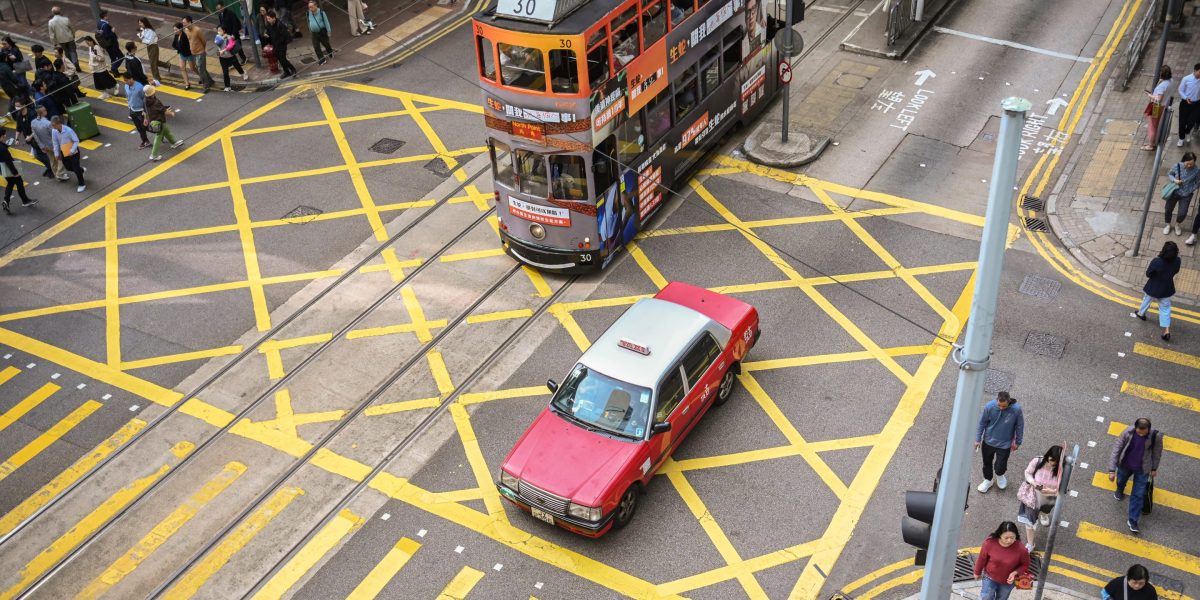
Whether Hong Kong’s notoriously unruly taxi sector will buy in remains to be seen. The city’s iconic red, green, and blue cabs—red for Hong Kong Island and Kowloon, green for the New Territories, and blue for Lantau—are instantly recognizable symbols of the city. They’re also famously idiosyncratic. Most drivers still accept cash only and have long attracted complaints of rude service, overcharging, and reckless driving. Reform efforts have repeatedly hit walls: A proposed fee hike in 1984 triggered citywide riots; drivers staged mass strikes in 1991 and 2008; and just this February, the drivers’ union threatened another unless the government cracked down on unlicensed ride-hailing services like Uber. 

At U Power’s Hong Kong launch ceremony in June, the chairman of the Hong Kong Taxi Drivers & Operators Association attended and signed a memorandum of understanding pledging to promote the adoption of the UOTTA system. Notably, though, no representatives of the Hong Kong Taxi Owners Association, which represents the interests of taxi license holders—and is generally considered the more politically powerful of the two major taxi unions—attended the event.  

Still, the symbolism of electrifying Hong Kong’s taxis is potent. In 2023, when the city’s stock exchange opened offices in New York and London, it marked the milestone with a cheeky global ad campaign featuring then-CEO Nicolas Aguzin rolling through Manhattan and Mayfair—not in a black limo, but in the back of a classic red Hong Kong cab. If Li Jia has his way, the next time one of those taxis makes an international cameo, it’ll be running on swappable power—a symbol not only of the city, but of the future of electric mobility. 


Source link

Continue Reading

Business

Epstein grand jury documents from Florida can be released by DOJ, judge rules

Published

on


A federal judge on Friday gave the Justice Department permission to release transcripts of a grand jury investigation into Jeffrey Epstein’s abuse of underage girls in Florida — a case that ultimately ended without any federal charges being filed against the millionaire sex offender.

U.S. District Judge Rodney Smith said a recently passed federal law ordering the release of records related to Epstein overrode the usual rules about grand jury secrecy.

The law signed in November by President Donald Trump compels the Justice Department, FBI and federal prosecutors to release later this month the vast troves of material they have amassed during investigations into Epstein that date back at least two decades.

Friday’s court ruling dealt with the earliest known federal inquiry.

In 2005, police in Palm Beach, Florida, where Epstein had a mansion, began interviewing teenage girls who told of being hired to give the financier sexualized massages. The FBI later joined the investigation.

Federal prosecutors in Florida prepared an indictment in 2007, but Epstein’s lawyers attacked the credibility of his accusers publicly while secretly negotiating a plea bargain that would let him avoid serious jail time.

In 2008, Epstein pleaded guilty to relatively minor state charges of soliciting prostitution from someone under age 18. He served most of his 18-month sentence in a work release program that let him spend his days in his office.

The U.S. attorney in Miami at the time, Alex Acosta, agreed not to prosecute Epstein on federal charges — a decision that outraged Epstein’s accusers. After the Miami Herald reexamined the unusual plea bargain in a series of stories in 2018, public outrage over Epstein’s light sentence led to Acosta’s resignation as Trump’s labor secretary.

A Justice Department report in 2020 found that Acosta exercised “poor judgment” in handling the investigation, but it also said he did not engage in professional misconduct.

A different federal prosecutor, in New York, brought a sex trafficking indictment against Epstein in 2019, mirroring some of the same allegations involving underage girls that had been the subject of the aborted investigation. Epstein killed himself while awaiting trial. His longtime confidant and ex-girlfriend, Ghislaine Maxwell, was then tried on similar charges, convicted and sentenced in 2022 to 20 years in prison.

Transcripts of the grand jury proceedings from the aborted federal case in Florida could shed more light on federal prosecutors’ decision not to go forward with it. Records related to state grand jury proceedings have already been made public.

When the documents will be released is unknown. The Justice Department asked the court to unseal them so they could be released with other records required to be disclosed under the Epstein Files Transparency Act. The Justice Department hasn’t set a timetable for when it plans to start releasing information, but the law set a deadline of Dec. 19.

The law also allows the Justice Department to withhold files that it says could jeopardize an active federal investigation. Files can also be withheld if they’re found to be classified or if they pertain to national defense or foreign policy.

One of the federal prosecutors on the Florida case did not answer a phone call Friday and the other declined to answer questions.

A judge had previously declined to release the grand jury records, citing the usual rules about grand jury secrecy, but Smith said the new federal law allowed public disclosure.

The Justice Department has separate requests pending for the release of grand jury records related to the sex trafficking cases against Epstein and Maxwell in New York. The judges in those matters have said they plan to rule expeditiously.

___

Sisak reported from New York.


Source link

Continue Reading

Business

Miss Universe co-owner gets bank accounts frozen as part of probe into drugs, fuel and arms trafficking

Published

on


Mexico’s anti-money laundering office has frozen the bank accounts of the Mexican co-owner of Miss Universe as part of an investigation into drugs, fuel and arms trafficking, an official said Friday.

The country’s Financial Intelligence Unit, which oversees the fight against money laundering, froze Mexican businessman Raúl Rocha Cantú’s bank accounts in Mexico, a federal official told The Associated Press on condition of anonymity because he was not authorized to comment on the investigation.

The action against Rocha Cantú adds to mounting controversies for the Miss Universe organization. Last week, a court in Thailand issued an arrest warrant for the Thai co-owner of the Miss Universe Organization in connection with a fraud case and this year’s competition — won by Miss Mexico Fatima Bosch — faced allegations of rigging.

The Miss Universe organization did not immediately respond to an email from The Associated Press seeking comment about the allegations against Rocha Cantú.

Mexico’s federal prosecutors said last week that Rocha Cantú has been under investigation since November 2024 for alleged organized crime activity, including drug and arms trafficking, as well as fuel theft. Last month, a federal judge issued 13 arrest warrants for some of those involved in the case, including the Mexican businessman, whose company Legacy Holding Group USA owns 50% of the Miss Universe shares.

The organization’s other 50% belongs to JKN Global Group Public Co. Ltd., a company owned by Jakkaphong “Anne” Jakrajutatip.

A Thai court last week issued an arrest warrant for Jakrajutatip who was released on bail in 2023 on the fraud case. She failed to appear as required in a Bangkok court on Nov. 25. Since she did not notify the court about her absence, she was deemed to be a flight risk, according to a statement from the Bangkok South District Court.

The court rescheduled her hearing for Dec. 26.

Rocha Cantú was also a part owner of the Casino Royale in the northern Mexican city of Monterrey, when it was attacked in 2011 by a group of gunmen who entered it, doused gasoline and set it on fire, killing 52 people.

Baltazar Saucedo Estrada, who was charged with planning the attack, was sentenced in July to 135 years in prison.


Source link

Continue Reading

Business

Elon Musk’s X fined $140 million by EU for breaching digital regulations

Published

on


European Union regulators on Friday fined X, Elon Musk’s social media platform, 120 million euros ($140 million) for breaches of the bloc’s digital regulations, in a move that risks rekindling tensions with Washington over free speech.

The European Commission issued its decision following an investigation it opened two years ago into X under the 27-nation bloc’s Digital Services Act, also known as the DSA.

It’s the first time that the EU has issued a so-called non-compliance decision since rolling out the DSA. The sweeping rulebook requires platforms to take more responsibility for protecting European users and cleaning up harmful or illegal content and products on their sites, under threat of hefty fines.

The Commission, the bloc’s executive arm, said it was punishing X because of three different breaches of the DSA’s transparency requirements. The decision could rile President Donald Trump, whose administration has lashed out at digital regulations, complained that Brussels was targeting U.S. tech companies and vowed to retaliate.

U.S. Secretary of State Marco Rubio posted on his X account that the Commission’s fine was akin to an attack on the American people. Musk later agreed with Rubio’s sentiment.

“The European Commission’s $140 million fine isn’t just an attack on @X, it’s an attack on all American tech platforms and the American people by foreign governments,” Rubio wrote. “The days of censoring Americans online are over.”

Vice President JD Vance, posting on X ahead of the decision, accused the Commission of seeking to fine X “for not engaging in censorship.”

“The EU should be supporting free speech not attacking American companies over garbage,” he wrote.

Officials denied the rules were intended to muzzle Big Tech companies. The Commission is “not targeting anyone, not targeting any company, not targeting any jurisdictions based on their color or their country of origin,” spokesman Thomas Regnier told a regular briefing in Brussels. “Absolutely not. This is based on a process, democratic process.”

X did not respond immediately to an email request for comment.

EU regulators had already outlined their accusations in mid-2024 when they released preliminary findings of their investigation into X.

Regulators said X’s blue checkmarks broke the rules because on “deceptive design practices” and could expose users to scams and manipulation.

Before Musk acquired X, when it was previously known as Twitter, the checkmarks mirrored verification badges common on social media and were largely reserved for celebrities, politicians and other influential accounts, such as Beyonce, Pope Francis, writer Neil Gaiman and rapper Lil Nas X.

After he bought it in 2022, the site started issuing the badges to anyone who wanted to pay $8 per month.

That means X does not meaningfully verify who’s behind the account, “making it difficult for users to judge the authenticity of accounts and content they engage with,” the Commission said in its announcement.

X also fell short of the transparency requirements for its ad database, regulators said.

Platforms in the EU are required to provide a database of all the digital advertisements they have carried, with details such as who paid for them and the intended audience, to help researches detect scams, fake ads and coordinated influence campaigns. But X’s database, the Commission said, is undermined by design features and access barriers such as “excessive delays in processing.”

Regulators also said X also puts up “unnecessary barriers” for researchers trying to access public data, which stymies research into systemic risks that European users face.

“Deceiving users with blue checkmarks, obscuring information on ads and shutting out researchers have no place online in the EU. The DSA protects users,” Henna Virkkunen, the EU’s executive vice-president for tech sovereignty, security and democracy, said in a prepared statement.

The Commission also wrapped up a separate DSA case Friday involving TikTok’s ad database after the video-sharing platform promised to make changes to ensure full transparency.

___

AP Writer Lorne Cook in Brussels contributed to this report.


Source link

Continue Reading

Trending

Copyright © Miami Select.