Connect with us

Politics

A rough year for journalists in 2025, with a little hope for things to turn around
Published

on


By nearly any measure, 2025 has been a rough year for anyone concerned about freedom of the press.

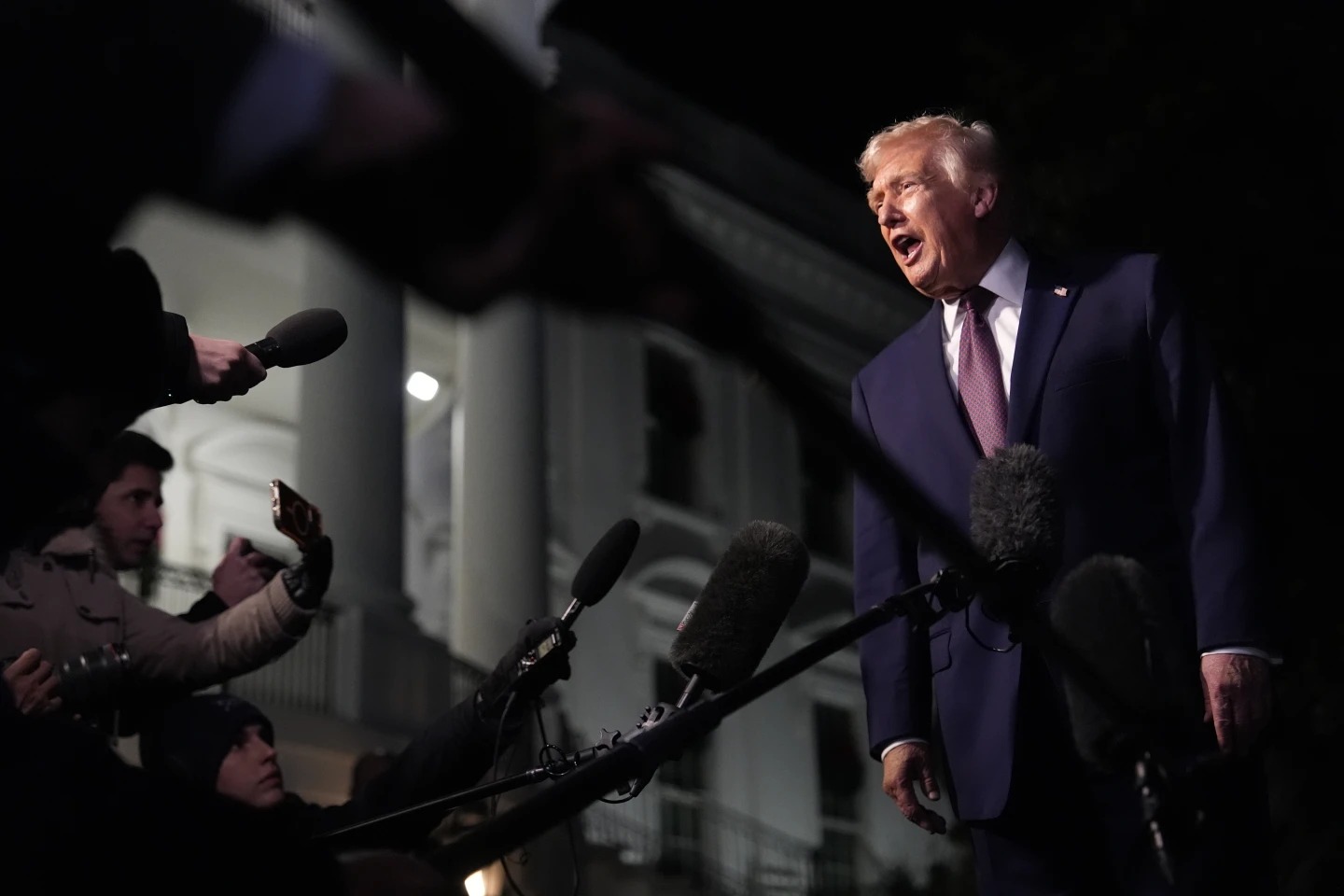
It’s likely to be the deadliest year on record for journalists and media workers. The number of assaults on reporters in the U.S. nearly equals the last three years combined. The President of the United States berates many who ask him questions, calling one woman piggy.” And the ranks of those doing the job continues to thin.

It’s hard to think of a darker time for journalists. So say many, including Tim Richardson, a former Washington Post reporter and now program director for journalism and disinformation at PEN America. “It’s safe to say this assault on the press over the past year has probably been the most aggressive that we’ve seen in modern times.”

Tracking killings and assaults against journalists

Worldwide, the 126 media industry people killed in 2025 by early December matched the number of deaths in all of 2024, according to the Committee to Protect Journalists, and last year was a record-setter. Israel’s bombing of Gaza accounted for 85 of those deaths, 82 of them Palestinians.

“It’s extremely concerning,” said Jodie Ginsberg, CEO of the Committee to Protect Journalists. “Unfortunately, it’s not just, of course, about the sheer numbers of journalists and media workers killed, it’s also about the failure to obtain justice or get accountability for those killings.

“What we know from decades of doing this work is that impunity breeds impunity,” she said. “So a failure to tackle journalists’ killings creates an environment where those killings continue.”

The committee estimates there are at least 323 journalists imprisoned worldwide.

None of those killed this year were from the United States. But the work on American soil has still been dangerous. There have been 170 reports of assaults on journalists in the United States this year, 160 of them at the hands of law enforcement, according to the U.S. Press Freedom Tracker. Many of those reports came from coverage of immigration enforcement efforts.

It’s impossible to look past the influence of President Donald Trump, who frequently seethes with anger at the press while simultaneously interacting with journalists more than any president in memory — frequently answering their cellphone calls.

“Trump has always attacked the press,” Richardson said. “But during the second term, he’s turned that into government action to restrict and punish and intimidate journalists.”

Journalists learn quickly they have a fight on their hands

The Associated Press learned that quickly, when Trump limited the outlet’s access to cover him after it refused to follow his lead to rename the Gulf of Mexico. It launched a court fight that has remained unresolved. Trump has also extracted settlements from ABC and CBS News in lawsuits over stories that displeased him, and is suing The New York Times and The Wall Street Journal.

Long angry about a perceived bias against conservatives on PBS and NPR newscasts, Trump and his allies in Congress successfully cut funding for public broadcasting as a whole. The President has also moved to shut down government-run organizations that beam news to all parts of the world.

“The U.S. is a major investor in media development, in independent media outlets in countries that have little or no independent media, or as a source of information for people in countries where there is no free media,” Ginsberg said. “The evisceration of Radio Free Europe, Radio Free Asia and the Voice of America is another blow to press freedom globally.”

Others in his administration take Trump’s lead, like when his press office chose the day after Thanksgiving to launch a web portal to complain about outlets or journalists being unfair.

“It’s part of this overall strategy that we’re seeing from certain governments, notably the United States, to paint all journalists who don’t simply (repeat) the narrative put out by the government as fake news, as dubious, as dodgy, as criminal,” Ginsberg said.

Trump’s Defense Secretary, Pete Hegseth, has portrayed journalists as dark figures skulking around Pentagon halls to uncover classified secrets as his rationale for putting in restrictive rules for coverage.

That’s led to the most notable example of journalists fighting back: most mainstream news outlets gave up their credentials to work in the Pentagon rather than agree to these rules, and are still breaking stories while working off site. The New York Times has sued to overturn the rules. The newspaper also publicly defends itself when attacked by the President, such as when he complained about its coverage of his health.

Despite the more organized effort against the press, the public has taken little notice. The Pew Research Center said that 36% of Americans reported earlier this year hearing about the Trump administration’s relationship with the press, compared to 72% who said that at the same point in his first term.

Polls consistently show that journalists have never been popular, and are likely to elicit little sympathy when their work becomes harder.

“Really the harm falls on the public with so much of this because the public depends on this independent reporting to understand and scrutinize the decisions that are being made by the most powerful office in the world,” Richardson said.

Some reasons for optimism

The news industry as a whole is more than two decades in to a retrenchment caused largely by a collapse in the advertising market, and every year brings more reports of journalists laid off as a result. One of the year’s most sobering statistics came in a report by the organizations Muck Rack and Rebuild Local News: in 2002, there were 40 journalists for every 100,000 people in the United States and by this year, it was down to just over eight.

Asked if they could find reasons for optimism, both Ginsberg and Richardson pointed to the rise of some independent local news organizations, shoots of growth of growth in a barren landscape, places like the Baltimore BannerCharlottesville Tomorrow in Virginia and Outlier Media in Michigan.

As much as they are derided in Trump’s America, influential Axios CEO Jim VandeHei noted in a column recently that reporters at mainstream media outlets are still working hard and able to set the nation’s agenda with their reporting.

As he told the AP: “Over time, people will hopefully come to their senses and say, ‘Hey, the media like anything else is imperfect but, man, it’s a nice thing to have a free press.’”

___

Republished with permission of The Associated Press.


Source link

Continue Reading

Politics

Donna Deegan administration cleared in State Attorney gun registry probe

Published

on


The 4th Circuit State Attorney’s Office says that while Jacksonville officials were guilty of “poor communication” regarding a registry of people carrying guns into City Hall and the Yates Building, there is no ground for criminal charges related to the practice.

“The logbook incident stemmed from poor communication and a lack of legal review — not from deliberate misconduct. Once identified, the City acted responsibly to end the practice, cooperated fully with investigators, and implemented corrective measures,” the investigative memo released New Year’s Eve said.

Gov. Ron DeSantis and others have pilloried the gun registry as a violation of constitutional rights by the Donna Deegan administration. The “Check Points and Perimeter Security” memo from Facility Manager Mike Soto was drafted June 30, 2023, during the transition between the outgoing Lenny Curry administration and Deegan’s incoming group. It was revised in July after Deegan was sworn in.

State Attorney Melissa Nelson’s Office notes that the city “stopped the practice immediately once it was discovered,” but not before “more than 140 entries recording the names, birthdates, ID numbers, and firearm types of over 100 individuals” were memorialized.

In the course of the investigation, the State Attorney’s Office issued subpoenas to Roy Birbal, former public safety chief Lakeisha Burton, Chief Administrative Officer Karen BowlingSteven LongPat McColloughKelli O’Leary, former acting General Counsel Bob Rhodes, Facilities Manager Mike Soto, and former city lawyer and current City Council lawyer Jason Teal.

The SAO concluded that “sanctions only apply when a registry is created ‘knowingly and willfully.’” The Public Works manager who created the registry did so because “he wanted data about how many people carried firearms into City buildings — believing it would improve preparedness in case of an emergency, not realizing it created a legal problem.”

Indeed, the General Counsel and senior officials in the administration did not review the practice that was in place for nearly two years.

Florida Statutes 790.335 bans registries under threat of criminal and civil penalties, including potential “felony of the third degree” charges and “a fine of not more than $5 million” via a civil action from the Attorney General. But the SAO’s conclusion that no crime was committed insulates the administration and its members from any such sanction.

“The City of Jacksonville fully cooperated with State Attorney Nelson and her office from start to finish, and we thank them for conducting a careful and thorough review,” read a statement from a Deegan administration spokesperson.

“They confirmed that the policy in question was implemented by an individual employee concerned with building security unbeknownst to Mayor Deegan or her leadership team. This practice immediately ended when it was brought to the administration’s attention. Jacksonville will always follow the law and support constitutionally protected rights.”


Source link

Continue Reading

Politics

Times Square to feature patriotic crystal ball for New Year’s Eve, kicking off US’s 250th birthday

Published

on


After the crystal ball drops on New Year’s Eve in New York City, it will rise again, sparkling in red, white and blue to usher in 2026 and kick off months of celebrations for the nation’s upcoming 250th birthday.

The patriotic touches at this year’s Times Square gathering, including a second confetti drop, will offer an early glimpse of what’s ahead: hundreds of events and programs, big and small, planned nationwide to mark the signing of the Declaration of Independence in 1776.

“I’m telling you right now, whatever you’re imagining, it’s going to be much more than that,” said America250 Chair Rosie Rios, who oversees the bipartisan commission created by Congress in 2016 to organize the semiquincentennial anniversary. “It’s going to be one for the ages, the most inspirational celebration this country and maybe the world has ever seen.”

Rios and her group worked with the Times Square Alliance business district and One Times Square, the building from where the ball is dropped, to make the changes to this year’s ceremonies. They’re also planning a second ball drop event on July 3, the eve of the nation’s birthday, “in the same beautiful style that Times Square knows how to do it,” Rios said.

It will mark the first time in 120 years there will be a ball drop in Times Square that doesn’t occur on New Year’s Eve, she said.

A New Year’s Eve ball was first dropped in Times Square in 1907. Built by a young immigrant metalworker named Jacob Starr, the 700-pound (318-kilogram), 5-foot- (1.5-meter-) diameter ball was made of iron and wood and featured 100 25-watt light bulbs. Last year, the Constellation Ball, the ninth and largest version, was unveiled. It measured about 12 feet (3.7 meters) in diameter and weighs nearly 12,000 pounds (5,400 kilograms).

The only years when no ball drop occurred were 1942 and 1943, when the city instituted a nightly “dimout” during World War II to protect itself from attacks. Crowds instead celebrated the new year with a moment of silence followed by chimes rung from the base of One Times Square.

This year, the stroke of midnight will also mark the official launch of America Gives, a national service initiative created by America250. Organizers hope to make 2026 the largest year of volunteer hours ever aggregated in the country.

On the following day, America250 will participate in the New Years Day Rose Parade in Pasadena, California, with a float themed “Soaring Onward Together for 250 Years.” It will feature three larger-than-life bald eagles representing the country’s past, present and future.

“We want to ring in this new year from sea to shining sea. What better way to think about it than going from New York to California,” Rios said. “This has to be community-driven, this has be grassroots. We’re going from Guam to Alaska, from Fairbanks to Philadelphia, and everything in between.”

President Donald Trump has also announced the “Freedom 250” initiative to coordinate additional events for the 250th anniversary.

Rios said she sees the wide range of celebrations and programs planned for the coming months, from large fireworks displays and statewide potluck suppers to student contests and citizen oral histories, as an opportunity to unite a politically divided nation.

“If we can find something for everyone … having those menus of options that people can pick and choose how they want to participate,” she said. “That’s how we’re going to get to engaging 350 million Americans.”

___

Republished with permission of the Associated Press.


Source link

Continue Reading

Politics

Donald Trump vetoes plan to protect Miccosukee Tribe’s Osceola Camp

Published

on


President Donald Trump has vetoed a bipartisan bill calling for safeguarding the Osceola Camp in South Florida from flooding.

In a veto message, he cited the Miccosukee Tribe’s position on immigration after the Tribe sued earlier this year over Alligator Alcatraz. Trump also characterized the legislation as a misguided pursuit started under Democratic President Joe Biden.

“The previous administration developed a plan to protect and replace unauthorized infrastructure at the Osceola Camp, which could cost up to $14 million. But despite seeking funding and special treatment from the Federal Government, the Miccosukee Tribe has actively sought to obstruct reasonable immigration policies that the American people decisively voted for when I was elected,” reads a statement from Trump.

“My Administration is committed to preventing American taxpayers from funding projects for special interests, especially those that are unaligned with my Administration’s policy of removing violent criminal illegal aliens from the country.  Ending the massive cost of taxpayer handouts and restoring fiscal sanity is vital to economic growth and the fiscal health of the Nation.”

The action killed a bill (HR 504) sponsored by U.S. Rep. Carlos Giménez, a Miami-Dade Republican. The legislation passed in the House on a voice vote in July before being approved in the Senate through unanimous consent. U.S. Sen. Rick Scott, a Naples Republican, had sponsored a companion bill in the Senate.

Florida Politics has reached out to Giménez for comment about the veto.

In July, he spoke on the floor about the bill before it passed.

“This bipartisan legislation ensures that the Miccosukee Tribe has the legal authority to manage, protect and preserve their land — and continue their traditional way of life,” he said.

The bill would have amended the Miccosukee Reserved Area act to include the Osceola Camp, an inhabited tribal village located in the Everglades. As approved, the legislation would have directed the Interior Department to consult with the Miccosukee Tribe on the best ways to protect structures from flooding events.

“The Osceola Camp is not only home to tribal members, but it is also a site of historical and cultural importance. Including this land in the reserved area will empower the tribe to protect their community, manage water flow into Everglades national park, and raise structures within the Camp to prevent catastrophic flooding,” Giménez said on the floor.

“The Everglades is the largest subtropical wilderness in the continental United States, and one of the most unique ecosystems on the planet. For generations, the Miccosukee Tribe has served as a responsible steward of the fragile environment. Their leadership in conservation, water management and environmental protection has helped preserve the natural beauty, biodiversity and the cultural heritage of South Florida.”

But Trump, whose Mar-a-Lago home sits less than a two-hour drive from Osceola Camp, said the bill would offer unwarranted special treatment to the Tribe.

“This principle carries especially heavy weight here; it is not the Federal Government’s responsibility to pay to fix problems in an area that the Tribe has never been authorized to occupy,” he said. “For these reasons, I cannot support the Miccosukee Reserved Area Amendments Act.”

The Miccosukee Tribe has not released a statement about the veto on social media.

Earlier this year, Miccosukee Tribe Chair Talbert Cypress legally challenged the opening of the Alligator Alcatraz immigrant detention center in the Everglades. That resulted in a temporary halt of work there, though an appellate court overturned that decision in September.

“This is not the first fight for our land and our rights,” Cypress said in a statement in the Fall. “The Miccosukee Tribe remains steadfast in our commitment to protect our ancestral lands in Big Cypress from development as a permanent detention center. … We will always stand up for our culture, our sovereignty, and for the Everglades. When it comes to our homeland, there is no compromise.”


Source link

Continue Reading

Trending

Copyright © Miami Select.