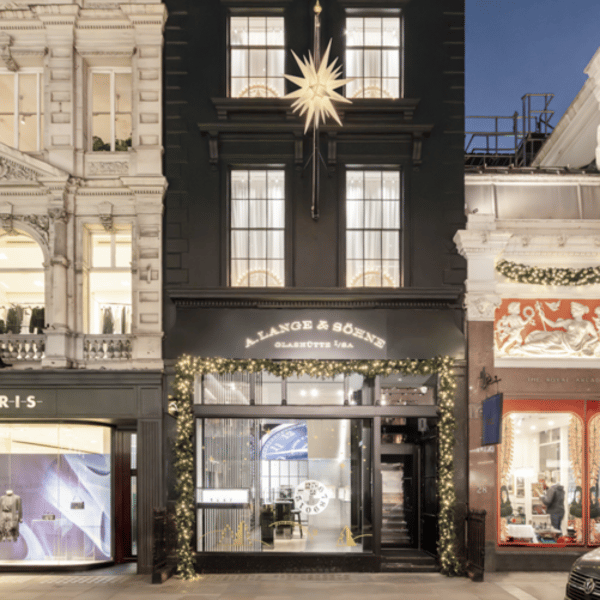
London’s Bond Street continues to be a must-be-there destination for global luxury brands and the latest to open there is A Lange & Söhne, with a new flagship boutique at the Mayfair end of the thoroughfare.
A Lange & Söhne
The street morphs from new Bond Street to Old Bond Street and the UK flagship for the luxury watchmaker is at number 29 on the latter.
The company said it’s strengthening its presence in the UK market via the four-storey space and that “whether spontaneously or by appointment, clients can receive expert and personalised advice when choosing their desired model amidst a relaxed atmosphere and luxurious ambience”.
To provide them with a comprehensive overview of the collection, a “representative selection” of timepieces is available, including boutique-exclusives and limited editions.
So what of the store itself? The key exterior colour of the historic façade is dark grey, which continues on the inside. On entering the ground floor, visitors get “an engaging introduction to the brand’s unique history and its six dedicated watch families”. This level also features a lounge, “seamlessly blending traditional London club aesthetics with a contemporary A Lange & Söhne environment, bathed in natural light from a sky window”.
A Lange & Söhne
On the ground floor, there are displays highlighting the “intricate artistry within each timepiece” and several hundred hand-finished movement components of a Zeitwerk, Lange’s award-winning mechanical digital watch, are displayed.
The first floor offers a more in-depth exploration with complicated movements on show. On the second floor is a bespoke lounge and a dedicated watchmaker is featured on the third floor “further enhancing the client experience with direct insights into Lange’s watchmaking craft”.
The company also has flagships in New York, Dubai, Shanghai, Singapore, Hong Kong, Tokyo, and Frankfurt, and CEO Wilhelm Schmid, said the new one is an important milestone in its global sales concept: “We are excited to be opening our new flagship boutique in such an incredible location. The club-style lounge is a friendly nod to the ever-growing community of A Lange & Söhne collectors in the United Kingdom. The opening of our new London premises is also a special moment for us because of our historical ties to the city, which played a decisive role in the brand’s international success in the mid-19th century.
“Testing the market digitally” has almost become a cliché. Where brands once opted for a selection of retailers or even a first store, digital is now seen as a gateway to international markets. But while online activity can be managed from the domestic market, turning it into a profit centre means sidestepping a few pitfalls. This was highlighted by Mathieu Grodner, president of Simone Pérèle, who shared his experience, alongside experts Rémy Daguillard of Stellae and Basile Ricordel of Global-e, at the Welcome on Board event, organised by the various federations and professional committees for economic development both in the fashion sector and dedicated to exports.
Mathieu Grodner (right) with Rémy Daguillard, from Stellae, and Basile Ricordel from Global-e at the Welcome on Board event – WOB
For the head of the premium lingerie brand, digital provided a complementary solution to its international brick-and-mortar presence. “We approached digital with our own platform,” said the grandson of the brand’s founder. “The question was how to develop our digital business in a way that was profitable, efficient, and compelling for our end customer. We were fortunate to have existing logistics flows in place to deliver a high-quality service to our customers wherever they are. We started with our core markets, the US and Australia, before expanding into other regions. You have to be able to adapt to different geographical areas and, increasingly, to the international context.”
Practically speaking, the brand had to deploy tools to clearly identify where its customers are located and offer an appropriate response in terms of language, currency, payment methods, taxes, customs duties, and even local logistical complexities.
“The complexity lies in removing all the barriers to purchase that may exist on the website,” said Rémy Daguillard, Stellae’s president for France, a logistics specialist for premium and luxury brands. “The aim is to ensure that the end consumer, whom you may have across the world, can enjoy the same customer experience as if your brand were domestic or local.”
“I would add that the question is not necessarily to sell everywhere in the world. Obviously that’s possible. Rather, can you do it and be profitable?” added Basile Ricordel, commercial director at Global-e, who recalls observing the digital expansion of the American brand Surface to Air. “E-commerce was seen as an El Dorado. But products were being shipped and customs duties and taxes were miscalculated. There was the issue of packaging, the choice of transport provider, or even the failure to take returns into account… In the end, costs can quickly stack up.”
Beware of hidden costs
The specialists emphasise that this accumulation rapidly erodes margins- and can even tip the business into the red. They therefore urge brands to scrutinise customs duties and taxes to avoid paying them several times over, and to right-size packaging to the actual dimensions of products, thereby reducing costs. They also recommend creating a returns collection point in certain markets to consolidate weekly or monthly returns and thus lower unit transport costs.
While e-commerce is a window into global markets, they nevertheless recommend a step-by-step approach to deployment. At Global-e, the company leverages its data to target potential markets in line with each brand’s needs. “We have insights into best practices, consumer habits, and macroeconomic trends, with the aim of improving conversion,” said Basile Ricordel. “In fact, given the international context, the US market is perhaps more complicated at the moment. Hence the idea of redirecting that investment budget towards other markets, such as Japan right now. But the idea is to focus on five to ten countries that warrant investment and work to generate margin.”
For his part, Rémy Daguillard also urges brands to avoid endless laundry lists and to take local and geopolitical realities into account. “Obviously, e-commerce in Russia right now is going to be tricky. But there are areas that aren’t closed and that require understanding. Mexico, for example, is a dynamic market for luxury goods, but it has specific features to take into account, with hidden costs.” The executive recounts the misadventure of customers who have to slip an extra note to couriers to be able to collect their parcels. “You can devise your best model; these things happen, and France doesn’t have the same norms as Mexico, Brazil, or Australia.”
“You can’t be adventurous on all fronts,” confirmed Mathieu Grodner, who pointed out that digital represents 20% of his business today. “You can’t be the best in every territory, and we’ve learned that the hard way. But we’re striving to be increasingly homogeneous worldwide, because today you can no longer claim to be an international brand if you have too much disparity, whether in your prices or in your offering.”
WOB
This prioritisation appears to be a key point, particularly in a geopolitical context that has been especially unstable in recent years, with the episode over US customs duties a notable flashpoint. The abolition of the de minimis exemption, which since 2016 had allowed brands to send parcels to the US without paying duties or taxes on products valued at under $800, has significantly disrupted export strategies for the US market.
“The question of the American market has indeed been top of mind for all our clients, who have been trying to adapt as best they can since August 29 to taxes and customs duties, particularly with the abolition of the de minimis rule. Since we developed a model that allows customs duties to be paid on the transfer price, this has reduced the impact,” said Rémy Daguillard.
“Throughout the debate on tariffs, brands were worried about how they would be affected,” agreed Basile Ricordel. “Questions are being asked about products made in Europe, but some brands also have products made in China. Brands are wondering whether they should hold local stock. And that raises questions such as appointing a fiscal representative… all while seeking the best option to avoid eroding profitability in the US.”
Opportunities therefore remain in the US, as in other markets, but the unstable economic and geopolitical context is prompting brands to take greater precautions when rolling out their digital business into new markets.
This article is an automatic translation. Click here to read the original article.
Barcelona-based fashion business Mango continues to advance its US expansion. Following the opening of its Portland store in June, which took it to 50 locations in the US, Mango has reached another milestone with the opening of a store in Chicago. Situated on North Michigan Avenue, the store marks the brand’s entry into Illinois and increases its network in this market to 60 locations.
Façade of the Barcelona-based brand’s new store in Chicago – Mango
“Expanding Mango’s presence in a city like Chicago is an important achievement for the entire team and reaffirms our deep commitment to our US customers,” said Daniel López, director of expansion and franchising at the Catalan company. “Our location on the prestigious Magnificent Mile is proof of the warm reception our value proposition has received in the US and represents another strategic step in strengthening our presence across the country.”
The new store spans 1,000 square metres and offers a wide selection from its women’s and men’s collections. The space adopts its Mediterranean-inspired New Med concept, combining warm tones, a welcoming aesthetic, natural materials, and a design intended to reflect the brand’s identity, with sustainability and architecture as central pillars.
The boutique was developed in collaboration with local construction teams, incorporating architectural elements characteristic of Chicago to create a dialogue between the city’s architecture and the brand’s Mediterranean universe. For example, the brickwork, laid horizontally with concealed vertical joints, pays homage to Prairie-style homes, while the geometric textiles decorating the space are inspired by a design by Eugene Masselink, a student of Frank Lloyd Wright.
The company continues to strengthen its position in the US, where this December it opened its fourth store in Manhattan, at 1976 Broadway, joining its New York locations on Fifth Avenue, in SoHo, and at Hudson Yards. As part of its growth strategy in the country, launched in 2006, Mango expects to end the year with around 65 stores, in line with its ambition to place the US among its top three markets by revenue by 2026 as part of its 4E 2024-2026 plan.
Founded in 1984 by Isak Andic, the company operates in more than 120 markets through a network of more than 2,900 points of sale. According to its latest figures, Mango reported revenues of €1.728 billion in the first half of the current financial year, 12% more than in the same period of the previous year. With its sights set on global growth, the Barcelona-based company expects to end 2026 with sales of €4 billion and the addition of 500 stores to its network.
This article is an automatic translation. Click here to read the original article.
Japanese lingerie brand Wacoal has bolstered its retail presence in Delhi NCR by launching a 300 square foot store in DLF Mall of India in Noida as part of its nationwide growth ambitions.
Inside Wacoal’s new store inside DLF Mall of India – Wacoal
“At Wacoal, we are dedicated to offering women exceptional fit, quality, and an elevated shopping experience,” said Wacoal India’s COO Pooja Merani in a press release. “With the launch of our store at DLF Mall of India, we are not only strengthening our presence in the Delhi-NCR region but also marking our entry into the city’s mall retail space. This expansion is an important step in bringing Wacoal’s distinct experience closer to our consumers.”
The store has a cream and gold interior and private fitting rooms, designed to promote well-fitting intimate wear for women. Following the launch, Wacoal counts 18 exclusive brand outlets in India and plans to open more in the near future, including in North India. The brand also aims to expand its omni-channel footprint, supported by its digital presence and multi-brand outlet partnerships.
“Our rapid growth in Delhi-NCR is driven by a strong and rising demand for premium, expertly crafted lingerie,” said Wacoal India’s CEO Hirokuni Nagamori. “The opening of our first mall store in Delhi at DLF Mall of India represents a significant milestone for Wacoal, reinforcing our commitment to the North India market. With several more stores in the pipeline for Delhi, we are accelerating our momentum and laying a solid foundation for Wacoal India’s long-term growth.”
Founded in 1946 in Japan, Wacoal began expanding into other Asian countries in the 1970s, then into the US in 1985 and Europe in 1990. The label’s first India store opened its doors in December 2015, retailing bras, panties, shapewear, and sleepwear.