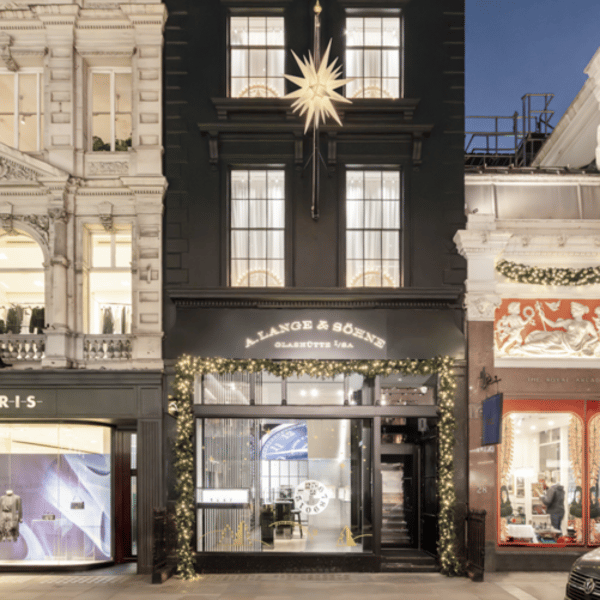
London’s Bond Street continues to be a must-be-there destination for global luxury brands and the latest to open there is A Lange & Söhne, with a new flagship boutique at the Mayfair end of the thoroughfare.
A Lange & Söhne
The street morphs from new Bond Street to Old Bond Street and the UK flagship for the luxury watchmaker is at number 29 on the latter.
The company said it’s strengthening its presence in the UK market via the four-storey space and that “whether spontaneously or by appointment, clients can receive expert and personalised advice when choosing their desired model amidst a relaxed atmosphere and luxurious ambience”.
To provide them with a comprehensive overview of the collection, a “representative selection” of timepieces is available, including boutique-exclusives and limited editions.
So what of the store itself? The key exterior colour of the historic façade is dark grey, which continues on the inside. On entering the ground floor, visitors get “an engaging introduction to the brand’s unique history and its six dedicated watch families”. This level also features a lounge, “seamlessly blending traditional London club aesthetics with a contemporary A Lange & Söhne environment, bathed in natural light from a sky window”.
A Lange & Söhne
On the ground floor, there are displays highlighting the “intricate artistry within each timepiece” and several hundred hand-finished movement components of a Zeitwerk, Lange’s award-winning mechanical digital watch, are displayed.
The first floor offers a more in-depth exploration with complicated movements on show. On the second floor is a bespoke lounge and a dedicated watchmaker is featured on the third floor “further enhancing the client experience with direct insights into Lange’s watchmaking craft”.
The company also has flagships in New York, Dubai, Shanghai, Singapore, Hong Kong, Tokyo, and Frankfurt, and CEO Wilhelm Schmid, said the new one is an important milestone in its global sales concept: “We are excited to be opening our new flagship boutique in such an incredible location. The club-style lounge is a friendly nod to the ever-growing community of A Lange & Söhne collectors in the United Kingdom. The opening of our new London premises is also a special moment for us because of our historical ties to the city, which played a decisive role in the brand’s international success in the mid-19th century.
Italian luxury sneakers brand Golden Goose is an acquisition target for Chinese investment fund HongShan, which is hoping to close the deal, worth €2.5 billion, before Christmas. The operation wouldn’t be HongShan’s first in the fashion sector.
In 2024, Golden Goose reported a revenue of €655 million – Golden Goose
HongShan was founded in 2005 by Neil Shen and Zhang Fan, as the Chinese investment arm of Sequoia Capital, and was known as Sequoia Capital China. It was an early investor in thriving Chinese tech giants like Alibaba, JD.com, Meituan, ByteDance and Pinduoduo, forging a reputation as a venture capital investor capable of identifying future market leaders and fast-tracking their growth.
Independence in 2024
Between 2023 and 2024, Sequoia Capital split up in three separate entities, and Sequoia Capital China was rebranded as HongShan (‘sequoia’ in Mandarin). In July 2024, HongShan embarked on a funding round that raised €2.15 billion ($2.5 billion). As well as becoming independent, HongShan expanded internationally, opening offices in London and, in 2025, in Tokyo, signalling that its strategy extends well beyond China’s borders.
HongShan became majority shareholder of Ami Paris in 2021, and is reportedly considering selling up soon – PP Group
Initially focused on early-stage venture capital investments, HongShan now operates across the entire funding spectrum, from seed capital to growth equity, private equity investment, and buyouts, in sectors like healthcare, consumer goods and public infrastructure. A diversification prompted by the aspiration to become a global player able to ink major international deals. As proof of its new dimension, in January 2025 HongShan acquired a majority stake in Anglo-Swedish audio equipment maker Marshall Group, valued at over $1 billion.
Track record in fashion
HongShan has moved beyond Asia and tech companies, investing also in fashion. Acquiring Golden Goose would be consistent with previous operations made by HongShan, even in its previous incarnation as part of Sequoia Capital. In 2021, it made fashion headlines by acquiring a majority stake in French label Ami Paris, which it then helped expand in China by staging runway shows and opening pop-up stores. Ami Paris is doing well, but HongShan is reportedly considering selling its stake soon.
HongShan bought a stake in Shein in 2018 – Reuters
HongShan also owns stakes in Amer Sports, lingerie brand Ubras, Urban Revivo, Halara, Miracle Miles (which owns footwear brands Dream Pairs, Bruno Marc, Norrtiv8 and Burudani), and also in Shein, the latter since 2018. The surprising elements in HongShan’s offer for Golden Goose are the brand’s valuation and the fact that its acquisition would mark HongShan’s entry into the luxury sector. HongShan’s portfolio currently includes over 1,500 names, among them 140 unicorns and 160 listed companies.
JW Anderson is running a Miami pop-up during the city’s Art Week in partnership with luxury retailer The Webster. It comes after the reinvention of the JW Anderson that now reflects Jonathan Anderson’s “utterly personal urge” to curate.
JW Anderson x The Webster
The ‘new’ JW Anderson is “centred on objects of elevated craftsmanship, curated fashion collections alongside homewares, artisanal goods and the very idea of collecting. A modern-day cabinet of curiosities”.
And this is what can be found at the JW Anderson x The Webster pop-up, which is open until 15 December at 1220 Collins Avenue Miami Fl, 33139. It’s a big deal for the brand given that it marks the first regional showcase of its “newly reimagined world”. It’s also a key moment in the label’s US expansion, “reintroducing the brand to an extended audience”.
So what can visitors find there? Pieces include knitwear “spun from the finest yarns, Japanese-crafted denim developed with expert makers, fold-over trousers inspired by archival designs, crafted in Donegal tweed and finest Locharron pure new wool tartan”.
These “elevated” versions of classic garments, “with a connection to local makers, sit alongside objects crafted in collaboration with artists and artisans”.
That means furniture, homewares and home textiles such as re-editions of Charles Rennie Mackintosh’s stools in Scottish oak, Jason Mosseri’s Hope Spring Chairs, Lucie Rie mugs, handmade Murano glassware, Welsh blankets, and ceramics by Akiko Hirai.
There are also hand-picked books and antique gardening tools, hand-forged nails, Houghton Hall Estate honey and coffee-flavoured tea from Postcard Teas, “extending the language of craftmanship. Heritage imagined through a contemporary lens”.
The pop-up concept was developed in collaboration with architects Sanchez Benton with the company saying the space “embodies the design language of the brand, a dialogue with the handmade and expertly crafted”.
EssilorLuxottica is betting big on smart eyewear and the gamble is about to be tested. Its Ray-Ban Meta glasses, powered by artificial intelligence, have delivered their first meaningful revenue boost this year, but analysts warn that privacy concerns and a wave of new rivals could limit their growth.
Ray-Ban Meta glasses – Ray-Ban
The frames, launched in 2021, promise to upend the smartphone era by letting wearers take photos and videos through tiny cameras in the lenses, stream content to Meta apps, and talk to an AI assistant. Yet the same features that promise to make the AI-powered frames- born from the collaboration between Mark Zuckerberg‘s Meta and French-Italian eyewear giant EssilorLuxottica- into a must-have device are sparking concerns, as bystanders have little control over being recorded or how their data is handled.
“AI smart glasses raise significant privacy concerns,” said Kleanthi Sardeli, a lawyer at European digital rights advocacy group NOYB. “The main issues are linked to the use of people’s personal data to train AI models and transparency for bystanders.”
Meta Platforms, which owns Facebook, Instagram, and WhatsApp and generates the bulk of its revenue from advertising, is leveraging user data to power artificial intelligence tools, a move that brought the company to face scrutiny over data practices.
European regulators have flagged risks since 2021, when Italy and Ireland asked Meta to clarify how it complied with local privacy laws. Ireland’s Data Protection Commission questioned whether a tiny LED indicator was enough to alert people they were being filmed, prompting Meta and EssilorLuxottica to enlarge the light and add a blinking pattern.
Privacy concerns are particularly strong in the European Union, where stricter regulations have slowed adoption of some AI features. AI-enabled wearables are regulated by the EU’s AI Act and the General Data Protection Regulation, or GDPR.
“Any recording of individuals must be clearly communicated and must have a legal basis to record individuals,” unless the data was processed for purely personal or household reasons, a European Commission spokesperson said. But enforcing those rights is difficult when the device owner is unknown, says NOYB.
A 2024 Monash University survey of more than 1,000 Australians found owners see smart glasses as boosting their self-image and social ties, while non-users fear privacy breaches and social disruption. EssilorLuxottica said it partners “with competent authorities to drive innovation, safeguard privacy and set new industry standards.” A Meta spokesperson declined to comment beyond referring to EssilorLuxottica’s statement.
Ray-Ban Meta glasses lead the AI eyewear market thanks to a partnership that bridges tech and fashion, analysts and experts say, a gap that doomed Google Glass a decade ago. According to Barclays, EssilorLuxottica currently holds a 60% share of the smart glasses market.
“Instead of trying to make something cool, Meta partnered with people who know what’s cool,” said Ross Gerber, CEO of California-based wealth management firm Gerber Kawasaki, which holds Meta shares. But its first-mover advantage may fade as rivals launch better products, said Bernstein analyst Luca Solca. Smart glasses could also cannibalise traditional eyewear, which accounts for about a quarter of EssilorLuxottica’s revenue.
Several tech giants aim to catch up. In November Alibaba released its new Quark AI-powered glasses in China, where Ray-Ban Meta are not sold. Apple is expected to unveil its own model next year and release it in 2027, Bloomberg News reported.
Google is working with Warby Parker and luxury fashion house Kering to develop its own version, announcing on Monday it expected to launch a first product in 2026, sending EssilorLuxottica shares lower. Amazon is also reportedly exploring the market and Xiaomi launched a similar product in June.
EssilorLuxottica, the world’s biggest eyewear maker, can lean on its 18,000-store network and brands such as Prada, Armani and Chanel. “One of the key differentiating elements for them is not just their ability to produce, but also their ability to distribute, and their ability to leverage a portfolio of brands,” said Bassel Choughari, Paris-based portfolio manager at Comgest, which holds EssilorLuxottica shares. “That is an element that shouldn’t be underestimated.”
EssilorLuxottica CEO Francesco Milleri, who took over as head of the company in 2020, is steering the group towards medical technology. Smart glasses, central to this strategy, contributed more than four percentage points to EssilorLuxottica’s nine-month sales growth, sparking a 14% market rally for the 140 billion euro company, even though they account for just 2% of global sales, investor CCLA estimates.
EssilorLuxottica is looking to build on this momentum. It has widened its portfolio to sports brand Oakley and held exploratory talks with Prada, heir to the luxury brand, Lorenzo Bertelli told Reuters. In September it introduced a model with an in-lens display, operated through a bracelet that converts hand gestures into commands.
Competition is welcome, the company says: “A vibrant ecosystem will help us drive market growth, fuel innovation and expand consumer choice.”