Connect with us

Politics

A guide to Thanksgiving travel after the government shutdown
Published

on


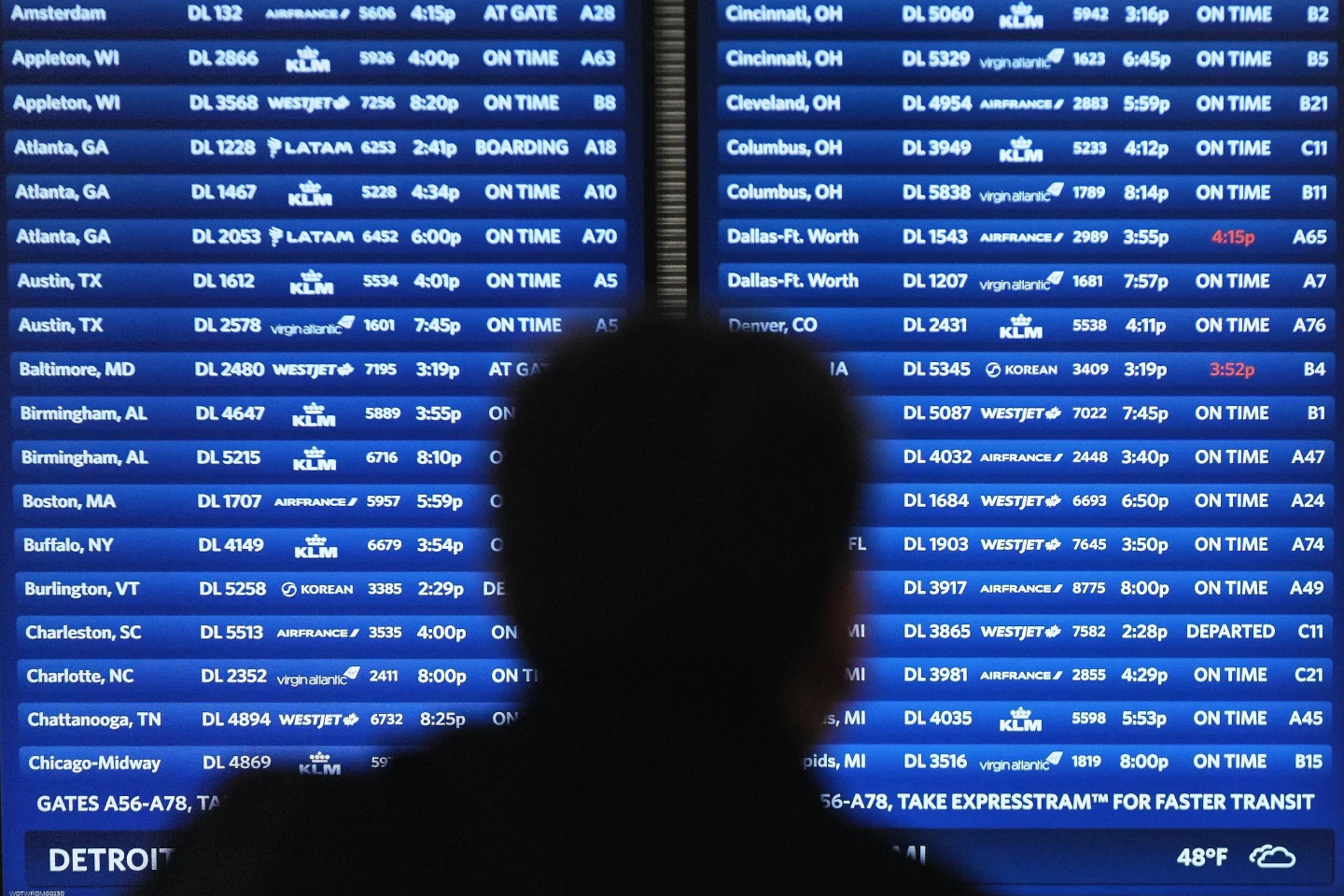
The turbulence caused by the longest U.S. government shutdown may still be fresh in travelers’ minds this Thanksgiving; experts say preparing for the usual holiday crush of winter weather, heavy traffic and crowded airports can help ease the jitters.

“I think the shutdown at this point is history for air travel. The airlines understand this time of year so well. They know exactly what they need to do,” said Sheldon H. Jacobson, an airport and airlines operations expert. “The real challenge is making sure travelers can help themselves.”

Here’s a guide to navigating the busiest travel week of the year:

How busy could it be?

Travel forecasts point to packed airports, roads and trains.

A week after lifting the unprecedented flight restrictions it placed on commercial airlines during the shutdown, the Federal Aviation Administration is preparing for its busiest Thanksgiving week in 15 years, with more than 360,000 flights scheduled between Monday and next Tuesday. That’s more than 17.8 million people who will be screened at airports, according to the Transportation Security Administration.

Transportation Secretary Sean Duffy said Monday at a news conference that air traffic controller staffing levels have stabilized in time for what he says will be the busiest Thanksgiving on record for travel. At the same time, the head of the FAA reassured passengers that they can “fly with confidence” this week.

AAA projects 1.3 million more travelers will be on the roads than last year, bringing the total to at least 73 million.

Winter weather

You can’t control the weather, but you can control how prepared you are if a storm hits. If your flight is canceled or delayed, will you drive instead, postpone your trip, or cancel it? Knowing your options ahead of time can reduce stress if a storm leaves you stranded.

The Weather Channel offers a Thanksgiving weekly forecast highlighting major airports and highways that could be affected by bad weather — including snow, ice and rain — along with a free online tool in the Weather Channel app that shows whether your travel route might be impacted.

Forecasters on Monday warned of flooding rain and the possibility of severe thunderstorms from Texas to Arkansas and Louisiana into Mississippi, which could affect airports in the Dallas-Fort Worth area and Houston.

By Monday afternoon, over 750 flights into and out of Dallas-Fort Worth International Airport were delayed and about 100 canceled, while at Love Field, more than 100 flights were delayed and nearly 70 canceled, according to the flight-tracking website FlightAware.

On Tuesday, the FAA’s busiest day with more than 52,000 flights scheduled, forecasters say rain is expected in the Pacific Northwest and in much of the eastern U.S. Airports in Atlanta, Chicago, New York, Philadelphia, Seattle and Washington, D.C. could be impacted, according to the Weather Channel.

Another winter storm in the central U.S. could also take shape late Friday into Saturday.

“The details will come into better focus over the next few days, but anyone traveling home after Thanksgiving should check in on the evolving forecast and be ready for changing conditions,” said Matt Sitkowski, science editor-in-chief at the Weather Channel.

What to pack (and what to skip)

Jacobson, whose research contributed to the design of TSA PreCheck, recommends starting your packing by unpacking.

Check every pocket in case TSA-restricted items, like full-sized bottles, were left behind from a previous trip. This simple scan can help you get through security faster, especially when airports are crowded.

If you’re traveling with gifts, Jacobson suggests wrapping them at your destination because TSA agents may need to open them.

When deciding which clothes and shoes to pack, James Belanger, vice president of meteorology at the Weather Company, said to check the “feels like” temperature for a better sense of the weather, especially for those not used to the cold.

And don’t forget a REAL ID is required to fly within the U.S., or bring another accepted form of ID, like a passport or military ID.

People with iPhones can now also add their U.S. passport details to Apple Wallet, which can be scanned at participating airports if travelers don’t have a REAL ID. More than a dozen states already accept some form of mobile ID at airport checkpoints, and travelers can visit the TSA website for more details.

Road trip ready

Whether driving is your top choice or backup plan, AAA spokesperson Aixa Diaz suggests checking your tires, car battery and fluids, then hitting the road with a full tank of gas as early as possible to avoid traffic. Last year, AAA said, it responded to nearly 600,000 emergency roadside assistance calls during the Thanksgiving travel period to help drivers stranded by dead batteries, flat tires and empty tanks.

According to an analysis by Google Maps:

— Traffic on Wednesday is expected to be 14% heavier than usual between 10 a.m. and 4 p.m., with peak traffic from 1 p.m. to 3 p.m.

— On Thanksgiving Day, the roads will be busiest between noon and 3 p.m.

— When it’s time to head home, avoid driving from 12 to 3 p.m. on Saturday and Sunday, when traffic is heaviest.

The best passenger

“…is an informed passenger,” Jacobson likes to say.

Download your airline’s app to track your flight status, and check it regularly as your travel date approaches. That way, if your flight is canceled the day before, you can quickly look for alternatives.

Driving or flying, leave earlier than you think you need to. Knowing you won’t have to rush to your destination can help calm any nerves, whether it’s lingering anxiety from the shutdown or because you’re traveling with young kids or someone who needs extra help getting around.

“These are some very simple things to think about, but they’re important things to think about,” Jacobson said.

___

Rio Yamat reports via The Associated Press; republished with permission.


Source link

Continue Reading

Politics

Senate advances Jason Pizzo bill extending PTSD workers’ comp coverage to 911 dispatchers

Published

on


Legislation that would narrowly recategorize 911 dispatchers as first responders so they can receive workers’ compensation for work-related psychological injuries is one step closer to passing in the Legislature’s upper chamber.

Members of the Government Oversight and Accountability Committee voted unanimously to advance the bill (SB 774), which would eliminate a barrier that today denies aid to people who are often the first to respond to a crime.

The measure’s sponsor, Hollywood Sen. Jason Pizzo, noted that during his time as a prosecutor, playing a 911 call would often be the most effective thing to do to sway a jury.

“911, what’s your emergency? He’s going to kill me! He’s going to kill me! Now, imagine hearing that 12 times a day, 15 times a day,” he said.

“Two years ago, you all voted to require these 911 operators to be proficient in CPR so they could administer (it) over the phone. And they’re not considered first responders? They are first responders, and they’ve been grossly overlooked and screwed, and this brings some remedy.”

SB 774 would add 911 dispatchers to the group of “first responders” covered by Florida’s special workers’-compensation rules for employment-related mental or nervous injuries. It would apply the same framework to them as other first responders for mental health claims.

Essentially, if you’re a 911 dispatcher and develop post-traumatic stress disorder, anxiety or similar mental health injuries from traumatic calls, SB 774 would make it so you can get workers’ comp-covered treatment and that your claim is handled under the same special rules lawmakers already set for other first responders — without certain time-limit restrictions that typically apply to mental injury benefits.

Several dispatchers signaled or spoke in favor of the bill, as did representatives from the Florida Police Chiefs Association, Florida Sheriffs Association and Consolidated Dispatch Agency.

Jennifer Dana, a dispatcher with the Palm Beach Sheriff’s Office, noted that in a Senate analysis of SB 774, there’s a list of disturbing things first responders see and do on the job, from seeing dead children and witnessing murders to helping severely injured people, including those who commit suicide.

What it doesn’t include, she said, is that 911 dispatchers also witness those things.

“We’re seeing and hearing it,” she said. “We have the technology for people to livestream it now, so it’s a double-whammy for us, and we want to make sure we have the protections.”

Kim Powell, a licensed and clinical mental health counselor who oversees an employee behavioral health program at a 911 communications center in Leon County, detailed several examples of what dispatchers experience: a woman struggling to breathe while dying from a gunshot wound inflicted by her child’s father; an officer’s final words moments before his murder; the sound of a mother discovering her deceased infant; the 800 or so calls received in the wake of the Florida State University shooting last April.

“These are not isolated events; they are part of the job,” she said. “The trauma compounds over time with repeat exposure.”

St. Petersburg Republican Sen. Nick DiCeglie thanked Pizzo for carrying the bill and expressed gratitude to the “3,500 dispatchers” across Florida for their work.

“For me personally, (this) could be one of the most important bills that we have this Session because of the importance there is for your well-being and your quality of life,” he said.

Melbourne Republican Sen. Debbie Mayfield, who chairs the committee, echoed DiCeglie’s remarks.

Pizzo reminded the panel that four years ago, during COVID, a $280 million set-aside for payments to first responders and front-line workers did not extend to 911 dispatchers.

“They never stopped working,” he said, adding that Mayfield at the time acknowledged the oversight and pledged that the Legislature would get it right in the future. “So, it’s serendipitous that you were kind and gracious enough to put us on the agenda.”

SB 774 will next go to the Senate Appropriations Committee on Agriculture, Environment and General Government, after which it has one more stop before reaching a floor vote.

An identical bill (HB 451) by Republican Rep. Jeff Holcomb of Spring Hill awaits its first hearing in the House.


Source link

Continue Reading

Politics

Hillsborough College Trustees OK first step in Tampa Bay Rays stadium talks

Published

on


The Tampa Bay Rays’ search for a new home took a tangible step forward as the Hillsborough College Board of Trustees approved a nonbinding agreement that could ultimately shift the franchise away from St. Petersburg under its new ownership.

The Board voted to approve a memorandum of understanding (MOU) authorizing staff to negotiate with the Tampa Bay Rays over a potential stadium and mixed-use redevelopment at the college’s Dale Mabry Campus.

The agreement does not commit the college to the project and can be terminated by the Board at any time. Instead, it outlines key terms the parties would like to see in any future binding agreements, which would require separate Board approval at a later public meeting.

College officials characterized the MOU as the beginning of negotiations. Under the document, staff would begin drafting potential project agreements for Trustees to consider in the future, with an anticipated negotiation timeline of up to 180 days.

Rays CEO Ken Babby addressed Trustees during the meeting, calling the proposal an early milestone. He emphasized that the effort involves the college, the team, the state and local governments. Babby said the Rays are exploring a roughly 130-acre redevelopment anchored by a new stadium and an integrated college campus, alongside residential, commercial and entertainment uses. 

“As we envision this development, together in cooperation and partnership with the community and the college, we’ve been calling the campus portion of this work ‘Innovation Edge’ featuring Hillsborough College,” Babby said.

“It’ll be neighbored by, of course, what we envision to be ‘Champions Corridor,’ which we hope will be the mentioned home of the Tampa Bay Rays. Of course, this will be a mixed-use with residential, with commercial, and, as we’ve said, billions of dollars of economic impact to the region. … This is an incredible moment for our community.”

Public input was split. Supporters recognized the economic impact the project could have, while critics worried about the effect on housing affordability, in particular for college students.

Following the vote, Trustees acknowledged uncertainty among students, faculty and staff, particularly those based at the Dale Mabry campus, but stressed that the approval did not determine final outcomes.

“This is a major decision, and I truly hope that it leads Hillsborough College towards growth and advancement,” Student Trustee Nicolas Castellanos said. 

Trustee Michael Garcia echoed the sentiment.

“It’s a tremendous day for the future of Hillsborough College and for the future of Major League Baseball in the area and also for the future of the city of Tampa,” Garcia said.

Gov. Ron DeSantis publicly expressed support for the concept ahead of Tuesday’s meeting, saying it could benefit both the college and the region, while cautioning that details still need to be resolved.

“It could be very good for HCC, and I’ve met with the President about it. I think he’s excited about the possibility,” DeSantis said in Pinellas Park.

“Obviously, they’ve got to iron out details. But basically, we’re supportive of them pursuing that partnership because I think it could be good for them. I think it could be good for the state. But I definitely think it could be really good for this region.”

Also ahead of Tuesday’s meeting, Tampa Mayor Jane Castor told Florida Politics the city and Hillsborough County have been in ongoing discussions with the Tampa Bay Rays as the team explores long-term stadium options — including the potential Hillsborough College site. She emphasized that any future stadium proposal would require coordination among multiple governments and would be evaluated alongside existing contractual obligations related to other major sports facilities.

No timeline for construction, campus relocation or final land disposition was discussed Tuesday. College officials emphasized that any binding agreements would return to the Board of Trustees for approval at a future public meeting.

___

A.G. Gancarski and Janelle Irwin Taylor of Florida Politics contributed to this report.


Source link

Continue Reading

Politics

House panel approves bill to expand James Uthmeier’s power to target physicians

Published

on


A House subcommittee approved a bill to give Attorney General James Uthmeier expanded power to investigate health care professionals for taking care of transgender youth.

The Criminal Justice Subcommittee passed HB 743 with a 12-5 vote as Democrats and LGBTQ+ advocates rallied against it.

Under the bill, Uthmeier would be allowed to investigate and sue health care practitioners who give puberty blockers, hormones or other prescriptions to minors, or perform surgical procedures. Each violation could bring up to a $100,000 fine.

Uthmeier’s amplified authority would come after the state previously banned gender-affirming care for minors in 2023.

But Rep. Kelly Skidmore warned lawmakers that it was dangerous to give Uthmeier more power following the Hope Florida scandal.

“No disrespect to the folks who are here about gender-affirming care, but that’s not what this bill is about,” the Boca Raton Democrat said. “It is about giving one individual and maybe his successors authority that they don’t deserve and they cannot manage. They’ve proven that they cannot be trusted. This is a terrible bill.”

Uthmeier, then Gov. Ron DeSantis’ Chief of Staff, chaired a political committee that was funneled millions of dollars from a $10 million state Medicaid settlement. Critics have accused DeSantis and Uthmeier of misappropriating the money to use for political purposes. Uthmeier has denied wrongdoing.

But at Tuesday’s hearing, Rep. Taylor Yarkowsky argued Uthmeier is doing “unprecedented work” to protect kids. The lawmaker added that he is against minors transitioning until they are 18 years old and can legally decide for themselves.

“I understand this is a tough situation and I know that these feelings and emotions are real,” the Montverde Republican said. “But we have to uphold the principles and standards that made this country great, biblical, constitutional law and order at all costs. And sometimes that stings.”

HB 743 would also update the law to add that a health care practitioner who “aids or abets another health care practitioner” giving gender-affirming prescriptions or doing procedures to minors would now be charged with a third-degree felony. That could mean pharmacists filling prescriptions at Publix or Walgreens could potentially be charged for crimes, said Rep. Lauren Melo, the bill sponsor.

Melo said her bill comes as some minors are trying to skirt state law.

“What we’re seeing is there’s coding that’s actually being used that is becoming the problem, and hundreds of thousands of dollars is spent per child for them to transition and codes are being misrepresented where they are saying that it’s an indoctrination disorder instead of saying it’s a gender identity disorder,” Melo said.

Minors who have been receiving gender-affirming care continuously since May 2023 are exempt from state law, so the bill’s changes would only be applied to minors receiving care for the first time, the Naples Republican added.

Rep. Mike Gottlieb, who also believed the bill was giving Uthmeier too much power, said it could have other unintended consequences. The bill could scare doctors from prescribing medicine that helps women with bad menstruation symptoms — which has nothing to do with gender-affirming care, he said.

“You’re going to see doctors not wanting to prescribe those kinds of medications because they’re now subject to a $100,000 penalty,” the Davie Democrat said. “We really need to be cautious. I get where many of us sit in this battle. … We pass some of these laws, it’s a knee-jerk reaction. … We’re really not considering what we’re doing and some of the collateral harms that it’s having.”

He said he worried the bill would force more physicians to leave Florida.

But Melo argued her legislation was important because “unfortunately, what’s happening is there are physicians that are actually committing fraud.”

“This gives us an avenue to pursue and punish the people that are committing fraud against a minor child,” she said.

Shawna Flager, a mom advocating for her child who is transgender, criticized the bill during Tuesday’s debate.

“I feel like it introduces ambiguity. It also uses the government to create fear and intimidate our health care providers,” said Flager, of St. Augustine.


Source link

Continue Reading

Trending

Copyright © Miami Select.