
Politics
A grouper-sandwich town like St. Pete shouldn’t chase Michelin stars
In the summer of 2022, my family was in London for Queen Elizabeth’s Platinum Jubilee. I caught COVID on the back end of the trip, and the rules then required ten clear days before I could fly — so my family went home on schedule and I didn’t (I know, ten days alone in the Mayfair section of London; life can be hard).
Sick for a day, maybe a day and a half. Then I had the city to myself, and a London that, unlike the America at that time, had decided to get on with living. I walked everywhere. It was the front end of the health kick I’m still on four years later. And nearly every day, I wound up at Claude Bosi’s Bibendum — the bar, the oyster bar, the café, the dining room, whichever would have me.
On my first trip, I had to ask the maître d’ why the place leaned so hard into the Michelin thing — the Michelin Man in the stained glass, on the posters, pressed into the butter. He explained that the building was Michelin’s old London headquarters, an Art Nouveau pile on Fulham Road that opened in 1911, its three stained-glass windows built around the Michelin Man and the Latin toast Nunc Est Bibendum — “now is the time to drink.” That Bibendum is simply the Michelin Man’s name in French.
I was, despite a father who cooked for a living, gloriously ignorant of how this system works — a guide that started in 1900 as a tire company’s scheme to get Frenchmen driving more, and wearing out their tires faster. (Bosi has since closed Bibendum; I caught his new room, the two-starred Brooklands, over New Year’s.)
I admit the bias up front because I’ve since become a star chaser myself. I’m trying to dine my way to 100 Michelin stars this year. Half the year gone, I’m somewhere north of 30. I’ll need to pick up the pace.

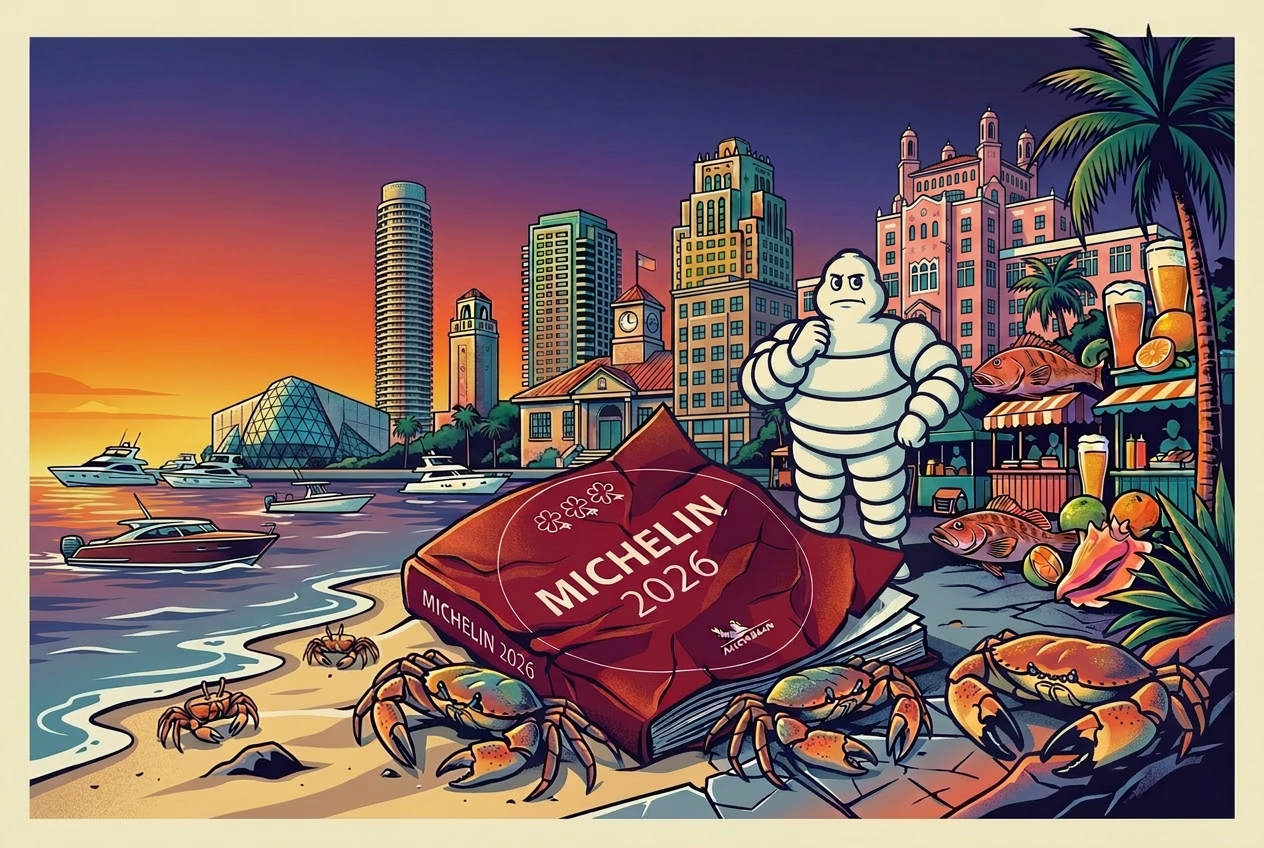
Michelin recently unveiled its first statewide Florida selections — Miami leading with 18 stars and the Panhandle finally on the board. Tampa didn’t gain a star and lost one, Lilac at the EDITION, sliding from five to four. Visit St. Pete-Clearwater had paid $180,000 over two years of hotel-tax money just to be eligible — on top of the roughly $1.5 millionthe state’s tourism boards spent to bring the guide here in the first place. And as one writer put it, you can pay Michelin to visit your town, but not to hand you stars.
The hometown news was familiar: for the second year running, not one Pinellas County restaurant — St. Pete to Tarpon Springs — earned a star, as the Tampa Bay Times’ Helen Freund reported.
Here’s the part my fellow boosters won’t want to hear: I don’t disagree with the verdict. There is no St. Pete restaurant that has earned a Michelin star. Service here doesn’t hold a candle to New York, New Orleans, or San Francisco, and consistency between visits — the same dish, the same way, on a Tuesday in August — is the whole ballgame in Michelin’s math.
We are a transient state with a transient workforce, grading out worst on the one thing the inspector cares about most.
Twenty-odd years ago, Chris Ponte’s Café Ponte in Clearwater ran the kind of room that could’ve earned a look — the mushroom bisque alone was worth the drive across the bay — but Ponte was the exception that proved the rule.

This is a land of grouper sandwiches, stone crabs, and waterfront seafood done right, of fast-casual and the early-bird two-for-one. Nobody sits down to a tasting menu at 5:30 p.m. on a 95-degree afternoon.
The one genre that does translate is omakase, which is exactly why Kōsen and Koya hold their stars — and even the best omakase in Pinellas, Sushi Sho Rexley, will tell you it lacks the Tampa polish.
But chasing the rating can also wreck a kitchen. Look no further than Ebbe, where a chef who won a star inside a year is now rarely in the building while his staff walks out and the Times documents the wreckage. Even losing one hurts: when Lilac fell off, Visit Tampa Bay’s Santiago Corrada told the Times, “You never want to see any of your friends go through that.” And Il Ritorno’s David Benstock — the consensus front-runner, who got nothing — put it best to the Times: “This doesn’t define us.”
He’s right. It doesn’t.
And maybe that’s what I keep missing while I sulk over Pinellas. Here’s where Visit Florida earns real credit, and where I’ll gladly eat my disappointment. The statewide deal has not bestowed a star in St. Pete — but it dragged anonymous inspectors, and their French expense accounts, into corners of this state that would otherwise never get a serious look. That’s what the money actually bought: not another laurel for Miami, which never needed the help, but a first-ever glance at towns that had never been in this conversation at all.
In Orlando, the restaurant I think is the best in the state — Capa, sitting atop the Four Seasons, overlooking all four of Disney’s parks, with the most exciting view of any restaurant in Florida — lost its star this year, a call I can’t begin to make sense of. Knife & Spoon at the Ritz-Carlton Orlando, Grande Lakes lost its star a couple of years back, and at the time I understood why: the service was sporadic, and the offerings didn’t match the family-resort, albeit high-end, market. For what it’s worth, having dined at K&S several times over the last year, I genuinely believe it has earned the star back, with some of the best dishes I had all year and a much-improved service level. And if the inspectors do head back to the Ritz, may I suggest they visit my favorite restaurant in the state, Highball & Harvest — which, because it must feed the hotel’s large audience, may not serve the absolute highest-end ingredients, but its fancied-up Southern food is always delicious, its brunch is wonderfully indulgent (I had the much-in-vogue fried chicken with caviar recently), and it’s run by an always-on-point, welcoming staff.
In Jacksonville, an inspector wrote up The Bearded Pig, a San Marco barbecue joint, and Rue Saint-Marc, a French room whose chef called the nod a win not just for his restaurant but for the whole city. Over at Amelia Island, Salt, one of our family’s favorite restaurants, deservedly took the statewide Service Award. In St. Augustine, Bar Citra and Sundaylanded Bib Gourmands out of the gate — the kind of recognition, the Bar Citra owner said, that tells a small staff somebody finally sees what they’re building. Tallahassee got Black Radish and The Huntsman, which so many of my friends in The Process speak highly of; Pensacola, a sandwich counter called A Mano Panino working off house-made schiacciata.
None of these places had ever registered with Michelin. Now, for the first time ever, a cook in the Panhandle can hang a cherry-red plaque on a one-way street and watch the book fill up.
That is worth every dollar of somebody’s hotel-tax money — the one check in this whole arrangement I’m glad got written.
Some of what I miss is just memory. I can still summon the glory days of the Maritana Grille at the Don CeSar, before that grand room got stripped down to something more resort-casual. There was a time when some of us thought Rococoand its vaunted wine list — a perennial Wine Spectator Best of Award of Excellence — might be the St. Pete name that finally popped nationally. Worthy, sure. Of course the region’s real wine landmark still sits across the bay: Bern’s, a Grand Award winner since 1981, playing a different sport entirely.
(Of all the restaurants in Tampa Bay, it’s Bern’s, with that wine list and dessert room, that most lives up to the Michelin definition of “worth a stop” — and I say that as someone who really doesn’t like the food there.)
So forgive me if I can’t summon much hope at home. The rooms that get close don’t last here. Café Ponte ran 18 years before COVID and a lease fight finished it. Baba and Barbouni — seven years in the Grand Central District, exactly the kind of ambitious, well-run operation you’d build a guide around — serve their last plates July 3. Il Ritorno is a very good restaurant, maybe the best in downtown, but I don’t think it would stand out if it were in a bigger city.
Lorene’s Fish House closed this month after 32 years. Red Mesa Cantina, after 16.
I ate at Mei, the new Nordic-Japanese room downtown with real pedigree out of Kōsen, on a soft-opening night last week — flavors that could stop you cold, a kitchen still finding its feet — and I’ll pull for it exactly the way I pulled for all the others, while bracing for the night the lights go dark.
Chasing a Michelin star in a town built for grouper sandwiches and sunsets isn’t ambition. It’s a fool’s errand.
—
Ed. note: This story was drafted with assistance from AI. Editorial judgment, sourcing, and final review were performed by Peter Schorsch and the Florida Politics editorial team.