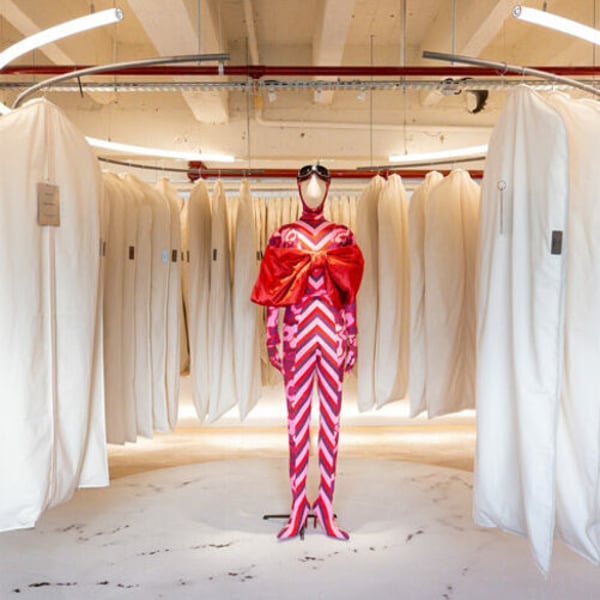
Head up to the very top of Galeries Lafayette Haussmann to discover its treasure: its archives! Dating from 1894 to the present day, they have shaped the identity of the Galeries Lafayette group throughout its history. The youngest of the Parisian department stores, now present in many international cities, remains rooted in the French capital, where it has become both a museum custodian and an active cultural player.
The archives include a large number of administrative documents – Samuel Gut
This is the work of Cécile Larrigaldie, the group’s director of cultural engagement. She works across three pillars: archives, alongside Bastien Salva; patronage, with Mathilde Gleyo; and artistic initiatives, supported by Pauline Toulouzou. With a background in contemporary art, she describes a “somewhat fortuitous” yet successful encounter with the world of archives. While working on the Galeries Lafayette Foundation project alongside François Quintin and Guillaume Houzé in 2013, she took the helm of the newly created Artistic Actions department, which later expanded to include patronage and heritage.
A 1920s dress and an imaginary museum…
The historical collection is extensive and comprises various elements: 350 items of furniture (period counters, cash registers, racks, hangers, objects linked to in-house craftsmanship such as vases…) and around 150 fashion and ready-to-wear pieces (from 1900 to the present day), housed on the store’s ninth floor. On a visit, guests might discover, for example, a dress from the 1920s, carefully preserved and accompanied by a photo from the wedding at which it was worn.
Scale model of the department store on display in an archive room – Samuel Gut
At the same time, the collection includes hundreds of linear metres of paper archives: minutes of Galeries Lafayette’s first board meetings, company filings, legal reports, sales records, employee-related documents spanning key historical periods, as well as Galeries Lafayette’s architectural projects, whether or not they were realised (Cécile Larrigaldie speaks of an imaginary museum), catalogues… “Employees very often got into the habit of keeping them. As a result, we have the first Galeries Lafayette catalogue, dated 1926,” she points out.
A “notion of transmission” within the company
The Haussmann store houses all the ready-to-wear archives, as well as three quarters of the paper collections. As for the objects and furniture department, the store only accommodates the most fragile pieces, kept under controlled humidity and constant temperatures. The larger pieces, such as the counters or the Majorelle staircase, are stored in a warehouse in the Île-de-France region.
Archives cover the period from 1894 to the present day – Samuel Gut
This archiving effort is recent: it began in 2008, when Guillaume Houzé created the Heritage Department. There was already a “notion of transmission” within the department store, which had welcomed several generations of employees, according to Cécile Larrigaldie. “At each farewell gathering, employees archived their entire careers and gave them to us,” she explains.
Inventory and cataloguing
Faced with the influx of archives, the group decided in 2010 to adopt a rigorous policy, keeping only items that could be preserved and used. A selection had to be made from the existing collection, because “not all of them met inventory standards,” explains the director of cultural engagement.
Galeries Lafayette produced a large number of catalogues in the last century, which are now considered important archives – Samuel Gut
From 2008 to 2020, Galeries Lafayette focused on setting up an inventory and cataloguing process. As part of this ongoing effort, the group acquires items through donations from employees and customers, and buys them from private individuals or at auction. In the coming months, Cécile Larrigaldie and Bastien Salva will take part in a sale of pieces created by Ghislaine de Polignac, Galeries Lafayette’s long-serving artistic director.
Creating the archives of tomorrow
“The principle is to acquire pieces that are missing and that allow us to illustrate a whole part of history that we haven’t been able to cover,” emphasises the director. A strategy has been put in place to avoid unnecessary acquisitions, particularly for the ready-to-wear collection: the team relies on Galeries Lafayette’s historical catalogues and tries to find the pieces illustrated in them, using a “mise en abyme” approach.
Galeries Lafayette cultural programmes such as Savoir Faire Savoir bring archives and artists into dialogue – Samuel Gut
And, “from 2020 to the present day, now that we’ve got the first steps of the staircase clean and stable, we’ve added another very important mission: creating the archives of tomorrow, by showcasing the collection,” explains Cécile Larrigaldie. This new phase mainly involves lending pieces. Last year, 500 were lent to the Musée des Arts Décoratifs, with nearly 300 objects and documents (postcards, promotional items, garment components), and to the Cité de l’Architecture, including a section of the handrail from the Majorelle staircase.
Galeries Lafayette, a “status at the scale of society”
With the archive rooms almost emptied during exhibitions, Cécile Larrigaldie and Bastien Salva realised that this is no mere collection of a private company. “When our national museums tackle the subject of the decorative arts, the construction of Paris, or Baron Haussmann’s breakthroughs in Paris, the department store comes up straight away,” says the director of cultural engagement. “It has a status at the scale of the city, at the scale of society, and bears witness to the evolution of consumption.”
Contemporary pieces are added to the collection – Samuel Gut
This is the idea on which the director guides her teams: “I want you to have in mind the loans we’ll be making in 2100 for the Musée des Arts Décoratifs,” she repeats. “It can’t be exclusively pieces from the 1970s.” And for good reason, she has already included current pieces in the collection: a chair by Benoît Maire, a multi-socket power strip by Marion Verboom in enamelled lava stone, and a coat hook by Pascale Marthine Tayou in turned and lacquered wood- objects at the crossroads of art and everyday life made as part of Galeries Lafayette’s Savoir Faire Savoir programme. “They testify to the company’s links with the creators of its time and to the principle of commissioning, which is inherent in the department store, since the first commission was placed by Théophile Bader with Jacques Gruber for the dome,” adds Cécile Larrigaldie.
1939–45: the scarred period
Witness to the history of France since being founded in 1893, Galeries Lafayette’s archives remain disparate from one era to the next. The large number of catalogues from the early 20th century contrasts with those of today, which are less frequent and slimmer. Archiving also depends on periods of crisis. For example, there is a serious lack of items from the Second World War period, due to their destruction. This shortfall is not unique to Galeries Lafayette, and the department store exchanges extensively with its counterparts (Samaritaine, BHV, Bon Marché, Printemps).
The collection does, however, include posters from the First World War – Samuel Gut
“There’s a lot of work involved in understanding and deciphering this period. We often ask each other whether we can find archives that were destined for us,” explains the director of cultural engagement. “Of course, the national archives also enable us to broaden the scope, as do municipal archives and warehouse archives.” For this period, then, it is less a hunt for surviving documents than an effort to reconstruct context and knowledge about the era.
A picture of French history
It’s worth noting that, in the post-war period, many objects were not suited to collecting. Furniture was inflatable, collapsible… People needed that; they needed lightness; they went on holiday, they went camping,” notes Larrigaldie. “In store, there were inflatable display stands. These are typically objects we don’t collect because they degrade quickly in everyday use. It’s an evolution in consumer trends and products. Everything is much more functional and rational.”
Historically, Galeries Lafayette has kept very few ready-to-wear items – Samuel Gut
Slowly but surely, Galeries Lafayette’s immense archiving work is making it possible to take in the department store’s full historical panorama. Through its collection of posters, suits, and administrative documents, the department store reveals itself as an active player, rather than a mere witness, in the history of commerce in France.
This article is an automatic translation. Click here to read the original article.
“It is with great pleasure that we announce Micaela Oliveira, the celebrated Portuguese designer, as one of the featured couturières at the Saudi Arabia Creative Women Forum 2025 Gala Dinner and Awards Ceremony,” the organisation declared on its social media channels, in a post also shared on the designer’s Instagram account, announcing the tribute at the event held on November 6 at the National Museum in Riyadh. The evening opened with an address by Princess Noura bint Saud bin Naif bin Abdulaziz Al Saud, patron of the Forum and founder of Saudi Fashion Week, followed by a runway show by the Portuguese designer, celebrating the rich traditions of this enchanted kingdom.
Lux
The publication further notes that the Trofa-born couturière “grew up surrounded by fabrics, prints, and creativity- a world that has shaped her lifelong devotion to fashion,” and that over the past 20 years she has “built an extraordinary career defined by elegance, daring, and refinement, consolidating her name among the leading designers of wedding dresses and haute couture,” the statement continues.
“Her creations- a harmonious blend of sophistication, sensuality, and femininity- embody her belief that each dress should tell a story, evoke emotion, and reflect the unique essence of the woman who wears it,” reads the message shared simultaneously on the Forum and the eponymous designer’s Instagram accounts.
“Guided by the values of exuberance, creativity, and impeccable craftsmanship, Micaela’s creations blend classic beauty with contemporary art, achieving a timeless charm,” the post adds, highlighting “a vision that transcends borders” that “continues to enchant the global fashion world, transforming dreams into haute couture masterpieces that celebrate individuality and the eternal elegance of femininity.”
Lux
For her part, Micaela Oliveira expressed her gratitude for the honour at the Saudi Arabia Creative Women Forum 2025 Gala Dinner and Awards Ceremony, which took place in Riyadh, the capital and principal financial centre of Saudi Arabia: “It was a privilege, as a designer, to travel to the Kingdom of Saudi Arabia, where I was honoured before members of international royalty and government representatives at a truly magnificent awards ceremony,” she said in a statement quoted by Lux.
“This prestigious award was presented to me by Her Royal Highness Princess Noura bint Saud bin Nayef bin Abdulaziz Al Saud, a pioneering woman and a leading figure in the Kingdom’s artistic community. I had the great honour of presenting a fashion show celebrating the rich traditions of this remarkable country during the Creative Women Forum 2025 Gala Dinner and Awards Ceremony.”
Instagram
“We are delighted to announce the return of the Creative Women Forum in Riyadh, which will take place from November 4–6, 2025, under the esteemed patronage of Her Royal Highness Princess Noura bint Saud bin Nayef Al Saud,” announced Creative Women Platform on Instagram. “This year’s forum will be held at the iconic Princess Nourah bint Abdulrahman University- the largest women’s university in the world.”
“A powerful stage for a global gathering of visionary women,” it continues. “Join us for three transformative days filled with innovative leadership, inspiration, and ground-breaking ideas, as we explore creativity, entrepreneurship, sustainability, and the future of women in leadership.”
This time, the experience culminated in a fabulous gala dinner and awards ceremony, “celebrating the brilliance of the women who shape our world,” concludes Creative Women Platform, on its social media.
This article is an automatic translation. Click here to read the original article.
British footwear brand Clarks is celebrating its 200th anniversary this year. In Italy, the brand is marking the bicentennial by opening a pop-up space within the Candiani Denim Store, in piazza Mentana 3 in Milan, where customers are able to personalise their Clarks shoes throughout December.
Clarks shoes can be personalised at the Candiani Denim Store in Milan – Clarks
From December 2 to 9, the Milanese store by Candiani, a premium Italian denim producer with its own jeans line, is hosting a Clarks pop-up shop. Visitors will have the opportunity to explore the British footwear brand’s history, its signature models, and learn about some of the leading figures who have worn Clarks and helped define its identity, influencing generations. A documentary about Clarks’s 200 years in business, entitled From Somerset to the World, will be screened inside the pop-up shop. The shop will showcase a selection of Clarks Originals models, including the Wallabee, Desert Boot and Desert Trek, as well as several items from the Fall/Winter 2025-26 collection, reinterpreting materials, shapes and colours with a contemporary feel.
In parallel with the pop-up shop (where a special event was staged on Thursday December 4), throughout December the Candiani Denim Store is giving Clarks customers the chance to create a personalised version of their shoes, choosing from two Clarks Originals models, the Wallabee and the Desert Boot. The limited-edition shoes will feature a personalised denim fob, and customers will be able to choose from an extensive library of patterns and designs. The motif chosen will be lasered directly on to the shoes at Candiani Custom, the denim brand’s urban micro-factory for bespoke jeans located next to the store.
FashionNetwork.com has had the opportunity to talk about Clarks’s distribution plans in Italy with Fabio Antonini, CEO of 3A, the company that has been distributing the British brand’s men’s and women’s lines since the Fall/Winter 2025-26 season.
FashionNetwork.com: Clarks has been busy overhauling its retail presence in Italy. What are the implementation steps, and what have the initial results been?
Fabio Antonini: Unlike the previous distributor, whose strategy was chiefly aimed at monobrand stores, we have rejigged Clarks’s distribution model by focusing on the wholesale channel and on a strong presence in multibrand stores. This is enabling us to rapidly extend our territorial footprint, making the brand more accessible and better integrated within the Italian market.
Fabio Antonini, CEO of 3A
FN: How many more Clarks corners are you planning to open in 2026 in Italy? And what about Clarks’s monobrand presence? Are you considering other initiatives like the one with Candiani?
FA: We currently don’t have any plans for new corners or monobrand stores. Our strategy is focused on the wholesale channel and multibrand retailers. The initiative with Candiani was developed as a special project to celebrate Clarks’s 200th anniversary. Over the next few years, we will assess new collaborations and special projects, in line with the brand’s future requirements. FN: In how many multibrand stores is Clarks currently distributed, and how many more are you planning to reach?
FA: In 2025, we have made Clarks available at 433 clients for a total of 619 doors [in Italy]. Next year, we’re expecting to grow the number of clients served by approximately 10%. FN: Clarks recently announced and deployed a strategy designed to boost its position in global e-marketplaces, is it also being implemented in Italy?
FA: Clarks’s new global strategy is set to make the brand even more accessible and reachable by online consumers. Its expanded presence on new global marketplaces is making Clarks easier to access in Italy too, strengthening its online presence and making it easier for consumers to buy. FN: What revenue result did 3A reach in fiscal 2024, how much did it grow by, and what is your forecast for 2025?
FA: In 2024, 3A generated a revenue of approximately €110.3 million, up 4.84% over the €105.2 million recorded in 2023. We’re expecting to grow at a similar rate in 2025.
Clarks
FN: Have there been new entries or other changes within 3A’s brand portfolio?
FA: Yes, there have been changes. Our portfolio includes underwear by Nike, Jordan, Calvin Klein and Tommy Hilfiger, as well as footwear and other products by Clarks, Converse Shoes, Nike Swim, Nike, Jordan, Converse Apparel Kids, Lacoste Kids, Huggies Apparel and Crep Protect.
We’re pursuing a strategy aimed at introducing new lines with a distribution exclusive, to further enrich our portfolio also in terms of brand quality. Some new lines will feature as early as spring 2026.
Brand background
Clarks was founded in Street, Somerset, in 1825, when Cyrus Clark opened a tannery with his brother James. It began shoemaking by using leather offcuts to create slippers. In 1950, Clarks created the revolutionary Desert Boot shoes. Since then, Clarks has built an archive of over 22,000 models that have been worn across generations all over the world.
In fiscal 2024, Clarks’s parent company C&J Clark Ltd reported a revenue drop of 9.4%, to £901.3 million (approximately €1.07 billion), and a pre-tax loss of £39.3 million. This led the company to overhaul the Clarks brand, cutting overheads, modifying the marketing approach, and repositioning the range. The brand’s retail strategy too has been reappraised, streamlining the store fleet and developing initiatives like the Milanese pop-up store.
Clarks, in typically innovative fashion, is also expanding its online presence with several new launches on global e-tailers like Shein, Walmart, Target, Secret Sales and TikTok Shop. In the UK, Clarks has recently been introduced on Shein and Secret Sales, while in Europe it will be available at Secret Sales Netherlands and Dress for Less later this year. In the Americas, it has been featured on eBay for the last five years, and has recently reached Shop Simon, Shein and Walmart, while it will be available on Target this month.
Clarks has recently returned to Tottenham Court Road in London, with a new retail concept – Clarks
Clarks is also aiming to consolidate its presence on TikTok Shop. It launched on the Chinese social shopping channel in Singapore and Malaysia last year, and this year it has reached the UK and the Americas, with Europe set to follow in 2026. This expansion drive follows the September announcement of the first Clarks-owned digital marketplace, which is set to be launched in the UK in early 2026.
Candiani is an Italian family company founded in 1938 and based in Robecchetto con Induno, near Milan, in the Ticino Park Nature Reserve. Besides owning the store in piazza Mentana in Milan, with the Candiani Custom micro-factory for bespoke jeans, Candiani owns among others the patent for Coreva, the first and only biodegradable and compostable stretch denim available on the market.
Another creative director departure at a major brand is shaking up the fashion industry. It is now the turn of Austrian designer Norbert Stumpfl to leave Brioni. The label has just confirmed the end of its collaboration with the designer in a statement. Stumpfl had designed Brioni’s collections for the past seven years.
The fashion house founded in 1945, which in 1952 became the first menswear brand to stage a fashion show (in Florence’s legendary Sala Bianca), has expressed its “deep gratitude for the contribution he has made over the years. During his tenure at Brioni, Norbert interpreted with precision the concepts of lightness and discretion, contributing to the evolution of the men’s wardrobe with a modern approach that pays homage to tradition,” Brioni said.
Federico Arrigoni, CEO of Brioni, said, “Our journey continues, and the Maison will continue to consolidate its tradition- perfection of craftsmanship, exceptional materials, and innovation in tailoring techniques- to create true masterpieces, from formalwear to leisurewear and accessories. Brioni pursues its mission of defining the contemporary codes of Italian elegance, while elevating its mastery of high tailoring and bespoke craftsmanship for those who lead and accept nothing but the exceptional.”
Since 2011, Brioni has been part of the Paris-based French luxury group Kering. From 2018 until his departure, the brand’s collections were designed by Norbert Stumpfl, the acclaimed Austrian menswear couturier, celebrated for his blend of impeccable tailoring and cutting-edge fabrics- among his creations were dinner jackets woven with 24-carat gold threads and enzyme-treated silk-linen blends with a soft, distinctive handle. During his tenure, Brioni also expanded masterfully into womenswear, expressing discreet luxury with rare aplomb.
A pinnacle of Roman sartorial luxury, the Italian label marked its 80th anniversary in late November with an exhibition of its superb tailoring and a gala dinner at the Chiostro del Bramante in Rome.
This article is an automatic translation. Click here to read the original article.