Dyeing and finishing are the stages that generate the largest share of the textile industry’s carbon impact (36%), ahead of spinning. The challenge of eco-responsibility is therefore particularly acute in the world of denim, where specialists are pursuing responsible alternatives to indigo and other chemical pigments.
Chloris at Denim Première Vision – MG/FNW
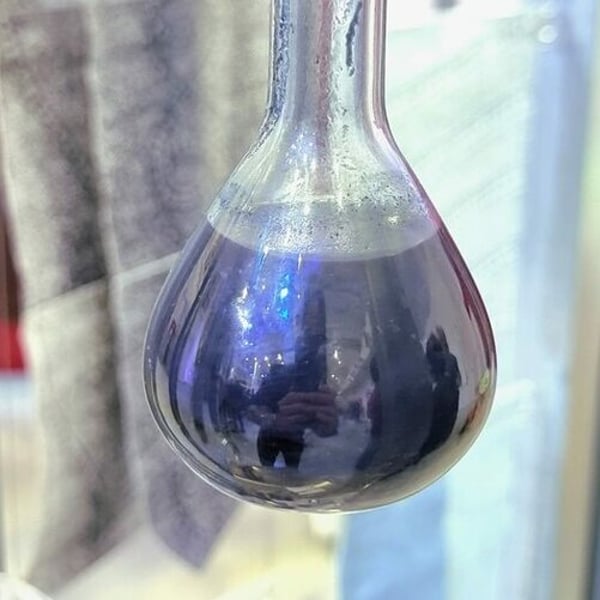
For its first appearance at the Denim Première Vision show, which opened on November 26 in Milan in a collegial, businesslike atmosphere, U.S. company Chloris set out to pre-empt any doubts. “It’s not indigo, but Classean Blue, named after the German scientist who discovered this compound in 1890,” founder Lei Seun explained to FashionNetwork.com.
Last year, the company launched its first industrial production unit in China, dedicated to a pigment obtained by fermenting waste from the sugar and maize industries. The natural pigment is said to reduce carbon impact by 65% and heat consumption by 50% compared with a chemical colourant.
“Developing new technologies has become part of our DNA,” said Andrea Venier, director of Officina 39.
For the past 20 years, the 50-year-old Italian company has been refining alternatives to existing processes, notably its proprietary Recycrom process, which transforms pre- and post-consumer textile waste into coloured powder, without resorting to chemical synthesis. Around 100 kilos of material could be used to colour 5,000 tonnes of fabric, or 6,000 pairs of trousers.
Impatient brands
The company also highlights Zero PP, its alternative to potassium permanganate (known as “PP”), used to create faded effects, replacing it with laser- and ozone-based processes. “One problem we face is that when you launch something new, brands now expect you to move quickly to industrial scale. But these new processes need time to scale up,” noted the executive.
This view is shared by French designer Emily Gubbay, a graduate of Central Saint Martins in London, whose process for recovering indigo from denim, called Infinity Blue, is attracting attention.
“It’s an entirely natural process that works on end-of-life garments, but can also be used for fading, as it does not damage the material,” she explained, adding that the core process is said to take 30 minutes.
Jeans faded using the Infinity Blue process at Denim PV – MG/FNW
To develop the process, Infinity Blue is currently seeking partners, with Emily Gubbay believing the solution belongs with dyeing specialists. “Many brands are interested, but want this pigment now. There’s still a long way to go to reach that stage. We need an industrial partner, and that could be a yarn-dyeing specialist.”
Brands’ impatience with new solutions is also noted by Lucia D’Angelo Maddaleno, export manager at Montega Chemical Solutions. “For years now, there has been growing demand for mineral pigments and natural dyes from brands,” said the specialist, whose company has focused for 40 years on treatments for textiles, particularly apparel.
“An opportunity to stand out”
To support the shift towards more responsible finishes, Montega particularly promotes the use of a chlorine activator as an alternative to caustic soda, which is still used to achieve certain particularly aggressive wash effects. “If you launch a brand with the ambition of using natural dyeing, you have to be aware of the limits it imposes,” said the export manager, citing issues of colour fastness and the consistency of shades across an entire length of fabric.
A vial of indigo collected via Infinity Blue at the Denim PV stand – MG/FNW
The denim industry’s ambition to move towards greater responsibility is not new. Fifteen years after the harmful practice of sandblasting was called into question, manufacturers are nevertheless seeing these ambitions tested by economic realities.
“The market is going through a difficult time, and this is true in every country we go to,” noted Venier, whose customers supply major global denim brands. “However, some brands continue to show their willingness to change their approach, and sometimes even see this as an opportunity to stand out from competitors.”
“More than ever, brands need to understand what we do, how we do it, and what benefits they can derive from a product like ours,” explained Seun. “Our move to industrial scale allows us to match the prices of conventional pigments, and our product can be used in existing indigo dyeing machines. It has taken time, but that’s at least what it takes to convince brands to step out of their comfort zone,” summed up the specialist, who sees evolving Western regulations as a further incentive to adopt new forms of dyeing.
This article is an automatic translation. Click here to read the original article.
The demerger of Unilever‘s ice cream division, to be named ‘The Magnum Ice Cream Company,’ which had been delayed in recent months by the US government shutdown, will finally go ahead on Saturday, the British group announced.
Reuters
Unilever said in a statement on Friday that the admission of the new entity’s shares to listing and trading in Amsterdam, London, and New York, as well as the commencement of trading… is expected to take place on Monday, December 8.
The longest federal government shutdown in US history, from October 1 to November 12, fully or partially affected many parts of the federal government, including the securities regulator, after weeks without an agreement between Donald Trump‘s Republicans and the Democratic opposition.
Unilever, which had previously aimed to complete the demerger by mid-November, warned in October that the US securities regulator (SEC) was “not in a position to declare effective” the registration of the new company’s shares. However, the group said it was “determined to implement in 2025” the separation of a division that also includes the Ben & Jerry’s and Cornetto brands, and which will have its primary listing in Amsterdam.
“The registration statement” for the shares in the US “became effective on Thursday, December 4,” Unilever said in its statement. Known for Dove soaps, Axe deodorants and Knorr soups, the group reported a slight decline in third-quarter sales at the end of October, but beat market expectations.
Under pressure from investors, including the activist fund Trian of US billionaire Nelson Peltz, to improve performance, the group last year unveiled a strategic plan to focus on 30 power brands. It then announced the demerger of its ice cream division and, to boost margins, launched a cost-saving plan involving 7,500 job cuts, nearly 6% of the workforce. Unilever’s shares on the London Stock Exchange were steady on Friday shortly after the market opened, at 4,429 pence.
This article is an automatic translation. Click here to read the original article.
Burberry has named a new chief operating and supply chain officer as well as a new chief customer officer. They’re both key roles at the recovering luxury giant and both are being promoted from within.
Matteo Calonaci becomes chief operating and supply chain officer, moving from his role as senior vice-president of strategy and transformation at the firm.
In his new role, he’ll be oversee supply chain and planning, strategy and transformation, and data and analytics. He succeeds Klaus Bierbrauer, who’s currently Burberry supply chain and industrial officer. Bierbrauer will be leaving the company following its winter show and a transition period.
Matteo Calonaci – Burberry
Meanwhile, Johnattan Leon steps up as chief customer officer. He’s currently currently Burberry’s senior vice-president of commercial and chief of staff. In his new role he’ll be leading Burberry’s customer, client engagement, customer service and retail excellence teams, while also overseeing its digital, outlet and commercial operations.
Both Calonaci and Leon will join the executive committee, reporting to Company CEO Joshua Schulman.
JohnattanLeon – Burberry
Schulman said of the two execs that the appointments “reflect the exceptional talent and leadership we have at Burberry. Both Matteo and Johnattan have been instrumental in strengthening our focus on executional excellence and elevating our customer experience. Their deep understanding of our business, our people, and our customers gives me full confidence that their leadership will help drive [our strategy] Burberry Forward”.
Traditional and occasion wear designer Puneet Gupta has stepped into the world of fine jewellery with the launch of ‘Deco Luméaura,’ a collection designed to blend heritage and contemporary aesthetics while taking inspiration from the dramatic landscapes of Ladakh.
Hints of Ladakh’s heritage can be seen in this sculptural evening bag – Puneet Gupta
“For me, Deco Luméaura is an exploration of transformation- of material, of story, of self,” said Puneet Gupta in a press release. “True luxury isn’t perfect; it is intentional. Every piece is crafted to be lived with and passed on.”
The jewellery collection features cocktail rings, bangles, chokers, necklaces, and statement evening bags made in recycled brass and finished with 24 carat gold. The stones used have been kept natural to highlight their imperfect and unique forms and each piece in the collection has been hammered, polished, and engraved by hand.
An eclectic mix of jewels from the collection – Puneet Gupta
Designed to function as wearable art pieces, the colourful jewellery echoes the geometry of Art Deco while incorporating distinctly South Asian imagery such as camels, butterflies, and tassels. Gupta divides his time between his stores in Hyderabad and Delhi and aims to bring Indian artistry to a global audience while crafting a dialogue between designer and artisan.