Connect with us

Business

JPMorgan to build new London headquarters in Canary Wharf

Published

on


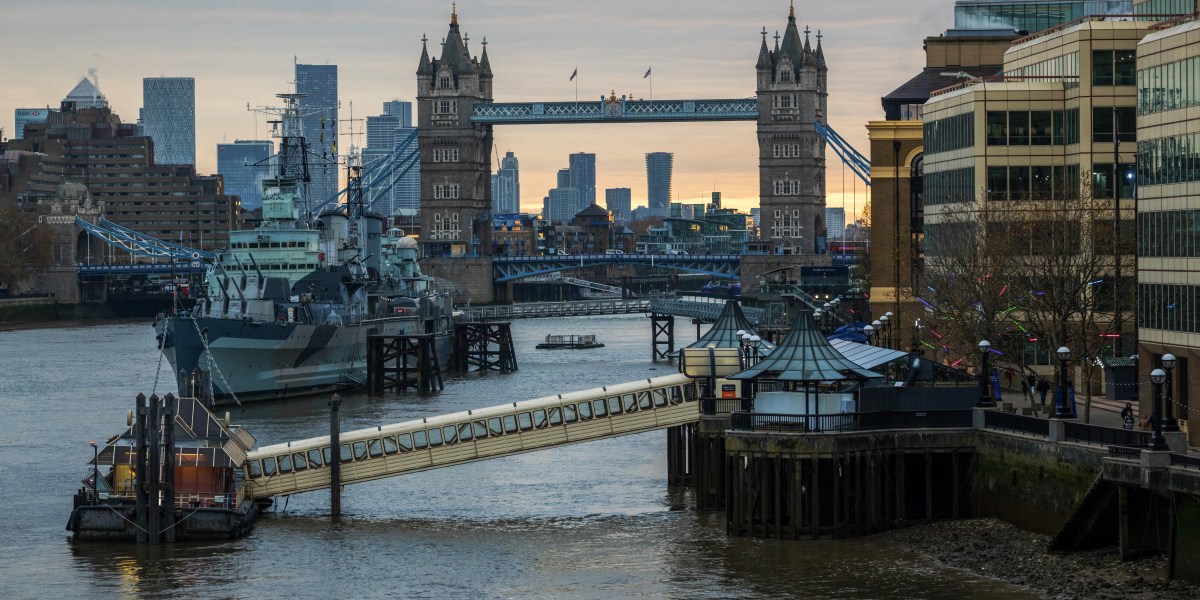
JPMorgan Chase & Co. plans to build a new tower in Canary Wharf for its headquarters in the UK, a multibillion-pound endorsement of London’s status as a global financial center a day after Rachel Reeves delivered a budget that largely spared banks. 

The office building would be London’s largest by far at three million square feet and could host as many as 12,000 employees, according to a statement from the investment bank Thursday. The construction is expected to take six years. 

The property, which will be co-developed by Canary Wharf Group, is being designed by Foster + Partners, the British architecture practice that’s also responsible for the bank’s recently opened global headquarters in New York

“This building will represent our lasting commitment to the city, the UK” and its staff, said JPMorgan Chief Executive Officer Jamie Dimon. “The UK government’s priority of economic growth has been a critical factor in helping us make this decision.”

The plans are “subject to a continuing positive business environment in the UK and the firm receiving the necessary approvals,” according to a JPMorgan statement. 

With a gross internal area of 3 million square feet, the proposal is about a third larger than the biggest office building currently in London, the 22 Bishopsgate tower, which has a a gross area of about 2.1 million square feet and about 1.2 million square feet of internal office space. JPMorgan said the development is expected to contribute £9.9 billion ($13 billion) to the local economy, including an additional 7,800 jobs across construction and other industries.

Read More: JPMorgan Draws Up New Plans for London’s Biggest Office Building

The decision is a major coup for Reeves as she looks to boost growth in the UK after raising taxes by £26 billion in her Nov. 26 budget. Despite announcing widespread tax hikes that will hit bankers and other high earners, the chancellor of the exchequer refrained from increasing a levy on bank profits, a measure that had previously been under consideration. 

Goldman Sachs Group Inc. also announced it would grow its UK presence by adding 500 roles to its Birmingham office in a separate statement Thursday. Various other lenders have also flagged plans to boost investment in the UK, which came after reports that the Treasury had encouraged the sector to publicly endorse the budget and talk up the economy.

JPMorgan’s decision to commit to the Riverside South site, having also examined a move to the City or a redevelopment of its existing UK headquarters, underscores the dearth of options for businesses seeking large new office buildings in London. Developers have been cautious about starting new projects following a series of shocks, including Brexit, post-pandemic flexible working, massive inflation in the cost of construction and the advent of higher interest rates. 

Dimon has been one of the staunchest advocates for a return to the office, mandating earlier this year that most employees work onsite five days a week, an edict that’s set the tone for tougher policies across Wall Street. That’s been a key driver of Canary Wharf’s recent revival with the number of visitors traveling to the east London financial district by rail and tube surpassing pre-pandemic levels as more bankers resume the daily trek to their desks.

Read More: Canary Wharf Crisis Eases as Dimon Leads Bankers Back to Office

JPMorgan has even needed to lease additional space to facilitate staffers’ return, renting several floors in the former Credit Suisse office close to the US lender’s overflowing European headquarters. 

Having made his mark on Manhattan with the bank’s new global headquarters, Dimon has now turned his attention to addressing the long-term question of the bank’s main European base, a project that will leave a lasting imprint on London. 

JPMorgan acquired the Riverside South site in 2008 before opting to buy the former Lehman Brothers London headquarters at 25 Bank Street for its own occupation in 2010. The bank mothballed plans for the plot of land and hired brokers to sell it in 2014, a process that drew interest from a handful of residential developers who considered the site a prime opportunity to build luxury apartments overlooking the river. But the lender halted that process at the 11th hour a year later, instead choosing to retain ownership.

Since then London’s financial industry has grappled with the shock 2016 Brexit vote, which raised fears of an exodus from the UK capital. Former Canary Wharf Group Chairman and Chief Executive George Iacobescu, who spent decades developing the infrastructure that cemented London’s status as a global financial hub, was among the fiercest critics of leaving the European Union, warning it risked a gradual unravelling. 

He’s now personally advising JPMorgan on the new development, a project that underscores London’s enduring appeal to investment banks even as most have been forced to bolster their footprints elsewhere in the EU. 

JPMorgan currently operates in London primarily from two locations that it owns, 25 Bank Street in Canary Wharf and 60 Victoria Embankment, while the firm also leases space at another building. It plans to retain the Victoria Embankment site once the new headquarters is completed and will consider options for 25 Bank Street, according to the statement. 

Last month, the finance group announced another £350 million investment plan in its Bournemouth campus for a new building and upgraded facilities.


Source link

Continue Reading

Business

Billionaire Marc Andreessen spends 3 hours a day listening to podcasts and audiobooks—that’s nearly an entire 24-hour day each week

Published

on


If you want to think like a billionaire, you might want to stop scrolling on TikTok and pick up a book. For venture capitalist Marc Andreessen, it’s not just a habit—it’s how he makes sense of the world and continually reshapes his thinking about business.

“I’ve always been like this, I’m reading basically every spare minute that I have,” Andreessen told the How I Write podcast in 2023.

The billionaire previously carved out two hours of reading time on most weekdays, according to a detailed version of his weekly schedule he published in 2020. However, with the business world only becoming more pressurized, he’s ramped up his knowledge intake—something made possible from “the single biggest technological leap” in his life: AirPods. 

Andreessen now spends two to three hours a day glued to audiobooks—typically alternating between histories, biographies, and material in new subject areas like artificial intelligence. Collectively, his practice amounts to nearly an entire 24-hour day dedicated to learning, each week.

Research suggests that listeners retain roughly the same amount of information from audiobooks as they do from reading text, making Andreessen’s shift in format less a compromise than an optimization.

“If nothing else is going on,” Andreessen added. “I’m always listening to something.”

Andreessen didn’t respond to Fortune’s request for further comment.

Mark Cuban and Bill Gates agree: reading will drive you to success

Andreessen’s approach is far from unusual among the ultra-wealthy. Reading ranks as the most commonly cited behavior tied to long-term success, according to a JPMorgan report that surveyed more than 100 billionaires with a combined net worth exceeding $500 billion.

Bill Gates, for example, has long championed reading—often finishing 50 books a year and releasing annual lists to encourage others to do the same.

“Reading fuels a sense of curiosity about the world, which I think helped drive me forward in my career and in the work that I do now with my foundation,” he told TIME in 2017.

Former Shark Tank star Mark Cuban has similarly cited reading as a critical habit that helped set him apart—and put him on the billionaire path.

 “I read more than three hours almost every day,” Cuban wrote on his blog in 2011.

“Everything I read was public,” the now 67-year-old added. “Anyone could buy the same books and magazines. The same information was available to anyone who wanted it. Turns out most people didn’t want it.”

Reading, as a whole, remains a cornerstone of nuanced thinking and communication—skills that are increasingly critical for business leaders, according to Brooke Vuckovic, a professor at Northwestern’s Kellogg School of Management.

“Reading long-form fiction, biography, and history demands focused attention, tolerance with ambiguity and unanswered questions or unrevealed nuance in characters and situations, and a willingness to have our preconceptions upended,” Vuckovic previously told Fortune. “All of these qualities are requirements of strong leadership [and] they are in increasingly short supply.”


Source link

Continue Reading

Business

Mass texts and EZ-Pass phishing: $17 billion stolen in crypto scams, largely by the Chinese

Published

on


EZ-Pass final reminder: you have an outstanding toll. Such texts have become all too familiar to many Americans, and it is a Chinese-backed criminal network that is largely behind them. These scammers are using crypto to steal a record $17 billion from regular people, according to Chainalysis’s recent report

The severity of this fraud has reached the attention of the U.S. government. On Wednesday, Jacqueline Burns Koven, the head of cyber threat intelligence at Chainalysis, spoke in front of the Senate about the increase of this criminal activity, and how the U.S. can combat it. Her testimony was titled, ‘Made in China, Paid by Seniors: Stopping the Surge of International Scams.’

“Scams that leverage cryptocurrency are having a record year in terms of proceeds,” Burns Koven said, in an interview with Fortune. “The Chinese scam conglomerates are the market leaders in criminal fintech. They’ve been doing this for a long time.” 

The estimated $17 billion received in crypto scams is up from about 30% from last year, according to the report. These operations have become increasingly sophisticated and include the use of AI-generated deepfakes. Crypto is an essential part of the operation because the criminals frequently use digital currencies to finance their scamming operations, such as purchasing tools like SMS phishing kits. 

Nefarious actors have leaned heavily on impersonation techniques, where they pose as legitimate organizations to coerce victims into paying digitally. The most well-known example of this is the EZ-Pass phishing campaign, which targeted millions of Americans. The operation was traced back to a Chinese-speaking criminal group called “Darcula”, which also has a history of impersonating the USPS. 

While 2025 also saw a record number of crypto seizures by law enforcement, Burns Koven says that government and industry responses are still fragmented and reactive. Just as criminals are using advanced technology for scams, both the public and private sector could use AI to block these messages from appearing on people’s phones. Also, with criminals using crypto to facilitate these scams and because these transactions are public on the blockchain, this makes it easier to identify criminal networks and disrupt activity.  

“Scammers are taking advantage of the disjointed and reactive responses from both the public and private sector,” she said. “We need to use advanced technologies like AI enabled fraud prevention, to prevent a human being from ever being in contact with that scam in the first place.”

Fraud usually never sleeps, but these Chinese criminal networks actually do take breaks. Chainalysis and other researchers found a dip in criminal activity during the Chinese New Year and other of the country’s public holidays. 


Source link

Continue Reading

Business

Fortune Article | Fortune

Published

on


The European Union’s top official on Tuesday described U.S. President Donald Trump’s planned new tariffs over Greenland as “a mistake especially between long-standing allies” and called into question Trump’s trustworthiness, while French President Emmanuel Macron said the bloc shouldn’t hesitate to use a powerful tool in retaliation.

European Commission President Ursula von der Leyen was responding to Trump’s announcement that starting February, a 10% import tax will be imposed on goods from eight European nations that have rallied around Denmark in the wake of his escalating calls for the United States to take over the semi-autonomous Danish territory of Greenland.

“The European Union and the United States have agreed to a trade deal last July,” Von der Leyen said at the World Economic Forum in Davos, Switzerland. “And in politics as in business – a deal is a deal. And when friends shake hands, it must mean something.”

“We consider the people of the United States not just our allies, but our friends. And plunging us into a downward spiral would only aid the very adversaries we are both so committed to keeping out of the strategic landscape,” she added.

She vowed that the EU’s response “will be unflinching, united and proportional.”

Trump has insisted the U.S. needs the territory for security reasons against possible threats from China and Russia.

Earlier Tuesday, U.S. Treasury Secretary Scott Bessent said America’s relations with Europe remain strong and urged trading partners to “take a deep breath” and let tensions driven the new tariff threats over Greenland “play out.”

“I think our relations have never been closer,” he said.

But Danish Prime Minister Mette Fredriksen, speaking in the Danish parliament, said that “the worst may still be ahead of us.” She said that “we have never sought conflict. We have consistently sought cooperation.”

Trump’s threats spark diplomatic flurry across Europe

The American leader’s threats have sparked outrage and a flurry of diplomatic activity across Europe, as leaders consider possible countermeasures, including retaliatory tariffs and the first-ever use of the European Union’s anti-coercion instrument.

The EU has three major economic tools it could use to pressure Washington: new tariffs, suspension of the U.S.-EU trade deal, and the “trade bazooka” — the unofficial term for the bloc’s Anti-Coercion Instrument, which could sanction individuals or institutions found to be putting undue pressure on the EU.

Macron said in Davos that “the anti-coercion mechanism is a powerful instrument and we should not hesitate to deploy it in today’s tough environment.” He pushed back against aggressive U.S. trade pressures and “an endless accumulation of new tariffs.”

Earlier Tuesday, Trump posted on social media that he had spoken with NATO Secretary General Mark Rutte. He said “I agreed to a meeting of the various parties in Davos, Switzerland.”

France’s Macron suggests G-7 meeting in Paris this week

Trump also posted a text message from Emmanuel Macron in which the French president suggested a meeting of members of the Group of Seven industrialized democracies in Paris after the Davos gathering. An official close to Macron, who spoke anonymously in line with the French presidency’s customary practices, confirmed the message shared by Trump is genuine.

Later, Trump posted some provocatively doctored images. One showed him planting the U.S. flag next to a sign reading “Greenland, U.S. Territory, Est. 2026.” The other showed Trump in the Oval Office next to a map that showed Greenland and Canada covered with the U.S. Stars and Stripes.

In a sign of how tensions have increased in recent days, thousands of Greenlanders marched over the weekend in protest of any effort to take over their island.

In his latest threat of tariffs, Trump indicated that the import taxes would be retaliation for last week’s deployment of symbolic numbers of troops from the European countries to Greenland — though he also suggested that he was using the tariffs as leverage to negotiate with Denmark.

Calls for a stronger Europe against Trump’s threats

Denmark’s minister for European affairs called Trump’s tariff threats “deeply unfair.” He said that Europe needs to become even stronger and more independent, while stressing there is “no interest in escalating a trade war.”

“You just have to note that we are on the edge of a new world order, where having power has unfortunately become crucial, and we see a United States with an enormous condescending rhetoric towards Europe,” Marie Bjerre told Danish public broadcaster DK on Tuesday.

Speaking on the sidelines of Davos, California Gov. Gavin Newsom slammed Europe’s response to Trump’s tariff threats as “pathetic” and “embarrassing,” and urged European leaders to unite and stand up to the United States.

“It is time to get serious, and stop being complicit,” Newsom told reporters. “It’s time to stand tall and firm, have a backbone.”

On Monday night, Greenland’s European backers looked at establishing a more permanent military presence in the High North to help guarantee security in the Arctic region, a key demand of the United States, Swedish Defense Minister Pål Jonson said.

Jonson said after talks with his counterparts from Denmark, Greenland and Norway that European members of NATO are currently “doing what’s called a reconnaissance tour in order to identify what kind of needs there are when it comes to infrastructure and exercises and so forth.”

In Moscow, Russian Foreign Minister Sergey Lavrov strongly denied any intention by Russia and China to threaten Greenland, while also describing Greenland as a “colonial gain” for Denmark. At a news conference, he said that “in principle, Greenland isn’t a natural part of Denmark.”

US-UK tensions over Chagos Islands

In another sign of tension between allies, the British government on Tuesday defended its decision to hand sovereignty of the Chagos Islands to Mauritius after Trump attacked the plan, which his administration previously supported.

Trump said that relinquishing the remote Indian Ocean archipelago, home to a strategically important American naval and bomber base, was an act of stupidity that shows why he needs to take over Greenland.

In a speech to lawmakers at Britain’s Parliament on Tuesday, U.S. House of Representatives Speaker Mike Johnson said he hoped to “calm the waters” as Trump roils the trans-Atlantic relationship with his desire to take over Greenland.

Johnson said the U.S. and the U.K. “have always been able to work through our differences calmly, as friends. We will continue to do that.”

___

AP writers Sylvie Corbet in Paris, Jill Lawless in London, Lorne Cook in Brussels, and Elaine Kurtenbach in Bangkok contributed to this report.


Source link

Continue Reading

Trending

Copyright © Miami Select.