Although still private, the shadow of OpenAI and its still-unprofitable business despite the blockbuster success of ChatGPT has rattled markets throughout the back half of 2025. Talk of a bubble in artificial intelligence (AI) was not quelled despite Nvidia delivering yet another blockbuster quarter in November. The question remains about how OpenAI will balance ChatGPT’s seemingly endless desire, on the one hand, for “compute,” provided by data centers sprouting throughout the economy, with a business model that takes it from the red into the black. This is the same question that OpenAI CEO Sam Altman answered in a single exasperated word in a recent podcast appearance: “Enough.”
The investment bank HSBC, while clarifying that it still believes AI is a “megacycle” and that its forecasts “indicate a leading position for OpenAI from a revenue standpoint,” nevertheless calculates that the company faces an extraordinary financial mountain if it is to deliver on its ambitions. HSBC Global Investment Research projects that OpenAI still won’t be profitable by 2030, even though its consumer base will grow by that point to comprise some 44% of the world’s adult population (up from 10% in 2025). Beyond that, it will need at least another $207 billion of compute to keep up with its growth plans. This stark assessment reflects soaring infrastructure costs, heightened competition, and an AI market that is surging in demand and cash-intensive to a degree beyond any technology trend in history.
HSBC’s semiconductor analyst team, led by Nicholas Cote-Colisson, produced the figure by updating its OpenAI forecasts for the first time since mid-October, factoring in recent multi-year commitments to cloud computing, including a $250 billion agreement with Microsoft and $38 billion with Amazon. Importantly, HSBC notes, these deals came without any new capital injection, and they are the latest in a series of capacity expansions that now see OpenAI aiming for 36 gigawatts of AI compute power by decade’s end. Assuming that one gigawatt can power roughly 750,000 homes, electricity on this scale would represent the needs of a state somewhat smaller than Texas and a little larger than Florida. The Financial Times‘ AlphaVille blog, which previously reported on HSBC’s forecast, described OpenAI as “a money pit with a website on top.”
However, the bank projects that OpenAI’s cumulative free cash flow by 2030 will still be negative, leaving a $207 billion funding shortfall that must be filled through additional debt, equity, or more aggressive revenue generation. HSBC analysts model OpenAI’s cloud and AI infrastructure costs at $792 billion between late 2025 and 2030, with total compute commitments reaching $1.4 trillion by 2033 (HSBC notes that Altman has laid out a plan for $1.4 trillion in compute over the next eight years). It will have a $620 billion data-center rental bill alone.
Despite this, projected revenues—though growing rapidly, to over $213 billion in 2030—would simply not be enough to bridge the divide. (The bank’s revenue projections are based on an assumption of a higher proportion of paid subscribers in the medium term and an assumption that large language model, or LLM, providers will capture some of the digital advertising market.)
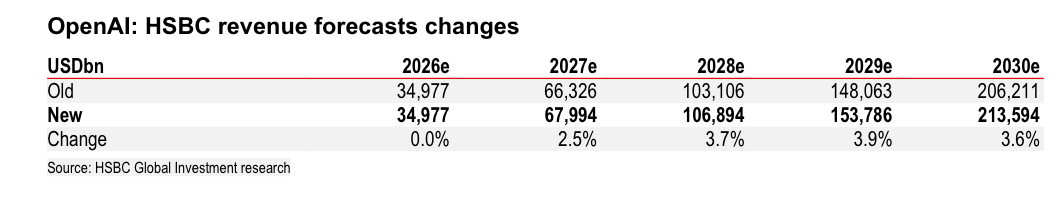
The bank notes several options to close the gap, including dramatically ramping up the proportion of paid subscribers (going from 10% to 20% could add $194 billion in revenue), capturing a larger share of digital ad spending, or extracting extraordinary efficiencies from compute operations. But even under bullish conversion and monetization scenarios, the company would still need fresh capital beyond 2030.
OpenAI’s survival is closely tied to its financial backers and the AI ecosystem. Microsoft and Amazon are not only cloud providers but also major investors, and cloud players such as Oracle, NVIDIA, and Advanced Micro Devices all stand to gain—or lose—depending on OpenAI’s fortunes. The risks, however, are considerable: unproven revenue models, potential market saturation for AI subscriptions, the threat of regulatory scrutiny, and the sheer scale of necessary capital injections.
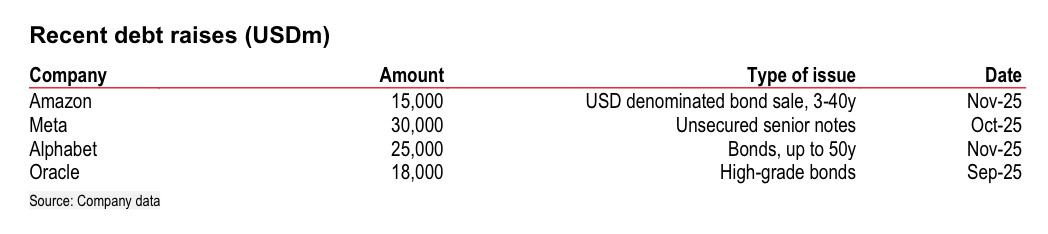
HSBC suggests that OpenAI could raise more debt to fund its compute requirements, but this would be “possibly the most challenging avenue in the current market conditions,” as Oracle and Meta have recently raised a “significant amount” of debt to finance AI-related capex, “raising market concerns about the general financing of AI.” The bank notes this is an exception as most of the so-called “hyperscalers” have funded themselves with free cash flow, as noted by JPMorgan’s Michael Cembalest recently. HSBC also noted a “sharp increase” in Oracle’s credit default swaps in recent days, which Morgan Stanley’s Lisa Shalett voiced alarm over several weeks earlier, in a previous interview with Fortune.
HSBC, like many other banks writing on the AI revolution, returned again to the famous quote by Nobel prize winner Robert Solow that “You can see the computer age everywhere but in productivity statistics,” noting drily that “poor productivity gains driven by weak total factor (labour and capital) productivity are an unfortunate characteristic of today’s developed economies.” In fact, the bank notes that some aren’t convinced of a meaningful return yet from the 30-year-old internet revolution itself, noting Federal Reserve Governor John Williams’ 2017 comment that “productivity provided by modern technologies like the internet has so far only influenced our consumption of leisure – and hasn’t yet trickled down to offices or factories.”
Bank of America Research’s Head of US Equity & Quantitative Strategy, Savita Subramanian, told Fortune in August that she sees a “sea change” for productivity emerging out of the economy of the 2020s in ways that aren’t fundamentally about AI. Through a combination of factors, including post-pandemic wage inflation, she said that companies have been prompted “to do more with fewer people,” replacing people with process in a scalable and meaningful way. A consideration that was giving her pause, though, was a shift from an asset-light to an asset-heavier focus, as many of the most innovative tech companies have discovered a near-unquenchable thirst for a kind of hardware that carries a lot of risk with it: data centers.
A few months later, Harvard economist Jason Furman did a back-of-the-envelope calculation and found that without data centers, GDP growth would have been just 0.1% for the first half of 2025. OpenAI seems to be asking markets a question: just how long can growth be built on the question of future returns—and a productivity revolution—from AI that are by no means ever guaranteed to arrive?
If you don’t like the price of Bitcoin, wait five minutes, and it will change. The major cryptocurrency’s volatility has been on full display to start the year, this time dipping about 7% since last week to its current price of just under $90,000 as of mid-day Tuesday.
Other cryptocurrencies have also slid. Ethereum is down 11% in the last six days to its current price of about $3,000, and Solana is down about 14% during that time to its price of about $127.
The dip comes as President Donald Trump threatened European nations with tariffs as they pushed back against his plans to take over Greenland, causing markets to scramble. Meanwhile, crypto markets faced an additional headwind as key legislation for the industry, known as the Clarity Act, became stalled after industry giant Coinbase unexpectedly withdrew its support late last week.
“President Trump’s threat to impose tariffs on Europe has put Bitcoin under pressure,” said Russell Thompson, chief investment officer at Hilbert Group. “The postponement of the Clarity Act in the Senate committee mainly due to concerns from Coinbase eliminated a large amount of positive sentiment in the market.”
Coinbase CEO Brian Armstrong objected to the Clarity Act primarily on grounds that crypto owners would not be able to earn yield from stablecoins. The new uncertainty over the bill, which many assumed was on a smooth path towards a Presidential signature, has shaken the price not just of crypto assets but also the share price of companies exposed to digital assets.
It’s uncertain whether the current headwinds will fade anytime soon. Trump has made his intentions of taking control of Greenland clear. When a group of European nations expressed solidarity with the Danish, he threatened those countries with tariffs, saying he would not back down until Greenland was purchased. Bitcoin and other risk assets subsequently fell, along with major stock indices, while the price of gold rose.
It’s not all gloom and doom for crypto, at least according to some analysts, who view Bitcoin’s correlation with macroeconomic forces as confirmation that digital assets have finally gone mainstream.
“Bitcoin’s reactivity is another sign of its increasing integration with broader macroeconomic forces, signaling maturation rather than fragility, even as short-term volatility continues,” said Beto Aparicio, senior manager of strategic finance at Offchain Labs.
Join us at the Fortune Workplace Innovation Summit May 19–20, 2026, in Atlanta. The next era of workplace innovation is here—and the old playbook is being rewritten. At this exclusive, high-energy event, the world’s most innovative leaders will convene to explore how AI, humanity, and strategy converge to redefine, again, the future of work. Register now.
President Trump lives on deals: “That’s what I do—I do deals,” he once told Bob Woodward. On the one-year anniversary of his second presidency, he’s pushing hard to make his biggest, most disruptive deal ever, one that would bring Greenland under the control of the U.S.—and the global business community is still scrambling to adapt to his approach. Here are nine of Trump’s most unorthodox deals from the past year.
Nine deals that shook the business world
April 2, 2025: Reciprocal tariffs
Trump imposes “reciprocal tariffs” on 57 countries, with each tariff understood as an opening bid in a negotiation. Several countries have since made deals. The one-on-one negotiations, unlike the multilateral system of the past 80 years, can be chaotic for companies and economies
June 13: U.S. Steel “Golden Share”
In return for allowing Nippon Steel to buy U.S. Steel, Trump requires that the U.S. receive several powers over the company, including total power over all the board’s independent directors and vetoes over locations of offices and factories.
July 10: MP Materials
The U.S. pays $400 million for a large equity share in MP and signs a contract to buy all of MP’s rare earth magnets for 10 years. The reason for the equity stake was not disclosed.
Trump reverses the U.S. ban on selling Nvidia H20 chips to China in exchange for Nvidia paying the U.S. 15% of the revenue.
July 23: Columbia University
LYA CATTEL/Getty Images
The Trump administration restores $400 million of canceled federal research funding for the university under an unprecedented multipoint deal. For example, Columbia must supply data to the federal government for all applicants, broken down by race, “color,” GPA, and standardized test performance. A few other schools later make similar deals.
August 6: Apple
Bonnie Cash—UPI/Bloomberg/Getty Images
At a public appearance with Trump, CEO Tim Cook announces Apple will invest an additional $100 billion in the U.S. over four years; Trump announces Apple will be exempt from a planned tariff on imported chips that would have doubled the price of iPhones in the U.S.
August 22: Intel
Justin Sullivan—Getty Images
Intel trades the U.S. government a 9.9% equity stake in exchange for $8.9 billion that might already be owed to Intel under the CHIPS and Science Act. The deal is unusual because the company was not in immediate danger or significantly affecting the economy.
December 8: Nvidia, Part 2:
Trump reverses the U.S. ban on selling powerful Nvidia H200 chips in exchange for Nvidia paying the U.S. 25% of the revenue. Both Nvidia deals are unusual because the payments to the U.S., based on exports, appear to be forbidden by the Constitution.
December 19: Pharma
Alex Wong—Getty Images
Nine pharmaceutical companies make deals with Trump that are intended to lower drug prices. This is unusual because Trump negotiated separate deals with each company, and the terms have not been released.
All eyes this week will be watching President Trump at the World Economic Forum in Davos, where the president has hinted he’ll announce some high-stakes agreements. Expect the unexpected.
A version of this piece appears in the February/March 2026 issue of Fortune.
Microsoft CEO Satya Nadella has been leading the charge on artificial intelligence (AI) for years, owing to his long alliance with OpenAI’s Sam Altman and the groundbreaking work from his own AI CEO, Mustafa Suleyman, particularly with the Copilot tool. But Nadella has not spoken often about the fears that rattled Wall Street for much of the back half of 2025: whether AI is a bubble.
At the World Economic Forum annual meeting in Davos, Switzerland, Nadella sat for a conversation with the Forum’s interim co-chair, BlackRock CEO Larry Fink, explaining that if AI growth spawns solely from investment, then that could be signs of a bubble. “A telltale sign of if it’s a bubble would be if all we are talking about are the tech firms,” Nadella said. “If all we talk about is what’s happening to the technology side then it’s just purely supply side.”
However, Nadella offers a fix to that productivity dilemma, calling on business leaders to adopt a new approach to knowledge work by shifting workflows to match the structural design of AI. “The mindset we as leaders should have is, we need to think about changing the work—the workflow—with the technology.”
Growing pains
This change is not wholly unprecedented, as Nadella pointed out, comparing the current moment to that of the 1980s, when computing revolutionized the workplace and opened up new opportunities for growth and productivity and created a new class of workers. “We invented this entire class of thing called knowledge work, where people started really using computers to amplify what we were trying to achieve using software,” he said. “I think in the context of AI, that same thing is going to happen.”
Nadella argues that AI creates a “complete inversion” of how information moves through a business, replacing slow, hierarchical processes with a view that forces leaders to rethink their organizational structures. “We have an organization, we have departments, we have these specializations, and the information trickles up,” Nadella said. “No, no, it’s actually it flattens the entire information flow. So once you start having that, you have to redesign structurally.”
That shift may be harder for some Fortune 500 companies as structural changes could be accompanied by uncomfortable growing pains. Nadella says that leaner companies will be able to more easily adopt AI because their organizational structures are fresher and more malleable. On the other hand, large companies could take time to adopt new workflows.
Despite widespread adoption of AI, the 29th edition of PwC’s global CEO survey found that only 10% to 12% of companies reported seeing benefits of the technology on the revenue or cost side, while 56% reported getting nothing out of it. It follows up on an even more pessimistic finding about AI returns from August 2025: that 95% of generative AI pilots were failing.
PwC Global Chairman Mohamed Kande spoke to Fortune’s Diane Brady in Davos about the finding that many CEOs are cautious and lack confidence at this stage of the AI adoption cycle. “Somehow AI moves so fast … that people forgot that the adoption of technology, you have to go to the basics,” he explained, with the survey finding that the companies seeing benefits from AI are “putting the foundations in place.” It’s about execution more than it is about technology, he argued, and good management and leadership are really going to matter going forward.
“For large organizations,” Nadella told Fink, “there’s a fundamental challenge: Unless and until your rate of change keeps up with what is possible, you’re going to get schooled by someone small being able to achieve scale because of these tools.”
New entrants have the advantage of “starting fresh” and constructing workflows around AI capabilities, while larger firms will have to contend with the flattening effect AI has on entire departments and specializations.
To be sure, Nadella says that large organizations have kept an upper hand, especially when it comes to relationships, data, and know-how. However, he maintains that firms must understand how to use those resources to their advantage to change management style, then that could pose a major roadblock.
“The bottom line is, if you don’t translate that with a new production function, then you really will be stuck,” he said.