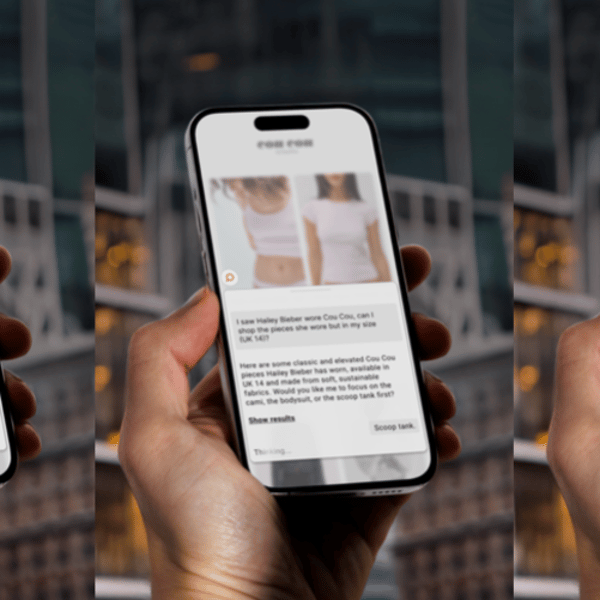
Big retailers traditionally spend millions on attracting eyeballs for the holiday season. Now, they’re looking to get noticed by something else- AI agents.
More shoppers are asking AI for shopping advice
Most of this holiday season’s projected $253 billion in US online sales will happen through website visits or standard online searches that favour companies that spend big on search engine ads. But chatbots like OpenAI’s ChatGPT or Google’s Gemini have become part of the mix, with shopper-facing tools that can give product descriptions, compare prices, or allow purchases directly within large-language models as US consumers increasingly use AI for advice on the best holiday stocking stuffers.
“We’ve seen brands that previously were putting out three or four new blog posts or articles a month, are now trying to do 100 or 200,” said Brian Stempeck, chief executive at generative engine optimisation platform Evertune.ai, which works with clients to make their websites discoverable by large language models.
The company charges “around $3,000” per month to its clients, which include apparel and shoe companies, for its services, Stempeck said. Traditionally, retailers based their Google and Meta ad placements on phrases that users searched for or links they previously clicked.
Without the ability to advertise in the largest generative AI tools, companies are trying new methods, like posting more frequently on branded blogs or writing about their products on Reddit. Big retailers are building websites that cannot be seen by shoppers, intended to be read solely by AI scrapers, automated data extraction tools that scour the internet for information. The scrapers then feed information to platforms like ChatGPT and Gemini, which then offer suggestions on gifts, apparel, and other holiday merchandise.
Traffic to retail websites from generative AI platforms is currently still a fraction of overall activity. ChatGPT referrals to Amazon, Walmart and eBay in October accounted for less than 1% of each site’s overall traffic, according to data firm Sensor Tower. EBay said while traffic from AI sources is a small percentage of overall traffic, shoppers finding its links through agentic AI come to the online marketplace with high intent. Walmart did not respond to a request for comment.
But retailers clearly see an opportunity. Bed linen company Brooklinen is paying social media influencers to talk about its bath towels and comforters on platforms like Facebook, YouTube, and TikTok, Brooklinen chief operating officer Rachel Levy said. AI scrapers pull information from the text of product reviews and audio transcripts on these posts.
Brooklinen has also submitted its $199 comforter for awards from publications like the New York Times’ Wirecutter to boost its chances of appearing in AI agent responses. Currently, traffic from agentic AI sources is “super small,” she said, because Gen Z, the biggest adopter of tools like ChatGPT, has less buying power than older generations.
Miami-based hair care company R+Co is buying ads on Amazon’s voice assistant Alexa based on the questions that customers are asking its Rufus agent, R+Co President Dan Langer said.
Google recently introduced features that help shoppers use AI to track prices and buy goods, a task that can only happen if retailers’ products are easily found by the tech giant’s scrapers. Its AI mode and Gemini chatbot consider numerous factors, such as store locations or retailer quality when referring links to users, said Lilian Rincon, vice president of product for Google Shopping.
Google is testing ads in AI Mode currently in the US, but not the Gemini app, the company said. Existing Shopping and Performance Max ad product campaigns are eligible to show up in AI mode through the testing, the company said. Amazon CEO Andy Jassy said on the company’s October earnings call that shoppers who use Rufus are 60% more likely to buy products. Among large retailers, Walmart and Target both recently announced plans for apps to allow people to shop directly with chatbots.
Jeanne Friot: a queer manifesto to rouse Fashion Week
With her “Awake” show, Jeanne Friot literally brought her guests to their feet at the Théâtre du Rond-Point des Champs-Élysées. Making her debut on the official calendar, the French designer opened the Paris proceedings with a high-octane performance that, true to form, championed LGBTQI+ causes.
The unveiling of Jeanne Friot’s Autumn/Winter 2026 collection, blending runway and choreography conceived with choreographer Maud Le Pladec and the Ballet de Lorraine company, could not have felt more timely given recent headlines and the American president’s posturing. The thirty-something designer issued a call to wake up, with several dancers wearing T-shirts emblazoned with the slogan “It’s never too late to fight fascism“.
Beyond words, the designer opened with three powerful womenswear looks: a black tweed suit with a cropped jacket; a cocktail dress reimagined in a tartan of silver, red and purple sequins, worn by a model with gothic make-up; and a jacket-and-mini-skirt ensemble in black faux leather, heightened by a play of metal straps and buckles—one of her signatures, applied horizontally or vertically to form skirts or dresses—always nodding to the queer wardrobe.
Soon, dancers—wearing tartan catsuits paired with thigh-high boots, faux-leather mini-shorts, colourful tulle tops or black sequin hoodies—launched into breathless choreography. Then came two women in generously cut suits, one black, the other white. The two models drew closer, stared each other down, touched and kissed intensely and at length, melding like yin and yang as, all around them, the troupe ratcheted up the intensity of their stagecraft. The tableau prompted a wave of approval throughout the Parisian theatre.
Ever more exacting in her use of deadstock materials, the French designer introduced several other visually striking pieces, including a long black faux-leather coat worn over a bodysuit and teamed with metallic thigh-high boots, a houndstooth suit with a broad-shouldered jacket and micro-shorts, and an opulent dress featuring a tartan motif that unfurled from the waist into a train of colourful feathers—a true tribute to the queer community.
That community made its support unmistakable when Friot took to the stage to bow, prompting a prolonged standing ovation for a show that opened Paris Fashion Week Men’s with a bang.
Études Studio and its elegant seekers of sound
On Tuesday, for its show in the impressive Institut de Recherche et Coordination Acoustique, Études Studio staged a composition exploring the tonalities of tailoring. For this collection, christened “N°28 Résonances”, co-founders Aurélien Arbet and Jérémie Egry explained in their letter of intent that they drew inspiration from the origins of 1990s dance music and from the universe of American philosopher John Cage, who questioned the very concepts of music and silence.
To pace their mixed show in soundproofed underground spaces, the French opted for powerful music, teaming with British artist Actress, who composed the soundtrack for a show charting new horizons for Études Studio.
Of course, the brand retained its velvet jackets, hefty canvas blousons with carefully worked washes and a few hoodies (with its logo in a circle of stars on the back), faithful to its utilitarian roots. But the label introduced a compelling, reimagined tailoring proposition, with no fewer than a dozen far more formal looks—straight-cut jackets, fluid trousers and layered shirts, waistcoats and roll-neck jumpers—in black, grey or earthy tones.
Gold prospectors or sound seekers? Between Walkman headphones and cowboy hats, Études Studio refused to choose. Its earnest youths saw their wardrobe explore different material aspects—from worn-in finishes to contrasts between nylon and velvet—and a few chromatic accents, such as an intense purple puffer, or camo riffs on substantial, fuzzy knitwear in shades of green or blue, paired with long, wide scarves in matching hues. This season, the brand presented pieces in collaboration with Berlin-based Canadian artist, Jeremy Shaw.
These silhouettes were accompanied, for the first time, by leather or canvas bags bearing the brand’s logo. This leather goods range, developed in two sizes, should provide a growth driver for the independent creative label.
Valette Studio pays tribute to the New Romantics
Once again this season, Valette Studio’s fashion looked to the past. As the first day of Paris Fashion Week drew to a close, the French brand took over the Institut du Monde Arabe. In a basement room supported by large, thick stone columns, Pierre-François Valette unveiled his Autumn/Winter collection entitled “Les Nouveaux Romantiques”, born of a contemporary melancholy caused by the displacement of creation by image.
This season, Valette Studio focuses on color, frills and ruffles – Samuel Gut
Accompanied by a rock soundtrack with wild percussion, later joined by a violin, the models wore a herringbone denim trench with matching skinny jeans, a short cream dress with a shirt collar and frills that cinched the waist and framed the chest, a black leather ensemble and Louboutins, in collaboration with Louboutin on this collection.
Another dress appeared heavy yet almost bounced, covered in frills and cut from a material that looks, to the eye, like balloon rubber. Perhaps the most striking pieces were two white skirts bearing a made-up face, a watercolour rendered alternately in blue and in orange, created by Teintures de France and inspired in particular by the legendary make-up of David Bowie, the pre-eminent figure of the New Romantics. The models were sometimes adorned with silver make-up swept along the outer corners of the eyes, another nod to the stars of this early-1980s movement. At the end of the show, Pierre-François Valette was warmly applauded by the many guests as he crossed the long room to take his bows.
This article is an automatic translation. Click here to read the original article.
Catimini: a name that resonates across France’s childrenswear market. And it is poised for a revival. On January 20, French baby and childrenswear specialist CWF announced the acquisition of Catimini.
CWF takes over Catimini to position it in the premium segment – Catimini
After several turbulent seasons under the ID Kids umbrella, marked by a drastic reduction in its store network from 2023 and a suspension of operations in 2024, Catimini is changing hands. The northern French group had taken over Catimini, along with several other brands from the beleaguered Kidiliz group, in 2020 but failed to restore the brand’s profitability; despite 18 million euros in revenue (per filed accounts) in 2021 and 2022, it posted multi-million-euro losses.
In formalising the deal, without disclosing the amount, Children Worldwide Fashion said it had brought the brand’s founders, Paul and Monique Salmon, who launched the label in 1972, on board.
“Catimini was born of a free and creative vision of children’s fashion. Seeing it join CWF, in Vendée, where it took root, is an obvious choice. We share the same values of know-how, high standards and respect for the brand’s DNA, and I have no doubt about the teams’ ability to embody its codes, gestures and soul,” said Paul Salmon, who is supporting this handover, in a press release.
For CWF, the stakes are high: to restore the lustre of a house that has defined the creative wardrobe of generations of children, while integrating it into the logistical and commercial set-up that has enabled it to establish itself as a strong player on the global children’s luxury stage.
The Les Herbiers-based group built its reputation managing luxury licences (from Givenchy to Marc Jacobs and, more recently, Boss), and is now accelerating the development of its own brands. Alongside Billieblush, Catimini becomes its new in-house standard-bearer. Repositioned in the premium segment, the brand will draw on the group’s expertise as it seeks to reclaim its place in the market by reconnecting with the strongest elements of its DNA, with joyful, graphic fashion in which its signature red is set to play an important role.
CWF is also announcing a first collection for spring/summer 2027, comprising 150 styles for ages 2-14, including accessories, footwear and a gift offering for babies. This comprehensive proposition should quickly find its place within the Kids around network, the group’s multibrand concept, which already boasts 85 stores in 29 countries. The French market accounts for more than a third of the group’s revenue, with CWF Fashion reporting 210 million euros in 2024, according to filed accounts.
To mark this new chapter, CWF intends to make a statement. The group will unveil the first looks of this “new” Catimini on March 11, at a special catwalk show at the Palais de Tokyo in Paris. A deliberate choice of venue, as the site hosts numerous fashion shows during fashion weeks. A symbol of CWF’s determination to bring its premium expertise to Catimini across the board.
This article is an automatic translation. Click here to read the original article.
Nike Inc.’s top executive in Greater China, Angela Dong, is stepping down as the sportswear company looks to reverse a sales decline in the market.
Angela Dong – Nike
Dong will leave Nike on March 31, the company said in a statement. She’ll be replaced by Cathy Sparks who was previously leading the Asia Pacific and Latin America division. Nike also announced changes for the leadership of the Europe Middle East and Africa division.
The leadership changes suggest Nike is looking at a new strategy for Greater China. Chief Executive Officer Elliott Hill has recaptured some of Nike’s momentum since taking over, but China remains a key challenge, with sales plunging 17% in the latest quarter.
He said in December that China is “at the top” of the company’s list of priorities, and stressed the company needs to move faster.
Nike shares fell less than 1% in extended trading in New York. The stock fell 16% last year, the fourth consecutive annual decline.