In early 2021, an army of retail traders made massive bets on meme stocks and briefly melted down the market. Trading volume swelled to such a huge extent that popular brokerage Robinhood had to halt buy orders for stocks like GameStop for a few days in order to escape a liquidity crisis. At the time, the situation led to claims of a conspiracy, but the reason for the meltdown was more mundane: Wall Street’s creaky infrastructure could not settle trades fast enough.
Robinhood CEO Vlad Tenev and others called for an overhaul, and since then there has already been progress, as stock trades now settle a day sooner than in 2021. But the financial industry is also pushing ahead with a more radical solution: turning stocks into digital assets that can be traded and settled instantly on a blockchain.
It is not just crypto firms and fintech players leading this charge for “tokenization.” Big banks like J.P. Morgan are also using blockchains to facilitate trades in certain assets and, in doing so, transforming the financial ecosystem more broadly. Already, tokenization—which Tenev has described as a “freight train” poised to eat Wall Street—has brought fundamental changes to how stocks and other assets are traded.
The potential upsides to tokenization are huge, but significant questions remain over how to implement it. Meanwhile, some fear the coming train could undermine some protections for individual “retail” investors and destabilize a U.S. equities market whose reliability has for decades been the envy of the world.
The tokenization wave isn’t the first push to overhaul Wall Street’s under-the-hood operations. In the 1970s, traders confronted what became known as the “paperwork crisis,” which saw stock markets, drowning in orders, shut down mid-week simply to keep up with recordkeeping. Repeated work stoppages finally led to a computer-based solution.
“Once upon a time there were leather-bound journals that said who owns all the stock,” explains Robert Leshner, a former economist who now runs the tokenization firm Superstate. “Then, people said, ‘This is too hard, let’s not update anymore,’ so they decided to create a legal fiction that assigned ownership of all the stock to the Depository Trust & Clearing Corporation,” or DTCC.
The DTCC regime, which has been in place for decades, means it’s no longer necessary to record every single share transfer. Instead, the clearinghouse keeps track of the stock held by different brokerages on behalf of their customers and settles up transactions between those brokerages the next business day.
Under this system, the brokerages nominally own the stock, but all the rights that attach to it—dividends, voting privileges, and so on—remain with the customers. The system has worked pretty well over the decades, and for those who insist on doing things the old-fashioned way, DTCC means they can still demand physical copies of their shares. (This option is popular with “GameStop truthers,” who believe reverting to paper will thwart a Wall Street conspiracy against retail investors.)
Now, though, the current DTCC system of “T+1”—in which the clearinghouse closes out trades the next business day by reconciling accounts among brokerages—has come to feel outdated in an age when so much business is conducted instantly and around the clock. This has prompted companies like Leshner’s Superstate to offer a faster alternative. The startup is working with companies to issue versions of their shares that trade on a blockchain, an arrangement under which the firms don’t have to rely on intermediaries to hold or track their stock. It also means stock trades can be settled instantly, while allowing firms to interact with their shareholders more directly.
Outside the U.S., tokenized assets are already helping investors avoid big trading commissions and invest in private companies like SpaceX
Other firms are approaching tokenization in a different fashion. Robinhood, for example, doesn’t help firms tokenize their stocks, but instead takes stocks available on the open market and offers them in a blockchain “wrapper” as a sort of derivative. These offerings are currently available only in Europe, where stock owners can buy and sell the “Stock Tokens” alongside assets like Bitcoin.
Retail investors unfamiliar with tokenization may be surprised, and possibly alarmed, to discover that a company they own is trading in the crypto-verse. For now, at least, it’s not something to worry about. Currently, even tokenization boosters say the new blockchain system will exist alongside the old one rather than replace it. So why do all this in the first place?
For the average investor who trades only from time to time, the arrival of tokenized assets won’t mean much. Active traders, though, will appreciate the move to blockchain, since it opens the door for more trading after hours and on weekends. The new regime will also be appealing to institutional investors, since it will free up collateral that might otherwise be tied up waiting for settlement.
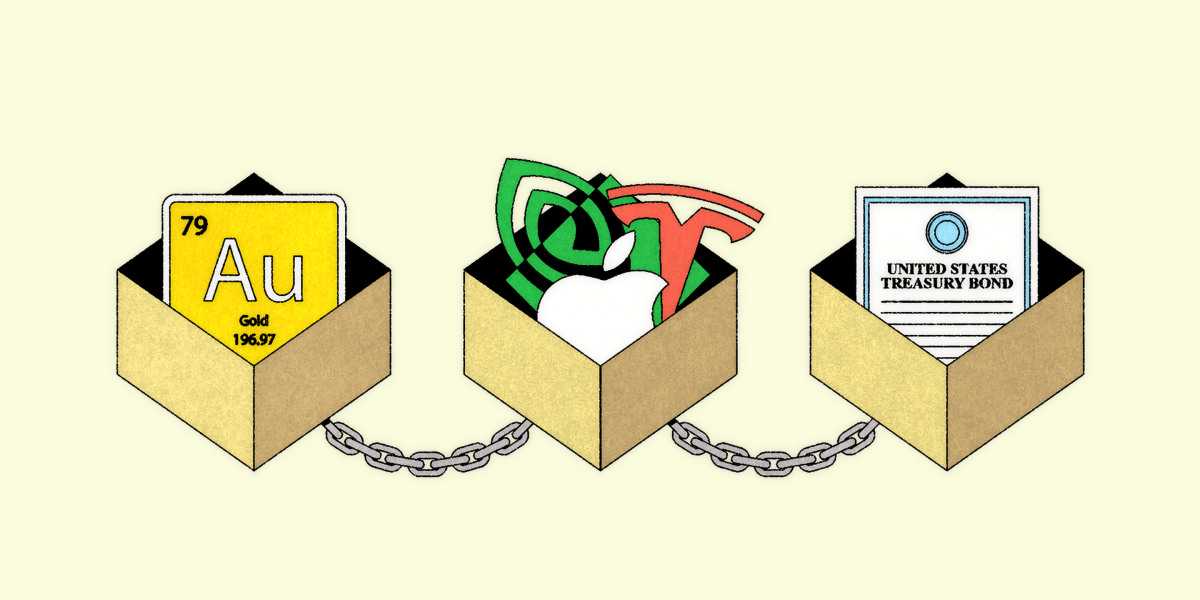
“Imagine you’re a hedge fund and want to buy $1 million of Tesla stock,” says Johann Kerbrat, SVP of Robinhood Crypto. “You buy it on Friday, so you don’t have the money anymore, but you don’t get the shares in your account until Monday. So for three days, you can’t do anything.” It’s not just stocks being tokenized. BlackRock’s BUIDL fund, working with Superstate’s tokenization rival Securitize, offers access to money-market funds and U.S. Treasuries via blockchain, and has already grown to $2 billion in assets under management. Meanwhile,J.P. Morgan is offering tokenized versions of private equity assets on its in-house Kinexys blockchain, in part because the process makes capital calls easier to track and manage.
This is likely just the beginning. Rob Hadick, a partner at venture capital firm Dragonfly Capital, notes that other realms of finance like credit and fixed income are still conducted primarily in pre-digital fashion, with some transactions still made official by means of a fax. A switch to tokenization could enable such transactions to settle faster and more reliably. Hadick says it will also produce savings for banks and brokerages since it will reduce the ranks of back-office staff and disrupt specialized middlemen who handle tasks like loan origination and servicing fees. Meanwhile, for traders of all sorts, tokenized assets will be easier to move across brokerages or post as collateral.
It is still early days, especially in the U.S., where the Securities and Exchange Commission has yet to give the green light to tokenized equities. As of mid-November, the total value of such assets worldwide was about $660 million, according to research site RWA.xyz; the most popular ones include tokenized versions of index-tracking ETFs and Big Tech stocks such as Tesla, Nvidia, and Alphabet.
But that nascent state hasn’t stopped brokerages from pushing forward, including crypto shop Kraken, whose tokenized versions of select U.S. stocks are doing a brisk trade in markets like Brazil and South Africa, where traders still pay hefty commissions that can amount to 10% or more, even as such fees have largely been eliminated in the U.S. Robinhood, meanwhile, got its hands on shares of privately held OpenAI and SpaceX, and has given away tokenized versions of them to European customers.
As for the DTCC, it would be easy to assume the clearinghouse opposes the tokenization wave. Quite the opposite: According to two sources familiar with the company, the outfit is eager to move into blockchain, partly because it offers a potential way to expand into private markets. Asked for comment, the DTCC did not provide details but did suggest it is embracing the technology.
“DTCC believes in the power and potential of tokenization to evolve and modernize market infrastructure. We are actively working to enable capabilities that further our products and services,” said Brian Steele, DTCC’s president of clearing and securities services.
Not everyone is convinced a rush to tokenization is a good thing. Those urging caution include Citadel Securities, which has asked the SEC to adopt a go-slow approach. According to a source close to the firm, the trading giant fears that some crypto-aligned firms want to use the rulemaking process around tokenization to gain exemptions from long-standing consumer protection obligations. The person also expressed concern that a rapid shift could undermine trust in a U.S. equities market that is the biggest in the world and has been fine-tuned for decades.
This concern may not be unfounded. Already, there have been notable discrepancies between the prices of traditional shares of a company’s stock and the prices of tokenized versions offered by the likes of Kraken. Meanwhile, it’s unclear if every firm offering tokenized equities has put in place adequate guardrails when it comes to custody and fiduciary obligations to the customer. What happens, for instance, in the event of a crypto firm going bankrupt while holding tokenized shares of a customer’s stock?
And while every financial institution appears to view blockchain as the technology of the future, they may not agree as to which blockchain. Robinhood, among others, is relying on the open-source Ethereum chain to build out its tokenization business, while J.P. Morgan appears wedded to its own proprietary chain. According to Hadick, the venture capitalist, this situation could slow adoption, since, he says, other big firms like Goldman Sachs will be reluctant to rely on a blockchain controlled by a rival.
Hadick adds, though, that any impasse is unlikely to last long, since “one thing blockchains do well is coordinate trust.”
This article appears in the December 2025/January 2026 issue of Fortune with the headline: “Get ready to own a tokenized portfolio.”
China has fulfilled its initial commitment to buy 12 million metric tons of soybeans from the U.S., but it’s not clear if the trade agreement announced in October can withstand President Donald Trump’s ever-shifting trade policy as American farmers are still dealing with high production costs.
Earlier this month, Trump said he would impose 25% tariffs on any country that buys from Iran, which would include China. Then last weekend he threatened to impose 10% tariffs on eight of America’s closest allies in Europe if they continue to oppose his efforts to acquire Greenland.
So the administration’s trade policy continues to change quickly, and Iowa State University agricultural economist Chad Hart said that could undermine the trade agreement with China and jeopardize the commitment by the world’s largest soybean buyer to purchase 25 million metric tons of American soybeans in each of the next three years.
“Those new tariffs — what does that mean for this agreement? Does it throw it out? Is it still binding? That’s sort of the game here now,” Hart said.
Beijing paused any purchase of U.S. soybeans last summer during its trade war with Washington but agreed to resume buying from American soybean farmers after Trump and Chinese leader Xi Jinping met in South Korea and agreed to a truce.
Treasury Secretary Scott Bessent announced the purchasing milestone China has met in an interview with Maria Bartiromo on Fox Business on Tuesday from the sidelines of a major economic forum in Davos, Switzerland, where Bessent met with his Chinese counterpart, Vice President He Lifeng. Bessent said China remains committed.
“He told me that just this week they completed their soybean purchases, and we’re looking forward to next year’s 25 million tons,” Bessent said. “They did everything they said they were going to do.”
Last fall, preliminary data from the Department of Agriculture cast doubts on whether China would live up to the agreement because it was slow to begin purchasing American soybeans and there is a lag before the purchases show up in the official numbers.
On Tuesday, the USDA data showed that China had bought more than 8 million tons of U.S. soybeans by Jan. 8, and its daily reports indicated that China placed several more orders since then, ranging from 132,000 tons to more than 300,000 tons.
China has shifted much of its soybean purchases over to Brazil and Argentina in recent years to diversify its sources and find the cheapest deals. Last year, Brazilian beans accounted for more than 70% of China’s imports, while the U.S. share was down to 21%, World Bank data shows.
Trump is planning to send roughly $12 billion in aid to U.S. farmers to help them withstand the trade war, but farmers say the aid won’t solve all their problems as they continue to deal with the soaring costs of fertilizer, seeds and labor that make it hard to turn a profit right now. Soybean farmers will get $30.88 per acre while corn farmers will receive $44.36 per acre. Another crop hit hard when China stopped buying was sorghum, and those farmers will get $48.11 per acre. The amounts are based on a USDA formula on the cost of production.
That and uncertainty about trade markets and how much farmers will receive for their crops has even some of the most optimistic farmers worried, said Cory Walters, who is an associate professor in the University of Nebraska-Lincoln’s Department of Agricultural Economics. Soybean prices jumped up above $11.50 per bushel after the agreement was announced, but the price has since fallen to about $10.56 per bushel on Tuesday. So prices are close to where they were a year ago and aren’t high enough to cover most farmers’ costs.
“Everything is changing — the land rental market, the fertilizer market, the seed market and it’s all pinching the farmer when they go to do their cash flows. The ability to make a decision is tougher now because of all the uncertainty in the market,” Walters said.
___
This story has been updated to correct that Bessent spoke on Fox Business, not Fox News.
___
Funk reported from Omaha, Nebraska. Associated Press writers Didi Tang and Fatima Hussein contributed from Washington.
Investors reacted emphatically to President Trump’s insistence that he won’t back down on his plan to take over Greenland: They hate it. The S&P 500 fell 2% yesterday, even though 81% of its companies have beaten their Q4 earnings expectations so far. The dollar fell off a cliff, losing nearly 1% of its value against a basket of foreign currencies. U.S. bond prices weakened modestly. Gold, the safe-haven investment, hit yet another new record high.
The “sell America” trade is in full effect, in other words. S&P futures were up marginally this morning, suggesting that the bloodletting has been put on hold until traders hear what Trump has to say at the World Economic Forum in Davos later today. Trump offered a small ray of hope before he left for Switzerland when he told NewsNation, “We’ll probably be able to work something out.”
The drama has started a global debate about ending America’s “primacy” as the place for investors to hold assets. Increasingly, analysts and economists are talking about hedging against U.S. risk and deploying their capital in markets which are more predictable. The fact that the S&P 500 underperformed last year compared to markets in Asia and Europe is helping make the case. It’s a rerun in 2026, too. The S&P is down 0.71% year-to-date, while the Europe STOXX 600 is up 0.69% and the South Korean KOSPI is up an astonishing 14%.
“Until the US no longer ‘threatens’ with the use of tariffs … the so-called ‘primacy’ of the U.S. remains at risk of further dissolution, and with it an upending of the geopolitical alignments that have upheld markets in recent years,” Macquarie analysts Thierry Wizman and Gareth Berry wrote in a recent note to clients.
Their argument—perhaps one of the most extreme ones that Fortune has ever seen in an investment bank research note—is that when the U.S. goes through a major political convulsion a period of stagnation follows, and thus investors should begin moving their money away from America:
“A line can be traced, for example, from the failure of the U.S. in the Vietnam War and the follow-on decline in U.S, primacy, to the U.S.’s gold reserve depletion, and the subsequent end of the fixed exchange rate system under the Bretton Woods Agreement of 1944. The ‘fiat money’ era that followed was associated with a large decline in the real value of the USD, from 1971 until 1981, as well as a period of inflation and recessions across the 1970s,” they said.
“We should worry about the USD and its relation to other currencies, too. If the reserve status of the USD does depend on the U.S. role in the world—as guarantor of security and a rules-based order—then the events of the past year, and of the past three weeks, in particular, carry the seeds of a reallocation away from the USD, and the search for alternatives, especially among reserve managers. So far, allocators have only found solace in gold, but they may eventually move toward other fiat currencies, too.”
Wall Street got a glimpse of what this might look like when the Danish retirement savings fund AkademikerPension said yesterday that it would sell its $100 million stake in U.S. bonds by the end of the week.
So far, traders are flinching at Trump’s actions. But we haven’t yet seen the kind of full-scale capital flight away from U.S. assets that might, for instance, raise inflation, interest rates or trigger a recession. But the mere fact that Wall Street is discussing it is significant.
Deutsche Bank’s George Saravelos told clients in a note at the weekend: “Europe owns Greenland, it also owns a lot of Treasuries. We spent most of last year arguing that for all its military and economic strength, the U.S. has one key weakness: it relies on others to pay its bills via large external deficits. Europe, on the other hand, is America’s largest lender: European countries own $8 trillion of US bonds and equities, almost twice as much as the rest of the world combined. In an environment where the geoeconomic stability of the western alliance is being disrupted existentially, it is not clear why Europeans would be as willing to play this part. Danish pension funds were one of the first to repatriate money and reduce their dollar exposure this time last year. With USD exposure still very elevated across Europe, developments over the last few days have potential to further encourage dollar rebalancing.”
The CEO does not stand by it but Saravelos’s colleagues may be more sympathetic. Jim Reid and his team, who religiously send an early morning email summarizing market action, did not send their email this morning. The bank told Fortune, “Deutsche Bank Research is independent in their work, therefore views expressed in individual research notes do not necessarily represent the view of the bank’s management.”
In fact, the idea that Europe might move out of U.S. assets is a commonplace inside investment banks right now. At UBS, Paul Donovan told clients earlier this week, “The implications of additional tariffs are more U.S. inflation pressures and a further erosion of the USD’s status as a reserve currency. So far, bond investors do not seem to be taking the threats too seriously.”
This morning he said that the most likely scenario wouldn’t be investors selling U.S. debt but simply refusing to buy new debt, thus reducing the flow of funds that the America is dependent on.
In a tariff war, one under-discussed weapon at Europe’s disposal is its Anti-Coercion Instrument: It has the power to ban U.S. services businesses from the E.U.
“U.S. services exports to the E.U. were $295B in 2024, equivalent to 0.9% of US GDP, suggesting the harm could be much greater if the E.U. pulled this relatively new lever at its disposal than if it responded simply with tariffs, though its economy would be hurt more too,” Pantheon Macroeconomics analysts Samuel Tombs and Oliver Allen told clients.
“In short, nobody would win from a new trade war, but the E.U. has ample scope to harm the U.S. if the Greenland situation escalates,” they said.
Here’s a snapshot of the markets ahead of the opening bell in New York this morning:
S&P 500 futures were up 0.19% this morning. The last session closed down 2.06%.
Gen Z is sometimes criticized for its proclivity toward slang or its approach to the workforce. But this generation is facing challenges very different from those of their elders. The young adults are slowing down their pursuit of the American Dream of finding “the one,” owning a home, and having kids.
But it’s not because Gen Z doesn’t want to find love, according to a report by Match Group and Harris Poll shared exclusively with Fortune. In fact, their survey results from 2,500 randomly selected U.S. adults shows 80% of Gen Z say they believe they’ll find true love, making them the most optimistic generation about finding love. Yet, only 55% of Gen Z feel like they’re actually ready for partnership.
Therein lies the “readiness paradox,” a phenomenon that paralyzes Gen Z from taking that initial step toward a serious relationship, and subsequently toward marriage and having children. While more than half of Gen Z says they feel lonely despite having online connections, 48% of Gen Z women report feeling additional pressure to enter a relationship for “the right reason,” rather than solely to avoid loneliness. This cycle traps young people in loneliness, which is amplified by social media pressures, like the dread of “hard-launching” a relationship.
“It makes total sense to be stuck in that paralysis of, I want this, I want a relationship, but I don’t feel ready for it, and so I don’t do it,” Chine Mmegwa, head of strategy, corporate development, and business operations at Match Group, told Fortune. “What they’re afraid of is failing. What they’re afraid of is that the other person on the other side isn’t ready.”
Match Group defines this phenomenon as a “self-reinforcing cycle” in which Gen Zers set a high bar for readiness for a relationship, then feel anxious about being alone, then crave new relationships, believe they’re not ready for it and wait longer, experience more loneliness, and then the cycle repeats.
And some of this cycle stems from the fact that Gen Z prioritizes investing in personal growth, therapy, and defining success over other generations. Nearly 60% of Gen Z women say therapy is essential to relationship success, according to the Match Group report, and almost 50% say that setting and respecting healthy boundaries is a prime indication of being ready for a romantic relationship. And as a result, they may be more likely to delay dating.
This report serves as a launchpad for Match Group and other dating app companies to rethink how to best serve Gen Z consumers, some of which had ditched the apps when they did have features they could relate to. But now Tinder has introduced more casual modes for Gen Zers to meet each other, like through its double-date feature and college mode where the generation can meet more people with the same relationship goals in mind.
That’s a step in the right direction for a generation that is reverting back to a desire to meet in real life.
“This is the way Gen Z wants to connect,” Match Group CEO Spencer Rascoff previously said. “They want to vibe their way through meeting people.”
Reprioritizing milestones
Unlike how some other reports about Gen Z love life have portrayed the generation, they’re not rejecting romance. Instead, they’re reshuffling life’s timeline amid economic and social strains.
Match Group’s report shows nearly half of Gen Z say they’re not ready for relationships now, and 75% aren’t rushing into one. But, again, 80% say they believe they’ll find true love.
“They believe that when they work on themselves, their relationships become stronger,” according to the Match Group report. “And they are more likely to wait until they can put their best selves forward to give themselves the highest chance of relationship success.”
Although that may sound like worrisome news for a company trying to appeal to the latest generation, Mmegwa didn’t shy away from the challenge.
Gen Z is “still looking to our products to solve real big issues. And they are still looking to our products and to dating to solve the things that are most important to them” she said. “It’s just a question of when and how they will use our products that [is] very different from prior generations.”
This generation also has a very different view of how happy their own parents’ and grandparents’ relationships are: Only 37% described those relationships as happy, and 34% of Gen Z women also feel working through issues from past relationships indicates readiness, according to the report.
Social media’s vicious cycle
Being highly inundated by and invested in social media has also exacerbated the readiness paradox. While 46% of Gen Z “soft-launch” relationships versus 27% overall, 81% see it as an ironclad agreement, and dread backlash from a public failure.
It’s different from how other generations view making relationships public: “You can also hard launch and then delete the photos the next day, and it’s okay,” Mmegwa said.
But still, for Gen Z, relationship performance pressure creates a cycle: High readiness bars lead to loneliness, which ultimately leads to them pursuing lower-stakes or casual relationships that rarely escalate into something more serious.
Instagram exacerbates the stall. While 46% of Gen Z “soft-launch” relationships versus 27% overall, 81% who hard-launch see it as an ironclad commitment, dreading public failure. Mmegwa highlighted this generational shift: “You can also hard launch and then delete the photos the next day, and it’s okay.” This “performance pressure” creates a cycle: High readiness bars lead to loneliness (over 50% feel it despite online ties), prompting low-stakes connections that rarely escalate.
“For us, the focus is on how we bring people together and encourage them to return to in-person connections,” Hinge CEO Jackie Jantos previously toldFortune. Hinge is part of Match Group, along with Tinder, Match, and OkCupid.
How Match Group plans to address the readiness paradox
Match Group is planning to meet Gen Z where they are: They’ll keep introducing “low-pressure” tools, like Tinder’s Double Dating feature and College Mode.
“The idea here is really around helping our users have the power to control what they’re looking for in a given moment and be able to find that more easily,” Cleo Long, Tinder’s senior director of global product marketing, previously told Fortune.
Using the report as a roadmap for new product plans, future features could include features like readiness signals, Mmegwa said, and more curated matches will be important.
“It’s no longer a speed and volume game,” she said. “It’s [about] truly making our algorithms help you know yourself better, and then help you know the person on the other side of the connection better.”







 Politics8 years ago