
Business
AI rivals like OpenAI, Nvidia, and Oracle are collaborating to build ‘Stargate’—but a Yale expert says it violates 135 years of antitrust law
On the evening of Jan. 21, 2025, President Trump on his first full day in office unveiled what he characterized as a “monumental undertaking” that would prove an exemplar of economic triumphs to come, and that he himself orchestrated. From a podium framed by the Roosevelt Room’s white-columned fireplace, Trump announced the formation of the Stargate Project, a head-spinningly huge, $500 billion joint venture that he lauded as “the biggest AI infrastructure project by far in history, all taking place right here in America … that will ensure the future of technology.” Shoulder-to-shoulder to the left of the POTUS stood three superstars of the AI firmament representing, in the host’s words, “a massive group of talent and money”—the principal Stargate partners, Oracle executive chairman Larry Ellison, OpenAI chief Sam Altman, and founder and CEO of Japan’s SoftBank, Masayoshi Son.
The first of the guests to speak was Ellison, who declared that Stargate would revolutionize health-tech by building applications that enable the sharing of electronic records “so that a doctor at an Indian reservation would be able to see how a doctor at [New York’s] Memorial Sloan Kettering or at Stanford would treat the patient,” as well as contribute to the development of wonder drugs that would vaccinate humans against cancer. Next up was Son, who gushed that “this is the beginning of the golden age in America” and assured Trump that “we wouldn’t have decided [to go forward] unless you won.” Altman hailed Stargate “as the most important project of this era,” and turning toward Trump, asserted: “We wouldn’t have been able to do this without you.”
A press release that OpenAI issued the same day detailed the full roster of Stargate participants. Besides the ChatGPT purveyor, Oracle, and SoftBank, it encompasses three additional colossi of the new wave of deep learning, Microsoft, Nvidia, and Arm, as well as MGX, the AI investment group backed by Abu Dhabi’s sovereign wealth fund.
What’s stunning about the venture isn’t so much the stupendous scale of investment—that’s what AI is all about—but that six leaders in the field that are competitors in different products to different degrees, and often fierce opponents, could unite to form a single company. Wasn’t this something like allowing GM, Ford, Toyota, suppliers Bosch and Lear, and auto software provider Continental AG, to collaborate on building immense car factories? And furthermore, is this not what more than 100 years of antitrust law have been designed to prevent? Namely, the potential competition-flattening effects of an enterprise that pools capital, technology, and purchasing clout on behalf of a half-dozen rivals?
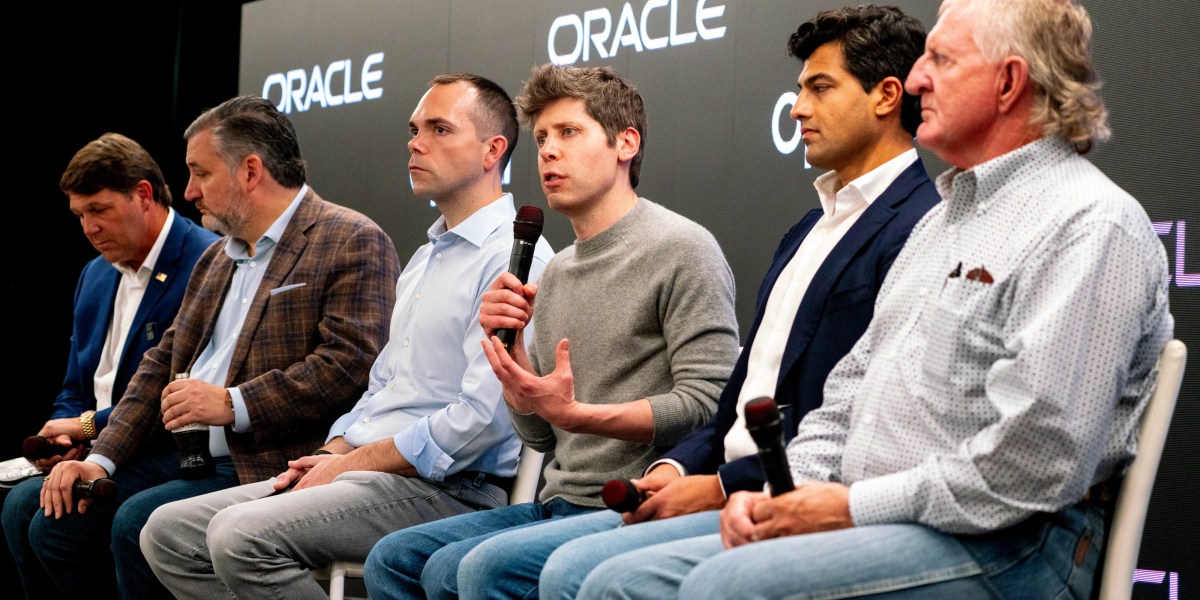
However, America has witnessed no outpouring of outrage from legal experts and legislators. Nor have regulators challenged the sprawling joint venture. The reaction in Congress ranges from high praise from Sen. Ted Cruz of Texas, host to Stargate’s biggest facilities, to an almost total lack of comment from everyone else. At a Senate Commerce, Science, and Transportation Committee hearing on May 8 headlined “Winning the AI Race,” Altman and Cruz extolled the Stargate model, and not a single senator questioned the legality of the construct. The term “antitrust” appears nowhere in the three and a half hour session’s transcript.
The highest-profile slap at Stargate came from the biggest name not in the club, Elon Musk. The day after the announcement, the then DOGE head, working alongside Trump in the White House, trashed his boss’s prize deal, charging on X that the group really “doesn’t have the money” to fund Stargate. Musk also reposted an image of a crack pipe, accompanied by a joking allegation that longtime foe Altman and his associates were freebasing, as the original poster put it, “to come up with their $500 billion number on Stargate.” Those broadsides infuriated the president’s staff, and marked the start of rising tensions between the Tesla CEO and Trump, leading to Musk’s departure from DOGE in May.
Still, Musk effectively did the Stargate founders a favor by not mentioning the real threat they pose to AI’s progress or the real reason Ellison, Son, and Altman are likely so grateful to Trump. He’s handing them an unprecedented gift by granting their companies wide freedom to join forces where they’d normally be pummeling one another in product after product. Put simply, the Stargate model may be great for them, but a downer for everyday and corporate customers by doing what cartels always do—boost prices, quash choice, and hamper innovation.
A Yale researcher provides the sole deep dive into the dangers of Stargate
So far, only one article in either the press or academia has provided a detailed analysis of how Stargate threatens to stifle competition. It’s the piece “Stargate or StarGatekeepers? Why this Joint Venture Deserves Scrutiny,” authored by Madhavi Singh, a researcher at Yale Law School and deputy director of Yale’s Thurman Arnold Project, an initiative dedicated to the study of antitrust issues. Singh’s paper is scheduled for publication in a forthcoming issue of the Berkeley Technology Law Journal. But a draft is posted on the Social Science Research Network (SSRN), and she shared a revised version with Fortune.
Singh argues that the Trump administration has wrongly veered from rigorous enforcement of the Clayton and Sherman competition laws toward extremely light-touch regulation. ”The joint venture has clear federal backing, which makes it unlikely the federal authorities would investigate it,” she told me in a phone interview. The emphasis, she argues, has shifted to advancing two objectives: first, supporting U.S. AI giants as “national champions in the U.S.-China trade war,” and second, allegedly protecting our national security by enabling these “flag-bearers” to work in concert on the theory that their teamwork will empower America to make the crucial AI components we need, including those deployed in our defense industries, at home.
Singh’s language is as blunt as her legal arguments are sober and precise. “The latest and most flagrant example of the government’s enabling private sector companies to expand and entrench their power under the guise of protecting American tech supremacy,” she writes, “was the launch of Project Stargate.”
Singh’s analysis raises the broader question of whether the joint ventures, equity investments, purchase agreements, and other arrangements that are tying together so many rivals in AI, and that are so unusual in other industries, merit scrutiny under the competition laws.
Stargate’s exact structure is unclear, but it’s pushing the biggest current data center build-out in all of AI
As Singh points out, several of the Stargate partners engage in the same or similar businesses. And this overlap will likely guide how the roles get divided in this epic data center campaign.
It’s important to note that Stargate has released little information on its ownership shares, governance, and the participation of the various partners. What we do know comes mainly from the initial OpenAI press release. It describes Stargate as a freestanding “new company” that “will deploy $100 billion immediately”—the money Musk claimed it didn’t have—and comprises four shareholders, SoftBank, OpenAI, Oracle, and MGX of Abu Dhabi. Oracle, OpenAI, and Nvidia “will collaborate closely to build and operate this computing system.” The implication is that OpenAI and Oracle, two players big in the outfitting of data centers as well as engaging in other parts of the AI “stack,” would purchase or lease the chips and systems that fill the data centers, and operate them, and that Nvidia, the largest GPU provider by far, would supply its top custom chips.
What about Microsoft? It apparently won’t offer any capital expenditures or computing capacity at Stargate campuses like OpenAI and Oracle, but it’s a “key technology partner” that could apparently rent computing power in the centers for such uses as running its Copilot product. The part to be filled by Arm, a publicly traded company that licenses IP to software providers, isn’t spelled out.
Kyle Grillot—Bloomberg/Getty Images
One Stargate megaproject was already in the works at the time of the White House announcement: A behemoth in Abilene, Texas, slated to cover roughly the size of Manhattan’s Central Park and harbor 1.2 gigawatts in power capacity, sufficient to light and heat as many as 1 million homes. Then in late September, OpenAI trumpeted plans for a staggering array of new facilities under the Stargate umbrella. The announcement implies that the different sites are being developed by varying sets of partners within the consortium. Oracle is supplying the computing capacity in Abilene, Nvidia is furnishing racks of superchips, and OpenAI this time is a customer, deploying the GPUs and integrated AI software to advance its next-gen research.
The September release also disclosed that a $300 billion–plus program in which Oracle will furnish 4.5 gigawatts of capacity for three data centers run by OpenAI, this time in operator mode, will also fall under the consortium. Their locations: Texas, New Mexico, and, as later revealed, rural Michigan—by the way, the Great Lakes State is giving that a project a big tax break. Two other sites comprising another 1.5 gigawatts, one each in Ohio and Texas, will rise over the next 18 months, erected by an arm of SoftBank that builds and wires a data center’s physical shell, and connects the facility to the local power grid. OpenAI has named SoftBank as its collaborator, apparently signaling that the GPT inventor and the Japanese conglomerate will act as partners in fitting out and operating the centers. OpenAI will likely be its own customer as well.
All told, those projects, and a slate of smaller ones, encompass a $400 billion investment in AI infrastructure and seven gigawatts, sufficient to power half the households in the state of Georgia. OpenAI further stated in the fall release that it should hit its commitment goal of $500 billion, covering 10 gigawatts, by the close of 2025. Even by AI standards, that half-a-trillion figure is a grabber. It represents roughly twice the cost of King Abdullah Economic City in Saudi Arabia and the U.S., Russia, Japan, Canada and Europe-funded International Space Station combined.
Singh identifies the ways Stargate could effectively forge near-monopolies, and how its practices may breach today’s antitrust laws
In her article, Singh furnishes a primer on the “AI stack,” relating that it consists of three layers. The first is the foundation of “infrastructure” that itself covers two areas, chips such as Nvidia’s GPUs and TSMC’s CPUs, and cloud services that supply the computational juice, led by Amazon’s AWS and Microsoft’s Azure. Occupying the second tier are the “models” such as GPT. Those models power the third and top layer, the user-facing apps such as ChatGPT, focused on consumers, or the likes of Microsoft Copilot for the B2B crowd.
Singh avows that competitors, choices, and new offerings are plentiful in the second two “upper” areas, models and apps—a prime example is the challenge China’s DeepSeek and sundry other entrants are mounting versus ChatGPT in open-source AI. The menace to competition, says Singh, comes at the infrastructure stratum. “The competition is only at the level of the models and apps,” she writes, adding that, by contrast, chips and cloud are highly concentrated. She notes that three players, Amazon, Google, and Microsoft, control 70% of cloud services, and that Nvidia holds between 80% and 95% of the market for GPUs, while TSMC accounts for 60% of all chip production.
Infrastructure—specifically chips and cloud—is precisely where Stargate is so powerful, and shrinks the sparse field by putting several of the few players on the same team, warns Singh. Oracle, Microsoft, and now OpenAI all play big-time in a lean field of cloud providers; those three are now insurgents in the AI chip business, where fellow consortium members Nvidia and Arm are dominant incumbents.
Singh reviews where Stargate could violate both of the two reigning antitrust statutes. First, she invokes the Clayton Act. “It states that a court will block a joint venture if it shows probable harm to future competition,” she says in the paper. “It doesn’t have to be showing harm yet, but potential damage of loss from head-to-head competition, such as higher prices, reduced choice, and reduced innovation.”
By squeezing the number of independent players, Singh argues, Stargate also raises the risk that they’ll “work together to protect their competitive moats.” She cites the example of Oracle versus Microsoft. In the past, she relates, Oracle exerted pressure on Microsoft and the other hyperscalers by charging lower prices and offering a flat-fee structure. “Oracle has been a disruptive force in the market. Now it may adopt Microsoft’s pricing strategy,” Singh states. “That would raise prices and lower options for customers. Stargate risks elimination of a maverick,” meaning Oracle. Arm now provides important IP software to Nvidia. Will Stargate discourage Nvidia from developing its own IP, and challenging its newfound partner?
The same temptation to divide markets and align interests under Stargate’s shield lurks in chips as well as cloud, says Singh. Today, Microsoft, Google, and Amazon are all developing their own custom offerings in both GPUs and CPUs to escape the strongholds respectively of Nvidia and Arm. Because of Stargate, “Microsoft might stop challenging Arm and Nvidia in chips,” she writes. For Singh, Stargate blunts the essence of the Clayton Act by potentially eliminating competition down the road. She adds that the FTC blocked a proposed merger between Arm and Nvidia in 2021 precisely because even though they didn’t make the same types of chips, their union would erase a potential competitor. If left independent, each might be tempted to enter the other’s market, providing more choices and lower prices to chip customers.
The Sherman Act bans agreements “in restraint of trade.” “Now, Arm, Nvidia, and Microsoft separately decide what types of chips they produce [or design],” Singh asserts. “The Sherman Act prohibits activity that deprives the market of independent centers of decision-making and therefore the diversity of economic interests,” asserts Singh. “This is precisely what Stargate does.”
How Stargate could ‘cartelize’ Big Tech
The chief argument against Singh’s take: Right now, it appears that the AI giants, and notably the Stargate members, are fighting hard to capture one another’s turf. A key example: the hyperscalers’ drive to develop and market their own GPUs in a gambit to escape Nvidia’s near-monopoly prices—a quest they are following separately, at least for now. OpenAI got into data centers to reduce its reliance on a small set of huge customers longing to hammer its prices, especially its Stargate partner Microsoft, and Nvidia is courting such “neoclouds” as CoreWeave to lessen its dependence on the dominant hyperscalers.
But for Singh, the temptation to coordinate will prove irresistible for a simple reason—it’s the ticket to maximum profitability. “All of these tech markets seem initially competitive,” she told me in our interview. “But it takes a bit of time for anticompetitive barriers to get erected. A lot of these players realized that instead of competing in each other’s markets, it makes economic sense to earn monopoly profits, and give each other a share by giving out such favors as IP licenses that are really designed to reward competitors for staying in their own lanes. The idea is, ‘I’ll take the monopoly in one kind of chips, and you take the monopoly in IP for those or another kind of chips.’”
Singh is virtually a lone voice challenging Stargate as a downer for competition. If the Trump paradigm would make a few protected players far richer, and minimize the payoff for our citizens and producers, it’s a bad deal for America.