Connect with us

Business

One of the world’s most popular economists on why AI is ‘undoubtedly going to crash:’ It’s built on ‘digital lettuce’—and the U.S. will be just fine anyway

Published

on


David McWilliams is shaking off the jet lag on his trip from Ireland to Los Angeles as he opens a Zoom call and logs on with Fortune. The widely read (and listened to) economist, with hundreds of thousands of followers on X and an economics podcast with claims to be Europe’s most popular, McWilliams is also, frankly, a very nice and affable man. He regales Fortune with tales of his old adventures in New York City in the late 1980s, when he spent a summer working at the Red Lion Inn on Bleecker Street, a job he got from “an uncle of a friend of mine.”

A Dubliner, McWilliams landed in the U.S. just 24 hours before talking to Fortune, as he was starting on a nationwide tour for the release of his History of Money, a widely acclaimed, international bestseller released in Europe in 2024. (In a blurb, Bono called it a “swashbuckling epic of grand sweeps and tight close-ups.”) McWilliams told Fortune he already sensed something different about America: “you kind of feel the boominess of the place, right?” He related his astonishment at getting in an Uber and being bombarded with a driver’s speculative initiatives. “Within two minutes, he was talking about the stock market, Bitcoin, AI, Nvidia, the whole thing. And I’m, like, driving down Sunset Boulevard with this guy, right?”

McWilliams added you wouldn’t see such a thing in Ireland, and “the way in which finance permeates the society” in the U.S. is “very, very different” from Europe. “The universality of money in the United States is something that Europeans find fascinating,” he said, noting it was the same way going all the way back to the 1840s and the travel writings of the Frenchman Alexis de Tocqueville. When do Tocqueville arrived in America, McWilliams said, “his whole idea was like, ‘My god, these people are obsessed with money.’ Europeans were obsessed with other stuff, you know, hierarchy.”

And that is how McWilliams, one of the world’s most closely followed popular economists, said matter-of-factly that America’s “boominess,” led by its piling into the artificial intelligence (AI) trade, is “undoubtedly going to crash.” Not only is it the case “AI doesn’t create any jobs,” he noted, but the key investments driving the boom are rapidly perishable. The massive investment in graphics processing units (GPUs) is problematic, McWilliams said, because it’s “digital lettuce,” prone to wilting before too long. “You’re investing in something that is a perishable good.”

“Technological change suggests that if you buy a GPU today, the chip is going to be outdated next year,” McWilliams explained, adding AI companies are “investing huge amounts of money in lettuce, which is going to go off now,” he said, referring to his mother’s expression for when a head of lettuce, well; went off.

McWilliams was wading into a debate here that long-time markets watcher Ed Yardeni calls “the useful life debate,” and that famous Big Short investor Michael Burry claims is the tip of a giant iceberg threatening the whole market. Burry, in particular, has noted the lengthening of depreciation schedules as suspicious, with big tech not marking to market on their unprofitable investments in McWilliams’ “digital lettuce.” Ultimately, Yardeni wrote on November 17, he does not believe this digital lettuce is due to wilt as rapidly as Burry and McWilliams say: “Data Centers existed before AI caught on in late 2022, when ChatGPT was first introduced. During 2021, there were as many as 4,000 of them in the US as a result of the rapidly increasing demand for cloud computing. Many are still operating with their original chips.” (McWilliams’ interview with Fortune took place before Nvidia disclosed its latest quarterly earnings, which seemed to assuage market fears about an imminent bubble bursting.)

Still, McWilliams told Fortune that even in the event of a crash, he isn’t too worried about the U.S. as the innovation center of the world. A big reason why has to do with his Uber driver in Los Angeles. And it’s a key part of why America is such a key player in the history of money.

The iconoclast society and the secret of innovation

McWilliams has no time for most economics texts, describing them as just too boring for the general public. He said he’s “always thought that the key to understanding economics is to grab economics away from second-rate mathematicians and put it back into the realm of storytelling.” He believes humans are “hardwired to tell stories, we are not hardwired to explain the world through mathematics.” And defining money as a technology, like fire, that humans invented long ago and have shaped and reshaped through millennia, was the spark for his new book.

He describes how anthropologists and biologists refer to humans as a “pyrophytic species,” which adapted to and was constantly adapting along with the technology known as fire. Money was invented to function the same way, he believes, and that’s why he expressed confidence in America coming through whatever crash lurks ahead. He sees the U.S. as an “iconoclast society” at heart, driven by its chaotic—but ultimately innovative—nature.

McWilliams explained he sees Europe as a society run like an “insurance policy,” designed to mitigate risk, whereas the U.S. is defined by embracing it. He said he sees the innovation that produces something like the AI boom is a feature, almost a byproduct of this attitude. “Acceptance of risk is why the U.S. is much more innovative than Europe,” he said, arguing “this innovative spirit is rooted in American history, going back to Alexander Hamilton, who established a great banking system and currency, allowing the revolutionary economy to borrow in its own paper within four or five years.”

McWilliams said the U.S. seems to understand innovation is “proximate”—the combination of small innovations, holding up his smartphone to the camera and noting it’s a proximate product, combining a phone, computer, camera and telephone, “which Europeans would never have conceived of.” He used the metaphor of a hammer and a nail, saying a nail is not very useful unless it’s used in combination with a hammer.

In Europe, on the other hand, “the whole idea is you mitigate risk all the time, right? You go to public health, you go to public schools, you get a job, can’t get fired, all that sort of stuff.” McWilliams added risk for Europeans “is something that is taken by weirdos in the United States,” adding risk is “the defining psychological state of the American.”

Better marketing for creative destruction

McWilliams said a big reason his book has been translated into so many languages (21 of them, to be exact) is to get across the idea the legendary Austrian economist Joseph Schumpeter—even though he was a “bizarre” character—”had the right idea, that basically, the economy is a large evolutionary mechanism, and the forces of evolution are the forces that propel innovation, and the forces of innovation are the forces that propel society and wealth creation.” When it’s pointed out to him that Schumpeter’s famous phrase, “creative destruction,” is a bit of a difficult sell, McWilliams agreed: “he needed a better marketing department, but his ideas were right.” (The Nobel Committee, based in Norway offered a tacit endorsement of Schumpeter in 2025, awarding the economics prizes to several economists who further unpacked the concept of “creative destruction.”)

Returning to the subject of a potential AI bubble popping in the U.S., McWilliams said he’s not concerned about AI companies growing “too big to fail,” a concern after recent remarks from OpenAI executives. The only real threat to the broader economy, according to McWilliams, would be if the AI industry successfully convinces the political administration chips are “strategic assets” or a matter of “national security”—linking them to the military industrial complex.

McWilliams ruled this out due to political sentiment. He suggested if President Donald Trump were to run again, his highly evolved “populist instincts” would recognize that being “against Silicon Valley is an absolute winner” electorally.

“One thing I’ve understood about America,” McWilliams added, is they by and large “don’t hate rich people … it’s the professional class they can’t stand.” The rich aren’t something to be hated in America, he said, because of the cultural attitude toward money: “Money is a great leveler.”


Source link

Continue Reading

Business

OpenAI COO Brad Lightcap says code red will ‘force’ focus, as ChatGPT maker ramps up enterprise push


Published

on


OpenAI’s Chief Operating Officer Brad Lightcap says the company’s recent ‘code red’ alert will force the $500 billion startup to “focus” as it faces heightened competition in the technical capabilities of its AI models and in making inroads among business customers.

“I think a big part of it is really just starting to push on the rate at which we see improvement in focus areas within the models,” Lightcap said on stage at Fortune’s Brainstorm AI conference in San Francisco on Tuesday. “What you’re going to see, even starting fairly soon, will be a really exciting series of things that we release.”

Last week, in an internal memo shared with employees, OpenAI CEO Sam Altman said he was declaring a “Code Red” alarm within the organization, according to reports from The Information and the Wall Street Journal. Altman told employees it was “a critical time for ChatGPT,” the company’s flagship product, and that OpenAI would delay other initiatives, including its advertising plans to focus on improving the core product.

Speaking at the event on Tuesday, Lightcap framed the code red alert as a standard practice that many businesses occasionally undertake to sharpen focus, and not an OpenAI specific action. But Lightcap acknowledged the importance of the move at OpenAI at this moment, given the growth in headcount and projects over the past couple of years.

“It’s a way of forcing company focus,” Lightcap said. “For a company that’s doing a bazillion things, it’s actually quite refreshing.”

He continued: “We will come out of it. I think what comes out of it that way will be really exciting.”

In addition to the increasing pressure from Google and its Gemini family of LLM models, OpenAI is facing heightened competition from rival AI lab Anthropic among enterprise customers. Anthropic has emerged as a favorite for businesses, particularly software engineers, due to its popular coding tools and reputation for AI safety.

Lightcap told the audience that the company was focused on pushing enterprise adoption of AI tools. He said OpenAI was developing two main levels of enterprise products: user-focused solutions like ChatGPT, which boost team productivity, and lower-level APIs for developers to build custom applications. However, he noted the company currently lacks offerings in the middle tier, such as tools are user-directed but also have deep integration into enterprise systems, like AI coding assistants that employees can direct while tapping into the organization’s code bases. He said the company was also prioritizing further investments to enable enterprises to tackle longer-term, complex tasks using AI.


Source link

Continue Reading

Business

AI isn’t the reason you got laid off (or not hired), top staffing agency says

Published

on


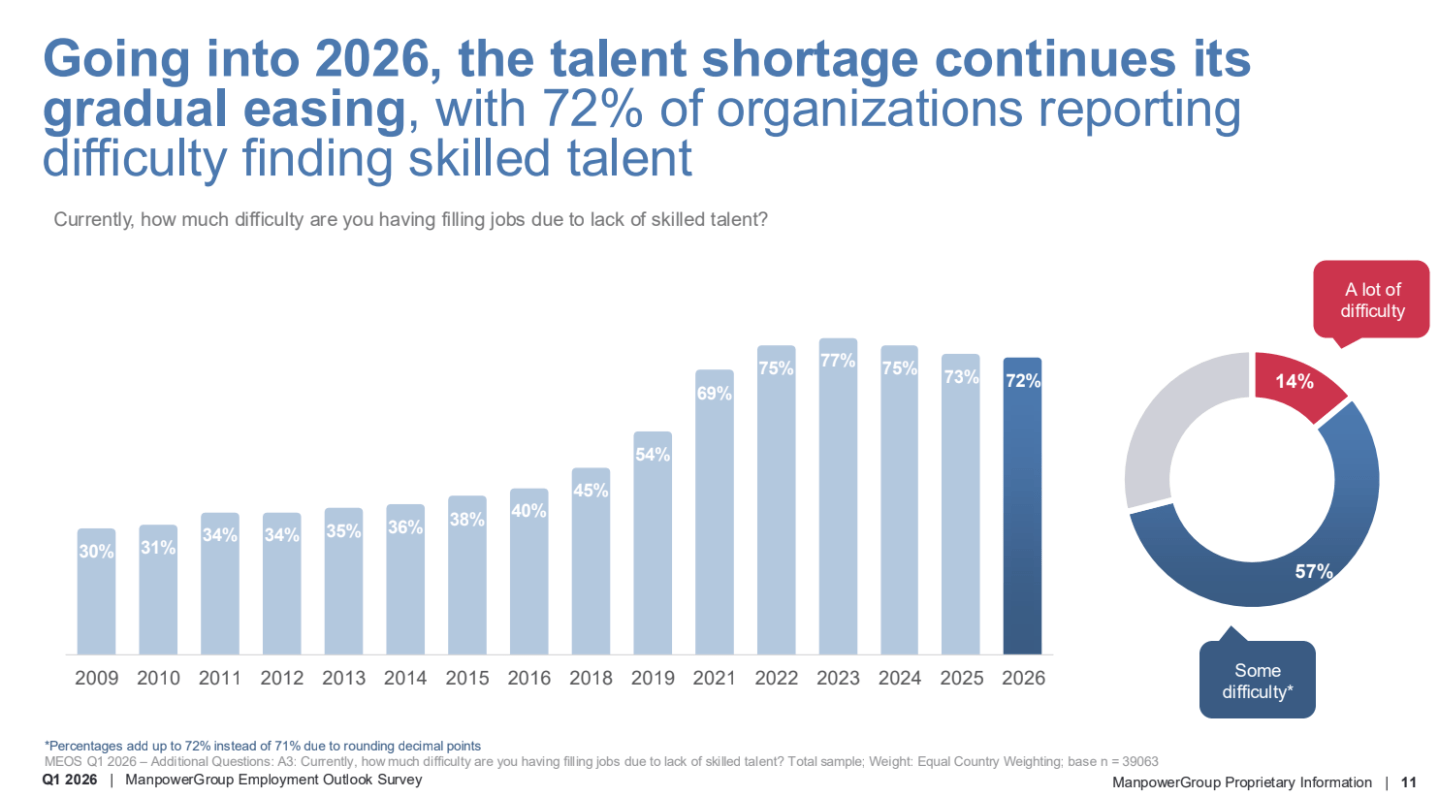
AI is not the main reason most people are losing their jobs right now; weak demand, economic headwinds, and skill mismatches are doing more of the damage, according to the latest quarterly outlook from ManpowerGroup, one of the largest staffing agencies in the world. While automation and AI are surely reshaping job descriptions and long‑term hiring plans, the first-quarter 2026 employment outlook survey suggests workers without the right mix of technical and human skills are far more exposed than those whose capabilities match what employers say they need.​

ManpowerGroup claims its Employment Outlook Survey, launched in 1962, is the most extensive forward-looking survey of its kind, unparalleled in size, scope, and longevity, and one of the most trusted indicators of labor market trends worldwide. Looking ahead to the turn of the year, the survey says employers around the globe still plan to hire, but at a slower pace and with fewer additions to headcount than earlier in the pandemic recovery.

Globally, 40% of organizations expect to increase staffing in the first quarter and another 40% plan to keep headcount unchanged, yet the typical company now anticipates adding only eight workers, down steadily from mid‑2025 levels. Large enterprises with 5,000 or more employees have cut their planned hiring roughly in half since the second quarter of 2025, underscoring just how much large employers are tightening belts even as they keep recruiting in priority areas.​

Regional patterns are uneven. North America’s employment outlook has dropped sharply year on year to one of its weakest readings in nearly five years, while South and Central America and the Asia Pacific–Middle East region report comparatively stronger optimism. Europe’s outlook is muted, with only a small decline from last year, suggesting that many employers there are in wait‑and‑see mode rather than embarking on aggressive expansion or deep cuts.​

Talent shortage, not job shortage

Despite cooling hiring volumes, 72% of organizations say they still struggle to find skilled talent, only slightly less than a year ago, reinforcing the idea that there is a talent shortage, not a work shortage. Europe reports the most acute pressure, with nearly three‑quarters of employers citing difficulty filling roles, while South and Central America report the least, though two‑thirds of companies in that region are still affected.​

The survey suggests shortages are particularly severe in the information sector and in public services such as health and social care. In those fields, three‑quarters of organizations report difficulty finding the right people, even as some workers in adjacent roles complain of layoffs and stalled careers, highlighting the growing gap between available workers and the specific skills employers require.​

AI skills are scarce, but AI isn’t the axe

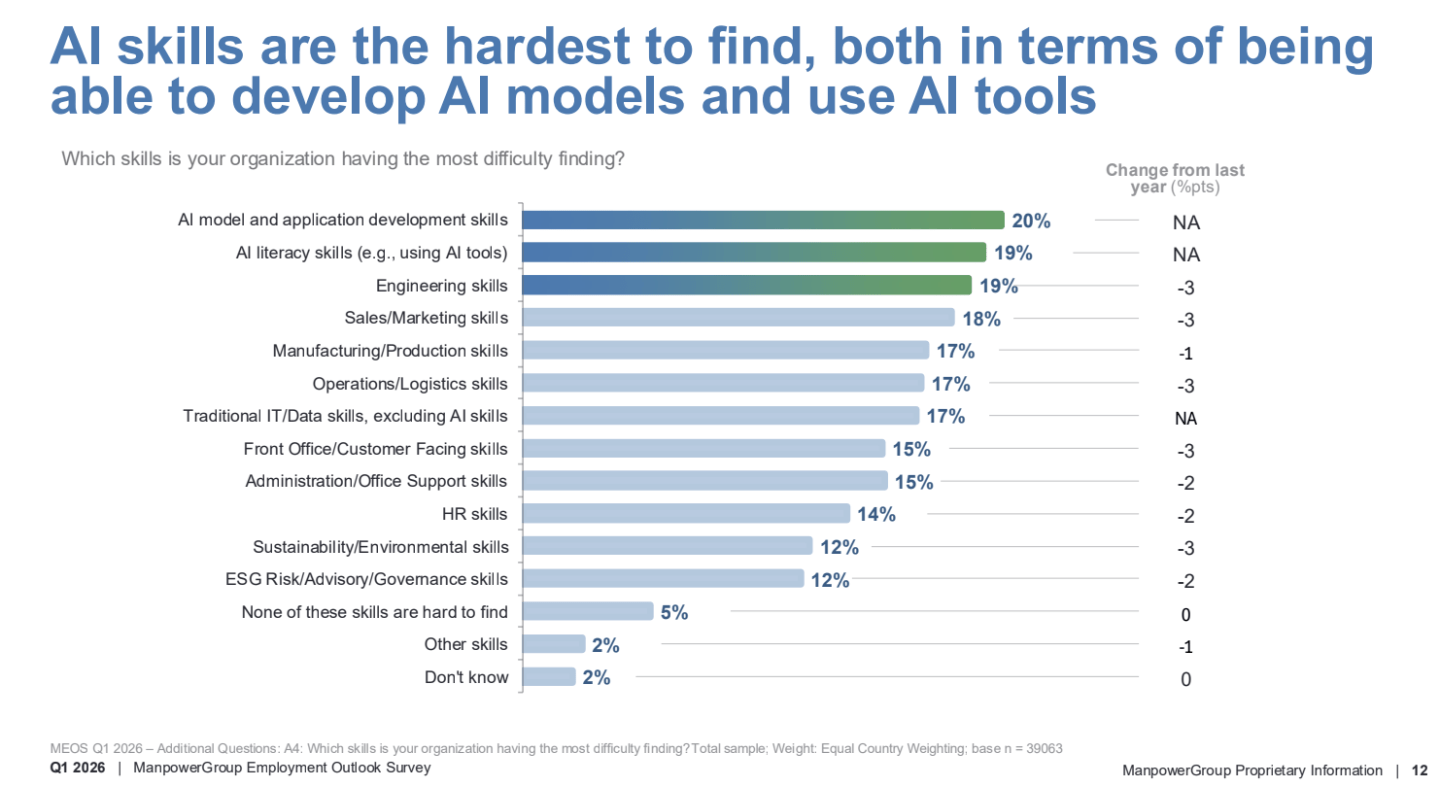
If AI were the primary driver of layoffs, employers would not simultaneously report that the hardest capabilities to find are AI‑related. Yet 20% of organizations say AI model and application development skills are the most difficult to hire for, and another 19% say the same about AI literacy, meaning the ability to use AI tools effectively; in Asia-Pacific and the Middle East, these shortages are even more pronounced.​

At the same time, when firms do reduce staff, they mostly blame the economy, not automation. Employers who expect to downsize cite economic challenges, weaker demand, market shifts, and reorganizations as the top reasons for cuts, with automation and efficiency improvements playing a secondary role and affecting only certain roles or functions. Changes in required skills appear at the bottom of the list of stated reasons for staff reductions, suggesting that technology is transforming jobs more often than it is eliminating them outright.​

Skills mismatch at the heart of layoffs

The report points to a widening skills mismatch as a central fault line in the labor market. Employers say the skills needed for their services have changed, creating new roles in some areas while making other roles redundant, and they struggle to rehire for positions that require capabilities many displaced workers do not yet possess. For organizations that are adding staff, nearly a quarter say advancements in technology are driving that hiring, but they need workers with the right expertise to fill those tech‑driven roles.​

manpower
The skills mismatch is all about AI.

Courtesy of ManpowerGroup

Outside of hard technical skills, hiring managers are clear about what they want: Communication, collaboration, and teamwork top the list of soft skills, followed by professionalism, adaptability, and critical thinking. Digital literacy is also rising in importance, especially in information‑heavy sectors, making it harder for workers who lack basic comfort with technology to compete even for nontechnical jobs.​

Rather than replacing workers with machines outright, many employers are trying to bridge the gap by retraining the people they already have. Upskilling and reskilling remain the most common strategies for dealing with talent shortages, ahead of raising wages, turning to contractors, or using AI and automation explicitly to shrink headcount.​

Larger companies are particularly invested in this approach, with the share of organizations prioritizing upskilling rising along with firm size. Employers in every major region report plans to train workers for new tools and workflows, reflecting the recognition that technology’s rapid advance will demand continuous learning rather than one‑time restructurings.​ ​

The big grain of salt for this survey is that it is limited to the next quarter. In the case of a worse long-term downturn, all bets could be off about just how many jobs could be automated with AI tools. This question is beyond the scope of the Manpower survey, but Goldman Sachs economists tackled the issue in October, writing, “History also suggests that the full consequences of AI for the labor market might not become apparent until a recession hits.” David Mericle and Pierfrancesco Mei noted that job growth has been modest in recent quarters while GDP growth has been robust, and that is “likely to be normal to some degree in the years ahead,” noting an aging society and lower immigration. The result is an oxymoron: “jobless growth.”

Until the era of jobless growth fully arrives, though, the Manpower survey suggests that growth will consist of hiring humans who have the right AI skills, whatever those turn out to be.

For this story, Fortune journalists used generative AI as a research tool. An editor verified the accuracy of the information before publishing.


Source link

Continue Reading

Business

American farmers warn Trump’s $12 billion bailout isn’t enough to solve trade, pricing woes

Published

on


President Donald Trump has delivered on his promise to provide aid to U.S. farmers hit by his sweeping tariff policy, but that hasn’t freed the agriculture industry from their worries of tight margins and volatile markets. 

On Monday, Trump, alongside Treasury Secretary Scott Bessent, Agriculture Secretary Brooke Rollins, and National Economic Council director Kevin Hassett, announced a $12 billion farm aid program, which outlined much-needed relief for farmers who sounded the alarms about increasing input costs and fewer export opportunities amid ongoing trade tensions. Farmers will begin receiving funds by the end of February, Rollins said.

“Now we’re once again in a position where a president is able to put farmers first,” Trump said at a Monday roundtable of farmers and lawmakers. “But unfortunately, I’m the only president that does that.”

While farmers and agricultural economists see the package as a way to move forward after a disappointing harvest season, they fear the precedent of cash bailouts does not provide systemic solutions to a beleaguered industry, and don’t believe the $12 billion gesture is enough to solve agriculture’s deeper challenges.

“We’re talking $12 billion, and while it is a lot of money, in the grand scheme of things, it’s still going to be a Band-Aid on a bigger wound,” Ryan Loy, assistant professor and extension economist for the University of Arkansas Division of Agriculture, told Fortune. “How can we triage this situation right now, work on that longer-term solution? That’s really, I think, the overall attitude toward it.”

The one-time payment program will send $11 billion to major row-crop producers growing corn, soybeans, and rice, and the remaining $1 billion will be reserved for specialty crop-growers, such as sugar. Trump said additional aid programs will depend on whether trade improves with China and other countries. While the money is welcome, farmers say they’d rather have the government secure stable markets and trade relations.

“At the end of the day, the farmers, they just want to conduct business, not necessarily have to get these packages to help them out during these times,” Loy said.

Farmers’ struggles

Since Trump introduced expansive import taxes—especially on China, provoking a wave of retaliatory tariffs—farmers have seen input costs increase while export demand and crop prices plummet. 

“It’s been a bit of a roller coaster in terms of not just uncertainty over our global markets and our prices, but also whether or not we were going to see any relief on the input side,” Kyle Jore, an economist, northwest Minnesota-based farmer, and secretary of the Minnesota Soybean Growers Association, told Fortune.

Tariffs on farming-related machinery as well as products like seeds and fertilizer sit at 9%, costing U.S. farmers about $33 billion more, according to North Dakota State University’s Agricultural Trade Monitor. That includes a more-than 15% tax on tractors and herbicides.

Soybean farmers, responsible for the U.S.’ biggest agricultural export that makes up about 14% of the country’s total crops sent overseas, have been hit particularly hard by tariffs. Trade disputes with Beijing have disincentivized China from buying American soybeans, and the country has instead turned to South American countries like Argentina and especially Brazil, which makes up about 71% of China’s soybean imports, according to the American Soybean Association.

To be sure, thawing relations between the U.S. and China has enlivened soybean trade. China committed in October to resume orders of U.S. soybeans after halting all purchases in May, promising to import 12 million tons of soybeans by the end of the year, as well as at least 25 million tons in each of the next three years. However, soybean prices have still lagged because of stifled demand, and farmers saw their third straight year of losses, in large part due to tariff turmoil.

According to agricultural economists, Trump’s farm aid program doesn’t hurt, but its benefits are limited: The bailout announcement arrived late in the harvest season, with farmers already booking orders at lower prices, nearly guaranteeing losses for the year. The package also doesn’t address input costs, which Jore sees as critical in improving tight margins.

“A lot of farmers are making purchasing decisions on the ‘26 year crop right now,” he said. “And the hope was that by now, we’d start to see some of the fertilizers and stuff come down, and it’s just not happening to the extent that we were hoping for.”

Changing systems

Joe Maxwell, a Missouri farmer and cofounder and chief strategy officer of agriculture watchdog group Farm Action, said many of the issues plaguing the U.S. agriculture industry—including input costs—go beyond the trade disputes created by the Trump administration. His celebration of the bailout package was tempered by his belief the administration should be addressing policies that for years have been hurting the industry.

“The message we’re wanting to get to Washington, D.C., is that the system is broke,” Maxwell told Fortune. “We need the financial support that the president has announced. But we need Congress to take a serious look at the structure of these programs, because it’s just failed.”

While input costs have risen substantially from tariffs, Maxwell said the reason behind rising fertilizer and seed prices have more to do with corporate consolidations and monopolies dominating the input industry. According to Farm Action’s Agriculture Consolidation Data Hub, three fertilizer companies (CF Industries, Nutrien, and Koch) control 93% of North American nitrogen fertilizer sales in North America. Four seed companies (Bayer, Corteva, ChemChina, and BASF) similarly dominated 60% of the global seed market.

On Saturday, Trump signed an executive order creating a task force to investigate alleged antitrust practices impacting the cost of farming.

“There is a disconnect from the fundamentals in the market, basic supply, demand,” Maxwell said. “One of the fundamentals is competition, and that does not exist in America’s agriculture.” 

Maxwell also noted Congress provides subsidies for export crops, which he argued has created an oversupply problem. That exposes U.S. farmers, such as soybean producers, in instances like trade disputes when export demand plummets, he added. These subsidies also discourage American farmers from planting fruits and vegetables that would make the U.S. less reliant on exports and encourage crop diversification, which lends itself better to regenerative farming practices like crop rotation, which can decrease input costs and ultimately widen profits, Maxwell argued.

The USDA directed Fortune to its press release about the bailout program when asked for comment.

Until the government addresses the purported anticompetitive input industry and how subsidies may be exposing the agriculture industry in times of trade volatility, bailout packages will only go so far, Maxwell said.

“If we don’t go after the antitrust violations that are there, and we don’t change the structure of our farm programs, we will not solve the financial crisis farmers are facing today,” he concluded.


Source link

Continue Reading

Trending

Copyright © Miami Select.