Connect with us

Fashion

LVMH’s ‘The Louis’ shows China’s luxury market has a pulse

Published

on


By

Bloomberg

Published


November 18, 2025

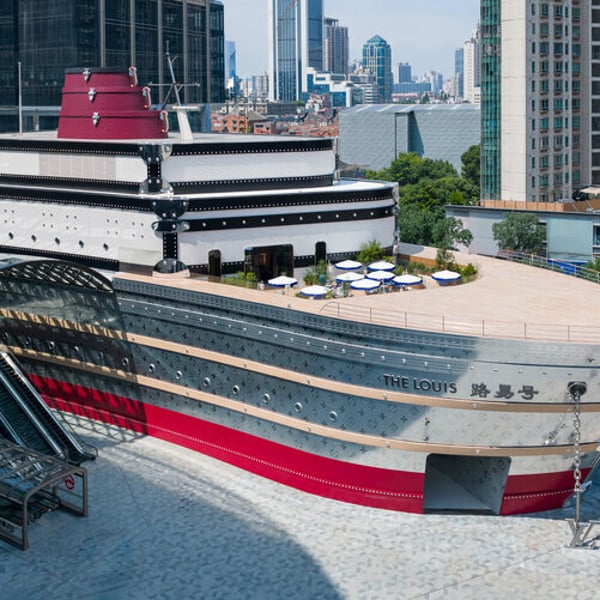
After setting sail with The Louis, a ship-shaped pop-up store and exhibition in Shanghai that proved to be an unexpected tourist attraction, LVMH Moet Hennessy Louis Vuitton SE is planning to accelerate its expansion in China.

Louis Vuitton

It’s the latest sign the country’s almost three-year luxury slump may be over. But investors betting on a swift bounce back may be disappointed. Many Chinese consumers are still grappling with the housing market crash and, among the young, unemployment. Confidence must improve before people unlock their $22.8 trillion in savings, nearly double the level just five years ago.

Optimistic shoppers are crucial to the luxury giants and their investors. Share prices have recovered since June. But reaching the next level depends on Chinese big spenders, the most potent force in global luxury, who could make up for any stumble in US demand.

LVMH, Gucci-owner Kering SA, Prada SpA and cosmetics giant L’Oreal SA have all indicated that the Chinese luxury downturn may be past its nadir. Burberry Group Plc said last week that it had returned to growth in the region in its most recent fiscal quarter. An easing of the trade war, an almost 30% increase in the Shanghai Composite Index since April and spending shifting back from Japan are all helping.

“I would not say it’s party time, but it’s a hell of a lot better than a year ago,” said Flavio Cereda, who runs the Luxury Brands Fund at GAM Holding AG, and has just returned from the country. “The second quarter of 2025 was probably the bottom.”

After two years of decline, global luxury sales could grow by a percentage in the mid-single digits in 2026, with China’s expansion in the high single digits, according to analysts at HSBC Holdings Plc. But neither the companies nor their investors should get carried away. 

“We are seeing some early signs, but I would not say that they are green shoots of recovery,” Johann Rupert, chairman of Cartier-owner Cie Financiere Richemont SA, said last week.

So what does it take to deliver a more pronounced upturn in the world’s second-biggest economy? It’s not that consumers don’t have the means. But widespread pessimism about job prospects because of a shift in national priorities toward artificial intelligence and other high-tech industries means shoppers are reluctant to part with their cash.

Data published last week showed a broad-based economic slowdown. Even though October retail sales got a boost from a major online shopping festival, they still grew at the weakest pace in a year.

What’s more, the property sector is not yet gaining traction. An index of new-home prices in 70 cities fell last month at its fastest pace in a year, during what was traditionally a strong period for sales. This is extremely worrying because 70% of household wealth is stored in real estate. Meanwhile, analysts at Berenberg note that individual balance sheet strains are being compounded by an ageing population.

Before everyone despairs, it’s worth remembering that there are counterintuitive bright spots in China’s consumption story — and Western players should be hustling to capitalize on the vibe shift. We’ve written before about Gen Z snapping up wacky collectibles or trendy experiences to feel happy, safe and comforted during times of uncertainty. Most of the retailers benefiting from the “emotional consumption” trend are Chinese, but that’s not always the case.

Luxury brands need to excite domestic shoppers in the same way by understanding and exploiting the zeitgeist. New designers at more than a dozen fashion houses should help reignite their interest — and visits to stores. Insights company LookLook found that the recent Chanel and Gucci shows were the most talked about in years by the 100 high-spending Chinese women in its “LuxuryVerse” panel.

Unexpected collaborations, perhaps highlighting relevant cultural traditions or an outdoor fitness craze that has taken off in cities would be helpful. LookLook found particular praise for Loewe’s partnership with ride sharing company Hello, which made the LVMH-owned brand feel relatable. 

Stores that provide a fresh experience are another way to win over consumers, as The Louis has demonstrated. The latter has had a halo effect on nearby Louis Vuitton stores, and it’s a fair bet that LVMH’s new Chinese outlets will test the limits too. 

Products must be good value and appeal to homegrown tastes, which have become more sophisticated. Chinese consumers were becoming “more selective,” Rupert said.

Richemont has seen a shift from a “you-only-live-once” mentality to “you only need one,” favoring jewelry. This is happening around the world but is most pronounced in Asia. Burberry Chief Executive Officer Josh Schulman said the company rediscovering its British roots appealed to younger Chinese who appreciated its “authenticity.”

Knowing how to engage with Chinese shoppers is even more important given local competition. This is most evident in beauty through the success of brands like Mao Geping Cosmetics, but jeweler Laopu Gold Co. and leather-goods retailer Songmont underline how they might become threats at the top end, too.

Luckily, 2026 is the Year of the Horse in the lunar calendar, a motif that suits the heritage of many luxury groups. But they will have to treat their most consequential market very differently from the way they once did to get spending off to the races again.


Source link

Continue Reading

Fashion

Cosmetics giant Unilever finalises business demerger

Published

on


By

AFP

Published


December 5, 2025

The demerger of Unilever‘s ice cream division, to be named ‘The Magnum Ice Cream Company,’ which had been delayed in recent months by the US government shutdown, will finally go ahead on Saturday, the British group announced.

Reuters

Unilever said in a statement on Friday that the admission of the new entity’s shares to listing and trading in Amsterdam, London, and New York, as well as the commencement of trading… is expected to take place on Monday, December 8.

The longest federal government shutdown in US history, from October 1 to November 12, fully or partially affected many parts of the federal government, including the securities regulator, after weeks without an agreement between Donald Trump‘s Republicans and the Democratic opposition.

Unilever, which had previously aimed to complete the demerger by mid-November, warned in October that the US securities regulator (SEC) was “not in a position to declare effective” the registration of the new company’s shares. However, the group said it was “determined to implement in 2025” the separation of a division that also includes the Ben & Jerry’s and Cornetto brands, and which will have its primary listing in Amsterdam.

“The registration statement” for the shares in the US “became effective on Thursday, December 4,” Unilever said in its statement. Known for Dove soaps, Axe deodorants and Knorr soups, the group reported a slight decline in third-quarter sales at the end of October, but beat market expectations.

Under pressure from investors, including the activist fund Trian of US billionaire Nelson Peltz, to improve performance, the group last year unveiled a strategic plan to focus on 30 power brands. It then announced the demerger of its ice cream division and, to boost margins, launched a cost-saving plan involving 7,500 job cuts, nearly 6% of the workforce. Unilever’s shares on the London Stock Exchange were steady on Friday shortly after the market opened, at 4,429 pence.
 

This article is an automatic translation.
Click here to read the original article.

Copyright © 2025 AFP. All rights reserved. All information displayed in this section (dispatches, photographs, logos) are protected by intellectual property rights owned by Agence France-Presse. As a consequence you may not copy, reproduce, modify, transmit, publish, display or in any way commercially exploit any of the contents of this section without the prior written consent of Agence France-Presses.


Source link

Continue Reading

Fashion

Burberry elevates two SVPs to supply chain and customer exec roles

Published

on


Published


December 5, 2025

Burberry has named a new chief operating and supply chain officer as well as a new chief customer officer. They’re both key roles at the recovering luxury giant and both are being promoted from within.

Burberry – Spring-Summer2026 – Womenswear – Royaume-Uni – Londres – ©Launchmetrics/spotlight

Matteo Calonaci becomes chief operating and supply chain officer, moving from his role as senior vice-president of strategy and transformation at the firm. 

In his new role, he’ll be oversee supply chain and planning, strategy and transformation, and data and analytics. He succeeds Klaus Bierbrauer, who’s currently Burberry supply chain and industrial officer. Bierbrauer will be leaving the company following its winter show and a transition period.

Matteo Calonaci - Burberry
Matteo Calonaci – Burberry

Meanwhile, Johnattan Leon steps up as chief customer officer. He’s currently currently Burberry’s senior vice-president of commercial and chief of staff. In his new role he’ll be leading Burberry’s customer, client engagement, customer service and retail excellence teams, while also overseeing its digital, outlet and commercial operations.

Both Calonaci and Leon will join the executive committee, reporting to Company CEO Joshua Schulman.

JohnattanLeon - Burberry
JohnattanLeon – Burberry

Schulman said of the two execs that the appointments “reflect the exceptional talent and leadership we have at Burberry. Both Matteo and Johnattan have been instrumental in strengthening our focus on executional excellence and elevating our customer experience. Their deep understanding of our business, our people, and our customers gives me full confidence that their leadership will help drive [our strategy] Burberry Forward”.

Copyright © 2025 FashionNetwork.com All rights reserved.


Source link

Continue Reading

Fashion

Puneet Gupta steps into fine jewellery

Published

on


Published


December 5, 2025

Traditional and occasion wear designer Puneet Gupta has stepped into the world of fine jewellery with the launch of ‘Deco Luméaura,’ a collection designed to blend heritage and contemporary aesthetics while taking inspiration from the dramatic landscapes of Ladakh.

Hints of Ladakh’s heritage can be seen in this sculptural evening bag – Puneet Gupta

 
“For me, Deco Luméaura is an exploration of transformation- of material, of story, of self,” said Puneet Gupta in a press release. “True luxury isn’t perfect; it is intentional. Every piece is crafted to be lived with and passed on.”

The jewellery collection features cocktail rings, bangles, chokers, necklaces, and statement evening bags made in recycled brass and finished with 24 carat gold. The stones used have been kept natural to highlight their imperfect and unique forms and each piece in the collection has been hammered, polished, and engraved by hand.

An eclectic mix of jewels from the collection
An eclectic mix of jewels from the collection – Puneet Gupta

 
Designed to function as wearable art pieces, the colourful jewellery echoes the geometry of Art Deco while incorporating distinctly South Asian imagery such as camels, butterflies, and tassels. Gupta divides his time between his stores in Hyderabad and Delhi and aims to bring Indian artistry to a global audience while crafting a dialogue between designer and artisan.

Copyright © 2025 FashionNetwork.com All rights reserved.


Source link

Continue Reading

Trending

Copyright © Miami Select.