Connect with us

Fashion

The retail recruitment crisis: what the fashion industry must rethink to attract talent
Published

on


Published


November 17, 2025

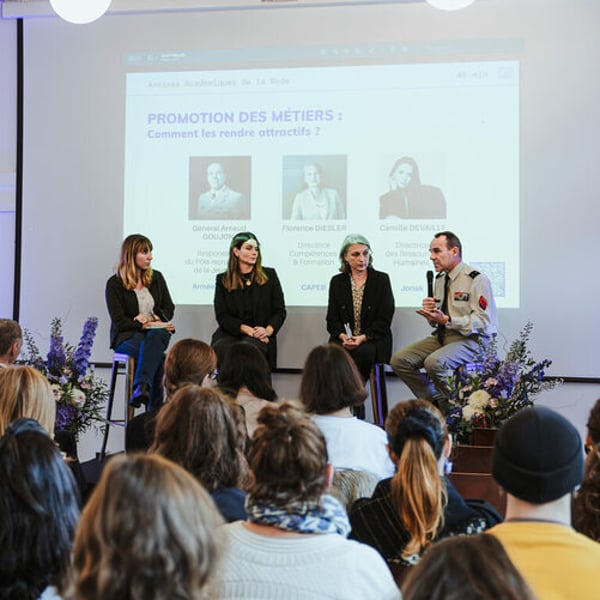
Whom to recruit, and how? How can the industry attract young workers? Are they really as lazy as they are said to be? These questions are preoccupying the fashion industry. They were addressed at the Assises académiques de la mode organised by the Fédération Française du Prêt-à-porter Féminin, held on November 6 at La Caserne in the 10th arrondissement of Paris.

It is, inevitably, a central issue. As Pierre-Jacques Brivet, a board member of the Union française des Industries de la mode et de l’habillement (UFIMH), noted in his introduction: the fashion sector is currently shedding jobs in France.

How can we attract, hire, and retain new entrants to the labour market? – Fédération Française du Prêt-à-porter Féminin

In an attempt to share solutions with recruiters and academic leaders through round-table discussions, speakers from a wide range of backgrounds came to share their insights. The army, fashion, construction, all voiced a need to guide young people, recruit them, and retain them.

Treating young people properly must become… second nature

The first key, according to General Arnaud Goujon, head of the French Army’s Youth Recruitment Unit, lies in showing up and embodying the message—in particular, by speaking to young people in the right way. “Marketers see them as mere brainless consumers; employers see them as lazy,” he asserts. “I see a generation whose ideals were dashed very early on. These are people who need a job that serves a purpose.” He points out that Gen Z, “extremely clear-eyed,” is bored, weary of consumerism—the only thing they are really offered.

While the army has the strongest employer brand in the country, according to the general, it must nevertheless go out and meet young people in person, by whatever means necessary. The territorial coverage it has established enables it to meet 365,000 young people a year nationwide.

The next challenge is to guide those interested, 90% of whom hope to join special units, whereas the army needs professionals with a wide range of skills, from construction to combat, and from communications to engineering.

To attract new recruits, a company or institution should lean into its distinctiveness, says Arnaud Goujon. If this is not possible, then the company must offer remuneration commensurate with the positions on offer and demonstrate flexibility, not least because new workers seem naturally inclined to leave an employer and later return.

For Florence Diesler, director of Skills and Training at the Confédération de l’artisanat et des petites entreprises du bâtiment (CAPEB), young people are looking for a job that pays well, is meaningful, and plays a role in their immediate communities. They also need an employer who genuinely takes them into consideration. “Craftspeople and young people are a winning duo when employers have no preconceptions about young people,” she stresses, adding that the reverse holds true as well.

The key: engaging with all pupils and students

Above all, young people need to be aware of the myriad professions that exist in the sectors that interest them. Without this, haphazard guidance rarely leads to a positive outcome, notes Florence Diesler. Hence, the need to reach out to schoolchildren and students. So says Jasmine Manet, founder and CEO of Youth Forever, an association working to promote intergenerational cohesion within organisations. Speaking at the Assises académiques de la mode, she points out that secondary school pupils, who are already being asked to choose their path, generally only know the professions in their immediate circle.

The role of career guidance organisations is therefore essential. Through their actions, they can enable young people to consider paths that were previously unknown to them. This knowledge is the first means of countering social determinism, which leads to a cruel lack of diversity in certain professional sectors. This is why Jasmine Manet is calling on industry professionals to engage with pupils and students — if only once a year — at a time when social inequalities continue to weigh heavily on young people’s access to employment.

“As many kinds of youth as there are young people”

Awareness that not everyone has access to the same resources and contacts is key to unravelling the recruitment crisis, where similar profiles stack up. These are the profiles that seem to make up Gen Z. Jasmine Manet is critical of this label: “The terms ‘Gen Z’ or ‘youth’ often refer to young urban graduates; but youth is not just that! There are as many types of youth as there are young people.” An emerging idea: it is partly because training and jobs are only accessible to one segment of the population that recruitment is so complicated in the fashion industry.

Fighting inequality can help solve the fashion industry's recruitment crisis
Fighting inequality can help solve the fashion industry’s recruitment crisis – Fédération Française du Prêt-à-porter Féminin

This view is shared by Anne Chutczer, Executive Director of the Atout Jeunes Universités association, which links young university students from outlying areas with companies. “Young people do not have the same access to the networks available to them,” she stresses. “And not all young people have the same aspirations, depending on their background.” A proponent of CV-free recruitment, like Flora Nioré, senior manager of Talent Acquisition, Diversity, and Inclusion at PVH Group, she explains: “The idea is not to [just] be content with the CVs of candidates who resemble you.”

Between constant commitment and shifting priorities

This work to combat inequalities will benefit companies. More young people could access a position that suits them — a fundamental factor in employee retention, according to Camille Devailly, Human Resources director at Jonak: “Jobs in retail should be a career choice, not a stopgap while waiting for something better. I don’t think the commitment of new generations is any less important than that of older generations.” For her, the quest for transparency and a “no-bullshit” approach is a decisive lever. An opinion shared by Arnaud Goujon: “Young people need to understand clearly who we are. Because the key point is managing disappointment.”

While the commitment of workers of all generations remains constant, it is accompanied by a clear shift in priorities among young people. Jérémie Pelletier, co-director of the Fondation Jean Jaurès, explains that sacrifice at work is not an option for a majority of young people: they shape their careers around their lives outside work, rather than the other way round. Jérémie Pelletier also notes that young people generally hope to reach a position of responsibility quickly, but insists that an organic career path remains important.

Flora Nioré, at PVH Group, is in favour of CV-free recruitment
Flora Nioré, at PVH Group, is in favour of CV-free recruitment – Fédération Française du Prêt-à-porter Féminin

According to Jérémie Pelletier, one of the most important demands of the new wave of workers is the assurance of improved working conditions, as they feel there is a lack of respect and recognition. This concern now prevails over environmental or social issues such as the fight against discrimination, which has dominated in recent years.

This article is an automatic translation.
Click here to read the original article.

Copyright © 2025 FashionNetwork.com All rights reserved.


Source link

Continue Reading

Fashion

River Island had tough 2024 pre-restructuring, but says turnaround plan is on tack

Published

on


Published


December 8, 2025

River Island has had a newsworthy year with the company having reportedly been on the brink of collapse if its restructuring plan hadn’t been approved. And having just filed its accounts for 2024, we can see what was going on in the period that led up to the need for the comprehensive restructuring, including store closures.

River Island

The company — River Island Holdings Limited — made a loss before tax of £124.3 million, much wider than the £32.2 million loss of the year before. That came as turnover fell to £690.1 million from £701.5 million and gross profit dropped to £37 million from £46.7 million. The operating loss also widened dramatically to £125.7 million from £34.1 million. And the net loss for the financial year was £138.4 million after a loss of £24.4 million in the previous year.

Recent years have been particularly tough for the business with it having swung to that £32.2 million pre-tax loss in 2023 after having made a profit of £7.5 million for 2022. Turnover during 2023 had fallen 15.1% although the previous year had been flattered by being a 53-week period rather than 52 weeks.

But at the time of releasing its 2023 figures in October 2024 it had said that 2023 was a year of “reset for the business” with product ranges refocused and a new leadership structure put in place, plus other key moves.

It had also said it was starting to see the benefits from its investment with customers “reacting positively” and “improved business performance”. 

The lower sales and wider losses it has just released for 2024, followed by the 2025 restructuring, would suggest that the improved trading either ended or simply wasn’t enough to turn around the company’s performance. Yet there were undeniable signs of the company starting to get back on track even last year.

In 2024, the turnover drop was only 1.6% and like-for-like turnover that excluded closed stores was down only 0.3%.

Higher costs

So what caused the very much wider pre-tax loss? The firm was hit by a non-cash provision of £80.4 million on an inter-company loan balance, as well as an £11.2 million increase in its trading loss. And it was impacted by a significant inflationary increase in the cost of good sold, which contributed to a lower gross margin on a percentage basis. That caused a 20.8% fall in gross profit.

It also saw significant inflationary pressures in its operating costs with staff costs increasing by 7.6%. And while cost savings in multiple areas did help, it’s overall distribution and admin costs increased.

As we know, the company has put a major restructuring plan in place which was approved in August by the High Court. This enabled a step change in the size and profitability of the retail estate and secured long-term funding. It now has a new and secure financing facility until 2028 and has been putting its restructuring plan into action that it said should allow it to return to profitability.

Part of that plan is Ben Lewis having returned as group CEO, having managed the business for nearly a decade before he stepped down in 2019. The company also appointed a new CFO in late 2024.

Its transformation plan sees it now working on right-sizing its store estate, growing like-for-like sales at improved margins and investing in growth and productivity.

It said it’s already seeing significant returns on its strategy with the gross margin percentage greatly improved, costs significantly reduced and underlying sales in its retail estate returning to growth. It’s expecting “a significant improvement in profitability” for the current year, although we probably won’t find out the details of this for some time, unless the company chooses to share the good news in advance of its next Companies House filing. 

Copyright © 2025 FashionNetwork.com All rights reserved.


Source link

Continue Reading

Fashion

L’Oreal in deal to increase stake in Galderma to 20%

Published

on


By

Reuters

Published


December 8, 2025

French cosmetics group L’Oreal is to increase its stake in Swiss dermatology firm Galderma to 20% from about ⁠10%, the Swiss firm said in a statement on Monday.

Galderma is a dermatology specialist – Reuters

L’Oreal ⁠is buying the stake for an undisclosed sum from a consortium led by Swedish ‍private ‌equity firm EQT, which includes Abu Dhabi ⁠Investment Authority and ‌Auba Investment Pte. Ltd. The ‌deal is due to close in the first quarter of 2026. As a result, Galderma is looking into ‍replacing board members representing the consortium by two non-independent board candidates from L’Oreal at ‌the ⁠company’s ​next annual general meeting in ⁠2026, ​it said.

“Galderma continues to deliver impressive growth, strong innovation, and category leadership across its broad, science-based dermatology portfolio,” said Galderma’s CEO Flemming Ørnskov in a press release. “With strengthened commercial execution, continued platform and portfolio expansion, and an increasingly consumer-focused approach to innovation, we are rapidly scaling into a dermatology powerhouse. We are pleased with L’Oréal’s increased investment, which affirms our direction and the meaningful value creation we expect in the years ahead. As we move into 2026, we remain fully focused on our Integrated Dermatology Strategy and on serving our customers, consumers, and patients.” 

The businesses also plan to explore additional scientific research projects of mutual interest with a shared focus on skincare and skin health, innovation, and long-term growth. Galderma, originally set up as a joint venture between Nestle and ​L’Oreal before the latter sold its 50% stake in 2014, listed ⁠an initial ⁠tranche of its stock in March 2024.

FashionNetwork.com with Reuters 

© Thomson Reuters 2025 All rights reserved.


Source link

Continue Reading

Fashion

Following meteoric rise, BHV boss Frédéric Merlin caught up in Shein storm

Published

on


By

AFP

Published


December 8, 2025

Under fire since his alliance with Shein, Frédéric Merlin, the young head of BHV whose rise has been meteoric, admits he “underestimated” the challenge posed by the Paris department store, but stands by his strategy, intended to “keep retail alive.”

Frédéric Merlin, president of Société des Grands Magasins (SGM) and owner of BHV, during a photo shoot in Paris, 22 October 2025. – (AFP – Thibaud MORITZ)

“I always try to be humble, because at 34, you don’t know everything,” the executive recently told AFP during an interview on the sixth floor of the Bazar de l’Hôtel de Ville.

It is here that Shein, the Asian e-commerce giant accused of unfair competition and environmental pollution, is due to open its first permanent shop on Wednesday, under an agreement with Société des Grands Magasins (SGM), the commercial property company founded in 2021 by Frédéric Merlin and his sister, Maryline.

Originally from the Lyon region and raised by a father who ran a small industrial piping business and a stay-at-home mother, the siblings’ fortune is estimated at €600 million, ranking them 233rd in France, according to Challenges.

A “friend” of former president Nicolas Sarkozy, Merlin benefited from the financial backing of businessman Jean-Paul Dufour, a shareholder alongside SGM with “a 42.5% stake in the majority of the group’s subsidiaries,” according to its latest social report published in August 2024, as noted by L’Express.

“Ocean liner”

The owner of the BHV business since 2023, SGM also operates a dozen shopping centres, as well as seven Galeries Lafayette stores in the provinces, five of which are set to host Shein.

In protest, several brands have announced they are leaving the Paris department store, already shunned by suppliers unhappy about a build-up of unpaid invoices, which Merlin says are linked to “tools” issues that are being resolved, and not to cash-flow problems.

Dropped by Banque des Territoires (an entity of Caisse des Dépôts et Consignations) for the acquisition of the BHV building, SGM has also been excluded from the Union du grand commerce de centre-ville (UCV), while the Galeries Lafayette group refuses to allow Shein to set up in stores bearing its name.

“Who would want to work with a pathological liar?” said Yann Rivoallan, president of the Fédération Française du Prêt-à-Porter Féminin, on RMC.

Merlin “is not collaborative”, Nicolas Bonnet-Oulaldj, the deputy mayor of Paris in charge of commerce, told AFP.

“He told everyone that he had the support of Anne Hidalgo regarding Shein, which is totally false.” More generally, Merlin didn’t realise he was taking on “an ocean liner”, according to the department store’s inter-union body.

“What I underestimated was all the political and media attention that comes with taking on this Paris monument right opposite City Hall,” admits Merlin, denouncing the “surrounding hypocrisy” in the face of Shein and its many consumers.

“Head of the family”

“We could have done better,” admits the man who says he has made BHV “profitable” and works “14 hours a day.”

Born in the Lyon suburb of Vénissieux, Merlin grew up in a family that gave him “self-confidence” and “entrepreneurial drive.” After a spell at law school, the young man obtained a BTS in property, having been drawn to the profession during a placement.

Armed with a “€15,000 student loan,” he and his sister founded, at the age of 20, a commercial property consultancy (IMEA) before launching another (ADI) in 2014, specialising in the redevelopment of commercial buildings.

The Merlins hired their father, who brought his “industrial rigour,” until his death in 2018, the year SGM was launched, turning around shopping centres that nobody wanted any more in towns such as Roubaix or Mulhouse.

“You had to have a lot of nerve,” recalls Fabrice Fubert, co-director of a commercial property consultancy, who notably suggested in 2021 that Merlin acquire seven Galeries Lafayette stores.

Not “from the establishment,” Merlin is “an audacious man who takes risks and shakes things up,” as when he brought in Pokémon or YouTuber Squeezie for pop-up shops at BHV, says Fabrice Fubert.

The father of a young boy, Merlin asserts his role as “head of the family,” putting himself on the front line to “protect” his sister and his mother, Dominique, SGM’s deputy managing director.

This article is an automatic translation.
Click here to read the original article.

Copyright © 2025 AFP. All rights reserved. All information displayed in this section (dispatches, photographs, logos) are protected by intellectual property rights owned by Agence France-Presse. As a consequence you may not copy, reproduce, modify, transmit, publish, display or in any way commercially exploit any of the contents of this section without the prior written consent of Agence France-Presses.


Source link

Continue Reading

Trending

Copyright © Miami Select.