
Politics
Government shutdown reaches its 40th day as senators work through a crucial weekend

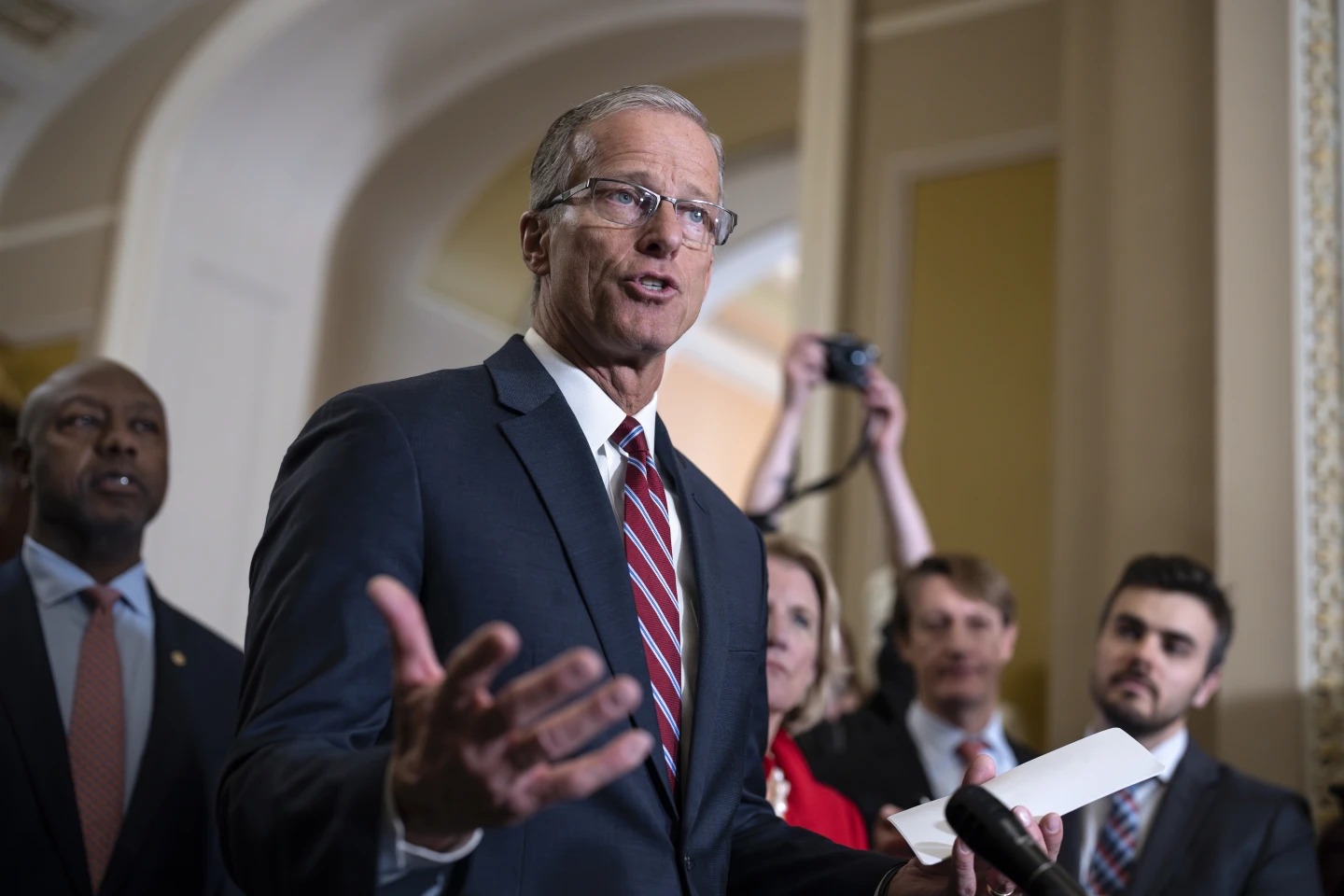
The government shutdown stretched into its 40th day Sunday even as senators stayed in Washington for a grueling weekend session hoping to find an end to the funding fight that has disrupted flights nationwide, threatened food assistance for millions of Americans and left federal workers without pay.
The Senate has so far shown few signs of progress over a weekend that could be crucial for the shutdown fight. Republican leaders are hoping to hold votes on a new package of bills that would reopen the government into January while also approving full-year funding for several parts of government. But the necessary Democratic support for that effort was far from guaranteed.
“We’re only a handful of votes away” from passing a bill to reopen the government, Senate Majority Leader John Thune, a South Dakota Republican, said Saturday.
Still, Democratic leaders are pushing hard for an extension of subsidies for health plans offered under the Affordable Care Act marketplace. Republicans have rejected that offer, but signaled openness to an emerging proposal from a small group of moderate Democrats to end the shutdown in exchange for a later vote on the “Obamacare” subsidies, which make coverage more affordable.
For those enrolled in Affordable Care Act exchanges, premiums on average are expected to more than double next year if Congress allows the enhanced subsidies to lapse.
Vermont Sen. Bernie Sanders, an independent who caucuses with Democrats, said the pledge to hold a vote on extending the health care subsidies would be a “wasteful gesture” unless “you have the commitment of the speaker of the House that he will support it and that the president of the United States will sign it.”
President Donald Trump has made clear he is unlikely to compromise any time soon. He pressed Republicans again over the weekend to get rid of the Senate’s filibuster rules that prevent the chamber from advancing on most legislation unless there is support from 60 senators.
Sen. Jeanne Shaheen, a New Hampshire Democrat, and others, negotiating among themselves and with some rank-and-file Republicans, have been discussing bills that would pay for parts of government — food aid, veterans programs and the legislative branch, among other things — and extend funding for everything else until December or January. The agreement would only come with the promise of a future health care vote, rather than a guarantee of extended subsidies.
It was unclear whether enough Democrats would support such a plan. Even with a deal, Trump appears unlikely to support an extension of the health benefits. House Speaker Mike Johnson, a Louisiana Republican, also said this past week that he would not commit to a health vote.
Republican leaders only need five additional votes to fund the government, and the group involved in the talks has ranged from 10 to 12 Democratic senators.

Some Republicans have said they are open to extending the COVID-19-era tax credits as premiums could skyrocket for millions of people, but they want new limits on who can receive the subsidies. They lined up Saturday to take to the Senate floor and argue that subsidies for the plans should be routed through individuals.
“We’re going to replace this broken system with something that is actually better for the consumer,” Sen. Lindsey Graham, A South Carolina Republican, said.
Trump wants Republicans to end the shutdown quickly and scrap the filibuster, which requires 60 Senate votes for most legislation, so they can bypass Democrats altogether. Vice President JD Vance, a former Ohio senator, endorsed the idea in an online post Saturday, saying Republicans who want to keep the filibuster are “wrong.”
Republicans have rejected Trump’s call, and Thune is eyeing a bipartisan package that mirrors the proposal the moderate Democrats have been sketching out. What Thune, who has refused to negotiate, might promise on health care is unknown.
The package would replace the House-passed legislation that the Democrats have rejected 14 times since the shutdown began Oct. 1. The current bill would only extend government funding until Nov. 21.
A test vote on new legislation could come in the next few days if Thune decides to move forward.
Then Democrats would have a crucial choice: Keep fighting for a meaningful deal on extending the subsidies that expire in January, while prolonging the pain of the shutdown? Or vote to reopen the government and hope for the best as Republicans promise an eventual health care vote, but not a guaranteed outcome.
New York Democrat Sen. Chuck Schumer on Saturday persisted in arguing that Republicans should accept a one-year extension of the subsidies before negotiating the future of the tax credits.
“Doing nothing is derelict because people will go bankrupt, people will lose insurance, people will get sicker,” Schumer said in a floor speech. “That’s what will happen if this Congress fails to act.”
___
Republished with permission of The Associated Press.



For the first time in a decade, hunters armed with rifles and crossbows are fanning out across Florida’s swamps and flatwoods to legally hunt the Florida black bear, over the vocal opposition of critics.
The state-sanctioned hunt began Saturday, after drawing more than 160,000 applications for a far more limited number of hunting permits, including from opponents who are trying to reduce the number of bears killed in this year’s hunt, the state’s first since 2015.
The Florida Fish and Wildlife Conservation Commission awarded 172 bear hunt permits by random lottery for this year’s season, allowing hunters to kill one bear each in areas where the population is deemed large enough. At least 43 of the permits went to opponents of the hunt who never intend to use them, according to the Florida chapter of the Sierra Club, which encouraged critics to apply in the hopes of saving bears.
The Florida black bear population is considered one of the state’s conservation success stories, having grown from just several hundred bears in the 1970s to an estimated more than 4,000 today.
The 172 people who were awarded a permit through a random lottery will be able to kill one bear each during the 2025 season, which runs from Dec. 6 to Dec. 28. The permits are specific to one of the state’s four designated bear hunting zones, each of which have a hunting quota set by state officials based on the bear population in each region.
In order to participate, hunters must hold a valid hunting license and a bear harvest permit, which costs $100 for residents and $300 for nonresidents, plus fees. Applications for the permits cost $5 each.
The regulated hunt will help incentivize maintaining healthy bear populations, and help fund the work that is needed, according to Mark Barton of the Florida chapter of Backcountry Hunters and Anglers, an advocacy group that supported the hunt.
Having an annual hunt will help guarantee funding to “keep moving conservation for bears forward,” Barton said.
According to state wildlife officials, the bear population has grown enough to support a regulated hunt and warrant population management. The state agency sees hunting as an effective tool that is used to manage wildlife populations around the world, and allows the state to monetize conservation efforts through permit and application fees.
“While we have enough suitable bear habitat to support our current bear population levels, if the four largest subpopulations continue to grow at current rates, we will not have enough habitat at some point in the future,” reads a bear hunting guide published by the state wildlife commission.

___
Republished with permission of the Associated Press.


Hegseth likens strikes on alleged drug boats to post-9/11 war on terror

Fire at Brazil Airport Causes Evacuation, Smoke Engulfs Jet

US debt crisis: Most likely fix is severe austerity triggered by a fiscal calamity
-

 Politics8 years ago
Congress rolls out ‘Better Deal,’ new economic agenda
-
Entertainment8 years ago
New Season 8 Walking Dead trailer flashes forward in time
-
Politics8 years ago
Poll: Virginia governor’s race in dead heat
-
Entertainment8 years ago
The final 6 ‘Game of Thrones’ episodes might feel like a full season
-
Entertainment8 years ago
Meet Superman’s grandfather in new trailer for Krypton
-
Politics8 years ago
Illinois’ financial crisis could bring the state to a halt
-
Business8 years ago
6 Stunning new co-working spaces around the globe
-
Tech8 years ago
Hulu hires Google marketing veteran Kelly Campbell as CMO