Connect with us

Politics

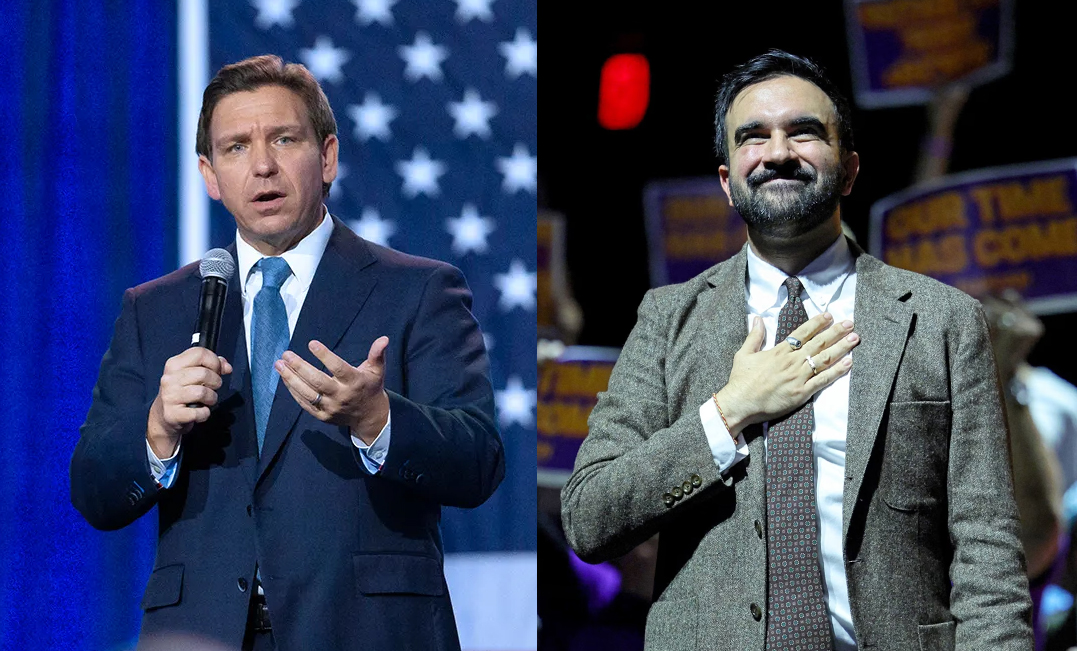
Ron DeSantis says NYC cops should quit since new Mayor Zohran Mamdani hates them
Published

on


Florida’s Governor says police officers in the Big Apple should abandon the city after Zohran Mamdani won Tuesday’s mayoral election.

“The $5k recruitment bonus we give to new officers will be utilized by a number of these NYPD officers. There is no reason to risk your life serving when the mayor hates you and believes your department shouldn’t even exist,” Gov. Ron DeSantis posted to social media.

DeSantis was responding to another poster, who said police officers were “putting in their papers” to leave after the Democrat defeated independent Andrew Cuomo and Republican Curtis Sliwa.

DeSantis has framed the police recruitment program as a way to appeal to “mistreated” officers with an inability to “take that environment” in New York and other Democratic strongholds.

The Governor has made similar points this year.

Speaking at the 2025 Florida Sheriffs Association Summer Conferencehe predicted attendees would “end up at this conference next year, potentially, be talking about, hey, they elected some anti law enforcement mayor in New York City, and now all these NYPD cops want to come work in our agencies and get the $5,000 bonus.”

He also has complained that the candidate wants to replace police with social workers.

DeSantis has been vocal about Mamdani this week, saying New Yorkers committed an act of “ballistic podiatry” by electing him, and saying that his administration would make that of former Mayor Bill de Blasio look like the “golden age.”

Before the election, he said that if elected, Mamdani would be “the most prominent Democrat in America the day he takes office.”

Mamdani has yet to mention DeSantis publicly, meanwhile.



Source link

Continue Reading

Politics

Winner and Loser of the Week in Florida politics — Week of 11.30.25

Published

on


Florida’s political class doesn’t agree on much these days, but this week produced a rare moment of full-spectrum alignment. Every member of Florida’s congressional delegation — all 28 House members and both U.S. Senators — signed onto a single message to the White House urging President Donald Trump to keep offshore drilling away from Florida’s coasts.

That kind of unanimity is almost unheard of in the state’s modern political era, but it’s been the consistent position of leaders in both parties here in Florida.

The show of solidarity is rooted in a simple political reality: drilling off Florida’s shores remains a third-rail issue for voters across the ideological spectrum. Tourism, the state’s largest economic engine, depends on pristine coastlines. Military leaders have long warned that operations in the Gulf Test Range would be disrupted by new rigs. And coastal residents — Republican and Democrat alike — still remember how the imagery of the Deepwater Horizon disaster reshaped public opinion.

And nobody running in Florida in 2026 wants to be caught on the wrong side of this issue.

With national energy policy in flux and Trump weighing moves that could open new waters for exploration, Florida lawmakers acted preemptively, positioning themselves as a single block drawing a bright line. It also signals that the delegation intends to preserve the long-standing de facto moratorium that has held for decades, regardless of who controls Washington next year.

Now, it’s onto our weekly game of winners and losers.

Winners

Honorable mention: Tourism. Florida’s tourism sector heads into the holidays with the swagger of an industry that keeps beating its own benchmarks.

The latest statewide report shows Florida drew more visitors in 2024 than in any previous year on record. Domestic travel remains the backbone of the industry, but international tourism — which lagged behind for years — finally roared back, helping push total visitation into uncharted territory.

Local indicators back up the statewide spike. Orange County’s tourist development tax reports continue climbing, with October’s haul marking yet another year-over-year increase. The stronger the tourist development tax numbers, the more room Orange County has to invest.

For tourism executives, the trajectory validates years of capital investment, marketing overhauls, and infrastructure upgrades. And for political leaders, particularly those who have staked their credibility on Florida’s economic climate, the industry’s performance provides a powerful proof point.

Plenty of sectors nationwide are wobbling as 2026 approaches. Florida tourism isn’t one of them.

Almost (but not quite) the biggest winner: Alex Andrade. For months, the Pensacola Republican has argued that the Gov. Ron DeSantis administration improperly siphoned $10 million in Medicaid settlement funds into the Hope Florida Foundation — money that was then routed into political efforts aligned with the Governor and now-Attorney General James Uthmeier.

The administration pushed back hard, insisting the diverted money wasn’t actually Medicaid-related and therefore wasn’t subject to federal pass-through requirements. But a new repayment from the state to the federal government shows Andrade had it right from the beginning.

Fresh financial records reveal the Agency for Health Care Administration (AHCA) calculated its federal repayment using the full $67 million Centene settlement — including the disputed $10 million the state insisted wasn’t Medicaid money at all. Florida has now paid back 57% of the entire settlement, amounting to $38 million, exactly what it would owe if every dime belonged to Medicaid.

That directly undermines the state’s original defense and aligns precisely with what Andrade’s investigation uncovered: the $10 million that went to Hope Florida should have stayed in the Medicaid program.

The repayment also adds a striking new twist to a scandal that has already damaged the Governor’s Office, fueled a grand jury probe, raised red flags about political interference in Medicaid dollars, and helped derail Casey DeSantis’ once-serious positioning for 2026.

For Andrade, who repeatedly pressed AHCA for answers and was stonewalled at every turn, this is a confirmation that his instincts, his oversight work and his insistence on accountability were justified.

The biggest winner: Rick Scott. Scott is riding high after a policy summit that managed to seize the spotlight as Washington still grapples with several issues before the close of 2025.

The event showcased ideological discipline, message testing and a reminder of Scott’s continued push to establish himself as one of the most effective architects of the GOP’s internal conversations.

The agenda ranged widely — health care, space, finance, foreign policy, party identity — but the through line was Scott’s effort to present himself as a central bridge between Senate Republicans, national conservatives and Florida’s rising stars.

The summit generated a steady drip of headlines. A pollster told attendees that Americans have soured on the Affordable Care Act, giving Scott and his allies fresh fodder for long-standing arguments about the law’s durability. Members of Congress used the forum to sketch out what an alternative might look like, offering a substantive policy moment at a time when the party often struggles to define next steps.

There were also unmistakably political flashes. Byron Donalds used the gathering to continue Republicans’ critiques against Cory Mills’ scandals. Randy Fine issued stern warnings about rising antisemitism. And members of the House Freedom Caucus emphasized the value of having Scott as their conduit to the upper chamber.

All of it underscored the same point: Scott convened a room full of people who matter, and they showed up ready to continue pushing the conservative conversation forward.

Losers

Dishonorable mention: Trajector Medical. A recent investigative report is painting the company as a predatory “claims-shark” exploiting disabled veterans.

According to the latest reporting, Trajector Medical has been charging veterans as much as $20,000 for help with disability benefits — even though such assistance is legally supposed to be free.

The price tag comes tied to promises of help filing claims, but veterans who relied on the firm describe an entirely different reality: pre-filled application forms submitted on their behalf without their explicit involvement, vague “medical-evidence packets” of questionable origin, and invoices that pop up only after the U.S. Department of Veterans Affairs (VA) increases a veteran’s disability rating.

The company uses a software tool — reportedly dubbed “CallBot” — to monitor clients’ benefit status through the VA hotline. When the system detects a payment increase, it automatically bills the veteran. One veteran NPR interviewed said he was charged $17,400 after his VA rating rose, even though he’d done much of the paperwork himself.

Federal law prohibits entities from charging for assistance in preparing or filing initial VA disability claims, which means Trajector’s business model appears to run entirely contrary to that protection. The company, however, says those restrictions don’t apply because it only does a limited amount of work during the process.

The VA had previously sent the company warning letters in 2017 and 2022 demanding it stop offering paid assistance — but Trajector apparently ignored those warnings and kept operating.

And it appears other companies like it are engaged in similar practices.

Disabled veterans, many of whom rely on VA benefits for basic medical care and financial stability, report feeling misled, exploited and trapped by aggressive billing practices. Former employees of Trajector also admit the firm drifted away from its original mission of helping vets and turned into a profit-driven debt-collection operation.

In a state like Florida — with a large veteran population — a company that claims to help veterans but instead levies steep, legally dubious fees is about as far from “serving those who served” as you can get.

Almost (but not quite) the biggest loser: Jay Collins. A few weeks ago, Collins’ issue was donor confidence due to Ken Griffin’s refusal to buy into DeSantis’ pitch to back Collins, showing he couldn’t land the kind of marquee support a DeSantis-aligned Lieutenant Governor was supposed to lock down effortlessly.

Now Collins is grappling with a problem even more glaring: the Governor himself can’t be counted on to show up for him.

Collins’ latest telephone town hall was supposed to feature DeSantis — a show of strength for a candidate who needs one badly. Instead, Collins got stood up. Again. And this wasn’t a minor scheduling hiccup. As Florida Politics reported, DeSantis’ schedule throughout the day Wednesday was plenty open during the time of the call.

It leaves one wondering how committed the Governor really is to lifting Collins in the 2026 field. Collins desperately needs a visible, unmistakable show of support from DeSantis to compensate for weak polling, slow fundraising and a late entry that already left him miles behind Byron Donalds. When your entire path to viability rests on the idea that the sitting Governor is clearing a lane for you (and we’re not even sure that would be enough), getting publicly ghosted undercuts the whole premise.

You can survive donor skepticism. You can sometimes survive weak early numbers. But surviving your own patron repeatedly failing to show up? That’s a much harder lift.

The biggest loser: Black bears. The hunt is on, with the state moving forward with a revived bear hunt that began Saturday.

Wildlife officials continue to insist the hunt is a management tool, citing increased human–bear encounters and steady population growth.

But environmental groups and community activists argue the data doesn’t justify an organized kill, especially as development pressures, shrinking habitats and inadequate trash management drive most conflicts.

Whatever the policy rationale, the optics are difficult to ignore. Florida spent decades pulling its black bear population back from the brink. Conservation efforts worked, numbers rebounded, and the species again became a fixture in Panhandle forests and Central Florida greenways.

Lawmakers eager to show they’re taking action have leaned hard into the hunt as a symbol of decisive wildlife policy. The bears, once again, are on the losing end of a fight they never chose.


Source link

Continue Reading

Politics

Carlos G. Smith files bill to allow medical pot patients to grow their own plants

Published

on


Home cultivation of marijuana plants could be legal under certain conditions.

Medical marijuana patients may not have to go to the dispensary for their medicine if new legislation in the Senate passes.

Sen. Carlos G. Smith’s SB 776 would permit patients aged 21 and older to grow up to six pot plants.

They could use the homegrown product, but just like the dispensary weed, they would not be able to re-sell.

Medical marijuana treatment centers would be the only acceptable sourcing for plants and seeds, a move that would protect the cannabis’ custody.

Those growing the plants would be obliged to keep them secured from “unauthorized persons.”

Chances this becomes law may be slight.

A House companion for the legislation has yet to be filed. And legislators have demonstrated little appetite for homegrow in the past.


Source link

Continue Reading

Politics

Rolando Escalona aims to deny Frank Carollo a return to the Miami Commission

Published

on


Early voting is now underway in Miami for a Dec. 9 runoff that will decide whether political newcomer Rolando Escalona can block former Commissioner Frank Carollo from reclaiming the District 3 seat long held by the Carollo family.

The contest has already been marked by unusual turbulence: both candidates faced eligibility challenges that threatened — but ultimately failed — to knock them off the ballot.

Escalona survived a dramatic residency challenge in October after a rival candidate accused him of faking his address. A Miami-Dade Judge rejected the claim following a detailed, three-hour trial that examined everything from his lease records to his Amazon orders.

After the Nov. 4 General Election — when Carollo took about 38% of the vote and Escalona took 17% to outpace six other candidates — Carollo cleared his own legal hurdle when another Judge ruled he could remain in the race despite the city’s new lifetime term limits that, according to three residents who sued, should have barred him from running again.

Those rulings leave voters with a stark choice in District 3, which spans Little Havana, East Shenandoah, West Brickell and parts of Silver Bluff and the Roads.

The runoff pits a self-described political outsider against a veteran official with deep institutional experience and marks a last chance to extend the Carollo dynasty to a twentieth straight year on the dais or block that potentiality.

Escalona, 34, insists voters are ready to move on from the chaos and litigation that have surrounded outgoing Commissioner Joe Carollo, whose tenure included a $63.5 million judgment against him for violating the First Amendment rights of local business owners and the cringe-inducing firing of a Miami Police Chief, among other controversies.

A former busboy who rose through the hospitality industry to manage high-profile Brickell restaurant Sexy Fish while also holding a real estate broker’s license, Escalona is running on a promise to bring transparency, better basic services, lower taxes for seniors and improved permitting systems to the city.

He wants to improve public safety, support economic development, enhance communities, provide more affordable housing, lower taxes and advocate for better fiscal responsibility in government.

He told the Miami Herald that if elected, he’d fight to restore public trust by addressing public corruption while re-engaging residents who feel unheard by current officials.

Carollo, 55, a CPA who served two terms on the dais from 2009 to 2017, has argued that the district needs an experienced leader. He’s pointed to his record balancing budgets and pledges a residents-first agenda focused on safer streets, cleaner neighborhoods and responsive government.

Carollo was the top fundraiser in the District 3 race this cycle, amassing about $501,000 between his campaign account and political committee, Residents First, and spending about $389,500 by the last reporting dates.

Escalona, meanwhile, reported raising close to $109,000 through his campaign account and spending all but 6,000 by Dec. 4.

The winner will secure a four-year term.


Source link

Continue Reading

Trending

Copyright © Miami Select.