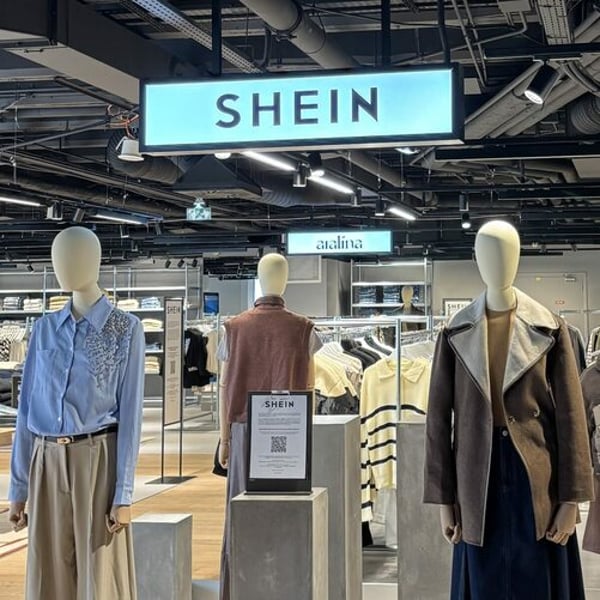
Wednesday, November 5, at 1pm. The opening of the Shein boutique at BHV Marais drew a large crowd. For several hours, the first customers waited in a long queue at the foot of the Parisian department store to enter the Chinese brand’s first permanent bricks-and-mortar store. On the other side of the street, dozens of demonstrators, local elected officials and union representatives voiced their disapproval at the much-maligned brand setting up shop.
Opening of the Shein boutique on November 5 – FNW/Léa minerve
The protest was largely ignored by the many enthusiastic customers celebrating the event, which began on the sixth floor, in the area dedicated to Shein, with an introductory speech followed by a countdown marking the official opening of the doors. Once the symbolic ribbon had been cut, Frédéric Merlin, managing director of BHV and Société des Grands Magasins (SGM), led the first customers through the store, presenting the different areas before concluding the tour at the tills. Facing numerous journalists from around the world, he said he was “very pleasantly surprised to see the enthusiasm for this opening, which is attracting new customers as well as regular BHV customers.”
The event quickly took on the feel of mass consumption, somewhere between curiosity and a shopping frenzy.
The new 1,000-square-metre space, mainly dedicated to womenswear, occupies a large open area segmented into several zones. Shein does not, however, occupy the entire level: a small part of the sixth floor is still devoted to Christmas décor. But there was certainly no party atmosphere in that area on Wednesday.
There is no major retail innovation in the layout. But the range is clearly compartmentalised: casualwear, sportswear, formalwear and accessories. Around 80% of the items are aimed at a female clientele across different profiles, the remainder forming a more limited menswear offer: zip-up jumpers, cargo trousers and other casual basics.
Clothes are presented on simple shelves fixed along the walls, while in the centre more classic rails display the vast majority of pieces on hangers. The overall look is restrained and clearly easy to reconfigure, but the staging is elevated by carefully chosen furnishings: marble, stone or glass tables add a chic touch, complemented by tempered-steel details.
The spaces are structured by zone, identified by Shein sub-brands such as Aralina, Motf, Dazy and Anewsta, offering a clear read of the range and a more premium visual impression. Each has a staging area with mannequins and a product presentation space. A few comfortable armchairs dotted around allow visitors to take a break, a sign that the brand also wanted to enhance the visitor experience.
Shein teams at work – FNW OG
On price, the promise of accessibility is clear: from a sports bra at €7.49 to a Dazy down jacket at €127.49, the store’s most expensive item. Yet although around 6,000 items have been selected, there is no sign of the €2 or €3 pieces that also helped drive the brand’s online success. Each in-store product carries a QR code on its label linking to the product page on the brand’s website, where prices are sometimes much lower online.
Another of Shein’s digital promises that does not necessarily carry over into the physical world is its offer for all body types. Sizes range from XS to XL, a more limited choice than online.
It is worth noting that the store features few screens, contrary to what you might expect from an e-commerce player. Here, Shein is asserting a physical presence and the classic conventions of apparel retail.
Finally, the opening did not escape controversy: beyond the gatherings in front of the building and the significant police presence around the event, protesters entered the Shein area to brandish placards and shout slogans against the Chinese retailer.
Despite this, inside the crowds were out in force. Bags filled, rails emptied. Shein has made a successful entry into the physical world, with a concept calibrated to appeal to a broad audience.
But what about the other floors of the department store? Merlin said he expected very low footfall on Wednesday. To try to generate traffic, the department store promised a voucher equivalent to the amount of Shein purchases made on Wednesday. Given the lacklustre traffic on the other seven levels, the pulling power of Shein as a locomotive for the whole of BHV remains to be demonstrated.
With Olivier Guyot
This article is an automatic translation. Click here to read the original article.
Testoni hails from Bologna, Italy, but in 2022 the luxury footwear and accessories maker came under the umbrella of Chinese group Viva China, which controls the Li Ning brand (which has just shown at Milan Men’s Fashion Week) and the British brand Clarks, having previously been acquired by Hong Kong-based Sitoy Group in 2018. The Emilia-based label, founded in 1929 and specialising in men’s footwear, has since placed greater emphasis on womenswear and, following a rebrand from a.testoni to Testoni 1929, in 2025 opened a 200 square-metre flagship on Via Manzoni in Milan.
Testoni, “Bracciano” moccasin, AW 2026/27
The Milan boutique is part of the brand’s relaunch plan. In the same vein, the company has taken on a larger showroom to support retail and wholesale activities, at Via Sant’Andrea 21, where the presentation of the Autumn-Winter 2026/27 collection was held. “We currently operate 30 single-brand stores; we have just opened a new one in Taipei,” Philip Yau, CEO of Testoni, tells FashionNetwork.com. “They are located mostly in Asia- in China, Japan, South Korea and, indeed, Taipei. But after focusing on the Far East, we now want to look more to Europe, with Italy as a starting point, and then move on to the US.”
“We had a presence in America in the past, but we had closed the business there. Now we will reopen that market, where we were selling 10 million shoes every year. We have a large distribution centre in Hanover, near Philadelphia. Retailers such as Macy’s and Nordstrom, with whom we have established contacts, can help us successfully resume business in that market,” continues Yau, who is also aiming for “operational, logistics, marketing and other synergies with the brands Clarks and Li Ning and with the group’s market reach.” “Asia remains a strong base for us at Viva China, where we own many companies,” he says.
Testoni, “Moena” laser-cut sneaker, AW 2026/27
There are around 60 multi-brand stores that sell Testoni, making distribution highly selective at the top end. “Testoni has always been a more retail-oriented brand, but we are working to expand into wholesale as well, which we believe can be a strong driver of growth,” adds Testoni’s general manager, Enzo Vaccari. “So wholesale expansions are planned, especially in the US and other overseas markets. Nor are we neglecting e-commerce, which is quite small at present. It can do much more; we will work on it by leveraging the synergies we can establish with Clarks’ platform.”
Autumn-Winter 2026/27 has seen an increase in men’s styles and focuses on the Testoni brand’s core offer: loafers, moccasins, clean lines, no eccentricities, underscoring its craftsmanship. “In three years we will celebrate our 100th anniversary, so we have a very rich archive that could certainly form the basis of a museum,” Vaccari adds. “It is one of our dreams, because in our archive there are original products from the 1940s through the 1950s and 1960s, and we have all the original designs by Marisa Testoni, the daughter of Amedeo Testoni, the founder. At the moment, these materials are kept in Piazza XX Settembre, near the Montagnola in Bologna, but we are working to rethink the space and reorganise everything properly. We wanted Bologna to be the focal point of this project, because it is the city where we were born, where the company’s history lies.”
Testoni, AW 2026/27
Testoni also makes handbags, another line that has expanded in terms of styles, while men still account for 70% of revenue and production. “However, we are trying to achieve a better balance between the collections: we need to develop more bags dedicated to women,” Yau notes.
From a financial standpoint, the official 2025 year-end has yet to be finalised, so Philip Yau does not intend to disclose Testoni’s annual turnover, which nonetheless grew in the single digits. The leading markets are China, Taiwan and Hong Kong combined- Greater China- accounting for 40%, followed by Japan. “But the US is and will be a key market for Testoni and for the entire Viva China group, as is the Middle East, not only through wholesale distribution but also via retail openings currently under consideration,” explains Enzo Vaccari. “In America we have just returned; we want to find a major retailer, like Macy’s, which has more than 300 doors. In the meantime, there will be consolidation of retail in Asia, where we are looking at other markets, such as Singapore and Malaysia, which we would like to enter within a couple of years, depending on the opportunities that arise.”
This article is an automatic translation. Click here to read the original article.
Add designer to Jaden Smith’s considerable list of professions- along with actor, singer, and rapper- after the Californian creator dreamed up an impressive Dadaist display for his debut at Christian Louboutin.
Jaden Smith’s take on the world of Christian Louboutin – FashionNetwork.com
Evoking a whole plethora of influences from Greek mythology and the Great Paris Exhibitions to Dadaism and the great movement for Civil Rights, in an elaborate set in a disused warehouse in Montparnasse. Mount Parnassus, you will recall, was the home to nine muses in arts and sciences.
Two fine works of footwear even had Greek names: The Plato Loafer, a 2017 model with Swisscheese like holes, which Smith updates with the new Neo CL signature on a steel silver coin. And the Asclepius Sling- named after the ancient god of medicine- with the same emblematic coin detail and metallic hardware on the backstrap.
“I brought my personal interest on Greek mythology in as I thought it would resonate with people, as humans at the end of the day are all very similar. I’m combining my perspective of being an African American designer, linked to my more Dadaist thinking into the heritage of a French maison,” explained courteous 27-year-old.
Mythology meets luxury – FashionNetwork.com
Close by stood a Nam June Paik worthy mound of TVs, with video showing images of Martin Luther King’s 1963 March on Washington, The Sphinx, and clips from Dadaist filmmaker Hans Richter.
“That art piece is about the overdose of information we experience. This revolution that we are in the midst of right now. And the fact that information is being thrown at us all the time. And the psychological effects of looking at 10 screens at the one time. While also drawing correlations between my ancestry and Christian’s ancestry, and the history of art,” said Smith, attired in a giant gangster jeans, an oversized parka and pearl encrusted beanie.
Another installation was a broken temple with fluted columns on which were perched Jaden’s new bags. Notably a series of humungous backpacks and biker satchels, some with a dozen exterior zippered pockets with gold lettering reading- coins, pills, keys, tools, phone, documents, phones, and chargers. Alongside a surrealist tote finished like a bucket of overflowing paint and a Dadaist style back made in a black and white photo of an urban madding crowd.
Creator Jaden Smith – FashionNetwork.com
The whole space was dubbed Christian Louboutin Men’s Exhibition, as a small group of models bathed, inevitably, in red light, circulated wearing the new footwear and bags. Large red fabric rolls made into benches allowed one to enjoy a large video montage, including Jaden as a Wagnerian hero posed in front of gothic castles. Which is where we spotted founder Christian Louboutin, in a video stirring a large vat of red paint, before symbolically handing over a paintbrush to Jaden.
“It’s about craftmanship, extreme luxury, and highest level of design. That’s what Christian Louboutin is all about,” said Smith, describing the brand’s DNA.
Eyebrows were raised when Christian appointed Jaden to the position of creative director, as Parisian designers with two decades long CVs gritted their teeth that an untrained talent got such a coveted position. However, judging by this display, Jaden Smith has the chops, talent, and grace to be very effective in this role.
One suspects the gods of style and time are probably rather pleased.
To coincide with Milan Fashion Week, the S|STYLE 2025- Denim Lab is setting up at Fondazione Sozzani for an edition devoted to the future of sustainable denim and water management in the textile industry. Led by the S|STYLE Sustainable Style platform, founded in 2020 by independent journalist and curator Giorgia Cantarini, this initiative forms part of an ongoing programme of research and experimentation into responsible innovations applied to contemporary fashion.
Designers brought together for the S|STYLE 2025 – Denim Lab project – Denim Lab
The exhibition, open to the public on September 27 and 28, features a site-specific art installation by Mariano Franzetti, crafted from recycled and regenerative denim. Conceived as an immersive experience, it brings fashion design, technological innovation and artistic expression into dialogue.
Water: a central issue in fashion sustainability
Developed in collaboration with Kering‘s Material Innovation Lab (MIL), the Denim Lab brings together a selection of young international designers invited to create a denim look using low-impact materials and processes. They benefit from technical support and access to textiles developed with innovative technologies aimed at significantly reducing water consumption, chemical use, and the carbon footprint of denim production.
This edition places water at its core, an essential issue for a fabric whose production has traditionally demanded substantial volumes of water, from cotton cultivation through to dyeing and finishing. Denim therefore serves as an emblematic testing ground, both familiar and closely associated with the environmental challenges facing the fashion industry.
Outfit created for the Denim Lab by designer Gisèle Ntsama, one of the participants – Maison Gisèle
The fabrics were developed by PureDenim Srl, a specialist in low-impact dyeing techniques, while treatments and finishes were applied by Tonello Srl, a recognised leader in sustainable washing and finishing technologies. The selected designers, from Europe, Asia, and Africa, each offer a distinctive interpretation of denim, blending formal exploration, textile innovation and reflection on the contemporary uses of clothing.