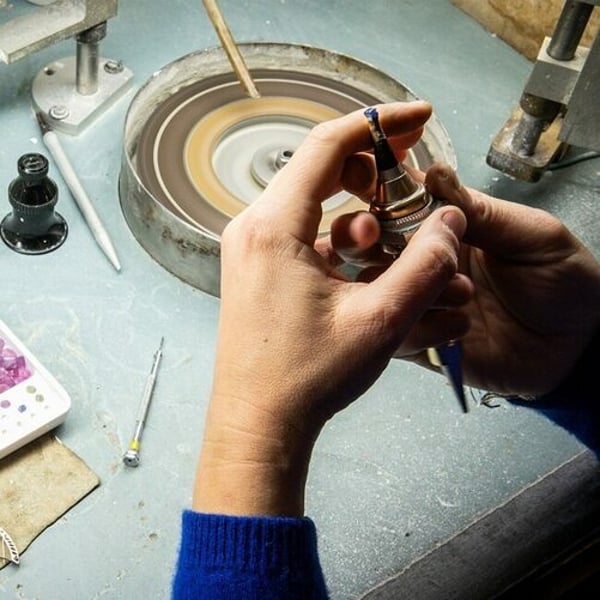
How does a jewellery house update an iconic collection that’s fundamental to its bottom line? In the case of Van Cleef Arpels and the the juggernaut Alhambra fine jewellery line, you lean into subtle transformations. This month, the French jeweller is adding new convertible pieces that can be worn multiple ways.
Jewellery making by Van Cleef Arpels – Van Cleef & Arpels – Facebook
The first is a long Magic Alhambra necklace with an attachment that can either be another layer of the necklace, or its own bracelet. The second is a ring in the Vintage Alhambra style, with a reversible head that will come with either rose gold and gray mother of pearl or white gold and chalcedony with diamond. The wearer can flip the head over and showcase one side or the other depending on the mood.
This shape-shifting nature of these pieces also happens to be a tenet of Van Cleef Arpels jewelry design going back to the mid-20th century, and is exemplified by the brand’s Zip necklace, which can be opened and shut around the neck like the zipper of a jacket. Originally commissioned by Wallis Simpson, the Duchess of Windsor, in 1938, it was not produced until 1951, but it continues to be a hallmark of the brand’s high jewellery.
The Alhambra collection of rings, bracelets, watches and necklaces features four-leaf clover motifs outlined with tiny beads of gold. The clover shapes themselves can be semi-precious stones, like malachite and carnelian, or carved gold or mother of pearl. Since this hugely popular line is so key to the Parisian jewellery house, I wanted to chat with CEO Catherine Rénier about what goes into making changes and additions. Here’s our conversation, edited for length and clarity.
How do you keep a recognisable line like Alhambra fresh?
Alhambra was born in 1968 and since then has always been part of the maison’s expression. And the symbolism behind Alhambra, luck and the positive vision of life, has been core to the maison since before even that. The new collection is a play with alternating motif sizes that we began with Magic Alhambra in 2006, but this time adding the transformability that is dear to the maison—where a long necklace becomes a short necklace and a bracelet. That’s the first that we’ve brought this aspect of our inspiration into Alhambra.
Even after many years with the maison and loving this collection, when I see a new color or stone in Alhambra, I always feel that it’s a new collection. It does bring a new identity every time.
Since it’s so important to the maison, who decides what stones to use? Is there a high stone council?
Well, the “high council” are our stone experts. Because the big question is whether the quality of the stone we want to use is within our standards and whether there is enough availability. Sometimes there are stones and colours that we like so much that we decide to launch them despite small quantities. And these are what we call our “rare materials,” which we know will never have enough of for the market, but still they are adding to the identity and the story of Alhambra. For instance, turquoise or lapis lazuli have been there for a long time, but always in very small quantities because the supply is extremely limited.
How much of a percentage of your fine jewellery business does Alhambra represent?
I cannot share numbers. Of course it’s an iconic collection for the maison. But beyond the numbers, it’s really the identity—and has built the awareness—for Van Cleef Arpels with a clientele at large. Since it was created, Alhambra has been a steady signature because of its style, its play with colors, and the fact that it’s permanently renewing itself.
Would you ever do leather goods with Alhambra motifs? Or go into other categories, the way Bulgari has bags with snake-shaped clasps?
We’ve done such projects in the past, and in the end we like to stay where we know best. Meaning that we are truly jewellers. We have been for a hundred years, and we have learned that the best expression is within the area we’ve mastered: jewellery, and of course watches. There is no point for us to go and take it a lot further in areas where we would not add value on the craftsmanship.
How important is it for you to expand the fine jewellery business beyond Alhambra?
It’s not more important today than it was yesterday. We’ve always been extremely creative in our expression. For us to bring new symbols, new ways to reinterpret our patrimony, that brings our artisans inspiration and motivation. This year we introduced a new collection just this month with Flowerlace, with new shaped flowers in gold. We try to have a permanent, ongoing inspiration, not only in high jewelry, but in fine jewelry as well. This is what gives us this fuel of creativity.
There are stories you simply couldn’t invent. The tale of Bourrienne Paris X, a finalist for the DHL 2025 Award, is one of them. The French shirtmaker for men and women, co-founded in 2017—among others—by two women with entirely different backgrounds, is now entering a phase that balances dynamic expansion with a quest for longevity, projecting growth of over 50% in 2025 and an equally high target for 2026.
Cécile Faucheur is the label’s artistic director – Bourrienne Paris X
The designer behind the Bourrienne Paris X collections is Cécile Faucheur. A former fashion design teacher, pattern cutter and stylist, she is now head of design at the brand she co-founded. Her research at the Musée de la Chemiserie in Argenton-sur-Creuse captivated both her and Charles Beigbeder (who had just taken over the Hôtel de Bourrienne in Paris), prompting them to dedicate a men’s shirting brand to the building.
Historical details and diverse trajectories
For her part, Carine Beigbeder, co-founder and CEO of Bourrienne Paris X, draws on a background that spans finance and entrepreneurship. She previously managed a listed small-cap fund at Financière Arbevel. Her analysis of companies’ business plans and strategies spurred her to take on an operational role—one she now fulfils at Bourrienne Paris X. A luxury brand, or at least on the way to becoming one, the label currently employs around ten people and is attempting to compete with luxury giants such as Hermès in a niche that has, until now, been very narrow: the shirt.
Carine Beigbeder aims to bring longevity to Bourrienne Paris X – Bourrienne Paris X
“The idea was to build a brand inspired by historical details and the shirtmakers of yesteryear. We realised that the men’s wardrobe had lost much of the richness it once had.”
Today, the Bourrienne Paris X wardrobe is rooted in both French stylistic heritage and modern fashion, having opened up to womenswear as early as its second season. This now accounts for more than half of the house’s turnover.
In search of quality materials
“For women, the shirt was a vehicle of emancipation as womenswear became uncorseted and a little freer. It wasn’t necessarily at the same time, but that’s not the point,” explained Beigbeder.
Bourrienne Paris X now goes beyond the shirt and has launched men’s trousers on pre-order, cut from a very heavy Belgian linen, “as if coated with a fine layer of beeswax, which gives it a very new and very innovative look,” in the CEO’s words.
Details play an important role in Cécile Faucheur’s work – Bourrienne Paris X
At Bourrienne Paris X, the linen comes from Belgium, the poplin from Italy, the embroidered trims inspired by the Hôtel de Bourrienne are made by a century-old manufacturer in northern France, the pleating by a Breton artisan, and the mother-of-pearl is sourced from Australia. The shirts, meanwhile, are made in Portuguese and Romanian workshops, and the house is considering other production sites elsewhere in Eastern Europe.
Priority given to digital
Soon to mark its tenth anniversary, Bourrienne Paris X is now in its third year of profitability. Struck by the Covid-19 pandemic after a loss-making start, the brand managed to “keep its head above water,” thanks to digital, which provides sufficient data to respond to its customers’ tastes. The company has self-financed its digital investments and plans to double them in 2026 to accelerate growth, a priority given that its e-commerce site generates over 50% of its sales.
Bourrienne Paris X is largely inspired by the Hôtel de Bourrienne – Hôtel de Bourrienne
Bourrienne Paris X also invests in SEO, and in Google, Pinterest and Meta campaigns tailored to each of the countries where it is sold, namely the United States, England, Switzerland, Canada and Australia. Customs duties, included in the final price across the Atlantic, are no longer an issue for the brand, thanks to the purchasing power of its American customers.
International expansion
With 60% of its sales generated abroad, the label is stocked by a number of department stores, including Le Bon Marché’s men’s department in Paris, as well as Bongénie in Geneva and Zurich, Lane Crawford in Hong Kong, and Isetan, Tomorrowland, United Arrows and Wako in Japan. This is why it is presenting its project to the DHL Prize jury this year.
The brand is a finalist for the DHL 2025 Award – Bourrienne Paris X
The brand remains based at 58 Rue d’Hauteville, opposite the Hôtel of the same name, in the 10th arrondissement of Paris. It’s not unusual for curious customers to be invited to discover the place that inspires the brand with each new collection. The brand’s desire to prioritise digital shapes its approach to welcoming investors, whose most valuable contribution would be their expertise.
For the time being, beyond the brand’s growth, Beigbeder is focused on a mission that is no less important: ensuring that Bourrienne Paris X stands the test of time. A “real challenge” consisting of remaining faithful to the house’s convictions and avoiding, as far as possible, the pull of passing trends.
Jeanne Friot: a queer manifesto to rouse Fashion Week
With her “Awake” show, Jeanne Friot literally brought her guests to their feet at the Théâtre du Rond-Point des Champs-Élysées. Making her debut on the official calendar, the French designer opened the Paris proceedings with a high-octane performance that, true to form, championed LGBTQI+ causes.
The unveiling of Jeanne Friot’s Autumn/Winter 2026 collection, blending runway and choreography conceived with choreographer Maud Le Pladec and the Ballet de Lorraine company, could not have felt more timely given recent headlines and the American president’s posturing. The thirty-something designer issued a call to wake up, with several dancers wearing T-shirts emblazoned with the slogan “It’s never too late to fight fascism“.
Beyond words, the designer opened with three powerful womenswear looks: a black tweed suit with a cropped jacket; a cocktail dress reimagined in a tartan of silver, red and purple sequins, worn by a model with gothic make-up; and a jacket-and-mini-skirt ensemble in black faux leather, heightened by a play of metal straps and buckles—one of her signatures, applied horizontally or vertically to form skirts or dresses—always nodding to the queer wardrobe.
Soon, dancers—wearing tartan catsuits paired with thigh-high boots, faux-leather mini-shorts, colourful tulle tops or black sequin hoodies—launched into breathless choreography. Then came two women in generously cut suits, one black, the other white. The two models drew closer, stared each other down, touched and kissed intensely and at length, melding like yin and yang as, all around them, the troupe ratcheted up the intensity of their stagecraft. The tableau prompted a wave of approval throughout the Parisian theatre.
Ever more exacting in her use of deadstock materials, the French designer introduced several other visually striking pieces, including a long black faux-leather coat worn over a bodysuit and teamed with metallic thigh-high boots, a houndstooth suit with a broad-shouldered jacket and micro-shorts, and an opulent dress featuring a tartan motif that unfurled from the waist into a train of colourful feathers—a true tribute to the queer community.
That community made its support unmistakable when Friot took to the stage to bow, prompting a prolonged standing ovation for a show that opened Paris Fashion Week Men’s with a bang.
Études Studio and its elegant seekers of sound
On Tuesday, for its show in the impressive Institut de Recherche et Coordination Acoustique, Études Studio staged a composition exploring the tonalities of tailoring. For this collection, christened “N°28 Résonances”, co-founders Aurélien Arbet and Jérémie Egry explained in their letter of intent that they drew inspiration from the origins of 1990s dance music and from the universe of American philosopher John Cage, who questioned the very concepts of music and silence.
To pace their mixed show in soundproofed underground spaces, the French opted for powerful music, teaming with British artist Actress, who composed the soundtrack for a show charting new horizons for Études Studio.
Of course, the brand retained its velvet jackets, hefty canvas blousons with carefully worked washes and a few hoodies (with its logo in a circle of stars on the back), faithful to its utilitarian roots. But the label introduced a compelling, reimagined tailoring proposition, with no fewer than a dozen far more formal looks—straight-cut jackets, fluid trousers and layered shirts, waistcoats and roll-neck jumpers—in black, grey or earthy tones.
Gold prospectors or sound seekers? Between Walkman headphones and cowboy hats, Études Studio refused to choose. Its earnest youths saw their wardrobe explore different material aspects—from worn-in finishes to contrasts between nylon and velvet—and a few chromatic accents, such as an intense purple puffer, or camo riffs on substantial, fuzzy knitwear in shades of green or blue, paired with long, wide scarves in matching hues. This season, the brand presented pieces in collaboration with Berlin-based Canadian artist, Jeremy Shaw.
These silhouettes were accompanied, for the first time, by leather or canvas bags bearing the brand’s logo. This leather goods range, developed in two sizes, should provide a growth driver for the independent creative label.
Valette Studio pays tribute to the New Romantics
Once again this season, Valette Studio’s fashion looked to the past. As the first day of Paris Fashion Week drew to a close, the French brand took over the Institut du Monde Arabe. In a basement room supported by large, thick stone columns, Pierre-François Valette unveiled his Autumn/Winter collection entitled “Les Nouveaux Romantiques”, born of a contemporary melancholy caused by the displacement of creation by image.
This season, Valette Studio focuses on color, frills and ruffles – Samuel Gut
Accompanied by a rock soundtrack with wild percussion, later joined by a violin, the models wore a herringbone denim trench with matching skinny jeans, a short cream dress with a shirt collar and frills that cinched the waist and framed the chest, a black leather ensemble and Louboutins, in collaboration with Louboutin on this collection.
Another dress appeared heavy yet almost bounced, covered in frills and cut from a material that looks, to the eye, like balloon rubber. Perhaps the most striking pieces were two white skirts bearing a made-up face, a watercolour rendered alternately in blue and in orange, created by Teintures de France and inspired in particular by the legendary make-up of David Bowie, the pre-eminent figure of the New Romantics. The models were sometimes adorned with silver make-up swept along the outer corners of the eyes, another nod to the stars of this early-1980s movement. At the end of the show, Pierre-François Valette was warmly applauded by the many guests as he crossed the long room to take his bows.
This article is an automatic translation. Click here to read the original article.
Catimini: a name that resonates across France’s childrenswear market. And it is poised for a revival. On January 20, French baby and childrenswear specialist CWF announced the acquisition of Catimini.
CWF takes over Catimini to position it in the premium segment – Catimini
After several turbulent seasons under the ID Kids umbrella, marked by a drastic reduction in its store network from 2023 and a suspension of operations in 2024, Catimini is changing hands. The northern French group had taken over Catimini, along with several other brands from the beleaguered Kidiliz group, in 2020 but failed to restore the brand’s profitability; despite 18 million euros in revenue (per filed accounts) in 2021 and 2022, it posted multi-million-euro losses.
In formalising the deal, without disclosing the amount, Children Worldwide Fashion said it had brought the brand’s founders, Paul and Monique Salmon, who launched the label in 1972, on board.
“Catimini was born of a free and creative vision of children’s fashion. Seeing it join CWF, in Vendée, where it took root, is an obvious choice. We share the same values of know-how, high standards and respect for the brand’s DNA, and I have no doubt about the teams’ ability to embody its codes, gestures and soul,” said Paul Salmon, who is supporting this handover, in a press release.
For CWF, the stakes are high: to restore the lustre of a house that has defined the creative wardrobe of generations of children, while integrating it into the logistical and commercial set-up that has enabled it to establish itself as a strong player on the global children’s luxury stage.
The Les Herbiers-based group built its reputation managing luxury licences (from Givenchy to Marc Jacobs and, more recently, Boss), and is now accelerating the development of its own brands. Alongside Billieblush, Catimini becomes its new in-house standard-bearer. Repositioned in the premium segment, the brand will draw on the group’s expertise as it seeks to reclaim its place in the market by reconnecting with the strongest elements of its DNA, with joyful, graphic fashion in which its signature red is set to play an important role.
CWF is also announcing a first collection for spring/summer 2027, comprising 150 styles for ages 2-14, including accessories, footwear and a gift offering for babies. This comprehensive proposition should quickly find its place within the Kids around network, the group’s multibrand concept, which already boasts 85 stores in 29 countries. The French market accounts for more than a third of the group’s revenue, with CWF Fashion reporting 210 million euros in 2024, according to filed accounts.
To mark this new chapter, CWF intends to make a statement. The group will unveil the first looks of this “new” Catimini on March 11, at a special catwalk show at the Palais de Tokyo in Paris. A deliberate choice of venue, as the site hosts numerous fashion shows during fashion weeks. A symbol of CWF’s determination to bring its premium expertise to Catimini across the board.
This article is an automatic translation. Click here to read the original article.