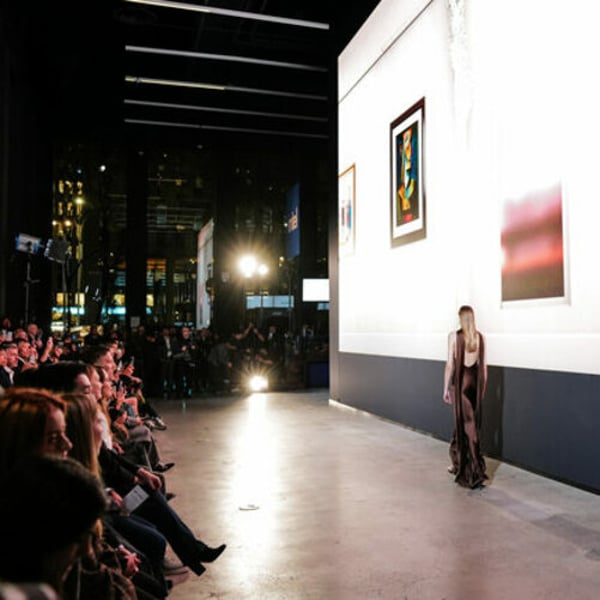
Intel and luxury fashion label Monse have teamed up to unveil the Intel Experience Store pop-up in New York City, merging artificial intelligence, design innovation, and fashion retail.
Intel experience store pops up in NYC with Monse runway show. – Intel x Monse
Open through November 30 at 1251 Sixth Avenue, the Intel Experience Store offers visitors a chance to explore how Intel’s AI PCs can enhance creativity, work, and entertainment.
The pop-up made its debut with a Monse fashion show featuring ready-to-buy looks. As models walked the runway, a synchronized AI-generated video experience played in real time, created on AI PCs powered by Intel. The immersive display illustrated how AI can serve as a creative partner that enhances human imagination rather than replaces it.
“Monse was built on the foundation of craftsmanship, artistry, and community. Our collaboration with Intel reflects our ongoing curiosity to explore new ideas and creative expressions. Through this partnership, we are able to further transport our community into the world of Monse, and facilitate the dialogue between creativity, culture, and innovation,” said Laura Kim and Fernando Garcia, co-creative directors of Monse.
The initiative also unveiled Monse’s runway collection through a see-now-buy-now model, giving consumers immediate access to pieces as they are showcased.
“Intel’s goal is to make AI accessible and meaningful in everyday life. Through our partnership with Monse, we’re showing firsthand how AI technology has the potential to enable better everyday experiences for all of us,” added Brett Hannath, chief marketing officer of Intel.
After ending 2024 down 2.1%, Italy’s childrenswear sector is expected to end 2025 with turnover of just over 3 billion euros, a decline of 3.2%, according to preliminary estimates by Confindustria Moda‘s Economic and Statistical Research Office. The value of production is expected to fall by 4.8% year on year.
In foreign trade, childrenswear exports are forecast to decline by 3.2%, bringing the total value of overseas sales to 1.5 billion euros and accounting for 48.9% of sector turnover. By contrast, imports are expected to grow by 1.8%, taking the total to almost 2.6 billion euros.
With regard to foreign markets, the analysis can be limited to babywear, which, according to Istat, fell by 3.9% in the first nine months of 2025 to 112.7 million euros. This negative trend affected both EU (-1.2%) and non-EU (-5.9%) markets.
During the period under review, the United Arab Emirates confirmed its position as the leading destination for babywear, posting growth of 18.1% to 10.3 million euros, equivalent to 9.2% of total exports. Despite a 2.3% contraction, Spain climbs to second place and accounts for 9.1%, while France takes third place with growth of 1.3%. The US, a strategic market for babywear, slips to fourth following a marked 17.0% decline, to 8.6 million euros and a 7.6% share. The UK and Germany, the fifth and sixth destination markets respectively, also contracted, but at very different rates: the UK recorded a modest 3.6% decline, with a value of 6.8 million euros, while Germany suffered a more pronounced 16% loss, with turnover of 4.8 million euros, corresponding to 4.3% of total exports for the segment.
Conversely, China, in seventh place, shows moderate growth (+4.5%) to 4.6 million euros, followed by Russia and Poland, with particularly strong increases of 35.3% and 63% respectively. Sales to Israel also rose sharply, up 131.2% to 3.9 million euros, taking its share to 3.5%.
Among other European markets, Portugal and Bulgaria, the eleventh and twelfth, both show increases of 1.9% and 0.3% respectively; while Greece and the Netherlands, in fourteenth and fifteenth positions, show declines of 12.3% and 14.5%, respectively. In the Middle East, in addition to the aforementioned Emirates, Qatar (2.9 million euros, +8.9%) and Saudi Arabia (2.2 million euros, +25.6%) stand out, strengthening their overall contribution.
Finally, with shares of less than 2%, Belgium and Romania show significant growth, with increases of 52.3% and 12.6%, respectively, while Croatia and Japan register smaller negative changes of 7.8% and 0.5%, respectively.
This article is an automatic translation. Click here to read the original article.
Monica Vinader has chosen English singer/songwriter Sienna Spiro as the face of the aspirational, ambitious premium jewellery brand.
Sienna Spiro
The “meaningful collaboration” links the jewellery brand “known for its design integrity and exceptional quality” to “one of music’s most compelling emerging voices… with her lyrics rooted in feeling and intention, qualities that closely align with Monica Vinader’s approach to design”, we’re told.
Throughout the campaign, Spiro wears the new Infinity collections as well as Monica Vinader pieces engraved with lyrics from her song ‘You Stole the Show’.
The engravings spotlight the brand’s personalisation services, “transforming jewellery into objects of meaning, from song lyrics and private messages to personal mantras”, the retailer said.
The brand, which has several stores in London, plus stores at Liverpool One, in Manchester and Edinburgh, appointed a new CEO in November. Sebastian Picardo now heads the previously family-run brand founded by siblings Monica (artistic director) and Gabriela (non-exec director) in 2008.
At the time of his appointment, the sisters said Picardo is “perfectly placed to guide our next phase of growth” and will work to accelerate the business’s global reach, “scaling innovation, inspiring existing and new audiences, and setting new standards for modern luxury jewellery”.
Scottish gymwear brand Dfyne has opening a 21,623 sq ft headquarters in Glasgow that “marks a major milestone in the company’s growth just four years after launch”, it said.
Dfyne
Designed in collaboration with workplace designer/builder Oktra, the new HQ provides a permanent base for Dfyne’s growing team and “reflects the brand’s ambition, identity, and people-first values.. as the business continues to grow”.
The opening marks ‘phase one’ of the project, with further phases planned to extend the workspace and complete the ground floor fit-out, it said.
The workplace is organised around a series of “clearly defined zones, balancing focused workspaces with informal collaboration areas and spaces to showcase Dfyne products”.
“Cultural storytelling” is also embedded within the design. Brown leather seating in the new meeting booths references a brown leather sofa from Dfyne’s original headquarters – a piece closely associated with the brand’s early days and formative moments.
“This detail symbolises [our] journey from a small founding team to a fast-growing international brand, while maintaining a strong connection to its roots”, it said.
CEO Oscar Ryndziewicz added: “In only four years, and thanks to our incredible community, we’ve grown to such a level that we can create a new, tailor-made space for our team that embodies our brand values. With the creation of unique workspaces, our new HQ is purposefully designed to enable everyone who supported the company’s growth to spark connections and inspire innovation.”