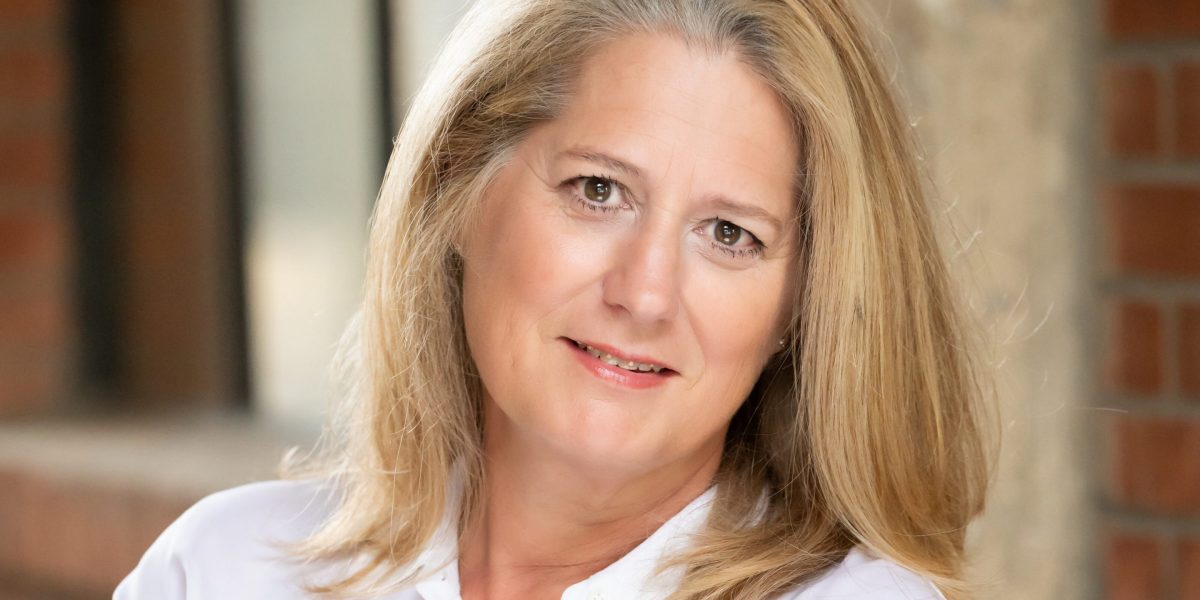
Happy Meal toys like Transformer figurines and Hot Wheels cars have sparked joy with little kids for decades—and now, one of the designers behind the miniatures is changing lives for thousands of people. Dallas-based entrepreneur Nancy Hairston founded MedCAD, a surgical solutions company, in 2007—and in the decades since, its 3D-printing innovations have helped patients recognize themselves in the mirror again.
But before Hairston was building skull implants, she spent most of her career in the design world. When she graduated art school with a sculpture MFA from Loyola University in 1991, she had a rude awakening: She couldn’t find any open jobs for what she wanted to pursue. Meanwhile, 3D animation was all the rage at the time, so Hairston pivoted and took on a litany of modeling and animation jobs, from Mary Kay cosmetics to software company Alias. Eventually, she landed in the toy industry. The tactile practice of sculpting in clay was now being done digitally on a computer, which meant designing in 3D—and major corporations were wanting it to manufacture everything from toys to shoes.
“It was as if a lightning bolt hit me,” Hairston tells Fortune, speaking of the first time she entered the 3D-modeling world. “That was [all] the rage. That was the tool to use. So I started doing Happy Meal toys and Bratz toys for Mattel.”
However, the late 2000s changed things: The entrepreneur says her peers’ roles were all heading to Asia, leaving behind medical and aerospace work as the main points of entry in the U.S. Luckily, Hairston was already recognizing the potential for 3D modeling in healthcare—so she quit her “sensible” 9-to-5 job and launched MedCAD.
“It was thrilling and scary, but I saw the opportunity because the technology was so new,” Hairston recalls.
The call from a surgeon that changed Hairston’s life
She had already started tinkering with anatomy modeling, adapting the toy-development software she’d used for orthognathic surgery applications like jaw and teeth repairs. By the time 2009 came around, she built a business plan to get FDA clearance. And younger surgeons—who grew up exposed to advanced tech and 3D animation, Hairston says—were starting to take note as word spread of her innovations.
Then, Hairston’s phone rang. The ensuing call would alter the trajectory of her career.
“[I had] one of those pivotal moments in your life, where your whole world changes. I got a phone call from a surgeon that I knew, and he said, ‘Hey, you know, do you think you could make me a cranial implant?’” Hairston says. “And that’s how it started.”
MedCAD went on to fill the unmet needs of patients with small to large deformities stemming from trauma-related injuries or physical abnormalities. Skull implants have continued to be a huge part of the business, but the company has since expanded into other areas of the body such as foot, ankle, and facial reconstruction products, all conceptualized with 3D designs.
“We were some of the earliest people doing it,” Hairston continues. “There’s a fantastic thread to all of this is, that we are able to bring a person back as much as we can to a normalized state with a lot less surgeries. [Patients are] waking up with the ability to have teeth implants after they heal. That’s the power of this technology—we can do a more holistic approach to reconstructing a foot or a face.”
Scaling MedCAD to upwards of $20 million in annual revenue
Since founding MedCAD nearly two decades ago, the company has continued to grow in the 3D-implant space. The company tells Fortune it has achieved profitability and boasts an annual revenue estimated to be between $10 million and $20 million this year and in 2026, but did not specify exactly how much it’s making in annual profit. Cranial and neuro products are a key growth driver, experiencing 18% to 25% growth year-over-year since 2022. It’s also ramping up a direct-to-hospital strategy, but a majority of its revenue comes from long-term contracts with global medical leaders needing implants and medical devices.
Despite having a successful run in toy-designing and founding a profitable business, Hairston says she’s most energized by the difference her implants make in peoples’ lives. Sparking joy among little kids with her McDonald’s toys and Bratz dolls was one achievement, but she’s making even more waves for thousands of medical patients hoping to feel whole again.
“Toys are really fun for children, but they’re not played with for long,” Hairston says. “We can really make a difference making these kinds of products for humans that change their lives. That gave me a lot of the power and the passion to do it.”
For Josie Lauducci and her husband Christian, home isn’t tied to a zip code—it moves with the tides, literally.
For the past decade, the couple has lived aboard a 13-meter-long sailing yacht, traveling across the Pacific and at times raising their three children at sea. Their floating home has taken them from San Francisco to South America and as far as New Zealand.
They aren’t retired early or backed by generational wealth. Instead, their nomadic life is powered by something far more practical: Lauducci’s flexible nursing job in San Francisco.
About every five or six weeks, Lauducci flies from wherever the boat is docked—most recently in Mexico—back to the Bay Area. She works eight 12-hour shifts as a per diem neonatal intensive care unit nurse, making over $100 an hour. While per diem roles don’t guarantee shifts, they offer far more control over scheduling—and in Lauducci’s case, enough pay to cover her family’s expenses.
“That rhythm is what makes this life possible,” the 44-year-old told Fortune from the airport, en route back to Luana, the family’s newest vessel.
The arrangement might sound extreme, but it’s increasingly familiar at hospitals across high-cost cities like San Francisco. In fact, there’s a growing class of workers who live far from where they’re employed, compress their schedules, and travel long distances to make the math work.
Lauducci is one of them: a supercommuter.
The rise of supercommuting
Lauducci has worked as a nurse for more than 20 years and started out full-time, with stints as a travel nurse along the way. But as she gained seniority at her Bay Area hospital, she began to notice a different path emerging, one taken by per diem nurses who traded predictability for flexibility.
Some would fly overseas after completing their required shifts. Others lived out of vans, exploring the U.S. between work stints. What they shared was a willingness to reorganize their lives around compressed schedules.
This idea of supercommuting has long existed across the corporate ladder, from interns to CEOs. But its popularity soared during the pandemic, when workers got a glimpse of a calmer, cheaper life outside major cities.
Researchers from Stanford found that the share of workers in the 10 largest U.S. cities who commuted more than 75 miles each way had grown more than 32% since the pandemic. In the U.K., Trainline found that the number of Brits spending more than three hours getting to work and back has doubled since before COVID.
Work-life balance also now matters more than ever. A report released last month found that it has overtaken both pay and job security as the most important factor for job seekers.
The healthcare system—under pressure to fill critical roles while reducing burnout—has thus increasingly made room for flexibility, particularly for experienced nurses whom hospitals are eager to retain. For Lauducci, that means if she miscalculates time to port and misses her flight, preventing her from working a shift, it’s not the end of the world.
“You can self-cancel (a shift) and they don’t cry about it,” Lauducci said.
Courtney El Refai is another example. She is also a nurse working in the Bay Area, but her home is some 5,000 miles away in Sweden.
She stacks the four-shifts-a-month requirement together at the end of one month and the beginning of the next. So she spends about 10 days working eight shifts in California before heading back to Europe.
“The commute is absolutely outrageous, but imagine having six weeks off after working 10 days on a repeated pattern,” she said in a TikTok video that’s racked up over 500,000 views.
Moreover, since her husband and daughter made the move to Europe last year, she said she’s been enjoying an enhanced work-life balance.
“It basically feels like I am a stay-at-home mom, but I’m still a working mom…” El Refai said. “That is something no 9-to-5 job will ever give me.”
Life on the open waters
With the median sale price for a home in San Francisco being $1.48 million—241% higher than the national average—living almost anywhere else is going to be financially lower, including a sailboat.
Lauducci said the low-consumption lifestyle was part of what drew her to her husband, who grew up sailing and once lived in a low-income artist co-op. Today, the couple is intentional about keeping costs down.
“We don’t spend much time in marinas, so when we anchor, it’s free. We sail, so we’re not using much energy. We create energy through solar power. We make our own water through a desalinator,” she said.
Josie Lauducci and her family once sailed from San Francisco to New Zealand, a trip that took over three years. (Photo courtesy of Josie Lauducci)
One of the most common criticisms she hears is about retirement. Lauducci understands the concern but rejects the idea that security must come from “the golden handcuffs of the pension.” She still contributes to a retirement account and worked long enough full-time to become vested.
While two of their three children have since grown older and moved on to college or careers, she said life at sea gave them a rare perspective.
“Your kids aren’t just out there by themselves,” she said. “You end up on the same sailing trajectory as other families, and you meet up at the beach, or you do potlucks on each other’s boats, and it’s just a real, instant community.”
And thanks to Starlink satellite internet, staying connected—when they want to be—is easier than ever, whether that means downloading a school project for their 12-year-old, checking the weather, or mapping out the route to their next adventure.
The Justice Department released thousands of files Friday about convicted sex offender Jeffrey Epstein, but the incomplete document dump did not break significant ground about the long-running criminal investigations of the financier or his ties to wealthy and powerful individuals.
The files included photographs of famous people who spent time with Epstein in the years before he came under suspicion, including some candid snapshots of Bill Clinton, who flew on Epstein’s jet and invited him to the White House in the years before the financier was accused of wrongdoing. But there was almost no material related to another old Epstein friend, President Donald Trump, aside from a few well-known images, sparing the White House from having to confront fresh questions about a relationship the administration has tried in vain to minimize.
The records, consisting largely of pictures but also including call logs, grand jury testimony, interview transcripts and other documents, arrived amid extraordinary anticipation that they might offer the most detailed look yet at nearly two decades worth of government scrutiny of Epstein’s sexual abuse of young women and underage girls. Yet the release, replete with redactions, seemed unlikely to satisfy the clamor for information given how many records had yet to be released and because some of the materials had already been made public.
Democrats and some Republicans seized on the limited release to accuse the Justice Department of failing to meet a congressionally set deadline to produce the files, while White House officials on social media gleefully promoted a photo of Clinton in a hot tub with a woman with a blacked-out face. The Trump administration touted the release as proof of its commitment to transparency, ignoring that the Justice Department just months ago said no more files would be released. Congress then passed a law mandating it.
In a letter to Congress, Deputy Attorney General Todd Blanche wrote that the Justice Department was continuing to review files in its possession, was withholding some documents under exemptions meant to protect victims and expected additional disclosures by the end of the year.
Trump, who was friends with Epstein for years before the two had a falling-out, tried for months to keep the records sealed.
But bowing to political pressure from fellow Republicans, Trump last month signed a bill giving the Justice Department 30 days to release most of its files and communications related to Epstein, including information about the investigation into his death in a federal jail. The law set a deadline for Friday.
Limited details about Trump
Trump is hardly glimpsed in the files, with the small number of photos of him appearing to have been in the public domain for decades. Those include two in which Trump and Epstein are posing with now-first lady Melania Trump in February 2000 at an event at his Mar-a-Lago resort.
Trump’s connection to Epstein is well-documented, but he has sought to distance himself from his former friend. He has said he cut off ties with Epstein after the financier hired young female employees from Mar-a-Lago and has repeatedly denied knowledge of his crimes.
The FBI and Justice Department abruptly announced in July that they would not be releasing any additional records, a decision that was supported by Trump. But the president reversed course once it became clear that congressional action was inevitable. He insisted the Epstein matter had become a distraction to the Republican agenda and releasing the records was the best way to move on.
The White House, meanwhile, has moved to shift focus away from Trump’s ties to Epstein, with Attorney General Pam Bondi last month saying that she had ordered a federal prosecutor to investigate Epstein’s connections to Trump’s political foes, including Clinton.
Neither Trump nor Clinton has ever been accused of wrongdoing in connection with Epstein, and the mere inclusion of someone’s name in the files from the investigation does not imply otherwise.
Among other prominent Epstein contacts is the former Prince Andrew, who appears in a photograph released Friday wearing a tuxedo and lying on the laps of what appear to be several women who are seated, dressed in formalwear. Pop star Michael Jackson also appears in multiple photos, including one showing him standing next to a smiling Epstein.
New photos of Clinton
Unlike Trump, Clinton is featured prominently in the files, though the records included no explanation of how the photographs of the former president related to any investigation or the context surrounding them.
Some photos showed him on a private plane, including one with a woman, whose face is redacted, seated alongside him with her arm around him. Another shows him in a pool with Epstein’s longtime confidant, British socialite Ghislaine Maxwell, and a person whose face was also redacted. He is also seen in a hot tub with a woman whose face was redacted.
This undated, redacted photo released by the U.S. Department of Justice shows Ghislaine Maxwell and former President Bill Clinton swimming with an unknown person.
U.S. Department of Justice via AP
Senior Trump White House aides took to X to promote the Clinton photos.
White House press secretary Karoline Leavitt wrote “Oh my!” and added a shocked face emoji in response to a photo of Clinton in the hot tub.
“They can release as many grainy 20-plus-year-old photos as they want, but this isn’t about Bill Clinton,” Clinton spokesman Angel Ureña said in a statement.
“There are two types of people here,” he said. “The first group knew nothing and cut Epstein off before his crimes came to light. The second group continued relationships after that. We’re in the first. No amount of stalling by people in the second group will change that.”
The Epstein investigations
After nearly two decades of court action, a voluminous number of Epstein records had already been public before Friday, including flight logs, address books, email correspondence, police reports, grand jury records, courtroom testimony and deposition transcripts.
Besides public curiosity about whether any of Epstein’s associates knew about or participated in the abuse, Epstein’s accusers have also sought answers about why federal authorities shut down their initial investigation into the allegations in 2008.
“Just put out the files,” said Marina Lacerda, who says she survived sexual assault by Epstein. “And stop redacting names that don’t need to be redacted.”
One of the few revelations in the documents was a copy of the earliest known concern about Epstein’s behavior — a report taken by the FBI of a woman in 1996 who believed photos and negatives she had taken of her 12-year-old and 16-year-old sisters for a personal art project had been stolen by Epstein. The documents don’t show what, if anything, the agency did with that complaint.
Police in Palm Beach, Florida, began investigating Epstein in 2005 after the family of a 14-year-old girl reported being molested at his mansion. The FBI joined the investigation. Authorities gathered testimony from multiple underage girls who said they’d been hired to give Epstein sexual massages.
Ultimately, prosecutors gave Epstein a deal that allowed him to avoid federal prosecution. He pleaded guilty to state prostitution charges involving someone under age 18 and was sentenced to 18 months in jail.
Epstein’s accusers spent years in civil litigation trying to get that plea deal set aside. One of those women, Virginia Giuffre, accused Epstein of arranging for her to have sexual encounters, starting at age 17, with other men, including billionaires, famous academics, politicians and Andrew Mountbatten-Windsor, then known as Britain’s Prince Andrew.
Prosecutors never brought charges in connection with Giuffre’s claims, but her account fueled conspiracy theories about supposed government plots to protect the powerful. Giuffre died by suicide in April.
Federal prosecutors in New York brought new sex trafficking charges against Epstein in 2019, but he killed himself in jail after his arrest. Prosecutors then charged Maxwell, his longtime confidant, with recruiting underage girls for Epstein to abuse. She was convicted in 2021 and is serving a 20-year prison sentence.
The Justice Department’s extensive redactions to the Jeffrey Epstein files on Friday don’t comply with the law that Congress passed last month mandating their disclosure, according to Rep. Ro Khanna.
The California Democrat and Rep. Thomas Massie, R-Ky., led the effort on the legislation, which required that the DOJ put out its entire trove of documents by today.
But he blasted the document dump and singled out one file from a New York grand jury where all 119 pages were blacked out.
“This despite a federal judge ordering them to release that document,” Khanna said in a video posted on X. “And our law requires them to explain redactions. There’s not a single explanation. That entire document was redacted. We have not seen the draft indictment that implicates other rich and powerful men who were on Epstein’s rape island who either watched the abuse of young girls or participated in the abuse of young girls in the sex trafficking.”
He said Attorney General Pam Bondi has been “obfuscating for months” and called the files on Friday “an incomplete release with too many redactions.”
The Justice Department didn’t immediately respond to a request for comment.
In a separate X post, Massie agreed with Khanna, saying the DOJ “grossly fails to comply with both the spirit and the letter of the law” that President Donald Trump signed last month.
Deputy Attorney General Todd Blanche told Congress that the Justice Department had identified 1,200 victims of Epstein or their relatives and redacted materials that could reveal their identities, according to the New York Times.
Earlier on Friday, Blanche told Fox News that “several hundred thousand” pages would be released on Friday. “And then, over the next couple of weeks, I expect several hundred thousand more,” he added.
“Thomas Massie and are exploring all options,” Khanna warned. “It can be the impeachment of people at Justice, inherent contempt, or referring for prosecution those who are obstructing justice. We will work with the survivors to demand the full release of these files.”
Join us at the Fortune Workplace Innovation Summit May 19–20, 2026, in Atlanta. The next era of workplace innovation is here—and the old playbook is being rewritten. At this exclusive, high-energy event, the world’s most innovative leaders will convene to explore how AI, humanity, and strategy converge to redefine, again, the future of work. Register now.