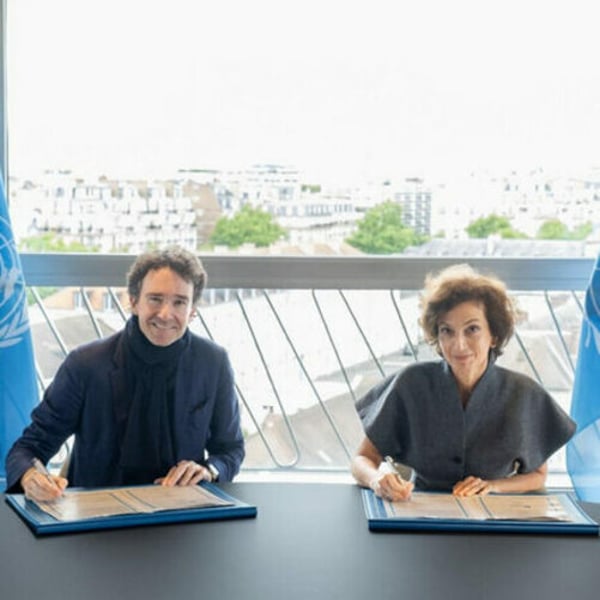
On October 30, LVMH and UNESCO renewed their five-year partnership. Initiated in 2019 as part of the Group’s Life 360 environmental program, this agreement aims to support the implementation of the “Man and the Biosphere” (MAB) Program, which promotes the preservation and restoration of ecosystems in UNESCO-recognized biosphere reserves. The new agreement, signed by LVMH Image and Environment Director Antoine Arnault and UNESCO Director-General Audrey Azoulay, covers the period from 2025 to 2029.
Antoine Arnault, LVMH Director of Image and Environment, and Audrey Azoulay, Director-General of UNESCO
The French group is committed to strengthening its actions in support of biodiversity, notably through research, awareness-raising initiatives, and sustainable local development projects in new regions.
“The initial five-year partnership aimed to preserve biodiversity in UNESCO-designated areas in the Amazon. We worked in eight areas in Bolivia, Ecuador, Peru, and Brazil. It’s a fundamental issue, for the simple reason that our products come from nature,” explained Hélène Valade, LVMH’s Environmental Development Director, to a group of journalists on October 30. “With UNESCO, we have developed a method. The first element of this method is that you can’t protect biodiversity if you don’t take care of local communities. We have created a geospatial platform that enables us to collect biodiversity data, combining scientific expert data with local community data.”
The program included training, strengthening local activities, and measuring the impact of actions. This process is now being replicated across all projects covered by the expanded partnership.
For this new phase, Tiffany & Co. is joining the initiative. The jeweler is aligning with this approach through its “Delivering a Healthy Ocean” initiative, which aims to protect marine and coastal ecosystems and support scientific research.
On the ground, this partnership is reflected in actions carried out in several pilot areas in Africa, Asia, and South America. Among these, the program to restore the Tonlé Sap biosphere reserve in Cambodia exemplifies this approach: LVMH supports reforestation initiatives, sustainable water management, and the development of economic activities that respect the ecosystem. These projects align with Life 360’s commitments, which aim to make the preservation of the living world a central pillar of the Group’s environmental strategy.
Hélène Valade – LVMH
A strategy that continues to gain momentum, according to the president of the Group’s CSR Observatory: “Despite the current context, it is ever more deeply rooted in LVMH’s DNA. We are more committed than ever to our strategy.”
While the Group is highlighting its partnership with UNESCO, ten years after the Paris Agreement and COP21, LVMH is also implementing new tools to refine its environmental strategy and bring the teams of its 75 Maisons on board. As the executive explains, over the past ten years, since 2015, the luxury giant has increased the share of renewable energy in its energy mix from 8% in 2015 to 71% in 2024, highlighting the many changes made by the Group in its direct operations, including impact measurement indicators now integrated into teams’ day-to-day practices.
To go further, however, the Group needs to work in depth on Scope 3 emissions — that is, the emissions generated by its suppliers. And to make progress on this front, the executive explains that the Group is pursuing several initiatives in parallel.
“On September 17, we organized a meeting with the environmental responsibility directors and the finance directors of our Maisons, to adopt a very cross-functional finance-sustainability approach,” explained Hélène Valade. “It was an extremely powerful moment of aligning our terminology with practical aspects, such as ‘How do you approach a climate transition plan financially?’ We decided to create a sustainability-finance task force.”
Its mission is to work on a financial approach to climate and biodiversity risks for LVMH.
“On the first point, we know that, according to IPCC scenarios, some of our supply chains are at risk. But we need to quantify this, because inaction on climate has a cost. The task force must also create a framework for investment capacity based on environmental criteria.”
Given that oversight of the supply chain and subcontracting is a particularly sensitive issue in the luxury sector following recent scandals in Italy, the Group also brought together 120 of its key suppliers last spring to raise awareness of the challenges involved in transforming business models. “They are our Scope 3, so we need to look after them and support them in their environmental transition,” said Hélène Valade, who advocates an incentive-based model rather than sanctions on this subject.
“It was a moment of co-creation. They are aware of the issues but face a heavy administrative burden and multiple reporting requirements. We need to help them in this respect. Some innovations may benefit all parties. We need to support them on these issues.” With this in mind, the Group has opened its training programs to its partners.
This article is an automatic translation. Click here to read the original article.
Long regarded as a core pillar of corporate strategy, DE&I (diversity, equity and inclusion) is now going through a turbulent period. Under intensifying political, economic and social pressures, it has reached a pivotal moment. The sixth White Paper from the International Association of Department Stores (IADS) examines whether inclusion remains a fundamental priority or risks being pushed into the background.
Inclusion in the United States is under strain amid pressure from the presidential administration – Shutterstock
The 2025 edition looks at DE&I at a time when commitments are being put to the test. The year 2024 saw heightened scrutiny of inclusion programmes. In January 2025, the signing of a controversial US presidential executive order entitled “Ending Radical and Costly Government Diversity, Equity and Inclusion Programs and Preferences” prompted immediate reactions from major North American companies fearing legal reprisals, according to IADS.
The myth that inclusion penalises businesses
The 2025 report draws on a set of concrete observations from an analysis of the practices of leading retailers worldwide. It highlights four dimensions in which DE&I, when embedded in day-to-day operations, serves as a measurable driver of performance. Firstly, organisations with diverse leadership teams report stronger decision-making and greater strategic agility.
Secondly, companies that value inclusion see improved employee retention, thereby reducing turnover costs in a historically volatile sector. Thirdly, inclusion fosters more effective communication within teams, which reduces operational errors and strengthens cohesion.
DE&I is a legacy of civil rights struggles
Finally, retailers note that some of the most relevant ideas come directly from frontline teams who, thanks to their diverse experiences, contribute significantly to innovation and to adapting to varied customer expectations. These findings show that DE&I is not only an ethical value, but also a concrete driver of organisational effectiveness.
Despite conservative rhetoric, inclusion and diversity are an asset for companies, says IADS – Shutterstock
The report also notes that DE&I forms part of a longer legacy, rooted in the civil rights movement and in the historic demands of retail frontline teams for fair treatment and safer working conditions. However, contemporary expectations, often unclear or poorly defined, have given rise to what some stakeholders describe as “DE&I fatigue”, fuelled by doubts about the sincerity of commitments rather than by clear strategic thinking.
Inclusion, between intention and ‘strategic advantage’
The White Paper further points out that DE&I cannot be one-size-fits-all: priorities vary by region — from gender parity, ethnicity and disability to socio-economic background and national integration — and expectations regarding language and transparency differ considerably. For international groups, tailoring local approaches while upholding universal principles of equity is a major operational challenge.
Finally, IADS sets out the conditions that enable inclusion to take root for the long term: listening to employees, setting clear behavioural expectations, fostering collaboration between stores and headquarters, and ensuring fairness in recruitment and development processes. Beyond intention, these capabilities help retailers turn DE&I into a tangible strategic advantage, strengthening resilience, engagement and relevance in a constantly evolving environment.
Founded in 1928, IADS coordinates exchanges between department stores worldwide and publishes an annual White Paper on a key industry issue. Previous publications have focused on the Covid-19 pandemic, digital transformation, sustainability, retail media and the role of middle management.
Lululemon founder Chip Wilson is trying to excise private equity firm Advent from the apparel maker’s board as part of an ongoing proxy fight, Semafor reported on Monday, citing people familiar with the matter.
Lululemon
Wilson had launched a proxy fight in late December by nominating three independent directors to the company’s board.
Wilson is one of Lululemon’s largest independent shareholders, with a 4.27% stake as of December 2025, according to data compiled by LSEG.
While Wilson has said he does not want a board seat, he is making it clear that he will not consider any settlement with Lululemon unless two legacy directors, including chair David Mussafer, resign, Semafor reported.
The yogawear maker founder’s frustrations have been compounded by Advent’s spotty record in the consumer space, according to the Semafor report.
Lululemon also faces activist pressure from Elliott Management, which took a $1 billion stake in the company earlier in December and has been working closely with former Ralph Lauren executive Jane Nielsen for a potential CEO role.
Reuters could not immediately verify the report. Lululemon and Advent did not immediately respond to requests for comment.
Men’s Fashion Week kicks off in Paris on Tuesday and will feature six days of trend-setting catwalk shows, a farewell at Hermes and tributes to late Italian fashion icon Valentino.
The first day of the Fall/Winter 2026 edition will be dominated by the latest mega-production from Louis Vuitton‘s celebrity menswear designer Pharrell Williams, as well as mourning for one of the industry’s biggest names.
Williams will unveil his collection at the brand’s glitzy gallery space in western Paris under the shadow of the death of Italy’s Valentino Garavani, who passed away Monday at the age of 93.
The giant in the world of haute couture died at his home in Rome, just four months after the death of fellow Italian great Giorgio Armani.
In a sign of industrial renewal, however, French designer Jeanne Friot will take her first steps on the daunting Paris calendar on Monday, with the young stylist telling AFP it was a “quite an unusual joy and stress” to take part.
French designer Veronique Nichanian will meanwhile present her last collection for Hermes on Saturday after 37 years at the helm.
The 71-year-old Parisian — one of the few women designing in menswear — will leave behind a brand in tremendous financial shape with an image of timeless, refined masculinity that she has helped shape.
Her successor, London designer Grace Wales Bonner, who is of English and Jamaican heritage, represents a generational and stylistic shift for the classic family-run French house.
Many fashionistas will be casting an eye on the Christian Louboutin show on day two where Jaden Smith — son of US rapper-actor Will Smith — will present his debut collection.
The model and musician, 27, was unveiled as the creative director of the famed French brand last September by founder Louboutin, who appears to be preparing to hand over the reins to the Gen Z trendsetter.
The choice is seen as a bold bet on relatively inexperienced youth by the veteran maker of red-soled stilettos, whose ready-to-wear menswear and accessories are estimated by analysts to account for about a quarter of his sales.
On Wednesday, much-hyped Dior designer Jonathan Anderson will unveil his second Homme collection, having made his debut in June last year with a widely praised show of unisex styling.
But the 41-year-old’s womenswear collection in September didn’t convince everyone, and some observers expect him to put a more decisive mark on Dior and cement the new identity he’s begun sketching out.
“There’s a lot of anticipation,” Alice Feillard, men’s buying director at Paris department store Galeries Lafayette, told AFP.
The luxury fashion industry has undergone a wave of changes over the last 12 months at a time of weak international growth following the bumper buying frenzy of the post-Covid period.
Slowing demand from China, US tariffs on imports and uncertainty about the global economy have all weighed on sales of European brands.
New faces such as Anderson, Matthieu Blazy at Chanel, Demna at Gucci or Sarah Burton at Givenchy represent the elevation of a new stable of couturiers who look set to dominate the major houses over the next decade.
Elsewhere over the week, Japanese brands from Yohji Yamamoto and Issey Miyake to Mihara Yasuhiro will be out in force.
LVMH-owned Kenzo, will hold a presentation instead of a runway show on Tuesday inside the vast Parisian house of late founder Kenzo Takada in the French capital’s trendy 11th district.
The four-storey modernist building, which features a Japanese garden, will host a day-long gathering of design, food and music curated by chief creative Nigo.
US designer Willy Chavarria, who is one of a handful unafraid to express political views, also returns for his third season in Paris and might have something to say about Donald Trump‘s presidency on Friday.