Connect with us

Business

Mormon women are lining up to purchase new $5 ‘sacred’ garments that symbolize a turning point for the church

Published

on


SALT LAKE CITY (AP) — Sleeveless versions of the sacred undergarments worn by members of The Church of Jesus Christ of Latter-day Saints flew off the shelves on their first day available in the U.S., marking a momentous occasion for many women in the faith who say they no longer need to trade comfort to feel close to God.

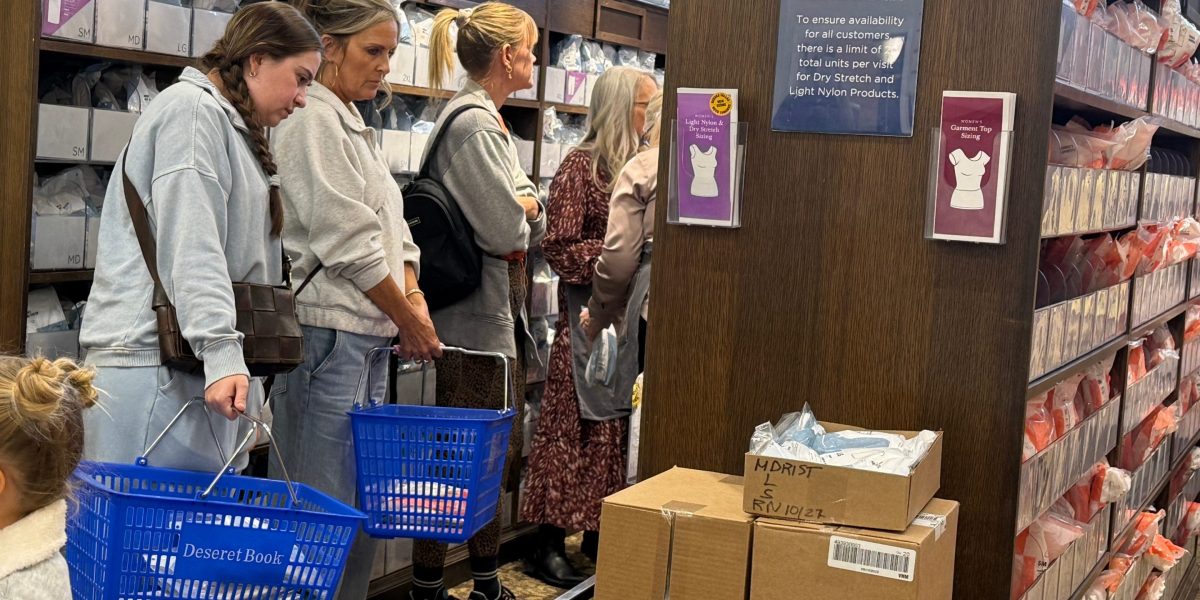
Social media was abuzz with pictures of long lines of mostly women waiting for their chance to get inside specialty stores to buy the new items Tuesday.

Enthusiasm for the new garments, worn under modest street clothes by members of what is widely known as the Mormon church, is not just about all the outfits they can more easily wear over a tank top. The introduction of more breathable fabrics and styles for the typically two-piece white garments is key, especially for those who struggle to wear them for medical reasons or live in warm climates.

“I think that it’s great that they are considering the needs of women,” said Amanda Shirley, a church member from Salt Lake City who was shopping for the garments Tuesday. She knows some women who struggle with the old cotton and polyester garments due to health problems, including gynecological issues.

While the symbolism of the garments is more important to Shirley than comfort, she’s excited for a more breathable alternative. She considers the church’s introduction of new garments “forward-thinking.”

The church, which has more than 17 million members worldwide, has an all-male priesthood and its top leaders are all men. The highest-ranking women serve on councils that sit several layers of leadership below groups reserved for only men.

Though at times they’ve drawn ridicule from outsiders, the garments, worn by men and women alike, are comparable to other faiths’ holy vestments. They remind temple-going Latter-day Saints that they made covenants of obedience, sacrifice, sexual purity and consecration, said Kathleen Flake, a former professor of Mormon Studies at the University of Virginia.

Flake said the new garments were designed by a group including both men and women within the church. They conferred with major lingerie manufacturers to develop these styles over the last two years or so, she said.

“They have tried to make underwear for the world, essentially,” Flake said. “The goal here was to ensure that people are comfortable as they fulfill this aspect of their religion.”

New garments draw long lines at Utah stores

In the church’s home state of Utah, lines for the new garments resembled those of a Black Friday sale, state Sen. Mike McKell said in a post on X.

A line of mostly women with blue shopping baskets snaked through one church-affiliated Deseret Book store in Salt Lake City’s Sugar House neighborhood on Tuesday afternoon. Earlier in the day, the line was out the door.

The new garments cost about $4 to $5 apiece. An employee walked down the line with a measuring tape, gleefully telling customers about the new stretchy fabric, made with some spandex, that she said provides a cooling effect. Signs at the store’s registers declared a limit of 20 items per customer to ensure availability for as many shoppers as possible. As of 3 p.m., the store was out of sizes small and extra small.

Asked why she was excited about the new garments, one shopper, Janae Skinner, simply said, “I sweat a lot!”

While there is a way to buy the new garments online, many shoppers told The Associated Press that they wanted a chance to try on the updated styles and sizes before purchasing.

Garments change with the times

Flake, the longtime Mormon expert, said the church has made a number of stylistic changes to temple garments throughout its history simply because the way people dress changes. This latest change has also been a long time coming because the faith is truly global and must cater to everyone who practices it, she said.

“This change shows the church’s responsiveness to make the garments as comfortable as possible for a maximum number of people,” Flake said.

It’s also why the garments were first introduced in other parts of the world where it was a more practical necessity, including hotter climates and where women typically wear dresses. Sleeveless tops, skirt bottoms and one-piece shifts were already available in Africa and the Philippines, according to the church’s online store.

Daniel Walker rushed to buy the new garments before he leaves Wednesday for missionary training. He said he was excited to try the new tank top style, which he hopes will be more comfortable in warmer months while serving his mission in Roseville, California. He said the current garments can get hot, but he has gotten used to them.

He said a friend who served a mission in Africa got the sleeveless garments there last year and encouraged Walker to buy them as soon as they hit the shelves stateside.

The missionary from Grantsville, 37 miles (59 kilometers) west of Salt Lake City, said he gets frustrated when people outside the faith joke that Latter-day Saints wear “magic underwear.” He hopes that by speaking openly about the spiritual significance, he can help cut through some of the stigma.

“I feel like sometimes people act like it’s like a secret or something that we need to hide,” Walker said. “But to me, it’s just something that reminds me of promises I made with God, and so I don’t think it’s anything that I should keep secret.”

___

Bharath reported from Los Angeles and Meyer from Nashville, Tennessee.

___

Associated Press religion coverage receives support through the AP’s collaboration with The Conversation US, with funding from Lilly Endowment Inc. The AP is solely responsible for this content.


Source link

Continue Reading

Business

Trust has become the crisis CEOs can’t ignore at Davos, as new data show 70% of people turning more ‘insular’

Published

on


Everywhere you turn in Davos this year, people are talking about trust. And there’s no one who knows trust better than Richard Edelman. Back in 1999, Edelman was on the cusp of taking  over the PR firm founded by his father Daniel. Spurred by the 1999 WTO protests in Seattle, he decided to try and measure the level of trust in NGOs compared with business, government and media, Edelman surveyed 1,300 thought leaders in the U.S., U.K., France, Germany and Australia, and the Edelman Trust Barometer was born. 

While the survey sample long ago expanded beyond elites to include about 34,000 respondents in 28 nations, its results are still unveiled and debated every year at the ultimate gathering of elites: the World Economic Forum. This year’s findings are grim: About 70% of respondents now have an “insular” mindset: they don’t want to talk to, work for, or even be in the same space with anyone who doesn’t share their world view. And “a sense of grievance” permeates the business world, Edelman finds. At Davos, debating such findings have spawned a series of dinners, panels, cocktails and media briefings on site. What better place to bring people together than the world’s most potent village green?

I moderated a CEO salon dinner with about three dozen leaders last night to discuss what they’re seeing and doing when it comes to building trust. Before the dinner, I asked Edelman what he’d like to see this year, after 26 winters of highlighting the erosion of trust. “Urgency,” he said. “A sense that time is running out.”

Because the gathering itself was held under the Chatham House rule, I won’t share names and direct quotes. But the focus was on how attendees are trying to address the problem through what Edelman calls “trust brokering,” or finding common ground through practices from nonjudgemental communications to “polynational’ business models that invest in long-term local relationships. (See the report for more information.) There were some success stories from the front lines of college campuses, politics and industries caught in a crossfire of misinformation.

Still, the mood was somewhat subdued, with a sense that there’s no easy fix to building trust. As one CEO pointed out, rarely have leaders faced such a confluence of geopolitical crises, tech shifts, economic divides, disinformation, job disruption and wicked problems. And as much as Davos is a great gathering ground to talk through all of these problems, the fact is the problems will all still be waiting once these CEOs return from the mountains.

This story was originally featured on Fortune.com


Source link

Continue Reading

Business

History says there’s a 90% chance that Trump’s party will lose seats in the midterm elections. It also says there’s a 100% chance
Published

on


Now that the 2026 midterm elections are less than a year away, public interest in where things stand is on the rise. Of course, in a democracy no one knows the outcome of an election before it takes place, despite what the pollsters may predict.

Nevertheless, it is common for commentators and citizens to revisit old elections to learn what might be coming in the ones that lie ahead.

The historical lessons from modern midterm congressional elections are not favorable for Republicans today.

Most of the students I taught in American government classes for over 40 years knew that the party in control of the White House was likely to encounter setbacks in midterms. They usually did not know just how settled and solid that pattern was.

Since 1946, there have been 20 midterm elections. In 18 of them, the president’s party lost seats in the House of Representatives. That’s 90% of the midterm elections in the past 80 years.

Measured against that pattern, the odds that the Republicans will hold their slim House majority in 2026 are small. Another factor makes them smaller. When the sitting president is “underwater” – below 50% – in job approval polls, the likelihood of a bad midterm election result becomes a certainty. All the presidents since Harry S. Truman whose job approval was below 50% in the month before a midterm election lost seats in the House. All of them.

Even popular presidents – Dwight D. Eisenhower, in both of his terms; John F. Kennedy; Richard Nixon; Gerald Ford; Ronald Reagan in 1986; and George H. W. Bush – lost seats in midterm elections.

The list of unpopular presidents who lost House seats is even longer – Truman in 1946 and 1950, Lyndon B. Johnson in 1966, Jimmy Carter in 1978, Reagan in 1982, Bill Clinton in 1994, George W. Bush in 2006, Barack Obama in both 2010 and 2014, Donald Trump in 2018 and Joe Biden in 2022.

Exceptions are rare

There are only two cases in the past 80 years where the party of a sitting president won midterm seats in the House. Both involved special circumstances.

In 1998, Clinton was in the sixth year of his presidency and had good numbers for economic growth, declining interest rates and low unemployment. His average approval rating, according to Gallup, in his second term was 60.6%, the highest average achieved by any second-term president from Truman to Biden.

Moreover, the 1998 midterm elections took place in the midst of Clinton’s impeachment, when most Americans were simultaneously critical of the president’s personal behavior and convinced that that behavior did not merit removal from office. Good economic metrics and widespread concern that Republican impeachers were going too far led to modest gains for the Democrats in the 1998 midterm elections. The Democrats picked up five House seats.

The other exception to the rule of thumb that presidents suffer midterm losses was George W. Bush in 2002. Bush, narrowly elected in 2000, had a dramatic rise in popularity after the Sept. 11 attacks on the World Trade Center and the Pentagon. The nation rallied around the flag and the president, and Republicans won eight House seats in the 2002 midterm elections.

Those were the rare cases when a popular sitting president got positive House results in a midterm election. And the positive results were small.

The final – and close – tally of the House of Representatives’ vote on President Donald Trump’s tax bill on July 3, 2025. Alex Wroblewski / AFP via Getty Images

Midterms matter

In the 20 midterm elections between 1946 and 2022, small changes in the House – a shift of less than 10 seats – occurred six times. Modest changes – between 11 and 39 seats – took place seven times. Big changes, so-called “wave elections” involving more than 40 seats, have happened seven times.

In every midterm election since 1946, at least five seats flipped from one party to the other. If the net result of the midterm elections in 2026 moved five seats from Republicans to Democrats, that would be enough to make Democrats the majority in the House.

In an era of close elections and narrow margins on Capitol Hill, midterms make a difference. The past five presidents – Clinton, Bush, Obama, Trump and Biden – entered office with their party in control of both houses of Congress. All five lost their party majority in the House or the Senate in their first two years in office.

Will that happen again in 2026?

The obvious prediction would be yes. But nothing in politics is set in stone. Between now and November 2026, redistricting will move the boundaries of a yet-to-be-determined number of congressional districts. That could make it harder to predict the likely results in 2026.

Unexpected events, or good performance in office, could move Trump’s job approval numbers above 50%. Republicans would still be likely to lose House seats in the 2026 midterms, but a popular president would raise the chances that they could hold their narrow majority.

And there are other possibilities. Perhaps 2026 will involve issues like those in recent presidential elections.

Close results could be followed by raucous recounts and court controversies of the kind that made Florida the focal point in the 2000 presidential election. Prominent public challenges to voting tallies and procedures, like those that followed Trump’s unsubstantiated claims of victory in 2020, would make matters worse.

The forthcoming midterms may not be like anything seen in recent congressional election cycles.

Democracy is never easy, and elections matter more than ever. Examining long-established patterns in midterm party performance makes citizens clear-eyed about what is likely to happen in the 2026 congressional elections. Thinking ahead about unusual challenges that might arise in close and consequential contests makes everyone better prepared for the hard work of maintaining a healthy democratic republic.

Robert A. Strong, Senior Fellow, Miller Center, University of Virginia

This article is republished from The Conversation under a Creative Commons license. Read the original article.

The Conversation


Source link

Continue Reading

Business

What a Walmart CEO contender’s exit reveals about when to move on

Published

on


There’s no such thing as a silver medal in a CEO succession race.

In November, Walmart named U.S. chief John Furner as its next CEO, crowning him the sixth leader in the history of the world’s largest retailer. The decision also quietly closed the door on another highly regarded contender for the corner office: Kath McLay, Walmart International’s CEO and a decade-long veteran of the company. On Thursday, Walmart disclosed that McLay would depart, staying on briefly to ensure a smooth transition.

The sequence was swift, orderly, and entirely unsurprising to those who study corporate succession. Boards rarely say it out loud, but experienced executives understand intuitively that once a CEO is chosen, the long-term prospects for previously whispered-about internal candidates dim almost immediately as power consolidates around the new chief executive. 

That’s why many of the most ambitious leaders in American business don’t linger after a succession decision. They move deliberately, and often quickly, because the moment immediately after a board makes its choice is paradoxically when a near-CEO executive’s market value is at its peak. The executive has just been validated at the highest level—close enough to be seriously considered for the top job—without yet absorbing the reputational drag that can follow prolonged proximity to a decision that didn’t go their way.

In that narrow window, the story is still about capability. Search firms and directors see a leader who was trusted with scale, complexity, and board scrutiny, not someone who failed to clear the final hurdle. 

When Jeff Immelt was named CEO of General Electric in 2001, the decision concluded one of the most closely watched succession contests in modern corporate history. Among the executives developed as credible successors was Bob Nardelli, then president and CEO of GE Power Systems. Nardelli didn’t stay to see how it might play out. Within months, he left GE to become Home Depot’s CEO.

A decade later, a different scenario unfolded at Apple, but with a similar outcome. Retail chief Ron Johnson had transformed Apple’s stores into an industry-defining, highly profitable global business and was widely viewed internally as CEO-caliber. Apple’s board had long centered its succession plans on Tim Cook, and when Cook was formally named successor to Steve Jobs, it effectively closed the door on a CEO path for Johnson. He left soon after to take the top job at J.C. Penney.

The executives who leave quickly aren’t being disloyal; they’re being realistic. Remaining too long after a succession decision can quietly erode an executive’s standing, both internally and externally, as the narrative shifts from “next in line” to “still waiting.”

At Ford Motor Co., president Joe Hinrichs was widely viewed as a leading CEO contender. When the board selected Jim Hackett in 2017, Hinrichs left not long afterward. Five years later, he resurfaced as CEO of transportation company CSX. Similarly, several senior Disney executives left or were sidelined after Bob Chapek was chosen as CEO in 2020. Most notably, Kevin Mayer, Disney’s head of direct-to-consumer and international, and a widely assumed CEO contender, departed within months to briefly become CEO of TikTok.

There are exceptions. But they tend to follow a different arc.

Although longtime Nike insider Elliott Hill was not passed over in a formal succession contest, he was widely viewed as CEO-ready when the board opted for an external hire in 2020. Hill stayed on for several years and later retired. Only after performance pressures mounted and the company embarked on a strategic reset did Nike’s board reverse course, asking Hill to return as CEO in 2024. Even then, such boomerangs remain exceedingly rare.

McLay’s departure from Walmart fits the dominant pattern. By exiting promptly while remaining to support a defined transition, she preserves both her reputation and her leverage. She leaves as an executive who was close enough to be seriously considered—not one who stayed long enough to be diminished by the process.

Join us at the Fortune Workplace Innovation Summit May 19–20, 2026, in Atlanta. The next era of workplace innovation is here—and the old playbook is being rewritten. At this exclusive, high-energy event, the world’s most innovative leaders will convene to explore how AI, humanity, and strategy converge to redefine, again, the future of work. Register now.


Source link

Continue Reading

Trending

Copyright © Miami Select.